Creative Brief
Last updated
A short, structured document that defines the objective, audience, message, and constraints for an ad before production begins. A tight brief cuts revision rounds, speeds approvals, and points every variant at the same measurable goal.
Creative Brief
A creative brief is a short, structured document that defines the objective, audience, message, and constraints for a piece of advertising creative before any production begins. It aligns everyone (strategists, copywriters, designers, and stakeholders) on what the ad must achieve and why, so the work that follows is focused rather than guesswork.
Why It Matters
Without a brief, creative becomes a series of opinions, and the loudest voice in the room wins instead of the strategy. A clear brief turns a vague request like "make us some ads" into a precise problem to solve, naming the audience, the value proposition, the desired action, and the metric that defines success. That clarity is what separates creative that converts from creative that just looks good.
The cost of skipping it is real. Industry studies consistently find that a large share of creative revisions trace back to unclear or missing briefs, and rework is the single biggest drain on creative throughput. A tight brief reduces rounds, speeds approvals, and gives every variant a shared target, which directly improves your creative testing velocity because the team is producing on-strategy work the first time.
How It Works
A creative brief works by forcing the hard thinking up front, before time and budget are committed to production. It is deliberately short, usually one page, so it stays read and used rather than filed and forgotten.
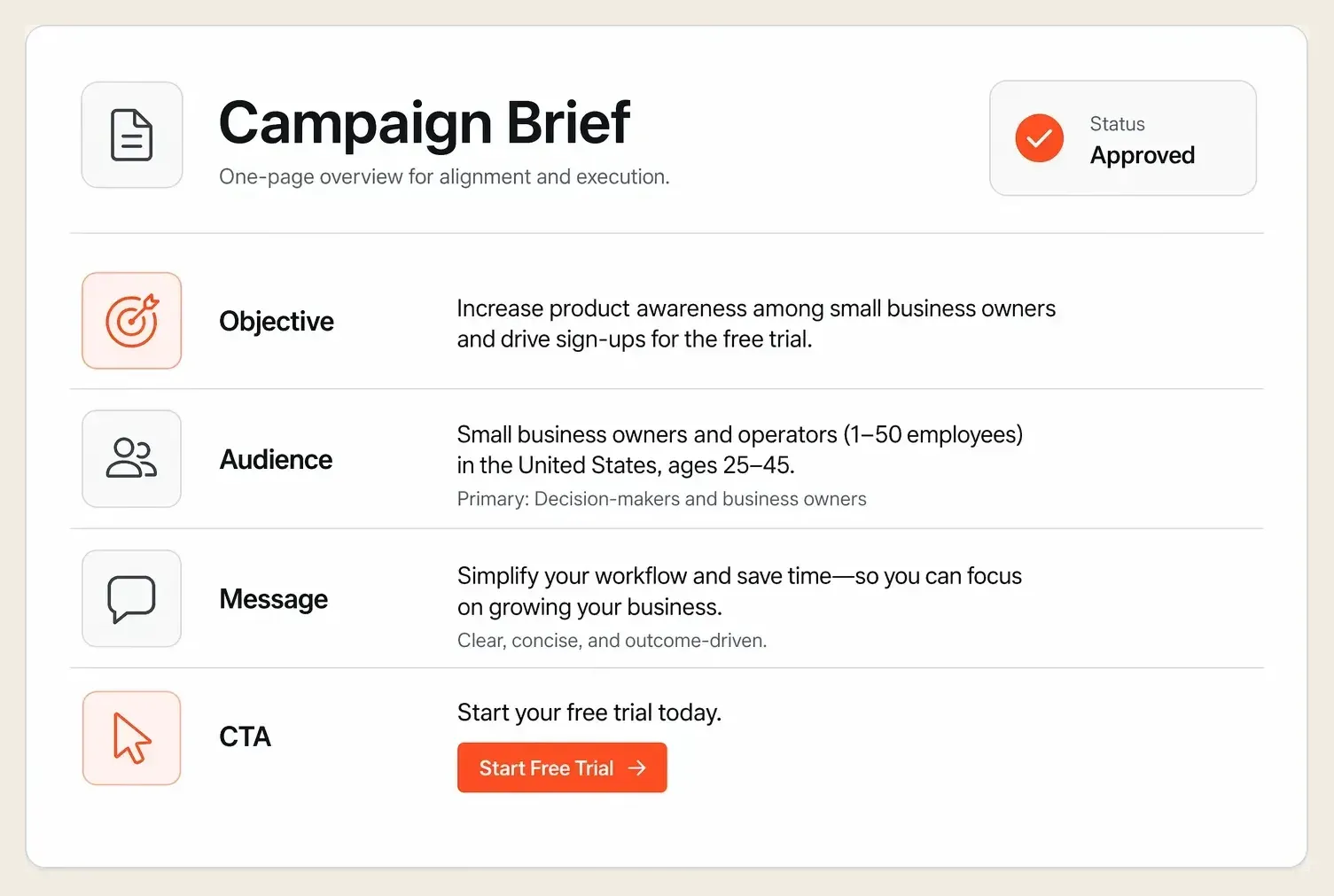
- Objective: The single business goal the creative must drive, tied to a metric like CPA or ROAS.
- Audience: Who the ad is for, including their problem, mindset, and funnel stage.
- Core message: The one idea the viewer must take away, plus the value proposition and proof.
- Call-to-action: The specific action you want, expressed as a clear call-to-action.
- Mandatories and constraints: Brand rules, formats, channels, offers, and anything that cannot change, anchored to your brand guidelines.
The best briefs also name the hook angle and reference proven examples, so the production team starts from evidence. A brief is a thinking tool, not paperwork, and the discipline of writing it usually exposes strategic gaps before they become expensive creative mistakes.
A Real Example
An agency was producing paid-social creative for a meal-kit client and kept burning rounds. The client would request changes, the team would revise, and the ads still missed, because the original ask was just "we need new ads for summer."
The team introduced a one-page brief before every sprint: objective (lower cold-audience CPA below $40), audience (busy parents who see cooking as a chore), core message (dinner solved in 15 minutes), CTA ("Get 50% off your first box"), and three reference hooks. With the brief in place, first-draft approval rate jumped from roughly 40% to 80%, revision rounds dropped from four to one, and the resulting batch hit a $34 CPA. The brief did not just speed production; it made the creative measurably better because every asset pointed at the same target.
Common Mistakes
| The Mistake | ❌ Wrong Approach | ✅ Better Approach |
|---|---|---|
| No single objective | Listing five goals so the brief pleases everyone | Naming one primary objective tied to a measurable metric |
| Vague audience | "Adults 18 to 65 interested in the category" | A specific persona with a real problem and funnel stage |
| Burying the message | Three paragraphs of background, no clear takeaway | One sentence the viewer must remember, plus proof |
| Skipping the CTA | Leaving the desired action implied | Stating the exact action and offer the ad should drive |
How Hawky Helps
A brief is only valuable if it consistently produces strong creative, and that translation from strategy to finished asset is where most teams lose time. Hawky's Creative Agent reads the brief directly, the objective, audience, value proposition, social proof, and CTA, and generates on-brand variants built to that strategy, so the gap between approved brief and testable ad collapses from days to minutes. It produces work that is on-message the first time because the brief is its input, not an afterthought.
The Performance Agent then runs those variants against the objective the brief named, scaling what hits the target metric, while FeatherDB stores which briefs, angles, and messages converted as living memory. Each new brief can start from the angles that already worked for the brand, so the team writes sharper briefs over time instead of starting every campaign from a blank template.
Frequently Asked Questions
What is a creative brief in advertising?
A creative brief is a concise document that defines the objective, audience, core message, call-to-action, and constraints for a piece of creative before production starts. It aligns the whole team on what the ad must achieve and why. A strong brief reduces revision rounds and gives every variant a shared, measurable target.
What should a creative brief include?
At minimum it should include a single objective tied to a metric, a specific audience with their problem and funnel stage, the one core message and value proposition, the exact call-to-action, and any brand or format mandatories. Many briefs also name the hook angle and reference proven examples. Keeping it to one page ensures it actually gets read and used.
How long should a creative brief be?
A creative brief should be short, ideally a single page. Brevity forces the hard strategic choices and keeps the document usable during production rather than filed and ignored. If a brief runs several pages, it usually signals unclear thinking that needs to be resolved before any creative is made.
Why do creative projects fail without a brief?
Without a brief, creative is driven by opinion instead of strategy, which leads to endless revisions and ads that miss the goal. A large share of creative rework traces back to unclear or missing briefs. The brief prevents that by naming the objective, audience, message, and action up front, so the team produces on-strategy work the first time.
Quick Takeaway
A creative brief is the one-page strategy that turns "make us some ads" into a focused problem to solve, cutting revisions and pointing every variant at the same goal. The discipline of writing it is what makes the creative work.
When a strong brief needs to become finished, on-brand creative without the days of back-and-forth, an agent should be doing that work. Ready to hire your first AI performance team? Book Demo