Creative Testing Velocity
Last updated
The rate at which an account generates, launches, and reaches a confident verdict on new creative variations, usually measured as validated tests per week. Because fatigue decays winners within weeks, learning speed is what keeps an account from plateauing.
Creative Testing Velocity
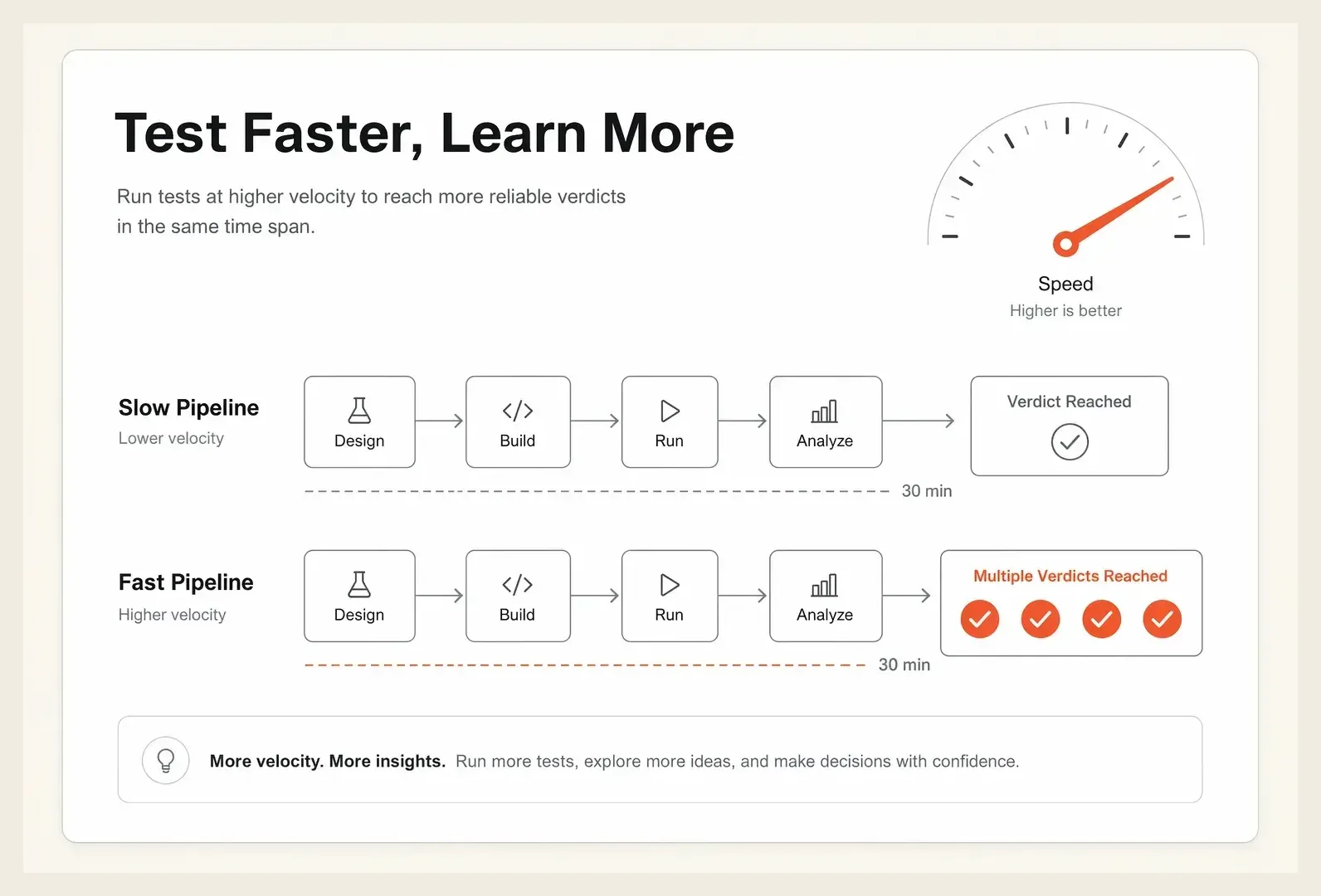
Creative Testing Velocity is the rate at which an advertising account generates, launches, and reaches a confident verdict on new creative variations over a given period, usually measured as validated tests per week. It captures not just how many ads you ship, but how quickly you learn which ones work, because a test only counts once it reaches a reliable result. Higher velocity means faster learning, and faster learning is what keeps a paid account ahead of fatigue and competition.
Why It Matters
Creative is the dominant variable in paid social performance, so the team that learns which creative works fastest wins the auction over time. Creative testing velocity is the metric that captures that learning speed. An account testing twenty validated variations a week discovers winning hooks far sooner than one managing four, and that head start compounds into lower costs and longer-lived campaigns.
The economics are stark. Because creative fatigue sets in within weeks on high-spend audiences, an account must replace winners faster than they decay just to hold performance flat. Meta's own creative guidance ties sustained efficiency to a steady cadence of fresh, tested creative, and accounts with higher velocity routinely maintain lower CPA because a proven replacement is always ready. Low velocity is the hidden reason many accounts plateau: they cannot test fast enough to outrun fatigue, so performance slowly erodes no matter how good the targeting is.
How It Works
Creative testing velocity is governed by the slowest step in the build-launch-validate cycle, so raising it means removing whichever bottleneck is capping the throughput.
- Generation Speed: How fast new variations are produced, often the first bottleneck for manual teams.
- Launch Throughput: How many tests can run in parallel without overlapping variables muddying the read.
- Time to Verdict: How quickly each test reaches statistical significance given its sample size and budget.
- Learning Reuse: Whether winning patterns feed the next round, so each cycle starts smarter and converges faster.
In practice, velocity is raised by attacking these in order: produce variations faster, run more in parallel inside a clean creative testing framework, and seed each new batch from proven elements so fewer tests are wasted on weak ideas. The aim is not just more tests, but more validated learnings per week, which is why a test that never reaches significance does not count toward velocity.
A Real Example
A home goods brand was shipping three creative tests a week and had plateaued at a $38 CPA for two straight quarters.
A teardown showed the bottleneck was generation, not budget: the single designer could not produce variants fast enough to keep more than a couple of tests live at once, so fatigue kept catching up. The team rebuilt the pipeline to generate variants from previously winning hooks and run eight tests in parallel under one framework, lifting velocity from three to twelve validated tests per week. Within six weeks they had found two new winning angles the old pace would have taken months to reach, CPA dropped from $38 to $25, and the account stopped plateauing because a fresh proven winner was always queued before the current one fatigued.
Common Mistakes
| The Mistake | ❌ Wrong Approach | ✅ Better Approach |
|---|---|---|
| Counting launches, not learnings | Bragging about ads shipped regardless of result | Measuring validated tests that reached a real verdict |
| Speed without structure | Flooding the account with overlapping variants | Running parallel tests inside a clean creative testing framework |
| Ignoring the bottleneck | Adding budget when generation is the real cap | Fixing the slowest step in the build-launch-validate cycle |
| Wasting cycles on weak ideas | Testing random variants every round | Seeding each batch from proven winning elements |
How Hawky Helps
Most accounts plateau because they cannot test creative fast enough to outrun fatigue, and that ceiling is a velocity problem. Hawky's Creative Agent attacks every step of the cycle at once, generating fresh variations from proven hooks, launching many in parallel under a clean framework, and reading each against the KPI, so the account reaches more validated learnings per week than any manual team. It removes the generation bottleneck that caps most pipelines.
Because each batch is seeded from what already won, fewer cycles are wasted on weak ideas and the system converges on winners faster every round. Those learnings live in FeatherDB as context the agents reuse, and the Performance Agent scales validated winners before the current creative fatigues. The result is an account whose testing velocity keeps it permanently ahead of decay, instead of a team shipping a few tests a week and slowly falling behind.
Frequently Asked Questions
What is creative testing velocity?
Creative testing velocity is the rate at which an account generates, launches, and reaches a reliable verdict on new creative variations, usually measured as validated tests per week. It measures learning speed, not just output, because a test only counts once it reaches a confident result. Higher velocity means an account discovers winning creative faster and stays ahead of fatigue.
How do you increase creative testing velocity?
You increase creative testing velocity by removing the slowest step in the build-launch-validate cycle, which is usually creative generation. Producing variants faster, running more tests in parallel inside a clean framework, and seeding each batch from proven winners all raise throughput. The goal is more validated learnings per week, not simply more ads launched.
Why does creative testing velocity matter for performance?
It matters because creative fatigue decays winners within weeks, so an account must find replacements faster than they wear out just to hold performance steady. Higher velocity means a proven new winner is always ready, which keeps CPA low and campaigns alive longer. Accounts with low velocity plateau because they cannot test fast enough to outrun fatigue.
How is creative testing velocity different from automated creative testing?
Creative testing velocity is the metric that measures how fast validated tests are completed, while automated creative testing is the system that raises that metric by running the generate-launch-measure loop with minimal manual work. One is the speed; the other is the engine that delivers it. Automating the testing process is the most reliable way to lift velocity.
Quick Takeaway
Creative Testing Velocity measures how fast your account learns which creative works, and because fatigue decays winners within weeks, learning speed is what keeps performance from plateauing. Count validated tests per week, not ads shipped, and attack the slowest step in the cycle to keep a proven winner always ready.
Plateaued because you cannot test creative fast enough to outrun fatigue? Ready to hire your first AI performance team? Book Demo