Automated Creative Testing
Last updated
A system that generates, launches, measures, and iterates on ad creative variations with minimal manual work, promoting winners and retiring losers continuously. It finds winning creative in days instead of weeks and keeps the pipeline ahead of fatigue.
Automated Creative Testing
Automated Creative Testing is a system that generates, launches, measures, and iterates on ad creative variations with minimal manual intervention, using rules or machine learning to promote winners and retire losers continuously. Instead of a marketer manually building each variant, watching dashboards, and pausing ads by hand, the process runs as an always-on loop that learns which creative elements work and feeds those learnings into the next round. The goal is faster, more reliable creative decisions at a volume no human team can match.
Why It Matters
Creative is the single biggest lever on paid performance, yet most teams test it slowly because every variant is a manual build-launch-read-pause cycle. Automated creative testing removes that bottleneck, letting an account evaluate dozens of variations in parallel and reach a confident winner in a fraction of the time. The speed compounds, because the faster you find a winning hook, the sooner the whole account benefits.
The performance gap is measurable. Meta's own guidance shows that accounts refreshing and testing creative continuously sustain materially lower CPA than those that ship a batch and let it run until it fatigues. Manual testing also caps volume: a human can reliably manage a handful of ab tests at once, while an automated system runs many more without losing track of statistical significance. When testing is manual and slow, creative fatigue outpaces the refresh rate and performance decays before the next winner is ready.
How It Works
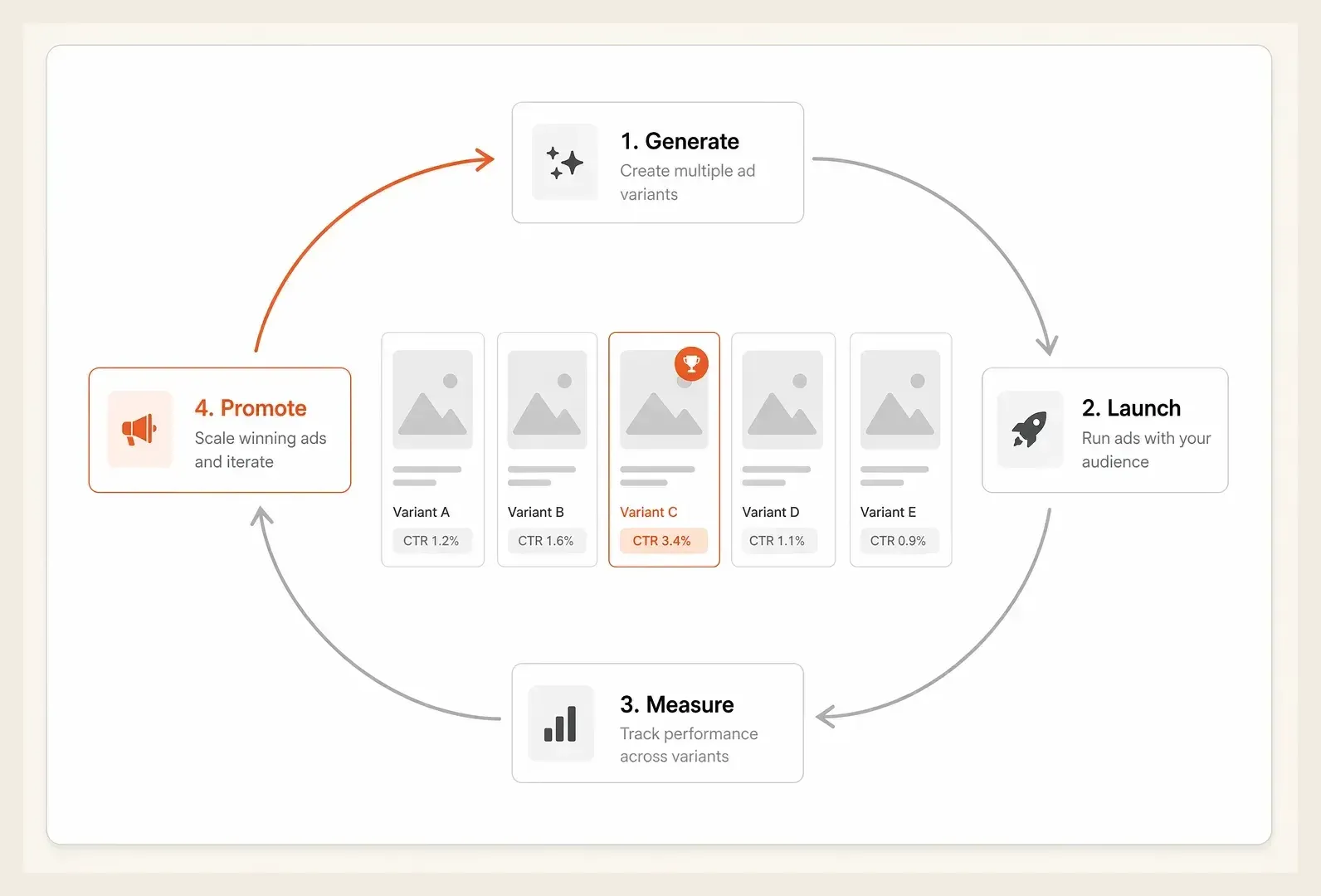
Automated creative testing works by connecting four steps into a continuous loop: generate variations, launch them under a controlled framework, measure against a primary KPI, then promote winners and kill losers automatically.
- Variation Generation: New hooks, formats, and angles produced from winning patterns rather than from scratch each time.
- Controlled Launch: Each variant runs inside a creative testing framework so the read is clean.
- Automated Measurement: The system tracks performance against the KPI and waits for statistical significance before deciding.
- Promote and Retire: Winners scale, losers pause, and the learnings feed the next generation of creative.
In practice, the system never stops. As soon as a winner is found it becomes the new control, fresh challengers are generated, and the cycle repeats. This is what separates automated testing from a one-off multivariate test: it is a standing process, not a single experiment, which keeps the creative pipeline ahead of fatigue.
A Real Example
A subscription fitness brand had one marketer manually testing creative and could ship roughly four new variations a week, reading results by hand in spreadsheets.
Performance was decaying because fatigue set in faster than the team could replace tired ads. After moving to automated creative testing, the account generated and launched 20 variations a week across hooks, formats, and angles, each measured against a $30 CPA target with a significance gate. Within five weeks the system had identified three winning hook structures the manual process never reached, blended CPA fell from $34 to $21, and the winning patterns were reused to seed the next rounds. The same single marketer now oversaw a pipeline producing five times the test volume without manually touching each ad.
Common Mistakes
| The Mistake | ❌ Wrong Approach | ✅ Better Approach |
|---|---|---|
| Calling winners too early | Promoting a variant after a day of data | Waiting for statistical significance before deciding |
| Testing without a framework | Throwing variants live with no clean structure | Running every test inside a creative testing framework |
| Automating chaos | Generating random variants with no learning loop | Seeding new creative from proven winning elements |
| Ignoring fatigue cadence | Testing fast but never retiring tired winners | Pairing automation with a steady creative refresh rate |
How Hawky Helps
Manual creative testing caps how fast an account can learn, and that ceiling is where performance quietly stalls. Hawky's Creative Agent runs automated creative testing as a standing loop, generating fresh hooks and formats, launching them under a clean framework, and reading results against the account's KPI, so winning creative surfaces in days instead of weeks. It promotes winners and retires fatigued ads on its own, keeping the pipeline ahead of decay rather than reacting to it.
The system seeds every new round from proven elements through element-level analysis, so each generation is smarter than the last instead of starting blind. Those winning patterns are written to FeatherDB as living context for the account, and the Performance Agent scales the winners across budget and placements. The result is a creative engine that learns and ships continuously, not a marketer manually babysitting a handful of tests.
Frequently Asked Questions
What is automated creative testing?
Automated creative testing is a system that generates, launches, measures, and iterates on ad creative variations with minimal manual work, using rules or machine learning to promote winners and retire losers. It runs as a continuous loop rather than a one-off experiment. The aim is to reach reliable creative decisions at a volume and speed that manual testing cannot match.
How is automated creative testing different from A/B testing?
A/B testing is usually a single, manually managed experiment comparing two or a few variants until one wins. Automated creative testing is a standing process that continuously generates new variants, tests them under a framework, and feeds winners back into the next round without manual intervention. A/B testing is one experiment; automated testing is an always-on pipeline of them.
Does automated creative testing replace human creative direction?
No. Automated testing handles the volume of generating, launching, measuring, and iterating, but human direction still sets the brand voice, strategy, and the elements worth exploring. The system accelerates learning and removes manual busywork, while people guide what the creative should say and stand for. The two work together rather than one replacing the other.
How do you avoid false winners in automated creative testing?
You avoid false winners by enforcing a statistical significance gate before any variant is promoted, ensuring each test has enough sample size and runs long enough to be reliable. Testing inside a clean framework prevents overlapping variables from contaminating the read. Without these guardrails, automation simply scales noise and promotes ads that only looked good by chance.
Quick Takeaway
Automated Creative Testing turns the slow manual build-launch-read-pause cycle into an always-on loop that finds winning creative in days and keeps the pipeline ahead of fatigue. Pair the speed with a significance gate so the system promotes real winners, not noise, and reuses every learning to make the next round smarter.
Stuck testing a handful of creatives by hand while fatigue outruns you? Ready to hire your first AI performance team? Book Demo