Best DTC Meta Ad Hooks for 2026 (with Real Brand Examples)

In paid social, the first three seconds decide everything. DTC Meta ad hooks are the part of your creative that earns the rest of the view, and in 2026 they decide your cost efficiency more than your targeting does. Get the hook wrong and you pay full CPM to be ignored.
This is a working list of hook patterns that move the needle for direct-to-consumer brands, with examples drawn from publicly observable ad styles you can find yourself in the Meta Ad Library. Use it as a swipe file, not a script.
Quick answer: A DTC Meta ad hook is the opening line, visual, or moment (usually the first 1 to 3 seconds) that stops the scroll and earns attention before the offer lands. DTC needs different hooks than B2B because the buyer is on a mobile feed, in an impulse mindset, and deciding in milliseconds. B2B can lean on logic and long consideration. D2C advertising lives or dies on emotion, pattern interrupt, and a visible payoff fast enough to beat the thumb.
Why hooks decide DTC Meta performance in 2026
Meta's delivery has gotten better at finding buyers, which means your creative is now the main lever you control. Advantage+ and broad targeting push more of the optimization onto the ad itself, so the hook does the heavy lifting. A strong hook lifts your hook rate (the share of impressions that become 3-second video views), and hook rate cascades into thumb-stop, CTR, CPA, and ROAS.
Weak hooks also burn out faster. Creative fatigue hits the opening first, so brands that ship a steady stream of fresh hooks keep CPMs sane and AOV intact. The patterns below are organized by intent so you can match a hook to your vertical.
One more reason hooks matter more in 2026: most DTC accounts now run broad, automated delivery, which means you are no longer winning auctions with surgical audiences. You are winning them with creative that holds attention long enough for Meta to learn who converts. The hook is the first signal the system reads, so a weak opener starves the entire learning phase.
What hooks work best for DTC Meta ads in 2026
Six hook families carry most DTC performance on Meta right now. Problem-first and before-after lead on cold traffic, social proof holds mid-funnel, and offer-led hooks convert warm audiences that already know the brand.
Problem and before-after hooks
These open on a pain the buyer already feels, then promise a visible change. They work because the viewer self-selects in the first second.
- "Your serum is sitting on top of your skin, not in it." A skincare brand opens on the problem the category ignores, then shows the fix.
- A before-after split screen with no voiceover, just a timer counting "Day 1 to Day 30."
- "I tried everything for my bloating. Here is what actually worked." A supplements brand frames the journey, not the ingredient.
- "POV: you finally found jeans that fit your waist and your thighs." An apparel brand names the exact frustration its product solves.
Before-after hooks are strongest in skincare, supplements, fitness, and home. The visual payoff has to be honest and fast. Hawky's published breakdown in Decoding SugarCosmetics Creative Strategy shows how a beauty brand pairs a problem frame with a quick product demo to keep the viewer past the third second.
Founder and origin-story hooks
People trust a face faster than a logo. Founder hooks borrow that trust in the opening frame.
- "I started this brand because I was tired of paying $80 for moisturizer that did nothing."
- "We almost shut down last year. Then this product sold out in 48 hours."
- A founder filming in a kitchen or warehouse, talking straight to camera with no studio polish.
- "Big food companies hated when we put the full ingredient list on the front." A food brand turns its origin into a stance.
Origin hooks fit founder-led brands, food, and challenger products taking on a legacy category. Hawky's analysis in Decoding The Whole Truth's Ad Creative Strategy walks through how a food brand uses radical-honesty framing in the opening to separate from incumbents.
Social-proof and UGC hooks
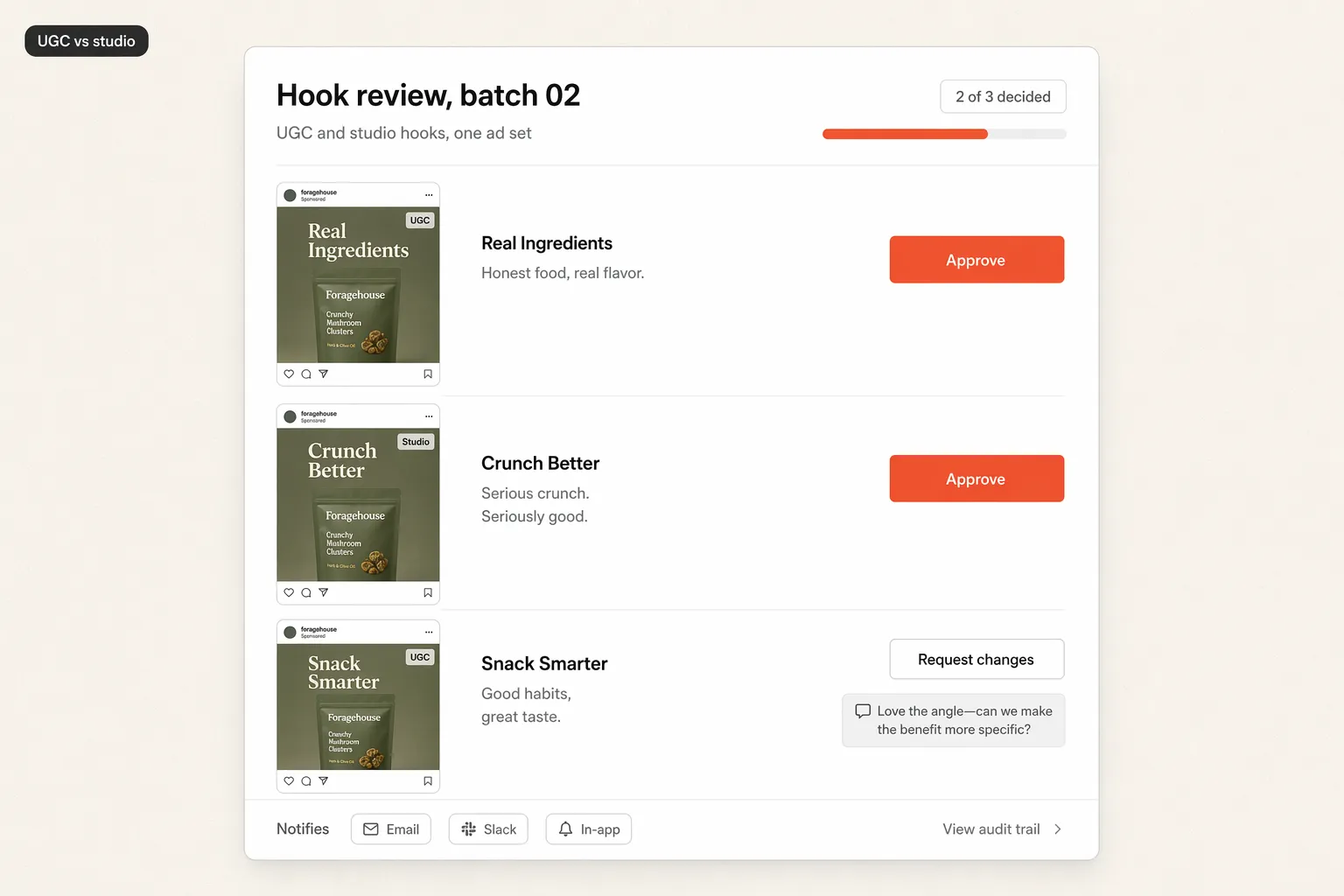
UGC hooks feel like a recommendation, not an ad. That native quality is exactly why they keep beating studio creative on cold traffic.
- "I did not believe the reviews until I tried it myself."
- "Bought this because everyone on my feed had it. Here is my honest take."
- A creator unboxing on a phone camera, reacting in real time.
- "47,000 five-star reviews can't all be wrong, right?"
| Format | Feels like | Best for | Typical hook |
|---|---|---|---|
| UGC (phone-shot) | A friend's recommendation | Cold traffic, new audiences | "I did not expect this to actually work" |
| Studio | A polished brand statement | Retargeting, brand campaigns | Clean product demo with bold claim |
| Creator duet/reaction | Social validation | Trend-driven launches | "Everyone is talking about this, so I tried it" |
| Talking-head review | Trust and detail | Considered purchases, supplements | "Here is what nobody tells you about..." |
UGC hooks fit almost every DTC vertical, but they over-index in beauty, supplements, and gadgets. Hawky's Decoding boAt's Ad Creative Strategy shows how a consumer-electronics brand mixes creator-style hooks with fast product shots to hold attention on a busy feed.
Offer and urgency hooks
When intent is already warm, lead with the deal. These hooks are blunt on purpose.
- "Our bestseller is back in stock, and it won't last the weekend."
- "Free shipping ends tonight. Your cart is waiting."
- "Buy one, gift one. This week only."
- "The bundle everyone asked for is finally here, at 30% off."
Offer hooks fit retargeting, seasonal pushes, and brands with a clear AOV bump from bundles. Use them sparingly on cold traffic, where a problem or UGC hook usually opens better. If your offer ads are getting clicks but not sales, the issue may be downstream, and Why Your Facebook Ads Are Not Converting covers the usual culprits.
Bold-claim and myth-busting hooks
A confident claim or a contrarian take stops the scroll because it dares the viewer to disagree.
- "Stop using retinol every night. You are wrecking your barrier."
- "Your protein powder is mostly filler. Here is the math."
- "Everything you know about hydration is wrong."
- "This $12 product replaced four things in my routine."
Myth-busting hooks fit supplements, skincare, and any category crowded with misinformation. The claim has to be defensible, because Meta and your audience both punish overreach. Keep it sharp, keep it true.
Curiosity and pattern-interrupt hooks
These open a loop the viewer has to close. The mechanism is tension, not information.
- "Wait, why is nobody talking about this?"
- An unexpected visual: the product used in a way you would not expect, with a "you are doing this wrong" caption.
- "I almost returned this on day one. I am so glad I didn't."
- A hard cut to a surprising result before any context is given.
Pattern-interrupt hooks fit trend-driven launches and gadgets, where the product itself is the surprise. They fatigue fast, so rotate them often.
| Hook type | Best-fit DTC vertical | Example opener |
|---|---|---|
| Problem / before-after | Skincare, supplements, fitness | "Your serum is sitting on top of your skin" |
| Founder / origin | Food, challenger brands | "I started this because I was tired of..." |
| Social proof / UGC | Beauty, gadgets, supplements | "I did not believe the reviews until..." |
| Offer / urgency | Retargeting, seasonal | "Back in stock, won't last the weekend" |
| Bold claim / myth-bust | Supplements, skincare | "Stop using retinol every night" |
| Curiosity / pattern-interrupt | Gadgets, trend launches | "Wait, why is nobody talking about this?" |
How to find which hooks work for your DTC brand
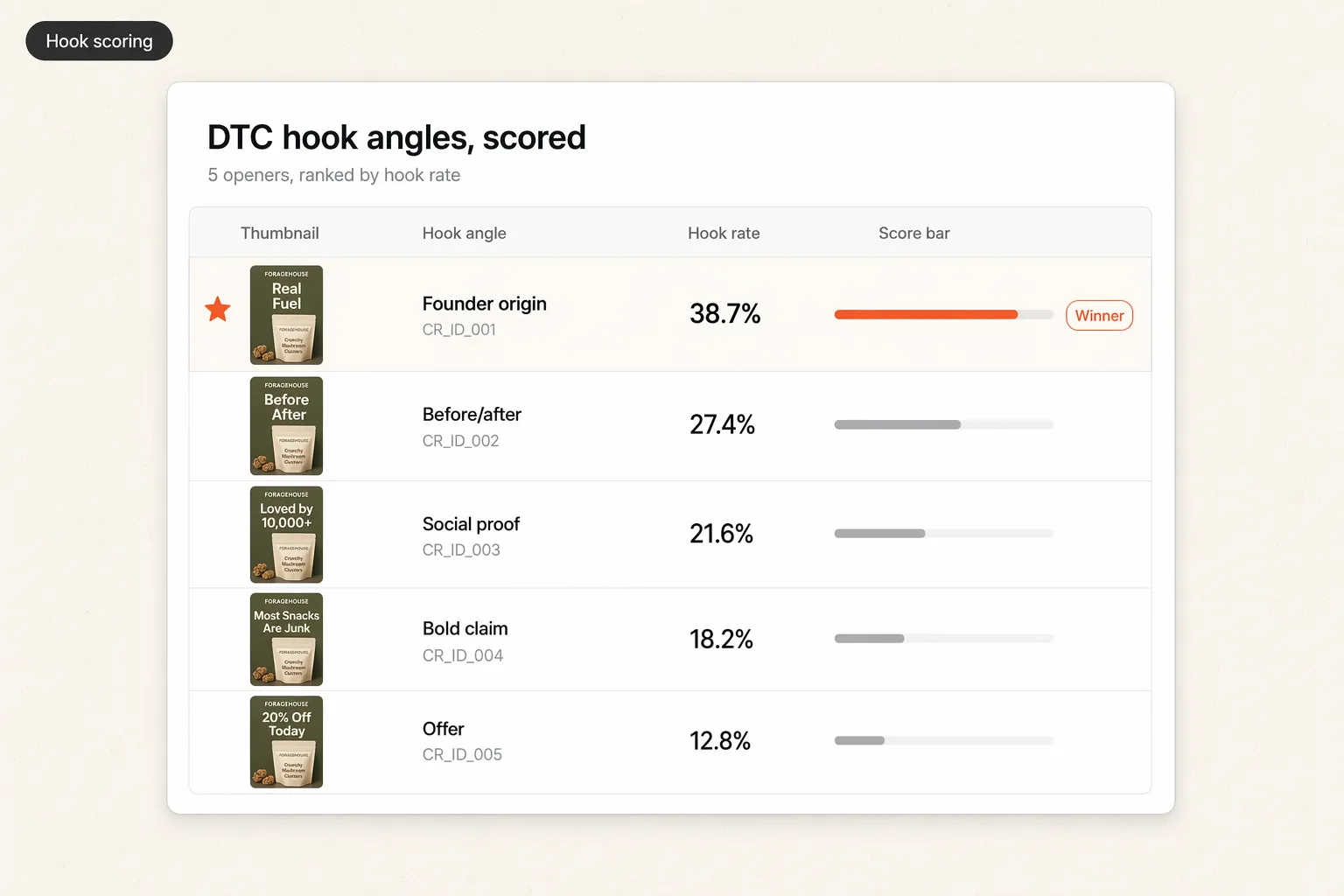
Start with research, not guesswork. The Meta Ad Library lets you see every active ad a competitor is running, and the ones running longest are usually the ones working. Hawky's guide on How to Use Meta Ad Library walks through filtering by region, format, and run time so you can spot the hooks competitors keep paying to serve.
Then test systematically. Hold the body and offer constant and vary only the first three seconds, so hook rate tells you which opener actually wins. Track 3-second video views and thumb-stop as your leading indicators, then CTR and CPA as the lagging ones. A hook with a strong hook rate but weak CTR is stopping the scroll without selling the click, which usually means the opener and the offer are not telling the same story.
Run at least three hook variants per concept, and give each enough impressions to read past noise before you call a winner. Patterns repeat across your account, so once a hook style proves out in one campaign, port it to others before competitors copy it from the Ad Library. Creative Performance Analysis covers how to isolate the hook from the rest of the creative so your read is clean. For deeper limits on what counts as a view, Meta's own Business Help Center documents how video metrics are defined.
How Hawky helps DTC brands ship winning hooks faster
Hawky is an agentic performance marketing platform built on FeatherDB. Its Competitor Analysis feature maintains an Ad Repository of Meta ads and runs hook analysis on competitor creative, so you can see which opening patterns a rival is doubling down on without scrubbing the Ad Library by hand. Creative Analysis takes it to the element level, scoring how individual hooks perform against your own historical winners.
From there, the Creative Agent reads past winners and competitor patterns from Feather and renders on-brand hook variants, with seat-level approval before anything ships. The autonomy is real, but it runs behind guardrails and an approval step, so a media buyer stays in control of what goes live.
The Performance Agent closes the loop on the media side, acting as an always-on operator that runs against your KPI with logged, reversible actions. New hook variants get tested, scaled, or paused based on what the numbers say, and every move is auditable. The pairing means winning hooks reach spend faster while losing ones get cut before they drain budget.
Common DTC hook mistakes to avoid
- Burying the hook. If your best line shows up at second six, the algorithm already moved on. Front-load it.
- Reusing one hook until it dies. Creative fatigue hits the opener first, so refresh hooks before performance craters, not after.
- Writing for desktop. DTC buyers are on mobile, sound-off, vertical. If your hook needs audio or a wide frame to land, it will not.
- Overclaiming. A hook that promises what the product cannot deliver tanks trust and invites Meta policy flags.
- Testing too many variables at once. Change the hook alone, or you will never know what actually moved hook rate.
Frequently asked questions
What is a DTC Meta ad hook?
A DTC Meta ad hook is the opening 1 to 3 seconds of a Facebook or Instagram ad (a line, visual, or moment) that stops the scroll and earns attention before the product or offer appears. For direct-to-consumer brands, the hook is the single biggest driver of hook rate, and hook rate flows into CTR, CPA, and ROAS.
What hooks work best for DTC brands?
Problem and before-after hooks, UGC and social-proof hooks, founder origin stories, bold claims, and curiosity pattern-interrupts all work, but the best fit depends on your vertical and funnel stage. Cold traffic usually responds to UGC and problem hooks, while retargeting responds to offer and urgency hooks. Test the opener in isolation to find your winners.
How do I find competitor hooks on Meta?
Use the Meta Ad Library to view every active ad a brand is running, filter by region and run time, and note the ads that have been live longest (those are usually the proven hooks). Tools like Hawky's Competitor Analysis maintain an ad repository and run hook analysis automatically, which speeds up the research considerably.
How long should a DTC ad hook be?
The hook should land within the first 1 to 3 seconds of a video, or the first line and visual of a static or carousel ad. On mobile feeds with sound off, viewers decide almost instantly, so the promise or pattern interrupt has to be visible immediately, not after a slow intro.
How often should DTC brands refresh hooks?
Refresh hooks as soon as hook rate or CTR starts sliding on a given creative, which for high-spend DTC accounts can be every one to two weeks. Creative fatigue hits the opener first, so rotating fresh hooks on a proven body keeps CPMs in check without rebuilding the whole ad.
Hooks are the cheapest lever you have to lower acquisition cost on Meta, and they are also the first thing to fatigue. The brands that win in 2026 treat hooks as a constant pipeline, not a one-time creative project. If your team is spending more time scrubbing the Ad Library and rebuilding openers than testing them, Hawky's Creative Agent is built for that job.
Ready to hire your first AI performance team? Book Demo