Creative Analytics 101: Everything Performance Marketers Need to Know
Creative analytics is the practice of measuring how the individual elements of your ads (hooks, visuals, copy, CTAs, formats) drive performance outcomes like CTR, ROAS, and CAC. It replaces "I think this ad looks good" with "this hook style cut our CPL by 27%."
Creative is now the biggest lever in paid media. Targeting options have narrowed, auctions are automated, and platforms like Meta and Google decide delivery for you. What you can still control is the creative, and creative analytics tells you what to make next.
What is creative analytics?
Creative analytics is the systematic analysis of every element inside an ad creative to understand what drives performance. Instead of judging an ad as one unit, it breaks the ad into parts: the hook, the visual style, the message, the offer, the CTA, the format. Then it connects each part to hard outcomes.
Think of it like a coach reviewing game film. The team won or lost (your ROAS), but the film shows why: which plays worked, which players executed, where the breakdowns happened. Creative analytics is game film for your ads.
This matters because platform reporting tells you which ad won, never why. Ads Manager shows you that Video A beat Video B on CPA. It does not tell you the winning ad opened with a customer testimonial, used on-screen captions, and showed the product in the first two seconds. Creative analytics extracts those patterns.
The discipline has matured fast. What started as manual tagging in spreadsheets is now handled by AI systems that tag elements automatically, score creatives against historical winners, and in the newest generation of tools, act on the findings without waiting for a human to read a dashboard.
Why creative analytics matters for performance marketers
Creative quality is the single biggest driver of advertising sales impact, ahead of reach, targeting, and recency. That finding, documented in Nielsen's advertising effectiveness research, reshaped how performance teams allocate effort. The media buying that used to consume your week is increasingly automated. The creative decisions are not.
Three forces make creative analytics non-optional in 2026:
- Targeting is gone as an edge. Broad targeting and Advantage+ style automation mean everyone reaches roughly the same auction. Creative is the remaining differentiator.
- Creative velocity demands are up. Accounts that used to run 5 ads now run 50, and creative testing only works when you can read the results. Without structured analysis, you cannot tell which of the 50 to iterate on.
- Fatigue cycles are shorter. Winning ads burn out in weeks. Teams that detect fatigue early protect their CAC; teams that detect it late pay for it.
The payoff is concrete. Teams running structured creative analysis consistently report lower CPL, higher ROAS, and faster iteration cycles, because every new creative starts from evidence instead of a blank brief.
Key components of creative analytics
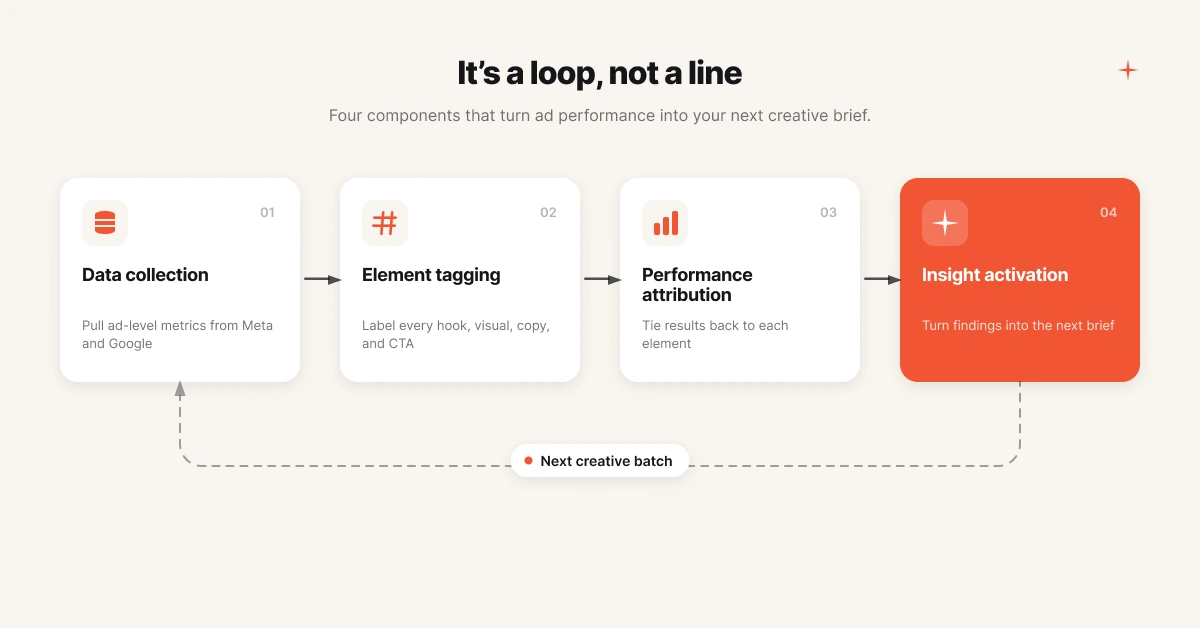
Creative analytics has four core components: data collection, element tagging, performance attribution, and insight activation. Each layer builds on the previous one.
| Component | What it does | Example |
|---|---|---|
| Data collection | Pulls performance data from ad platforms via API | Syncing Meta and Google Ads metrics daily |
| Element tagging | Labels each creative's attributes | "UGC, female creator, problem-first hook, captioned" |
| Performance attribution | Connects elements to outcomes | "Problem-first hooks: 31% higher hook rate" |
| Insight activation | Turns findings into the next creative | Briefing 5 new variants on the winning hook pattern |
Most teams get stuck between layers three and four. They produce insights nobody acts on. The report says testimonial hooks win, but the next creative batch ships without one, because the insight lived in a slide deck instead of the production workflow. Closing that gap is where the real return on creative analytics lives, and it is the problem the newest agentic tools are built to solve.
Creative analytics vs. marketing analytics
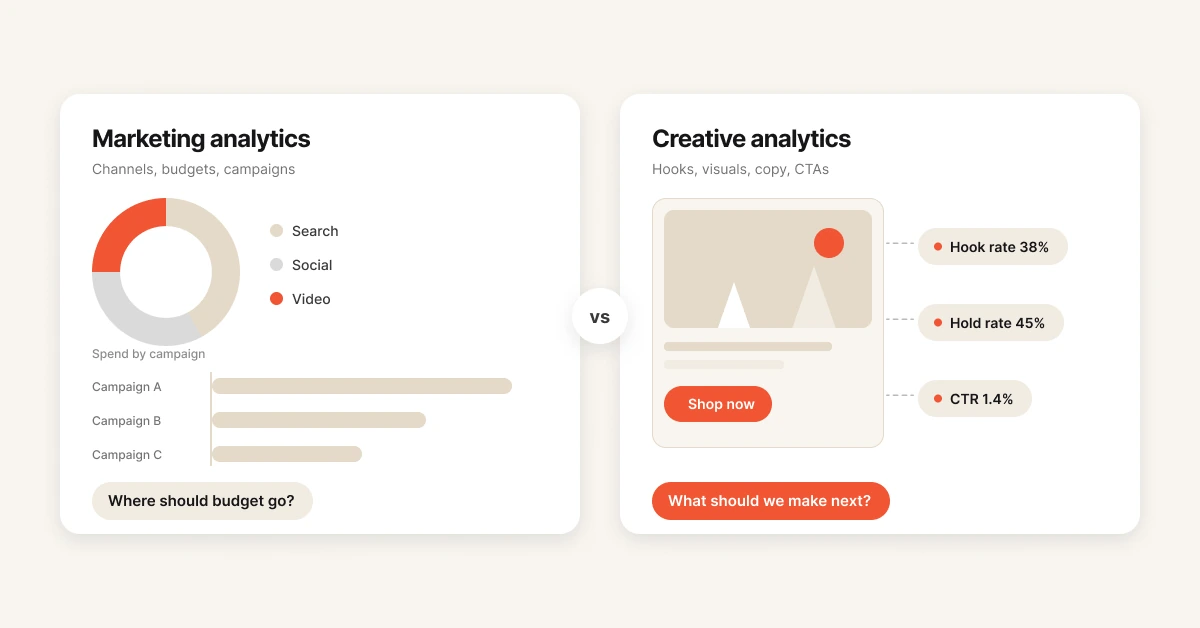
Creative analytics and marketing analytics answer different questions. Marketing analytics tells you which channels, campaigns, and audiences perform. Creative analytics tells you which ideas perform.
| Dimension | Marketing analytics | Creative analytics |
|---|---|---|
| Unit of analysis | Channel, campaign, audience | Hook, visual, copy, CTA, format |
| Core question | Where should budget go? | What should we make next? |
| Typical output | Channel mix report, MMM | Creative insights report, winning patterns |
| Primary user | Growth lead, media buyer | Creative strategist, designer |
| Acts on | Budget allocation | Creative production |
The two work together. Marketing analytics might show Meta prospecting CPA rising. Creative analytics explains the rise: your top three ads passed their fatigue point and nothing in the pipeline matches their hook style. One diagnoses the account, the other diagnoses the ads.
The metrics that matter
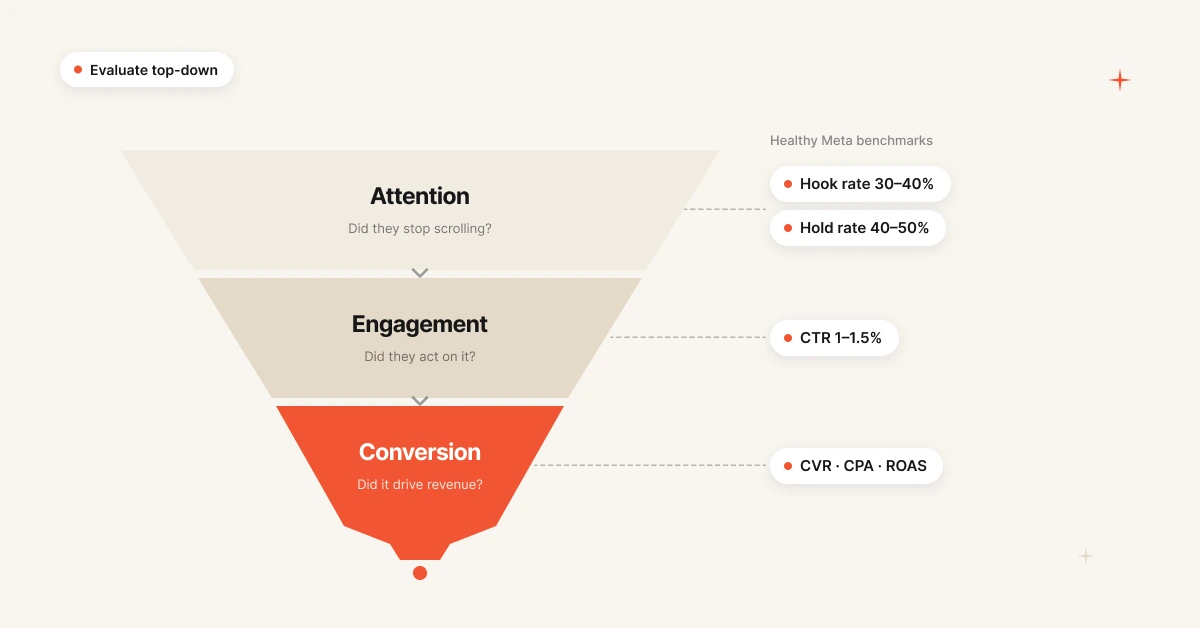
Creative performance metrics form a funnel: attention first, engagement second, conversion third. Evaluate them in that order, because a weak hook invalidates everything downstream.
| Stage | Metric | Formula | Healthy benchmark (Meta) |
|---|---|---|---|
| Attention | Hook rate (thumbstop) | 3-sec plays ÷ impressions | 30-40% |
| Attention | Hold rate | 15-sec plays ÷ 3-sec plays | 40-50%, 60%+ strong |
| Engagement | CTR | Clicks ÷ impressions | 1-1.5%+ |
| Conversion | CVR | Conversions ÷ clicks | Varies by AOV and offer |
| Efficiency | CPA / ROAS | Spend ÷ conversions | Against your KPI target |
Benchmarks compiled from AdManage's hook rate analysis and Vaizle's hook and hold rate formulas; your account history is the benchmark that matters most.
The community heuristic holds: use hook rate to kill obvious losers fast, then use conversion data to decide what to scale. A 45% hook rate with no purchases is engagement theater. A 20% hook rate never gets enough cheap impressions to matter.
Watch frequency and first-time impression ratio alongside these. Rising frequency with falling CTR is the classic creative fatigue signature, and catching it 4-7 days earlier is worth real money on accounts spending $50k+/month.
How creative analytics works in practice
Here is what creative analytics looks like for a D2C skincare brand spending $80k/month on Meta.
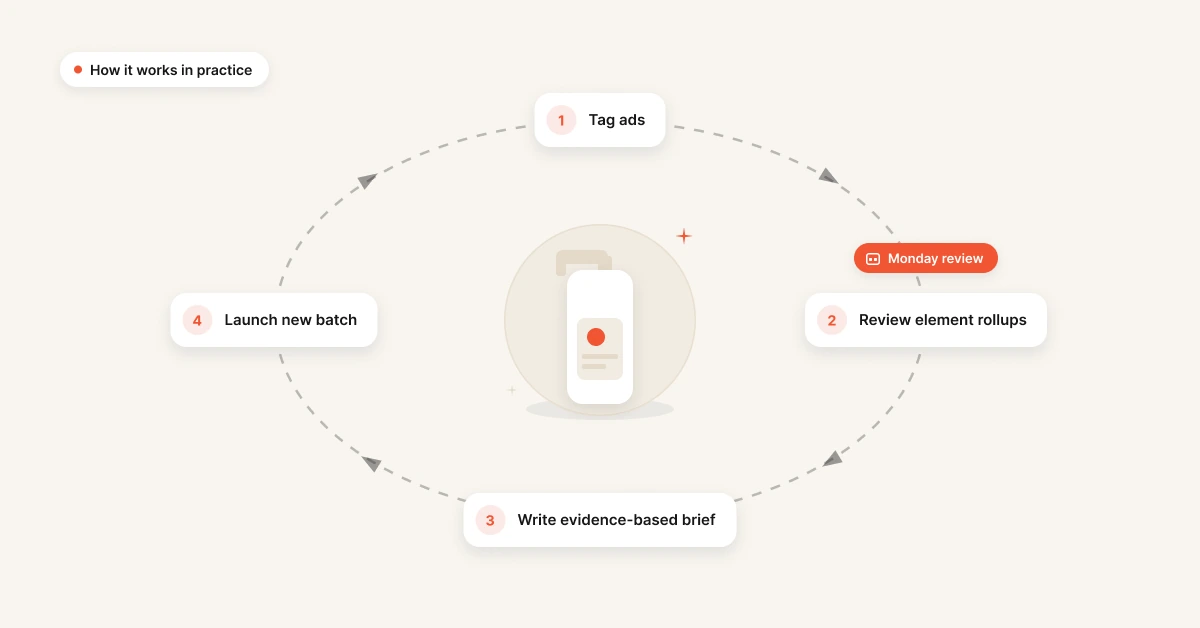
The team runs 40 active ads across prospecting and retargeting. Every ad is tagged on ingestion: format (UGC, static, motion graphic), hook type (problem, testimonial, demo, founder), creator persona, key message, CTA. The tagging used to be a spreadsheet job; now an AI system does it automatically.
Each Monday the team reviews element-level rollups instead of ad-level tables. This week's finding: ads opening with a before/after visual hold 58% of viewers to 15 seconds, against a 41% account average. Demo-style hooks underperform on prospecting but win on retargeting.
The insight feeds straight into production. The brief for next week's batch: five new UGC variants on the before/after pattern, two creators, three opening lines. Two weeks later, the batch's winner posts a 22% lower CPA than the account average, and the cycle repeats.
That loop (tag, measure, find the pattern, produce against it) is the entire discipline. Tools differ mainly in how much of the loop they automate. Dashboards automate the measuring.
Agentic platforms like Hawky automate the loop end to end: the Creative Agent reads winning patterns from account memory, renders new on-brand variants, and routes them through approval, with every decision logged and reversible. Autonomous creative production with guardrails is where the category is heading.
How to get started with creative analytics
You can stand up a working creative analytics practice in five steps:
- Define your KPI hierarchy. Pick the one business metric that decides scaling (ROAS, CAC, or CPL) and the two or three leading indicators (hook rate, CTR) you will use for early reads.
- Build a tagging taxonomy. Start simple: format, hook type, message, persona, CTA. Ten tags applied consistently beat fifty applied sometimes.
- Tag your last 90 days of ads. History is your training data. Patterns only emerge with enough tagged creatives behind them.
- Set a weekly review cadence. Thirty minutes, element-level rollups, one decision: what does the next batch test?
- Close the loop into production. Every insight becomes a brief line item, and every brief feeds the next round of creative testing. If an insight does not change what you make next, it was reporting, not analysis.
For a detailed walkthrough of steps 4 and 5, see the guide on how to find your winning creative with data. If you are evaluating software to automate the tagging and analysis layers, start with this comparison of the 9 best ad creative analysis tools.
Creative analytics examples
Example 1: Hook pattern discovery. A fintech app tags 120 historical ads and finds that hooks naming a specific dollar amount ("Save $400 a year") posted 35% higher CTR than generic hooks ("Save money"). Every subsequent brief requires a quantified hook. CTR rose 20% within a week of rollout.
Example 2: Fatigue detection. A D2C grooming brand notices its hero ad's frequency climbing past 3.5 while CTR slides 30% week over week. Creative analytics flags the fatigue signature before CPA spikes. The team rotates in two pre-tested variants and holds CPA flat through the transition. The Man Company ran this playbook with Hawky and doubled creative performance while cutting iteration cycles in half.
Example 3: Element-level surgery. An agency finds its client's video ads lose 60% of viewers between seconds 3 and 8. The product reveal sits at second 9. Moving the reveal to second 4 lifts hold rate from 38% to 52% with no other changes.
Frequently asked questions
What is creative analytics?
Creative analytics is the practice of analyzing the individual elements of ad creatives (hooks, visuals, copy, CTAs, formats) to understand what drives performance outcomes like CTR, ROAS, and CPA. It tells you why ads win, not just which ads won.
How is creative analytics different from marketing analytics?
Marketing analytics measures channels, campaigns, and audiences to guide budget allocation. Creative analytics measures the elements inside ads to guide what gets made next. Marketing analytics answers "where should money go," creative analytics answers "what should we produce."
What is a good hook rate?
A hook rate of 30-40% is a strong baseline for Meta video ads. Hook rate is calculated as 3-second video plays divided by impressions. Below 25% signals the opening needs rework; above 40% is elite.
What is creative fatigue?
Creative fatigue is the decline in an ad's performance as the same audience sees it repeatedly. The classic signature is rising frequency combined with falling CTR and rising CPA. Structured creative analytics catches fatigue 4-7 days earlier than manual review, which protects acquisition costs during creative transitions.
Do I need a dedicated tool for creative analytics?
Not at the start. A consistent tagging taxonomy and a spreadsheet can support a small account. Past roughly 20-30 active creatives or $50k/month in spend, manual tagging breaks down and dedicated tools (or AI agents that automate the full loop) pay for themselves in time saved and earlier insights.
Creative analytics is no longer optional homework. It is the operating system for the only lever you still fully control in paid media.
If your team produces creative insights that never make it into the next batch of ads, Hawky's Creative Agent is built for that job. It reads your winning patterns, renders on-brand variants automatically, and ships them through your approval flow with a full audit trail.
Ready to hire your first AI performance team? Book Demo