Ad Competitor Research: How to Reverse-Engineer Winning Creative
After reading this guide, you will be able to find any competitor's ads, identify which ones are actually winning, deconstruct why they work, and turn those patterns into creative briefs you can test this week.
Most teams do ad competitor research backwards. They scroll an ad library, screenshot whatever looks good, and copy the surface. The visual gets cloned, the strategy underneath gets missed, and the clone underperforms. Reverse-engineering means extracting the structure of a winning ad (the hook, the offer, the proof, the sequencing) and rebuilding it with your own brand inputs.
What you need before you start
Ad competitor research requires no paid tools to get started. The two foundational sources, Meta Ad Library and Google Ads Transparency Center, are free and public. You need three things before you begin.
First, a list of 5-10 competitors across three tiers: direct, indirect, and aspirational. Second, a place to log what you find: a spreadsheet works, a dedicated swipe file tool works better. Third, your own performance data, because competitor patterns only matter when compared against what already works for you.
Budget 2-3 hours for the first full pass. Weekly maintenance after that takes 15-30 minutes, or zero if you automate it (covered in Step 7).
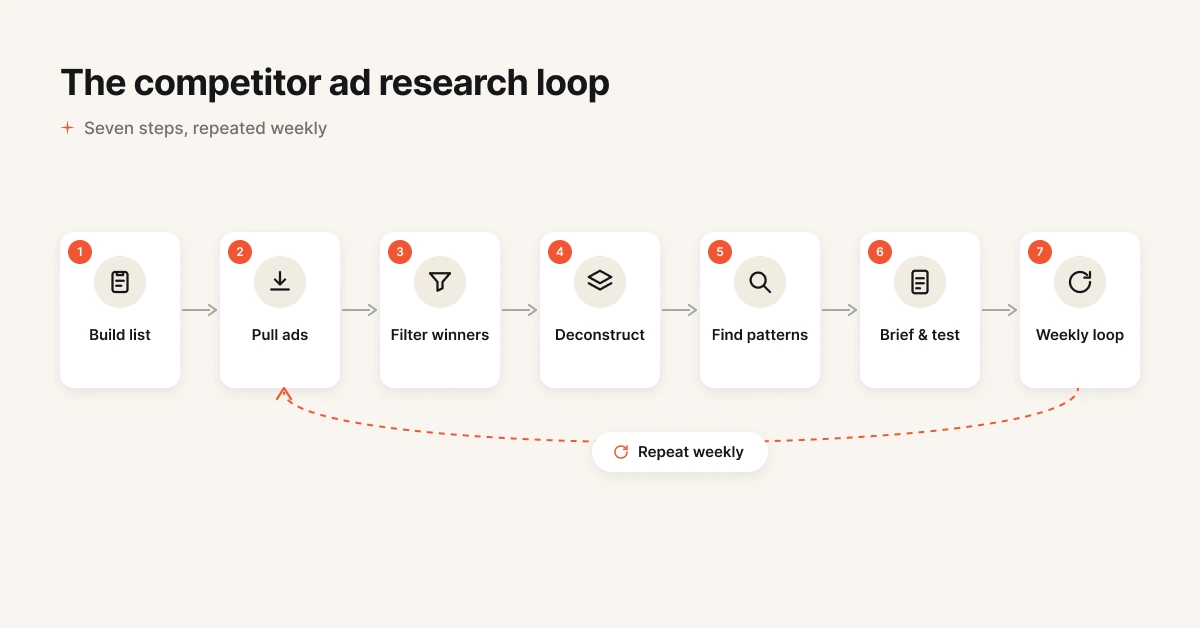
Step 1: Build your competitor list
A competitor list for ad research is broader than your sales-team competitor list. Your audience sees ads from every brand fighting for the same attention and budget, not just brands selling the same product. Build the list in three tiers.
Direct competitors sell what you sell to the audience you target. Indirect competitors solve the same problem differently, or compete for the same wallet. Aspirational brands run categories ahead of yours in creative sophistication: D2C brands study Liquid Death and Ridge, B2B teams study Gong and Klaviyo.
Cap the list at 10. Three direct, four indirect, three aspirational is a reliable split. More than 10 and the analysis stage collapses under volume.
Done looks like: a 10-row sheet with brand name, tier, and the platforms where each brand advertises.
Step 2: Pull every active ad from the ad libraries
Every major platform now publishes a searchable archive of active ads. Transparency rules made competitor ad research free; the skill is in the analysis, not the access.
Start with the Meta Ad Library. Search each brand, filter by country and media type, and you will see every active ad across Facebook, Instagram, Messenger, and Audience Network, including launch dates. For search and YouTube, use the Google Ads Transparency Center, which shows ads by advertiser across Search, Display, and YouTube.
| Source | Platforms covered | Shows run time | Shows performance | Cost |
|---|---|---|---|---|
| Meta Ad Library | Facebook, Instagram, Messenger, Audience Network | Yes (start date) | No | Free |
| Google Ads Transparency Center | Search, Display, YouTube | Yes (date range) | No | Free |
| TikTok Creative Center | TikTok | Partial | Yes (top ads by engagement) | Free |
| LinkedIn Ad Library | Yes | No | Free | |
| Paid spy tools (Foreplay, MagicBrief, etc.) | Multi-platform archives | Yes (historical) | No | $49+/month |
For each competitor, save every active ad: screenshot or save the link, note the start date, format, platform, and landing page URL. Native libraries only show active ads, so anything you don't capture now disappears when the campaign stops.
Done looks like: a logged set of 20-50 ads per direct competitor, each with start date, format, and destination.
Step 3: Filter for winners using longevity
Ad longevity is the strongest public signal of ad performance. No ad library shows competitor ROAS or CTR, but advertisers do not keep spending on ads that lose money. An ad running for 90 or more days is almost certainly profitable; an ad that vanished after a week almost certainly was not.
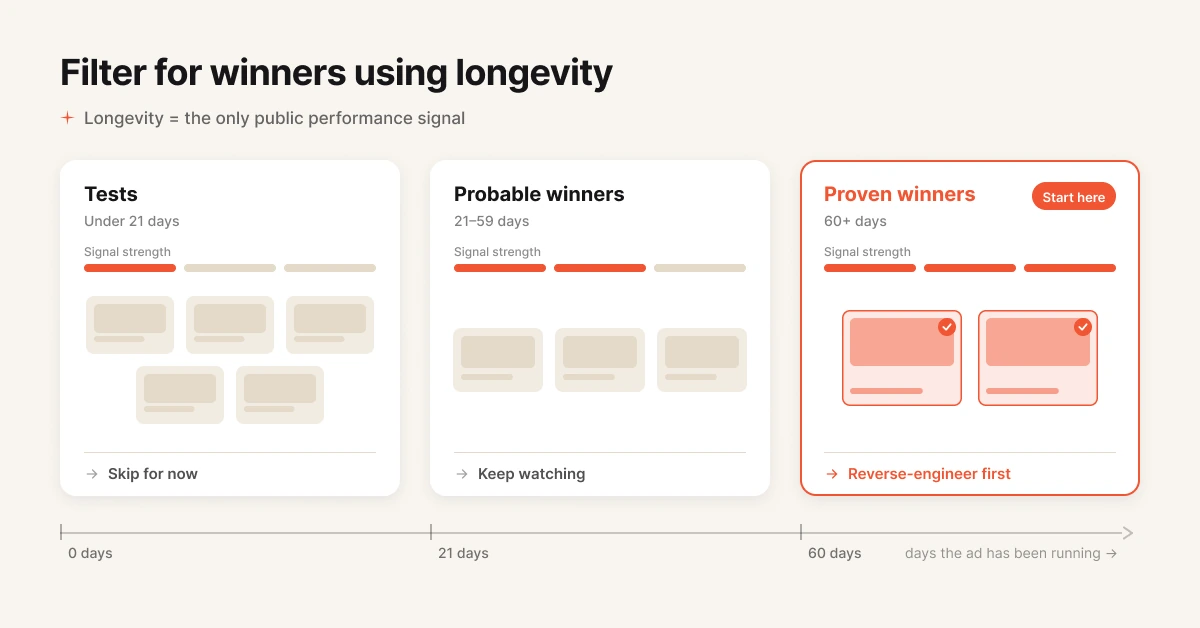
Sort your captured ads by run time and split them into three buckets. Proven winners have run 60+ days. Probable winners have run 21-59 days and often have multiple near-identical variants, which signals the advertiser is scaling them. Tests are under 21 days old and tell you what hypotheses the competitor is exploring, not what works.
Variant count is your second signal. When a brand runs eight versions of the same concept with different headlines, that concept earned a real budget. One-off ads, however polished, are unvalidated.
Pro tip: also log which winning ads use dynamic catalogue formats versus built creative. A brand whose long-runners are all DPA ads is winning on feed and offer, not creative, and that changes what you should learn from them.
Done looks like: a shortlist of 10-20 proven and probable winners per competitor, ranked by run time.
Step 4: Deconstruct each ad into its elements
Reverse-engineering an ad means separating what it says from how it looks. Every direct response ad reduces to six elements, and analyzing at this level is what makes the research transferable instead of copyable.
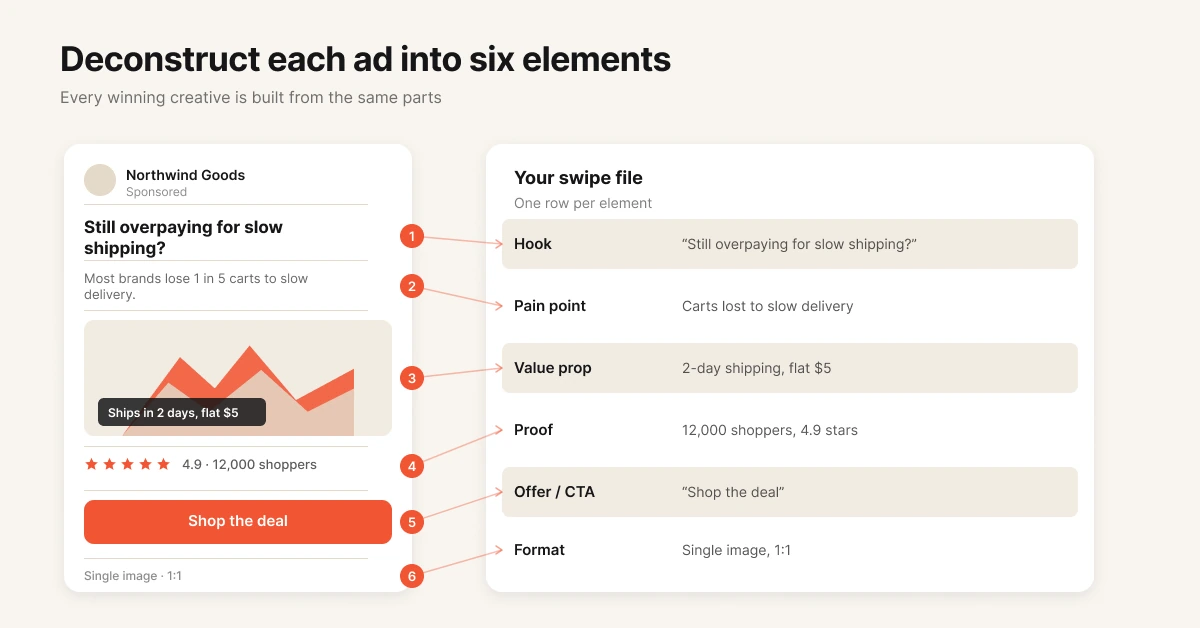
| Element | Question to answer | Example finding |
|---|---|---|
| Hook | What stops the scroll in the first 3 seconds or first line? | Negative call-out: "Stop wasting spend on lookalikes" |
| Pain point | Which problem, functional or emotional, does it press? | Wasted budget (functional), fear of falling behind (emotional) |
| Value proposition | How does it convert features into a specific outcome? | "Cut CPL 27% in 60 days" vs "AI-powered optimization" |
| Proof | What evidence backs the claim? | Customer count, named case study, before/after metric |
| Offer and CTA | What is the ask and the risk-reducer? | Free trial, demo, quiz, discount; "no card required" |
| Format and visual structure | UGC, static, carousel, motion? Text-heavy or product-led? | UGC testimonial with caption-style subtitles |
Work through your shortlist one ad at a time and fill a row per ad. The discipline matters: skipping straight to "I like this one" is how teams end up cloning visuals instead of strategies.
Tag the landing page too. A winning ad paired with a quiz funnel teaches a different lesson than the same ad pointed at a product page. Message match between ad and destination is part of why the ad wins.
Done looks like: a deconstruction table with one row per winning ad and all six elements filled in.
Step 5: Find patterns across five or more ads
A pattern that holds across five or more winning ads is signal; anything observed in a single ad is noise. This threshold is the difference between competitor research and competitor anecdotes.
Scan your deconstruction table by column, not by row. Across all winners, which hook types repeat, and which proof formats dominate? Is the category converging on UGC, or has everyone moved back to polished statics?
Write each recurring observation as a falsifiable statement: "4 of my 6 competitors lead with a cost-saving claim in the first line" rather than "competitors talk about price."
Then look for the gaps, because gaps are where you differentiate. If every competitor hammers the same functional pain point, an emotional angle is open. If nobody uses founder-led video, that format is uncontested. The output of ad competitor research is not "what they do", it is "what they have all validated, plus what none of them is doing."
Done looks like: 5-8 written pattern statements and 2-3 named gaps.
Step 6: Turn patterns into briefs and test
Patterns earn nothing until they become live tests. This is the step most teams skip, which is why most competitor research dies in a slide deck.
Convert each pattern or gap into a creative brief with three parts: the hypothesis ("a cost-anchored hook will beat your current curiosity hook on CPL, your test KPI"), the source evidence (the competitor ads that validated it), and the brand translation (your product, your proof, your voice). The structure transfers; the surface must be yours. Copying the surface is both legally risky and strategically useless, since the audience has already seen the original.
Run each brief as a controlled test against your current control ad, one variable at a time where budget allows. Teams that systematize this loop see measurable gains; practitioners consistently report 20-40% improvements in ad performance metrics when competitor insights feed creative briefs instead of sitting in folders. For the testing methodology itself, see our guide on building a creative testing framework.
Done looks like: 3-5 briefs in your creative queue, each citing its competitor evidence, with a test scheduled.
Step 7: Make ad competitor research a weekly system
Ad competitor research is a loop, not a project. Competitors launch new tests weekly, and a quarterly audit means you discover their winning angle three months after the market did.
The manual version: block 15 minutes every Monday, open the ad libraries, sweep your top three direct competitors, and log anything new. Flag ads that crossed the 60-day line into the proven bucket, and note any new hooks, offers, or formats for next month's brief cycle.
The automated version: agentic platforms now run this loop continuously. Hawky tracks competitor ads on Meta and Google in a searchable repository, sends weekly alerts on hook changes, new offers, and funnel shifts, and its Creative Agent reads those competitor patterns alongside your own winners to render on-brand creatives automatically. The output routes through seat-level approval with every creative citing its evidence, so the autonomous pipeline stays inside guardrails you control.
Done looks like: a recurring calendar block or an automated alert, and a swipe file that grows weekly without heroics.
Common competitor ad research mistakes to avoid
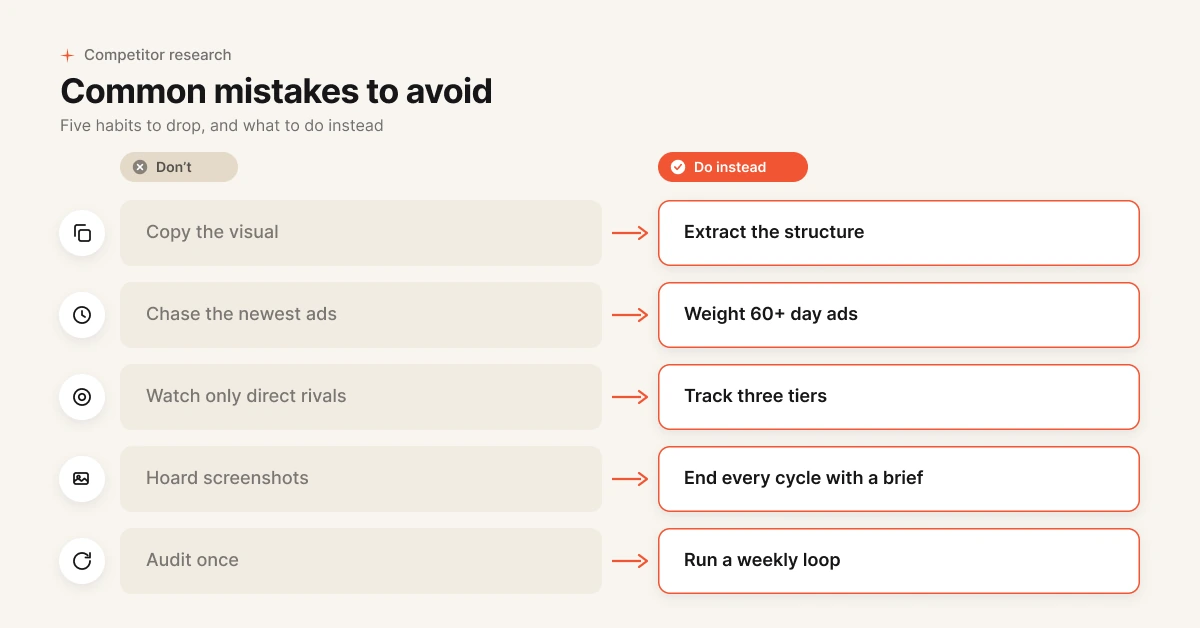
Copying instead of reverse-engineering. Cloning a competitor's visual gets you a worse version of an ad the audience has already seen. Extract the hook structure, proof format, and offer mechanics, then rebuild with your own inputs.
Treating new ads as winners. A freshly launched ad is a hypothesis, not a result. Weight your analysis toward ads with 60+ days of run time and multiple variants, because longevity is the only public performance signal you have.
Only watching direct competitors. Your audience's expectations are set by every ad they see, including brands outside your category. Keep indirect and aspirational brands in the rotation or your creative will converge on the category average.
Collecting without operationalizing. A swipe file with 400 screenshots and zero briefs is decoration. Every research cycle should end with at least one testable brief in the creative queue.
Doing it once. Creative fatigue sets in within weeks on Meta, not quarters, and competitor creative cycles move just as fast. One-time research gives you a snapshot of a market that has already moved; only a recurring loop compounds.
Tools that make this easier
Meta Ad Library and Google Ads Transparency Center. The free foundation. Complete coverage of active ads with run dates, no performance data, no history after an ad stops. Right for anyone starting manual research.
Foreplay / MagicBrief. Swipe file and briefing tools that archive ads (including after they stop running) and organize them into boards and briefs. Strong for creative teams; G2 reviewers' most common complaint across this category is price, and the analysis is still manual.
Hawky. An agentic performance marketing platform whose Competitor Analysis maintains current and historical competitor ad repositories with weekly change alerts, SWOT and hook analysis, and influencer collab detection. Its Creative Agent turns those patterns plus your own winning ads into finished on-brand creatives bound to specific ad sets, with approval gates and a full audit trail. Hawky covers Steps 2 through 7 of this guide in one loop; Hiveminds cut CPL by 27% running it.
Spreadsheet templates. A shared sheet with the six-element deconstruction table is enough for a solo media buyer at low volume. It stops scaling around two competitors and ten ads a week.
Evaluating analysis tools more broadly? See the 9 best ad creative analysis tools in 2026 for a full comparison.
Frequently asked questions
What is ad competitor research?
Ad competitor research is the systematic process of finding, logging, and analyzing the ads your competitors run in order to extract the strategies behind their best performers. It covers which platforms they use, which creative formats and hooks they test, what offers they push, and how long each ad survives, with ad longevity serving as the main public proxy for performance.
How can I see my competitors' ads for free?
Use the platforms' own transparency tools. Meta Ad Library shows every active ad on Facebook and Instagram, Google Ads Transparency Center covers Search and YouTube, and TikTok Creative Center and LinkedIn Ad Library cover their platforms. All are free, searchable by brand name, and require no account.
How do I know if a competitor's ad is actually working?
Run time is the strongest available signal: advertisers do not fund losing ads for months, so an ad active for 60-90+ days is almost certainly profitable. Multiple variants of the same concept are the second signal, since brands scale concepts that convert. No public tool shows competitor ROAS or CTR directly.
How often should I do competitor ad research?
Run a deep audit quarterly and a light sweep weekly. The weekly pass takes about 15 minutes per three competitors and catches new hooks, offers, and formats while they are still fresh. Automated competitor tracking tools remove the manual sweep entirely by alerting you when something changes.
Is it legal to analyze competitors' ads?
Yes. Ad libraries are public by design, published by the platforms under transparency rules, and analyzing them is standard practice. What you cannot do is copy creative assets outright, since ad copy, images, and video are protected by copyright. Reverse-engineer the strategy, never the asset.
Can AI do competitor ad research automatically?
Yes. Agentic platforms now monitor competitor ad libraries continuously, flag changes in hooks, offers, and spend patterns, and generate creative responses automatically. Hawky's competitor intelligence feeds its Creative Agent, which drafts on-brand creatives from validated competitor patterns and routes them through human approval, keeping the autonomous loop auditable and reversible.
If your competitor research keeps ending up in folders instead of briefs, Hawky's Creative Agent is built for that job: it reads competitor patterns and your winning ads, renders finished creatives, and ships them through your approval gates with every decision logged.
Ready to hire your first AI performance team? Book Demo