Why Your Facebook Ads Are Not Converting (and How to Fix It in 2026)
Facebook ads not converting usually points to a tracking, targeting, or post-click problem, not a budget one. This guide breaks down the eight real causes and the exact fix for each.
Quick answer: Most Facebook ads that get clicks but no conversions fail for one of three reasons: broken or undercounted conversion tracking, a campaign objective that optimizes for the wrong action, or a post-click experience that does not match the ad. Fix tracking first, confirm the objective is set to conversions, then align the landing page before you touch budget or audience.
Why your Facebook ads get clicks but don't convert
A Facebook ad that earns clicks but no conversions has a funnel problem, not an interest problem. The click already proves the creative and targeting can win attention. The missing conversion points to what happens after the click, or to tracking that never records the conversion in the first place.
High CTR with a low conversion rate almost always means one of two things. Either the ad attracts curious clickers instead of buyers, or the post-click experience leaks the visitor before they convert. Both are fixable once you know which one you are dealing with.
The mistake most teams make is reaching for budget. They raise spend on an ad that cannot convert, and the only result is a more expensive failure. Diagnosis comes before spend, every time.
The 8 most common reasons Facebook ads are not converting
Most underperforming campaigns trace back to the same short list of causes. Work through them in order, because the early ones distort the data you need to judge the later ones.
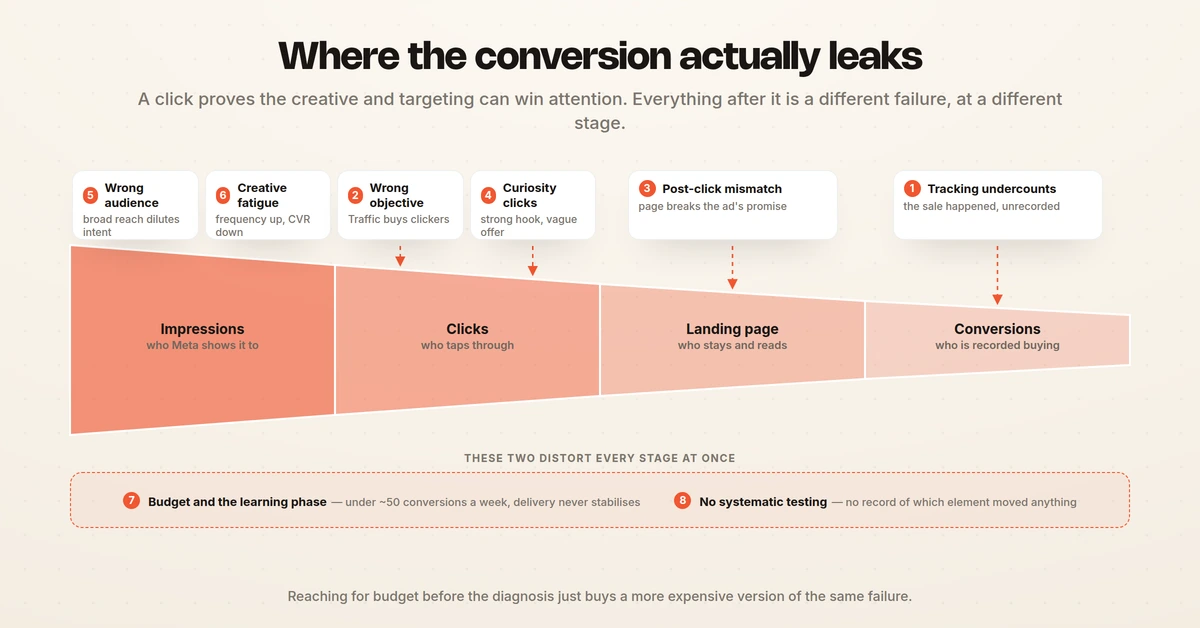
1. Conversion tracking is broken or undercounting
If tracking is wrong, every other metric lies. A misfiring Meta Pixel or a missing Conversions API setup starves the algorithm of the data it needs to find buyers, and it makes a working campaign look like a failure in reports.
- Use the Meta Pixel Helper to confirm events like ViewContent, AddToCart, and Purchase fire correctly.
- Add the Conversions API to recover conversions that browser tracking misses after Apple's App Tracking Transparency changes.
- Audit event deduplication so pixel and server events are not double counted.
Since iOS opt-outs, pixel-only tracking misses a meaningful share of real conversions. Server-side tracking is no longer optional for accurate optimization.
2. The campaign objective optimizes for the wrong action
Meta delivers what you ask for. Choose a Traffic objective and the algorithm finds people who click, not people who buy, which produces strong CTR and weak sales.
Set the objective to Sales or Leads, and confirm the pixel event you optimize for is the same event you measure success by. A campaign optimized for AddToCart will rarely maximize Purchases.
3. The post-click experience does not match the ad
The landing page is where most conversions are lost. A page that loads slowly, buries the offer, or breaks the promise made in the ad creates friction and kills trust.
- Match the landing page headline and offer directly to the ad copy.
- Keep mobile load time under three seconds, and test it with Google PageSpeed Insights.
- Strip distractions and point every page to a single conversion goal with a clear call to action above the fold.
4. The creative attracts clicks but not buyers
Creative is the single biggest driver of paid performance, and weak creative pulls the wrong clicks. A strong hook with a vague offer earns curiosity, not purchases.
Element-level analysis tells you which part of the ad is failing. Hawky's creative analysis scores the hook, visual, CTA, and body copy separately, so you fix the specific element dragging conversions instead of guessing at the whole ad.
5. Audience targeting reaches the wrong people
An ad can be well made and still convert poorly if it reaches people with no intent to buy. Broad targeting inflates clicks and dilutes conversions.
- Build custom audiences from past buyers, site visitors, and engaged users.
- Create lookalikes from high-value customers, not from all traffic.
- Check audience overlap so your ad sets are not bidding against each other.
6. Creative fatigue is driving up costs
When the same audience sees the same ad too often, engagement falls and CPMs climb. Conversions follow them down. Rising frequency with falling conversion rate is the signature of creative fatigue.
Rotate creatives before performance drops, not after. Predictive fatigue detection flags a declining creative early, which is the difference between a planned refresh and a wasted week of spend. For a deeper breakdown, see why your ads stop working.
7. Budget and the learning phase
Meta needs volume to optimize. Tiny budgets and constant edits keep a campaign stuck in the learning phase, where delivery is inefficient and conversions are unstable.
- Fund each ad set to reach at least 50 conversions per week.
- Give a new campaign 5 to 7 days before judging it.
- Avoid frequent edits, because each significant change restarts learning.
8. No systematic creative testing
Guessing wastes spend. Without structured A/B testing, you never learn which element actually moves conversions.
- Test one variable at a time: hook, visual, CTA, or audience.
- Let each test run long enough to reach significance, usually seven days.
- Record every result in a creative testing library so wins compound instead of resetting.
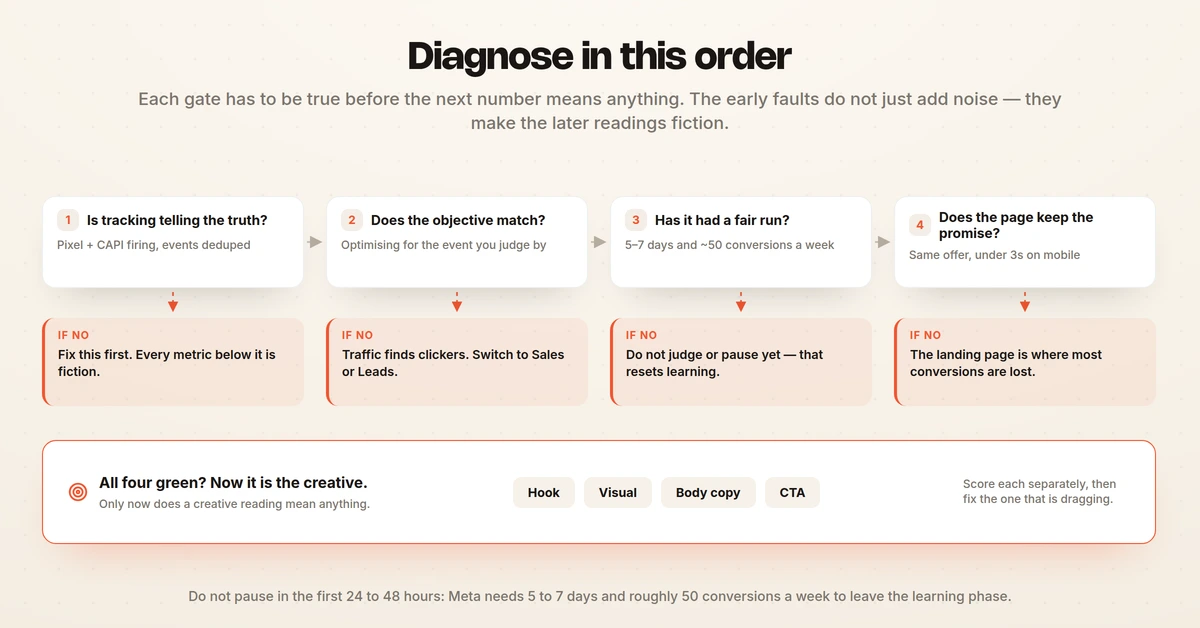
Should you pause a Facebook campaign that isn't converting?
Do not pause a Facebook campaign in the first 24 to 48 hours just because it has not converted yet. Meta needs roughly 50 conversions per week and 5 to 7 days to exit the learning phase, and pausing early resets that learning and wastes the data already gathered.
Pause only when the signals are clear. The table below separates a campaign that needs patience from one that needs to be stopped.
| Signal | Wait | Pause and fix |
|---|---|---|
| Time live | Under 5 to 7 days | Past learning phase with no conversions |
| Spend vs target CPA | Below 1x target CPA | Above 2 to 3x target CPA, zero conversions |
| Tracking status | Unverified | Verified working, still no conversions |
| Frequency | Under 2 | Above 3 to 4 with falling CTR |
If spend has passed two to three times your target cost per acquisition with verified tracking and still no conversions, the campaign is not in learning. It is broken, and the fix is creative, offer, or landing page, not more time.
How Meta ranks your ads: quality, engagement, and conversion rate ranking
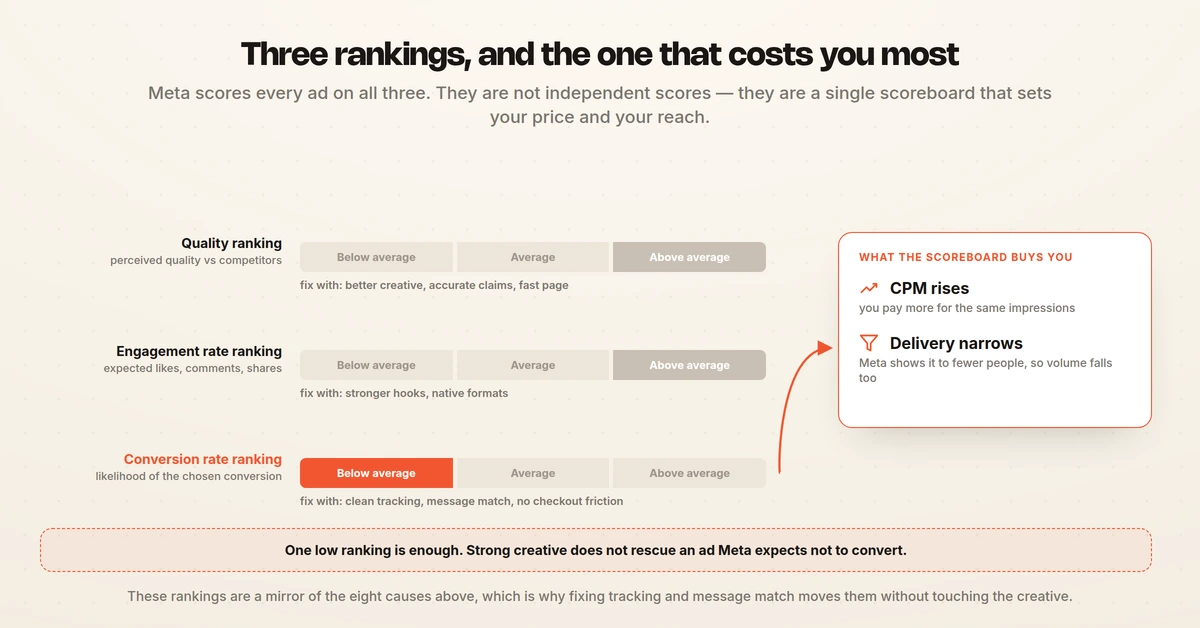
Meta scores every ad on three relevance rankings: quality ranking, engagement rate ranking, and conversion rate ranking. A low conversion rate ranking raises your costs and reduces delivery, even when the creative looks strong.
| Ranking | What it measures | How to improve it |
|---|---|---|
| Quality ranking | Perceived ad quality vs competitors | Better creative, accurate claims, fast landing page |
| Engagement rate ranking | Expected likes, comments, shares | Stronger hooks, relevant offers, native formats |
| Conversion rate ranking | Likelihood of the chosen conversion | Clean tracking, message match, frictionless checkout |
Improving these rankings lowers CPMs and widens delivery. They are a scoreboard for the same fixes covered above. You can read more on how ad relevance works in Meta's official documentation.
Facebook ad conversion benchmarks for 2026
Benchmarks give you a target to diagnose against. Treat these as directional ranges, since they vary by industry, offer, and funnel stage.
| Metric | What it means | Benchmark to aim for |
|---|---|---|
| Landing page conversion rate | Visitors who complete the goal | 2% or higher |
| CTR (link) | Clicks per impression | 1% to 2% or higher |
| Frequency | Average views per user | Keep under 3 to 4 |
| ROAS | Revenue per ad dollar | 2x or higher to scale |
| Hook rate | Viewers past the first 3 seconds | 30% or higher |
These ranges shift by sector. For target numbers by industry, see ROAS benchmarks by industry. If your CTR is healthy but your landing page conversion rate sits well under 2%, the problem is post-click, not the ad. If both are low, start with creative and targeting.
A real-world example: diagnosing a stalled campaign
A D2C skincare brand running $40k per month on Meta watched conversions fall while clicks held steady. The instinct was to cut budget. The data said otherwise.
Tracking came first. A Conversions API deduplication error was double counting some events and hiding the true drop. Once fixed, the real picture appeared: the top three creatives had crossed a frequency of four, and conversion rate ranking had slipped to below average.
The team rotated in two fresh hooks built from their best past winners and rebalanced budget away from the fatigued ads. Within seven days, conversion rate ranking recovered and cost per acquisition fell back under target. No extra budget was needed, only a sharper diagnosis.
How creative intelligence catches what manual checks miss
Manual audits work until you run more than a handful of ads. At scale, the signal that matters, a single fatiguing element inside one ad set, hides inside thousands of rows. That is where creative intelligence earns its place.
Hawky analyzes performance at the element level, predicts fatigue before it spikes your costs, and surfaces the exact reason behind a conversion drop. Its Command Center ranks fixes by expected impact, and competitor analysis shows which hooks rivals are converting on right now.
The results are measurable. Univest increased CTR by 20% within 7 days using element-level creative intelligence, and Hiveminds cut CPL by 27% while saving 160+ hours per brand each month. That is the difference between reporting a problem and fixing it before spend leaks.
Frequently asked questions
Why are my Facebook ads getting clicks but no conversions? Clicks without conversions usually mean a tracking, post-click, or creative-intent problem. The ad is strong enough to earn attention, but the conversion is either lost on the landing page or never recorded because the pixel or Conversions API is misconfigured. Verify tracking first, then check that the landing page matches the ad promise.
How long should I run a Facebook ad before it converts? Give a new campaign 5 to 7 days and enough budget to reach about 50 conversions per week before judging it. That is roughly the volume Meta needs to exit the learning phase and stabilize delivery. Editing or pausing before then resets learning and delays results.
Should I turn off a Facebook ad that is not converting? Only pause it once it has cleared the learning phase, has verified tracking, and has spent more than two to three times your target cost per acquisition with no conversions. Before that point, pausing wastes the data the algorithm has already gathered. After it, the fix is creative, offer, or landing page rather than more time.
Why is my Facebook or Instagram ad not delivering? Low or zero delivery usually comes from a tiny budget, an overly narrow audience, a campaign stuck in learning, or an ad in policy review. Widen the audience, fund the ad set to reach 50 weekly conversions, and confirm the ad is approved. Delivery problems are separate from conversion problems and should be ruled out first.
What is a good Facebook ad conversion rate? A landing page conversion rate of 2% or higher is a reasonable target for most campaigns, though strong offers exceed it. If your CTR is healthy but conversion rate sits well below 2%, the bottleneck is the post-click experience, not the ad.
Does creative fatigue cause low conversions? Yes. As frequency climbs, engagement and conversion rate fall while CPM rises. Rotating creatives before fatigue sets in, guided by predictive fatigue detection, keeps conversion rate ranking healthy and costs stable.
The bottom line
If your Facebook ads earn clicks but stall at conversion, the answer is rarely more budget. It is a sharper read on creative, tracking, and the post-click experience, fixed in that order. If you need to find the failing element before it drains spend, Hawky's creative analysis is built for that job.
Ready to Stop Guessing and Start Winning with Creative Intelligence? Book a demo.