Google Ads Updates 2026: Every Major Change, by Theme
Last updated: July 2026
The Google Ads updates 2026 share one theme: AI moved from an optional add-on to the default operating mode across Search, Performance Max, bidding, measurement, and policy. Google shipped these changes from late 2025 through mid-2026, and several carry hard deadlines that reshape how budget-limited accounts spend. This roundup groups every confirmed change by theme, attributes each to its source, and flags what is still reported rather than final.
Read this as a checklist, not a news feed. Each section opens with the change, states the effective date, and links the primary announcement so you can verify before you act.
The 2026 Google Ads updates at a glance
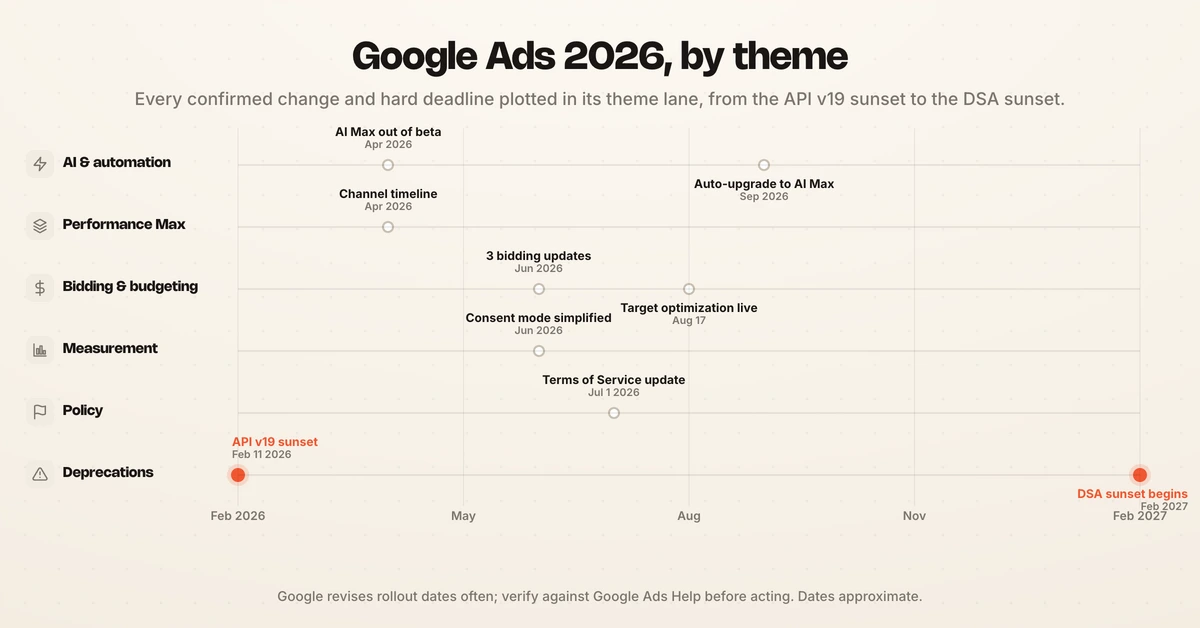
The table below summarizes the biggest confirmed changes and their effective dates. Every row links to a primary or reputable secondary source.
| Update | What changed | Effective date / quarter | Source |
|---|---|---|---|
| AI Max for Search out of beta | Broader targeting and creative quality, new controls | April 2026 | |
| Ask Advisor (Gemini) | Unified AI agent across Ads, Analytics, Merchant Center, GMP | Announced GML 2026 | blog.google |
| Promotion Mode (beta) | Temporary ROAS tolerance and extra daily budget for peaks | Announced June 15, 2026 | ALM Corp |
| Smart Bidding Exploration | Expanded beyond Search to Performance Max | June 2026 | ALM Corp |
| Bidding target optimization | Realigns budget-limited campaigns to CPA/ROAS targets | Effective Aug 17, 2026 | Google Ads Help |
| Performance Max channel timeline | Channel-level contribution timeline and segmentation | April 2026 | blog.google |
| Consent mode simplification | ad_storage governs advertising identifiers | June 2026 | ALM Corp |
| Terms of Service update | Automation-authority clause, advertiser keeps review duty | Effective July 1, 2026 | ZATO |
| Standard Display retired | Migrated into Demand Gen via migration tool | Tool from June 2026, into 2027 | Search Engine Journal |
| Google Ads API v19 sunset | v19 requests begin to fail | Feb 11, 2026 | PPC Land |
AI and automation lead the 2026 Google Ads updates
The headline of the Google Ads updates 2026 is AI Max for Search leaving beta. Google confirmed the feature moved out of beta in April 2026, with better targeting and creative quality plus more controls for advertisers. It layers Performance Max style expansion (broad match, keywordless matching, text customization, final URL expansion) onto standard Search campaigns while keeping keyword-level control.
Google cites its own internal data (Global, 2026) that non-Retail advertisers already using search term matching see an average 7% more conversions or conversion value at a similar CPA or ROAS when they add text customization and final URL expansion. In May 2026, Google added text disclaimers for regulated industries and extended AI Max into Shopping for retailers and Travel Ads inside Search. Treat those uplift figures as vendor-reported, since they come from Google rather than an independent audit.
At Google Marketing Live 2026, the automation push went further. Google announced Ask Advisor, a Gemini-built agent that spans Google Ads, Analytics, Merchant Center, and Google Marketing Platform as a single strategic assistant. It also introduced new multimodal Asset Studio capabilities that turn brand guidelines into creative, plus new Gemini-built ad formats for Search.
This is where autonomous execution enters the account. Google's tools now recommend and act, so the practical question is how much autonomy you grant and what guardrails you keep. Hawky's Performance Agent sits in the same shift, running paid media against a locked KPI with configurable autonomy, spend caps, and a reversible audit trail on every move. For a wider view of where the platforms are heading, see the guide on Google Ads automation.
Performance Max got more visibility and control in 2026
Performance Max spent 2026 answering its biggest criticism: the black box. In early April 2026, Google launched a channel performance timeline that shows how Search, Display, YouTube, Discover, and Maps each contributed over a selected period. The channel distribution table can now be segmented by conversion action and ad event type.
Google also rolled out structured asset experiments inside Performance Max, so you can test which headline, image, or video actually moves results and then apply the winner automatically. Asset-group reporting expanded to segment by device, time, conversions, and network. Reported (not confirmed on a primary Google post) is an expansion of campaign-level negative keyword capacity to as many as 10,000, per secondary roundups from groas.ai.
These controls matter because Performance Max still hands creative and placement decisions to the algorithm. The new reporting tells you where budget went, but acting on it every day is manual work. Hawky's Command Center consolidates that read across accounts, and the Performance Agent turns the signal into changes with approval gates. If you are still fitting creative to placements, the Performance Max creative specs guide covers the asset requirements.
Bidding and budgeting changes reshape how Smart Bidding spends
On June 15, 2026, Google announced three bidding and budgeting updates that change how automated bidding behaves. The most operational is a bidding target optimization change effective August 17, 2026, with notifications that began July 6. It realigns budget-limited campaigns so they track their CPA and ROAS targets as they scale, which means campaigns currently over-delivering on target should normalize toward the stated goal.
The second is Promotion Mode, a beta that lets you make temporary adjustments to ROAS tolerance and add daily budget during peak periods like seasonal events, flash sales, and launches, for Search and Performance Max. The third expands Smart Bidding Exploration beyond Search to all Performance Max campaigns without product feeds, with Shopping and feed-based PMax in beta. Exploration widens the acceptable ROAS range so the system can bid on queries that lack proven conversion history.
Three moves, one direction: more of the bid math sits inside Google's models. That raises the value of clean targets and disciplined budget pacing, since the algorithm now optimizes harder against whatever number you set. For the underlying strategy, see Google Ads bidding strategies, and for budget planning, Google Ads cost. Definitions for terms like Smart Bidding and tROAS live in the Hawky glossary.
Measurement and attribution shifted toward modeled, first-party data
The 2026 measurement changes reward first-party data and modeling. At Google Marketing Live 2026, Google reframed Analytics 360 as a measurement command center, integrating Meridian (its open-source marketing mix modeling tool) and a Future Long-Term Conversions feature that estimates downstream value.
Consent handling also got simpler. As of June 2026, ad_storage becomes the key consent setting that governs advertising identifiers, and the Consent Mode API gained new parameters for finer control. This follows Google winding down its Privacy Sandbox initiative in October 2025, which pushed the ecosystem further toward server-side tracking and modeled conversions rather than third-party cookies.
Ads inside AI Overviews and AI Mode kept expanding across surfaces through 2025 and 2026. Dedicated bidding and reporting controls for those placements are expected as the surfaces mature, but Google has not confirmed a full control set, so treat that as reported and expected rather than shipped. The practical takeaway is to strengthen first-party signals now, because modeled attribution only works when the inputs are clean.
Policy changes put automation responsibility on advertisers
The quietest change may be the most consequential. Google updated its Google Ads Terms of Service effective July 1, 2026, its first major revision in roughly eight years. The revised terms authorize Google to use automated features to format, select, or generate targets, ads, and destinations from advertiser inputs.
The catch sits in the same clause. Advertisers keep a continued obligation to review, approve, or remove campaigns and assets that Google generates automatically, so responsibility for what runs stays with the account owner, not Google. Accounts were bound to the new terms automatically, with no re-acceptance step, per secondary analysis.
Google paired the terms change with faster policy enforcement. Real-Time Policy Reviews now give instant feedback while you build Responsive Search Ads, cutting review times from hours to seconds, and Ads Advisor added three agentic safety and policy features for account protection. That combination raises the bar on oversight: automation runs more of the account, and the advertiser owns every output it produces. This is exactly why autonomous systems need control layers, and Hawky's Performance Agent logs every action with trigger data and one-click reversal so a human stays in command.
Deprecations in the 2026 Google Ads updates to plan around
Three sunsets need a calendar entry. The table below lists what is ending, what replaces it, and the timing Google has confirmed.
| Deprecation | Replaced by | Timing | Source |
|---|---|---|---|
| Standalone Display campaigns | Demand Gen | Migration tool from June 2026, continues into 2027 | Search Engine Journal |
| Dynamic Search Ads and legacy Search features | AI Max | ACA and campaign-level broad match auto-upgrade Sept 2026; DSA sunset delayed to Feb 2027 | blog.google |
| Google Ads API v19 | v20 and later (monthly releases) | v19 requests fail Feb 11, 2026 | PPC Land |
Standalone Display campaigns are being retired into Demand Gen. Beginning June 2026, eligible advertisers see a migration tool that ports Display campaigns (with performance history) into Demand Gen, and Google will eventually auto-migrate any that are not moved manually, a process that runs into 2027. Google Display Network inventory now lives inside Demand Gen alongside YouTube, Discover, Gmail, and Maps, per Google Ads Help.
Legacy Search features are folding into AI Max. Google confirmed that automatically created assets and campaign-level broad match settings auto-upgrade to AI Max starting September 2026, while the full Dynamic Search Ads sunset was delayed to begin February 2027, with legacy URL controls preserved. On the developer side, Google Ads API v19 sunsets on February 11, 2026, and Google moves to monthly API releases starting January 2026. For a refresher on which campaign types remain after these changes, see Google Ads campaign types and the practical how to run Google Ads guide.
What the 2026 Google Ads updates mean for your workflow
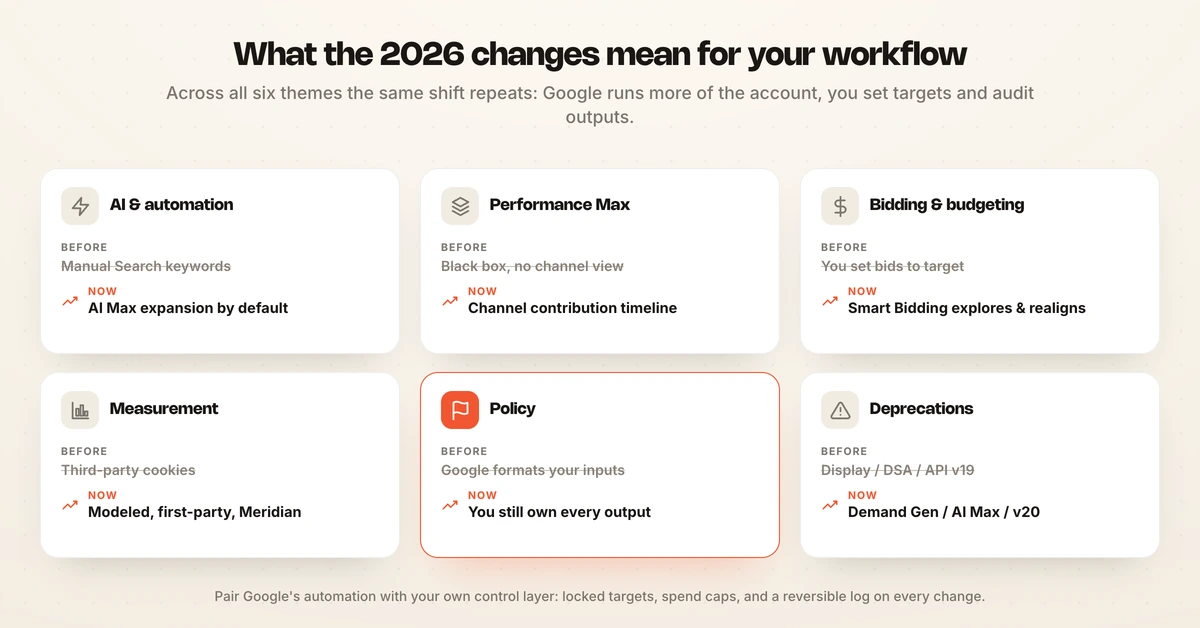
Every theme points the same way. Google is running more of the account, from bidding to creative to policy checks, and the advertiser's job is shifting from manual execution to setting targets, granting autonomy, and auditing outputs. The teams that win in 2026 will pair Google's automation with their own control layer, not fight it.
That is the gap agentic tooling fills. A dashboard tells you a channel underperformed; an agent changes the bid, pauses the asset, or reallocates budget against your KPI, with guardrails and a reversible log. Hawky's Performance Agent runs that loop across Meta, Google, YouTube, and TikTok, and you choose the autonomy gate, from shadow mode to approval-gated to fully autonomous. Pricing is outcome-based, with a subscription minimum plus KPI-tied upside.
If keeping pace with Google Ads changes while still executing daily optimizations is stretching your team, Hawky's Performance Agent is built for that job.
Ready to hire your first AI performance team? Book Demo.
Frequently asked questions
What are the latest Google Ads updates?
The latest Google Ads updates in 2026 include AI Max for Search leaving beta (April 2026), the Ask Advisor Gemini agent and Asset Studio from Google Marketing Live 2026, three bidding and budgeting changes announced June 15, 2026, a Terms of Service update effective July 1, 2026, and the retirement of standalone Display campaigns into Demand Gen.
What is AI Max for Search in Google Ads?
AI Max for Search is an AI-powered layer that adds broad match, keywordless matching, text customization, and final URL expansion to standard Search campaigns while keeping keyword-level control. Google confirmed it moved out of beta in April 2026, and legacy features like automatically created assets and campaign-level broad match auto-upgrade to it starting September 2026.
What is changing with Performance Max in 2026?
Performance Max gained a channel performance timeline in April 2026 that shows how Search, Display, YouTube, Discover, and Maps each contributed, plus structured asset experiments and expanded asset-group reporting. Secondary roundups also report a larger campaign-level negative keyword capacity, though Google has not confirmed that on a primary post.
Which Google Ads features are being deprecated in 2026?
Standalone Display campaigns are being retired into Demand Gen, with a migration tool from June 2026 that continues into 2027. Dynamic Search Ads and legacy Search features are upgrading to AI Max (ACA and campaign-level broad match in September 2026, DSA sunset delayed to February 2027), and Google Ads API v19 stops working on February 11, 2026.
How does the July 2026 Google Ads Terms of Service update affect advertisers?
Effective July 1, 2026, the revised terms authorize Google to use automated features to format, select, or generate targets, ads, and destinations from advertiser inputs. Advertisers keep a continued obligation to review, approve, or remove anything Google generates automatically, so responsibility for what runs stays with the account owner.