How Much Do Google Ads Cost? 2026 Pricing & Budget Guide
Google Ads cost most businesses between $1,000 and $10,000 per month, with an average cost per click of $2 to $5 on the Search Network and under $1 on the Display Network. There is no fixed price for Google Ads. You set the budget, and a live auction sets what each click costs, so a local plumber and a national insurer running the same platform can pay wildly different amounts.
This guide breaks down what Google Ads actually costs in 2026: the average cost per click by industry, realistic monthly budgets, how the auction calculates your price, what management adds, and whether the spend pays back.
How much do Google Ads cost?
Google Ads cost is driven by two numbers you control (budget and bid) and one the auction sets (cost per click). The average cost per click across all industries sits at $5.42, but most Search campaigns land between $2 and $5 per click, while Display clicks average under $1. (WordStream 2026 benchmarks)
Google Ads runs on a pay-per-click model for most campaigns, so you are charged when someone clicks, not when your ad shows. Two other pricing models exist: cost per thousand impressions (CPM) for awareness campaigns, and cost per acquisition (CPA) bidding, where you pay toward a target conversion cost.
| Metric | Typical 2026 figure |
|---|---|
| Average CPC, all industries | $5.42 |
| Average CPC, Search Network | $2 to $5 |
| Average CPC, Display Network | under $1 |
| Average monthly spend, SMB | $1,000 to $10,000 |
| Typical daily budget, new campaign | $20 to $50 |
The headline average hides enormous spread. What you pay depends on your industry, your keywords, your Quality Score, and how many competitors want the same clicks. The sections below break each of those down.
How is Google Ads cost calculated?
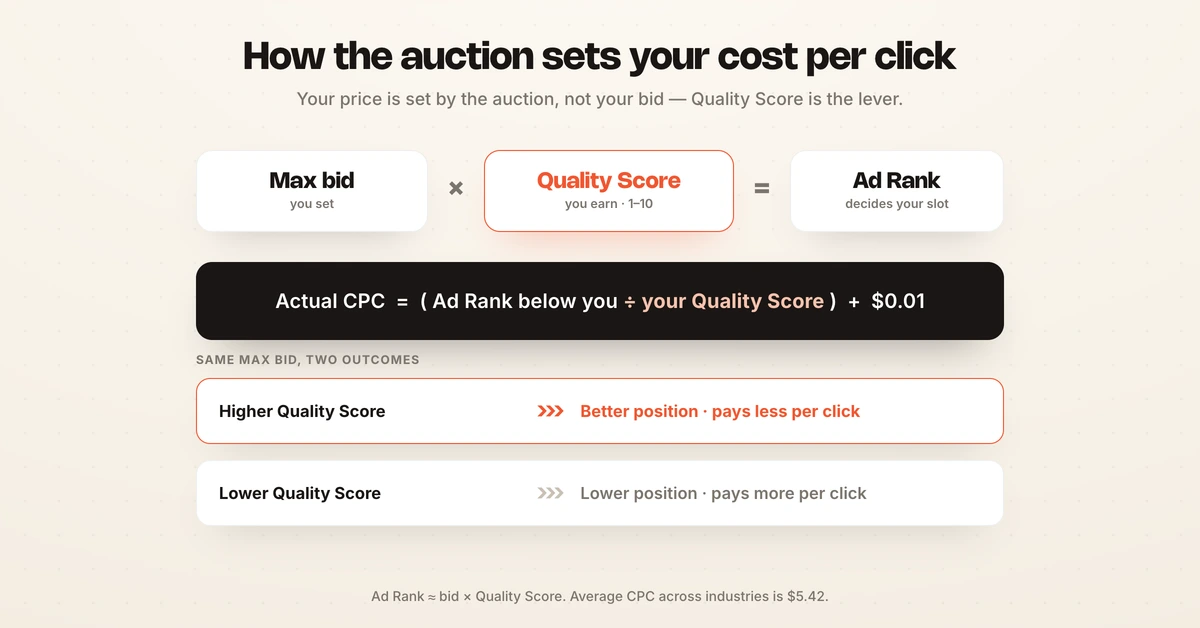
Google Ads cost is calculated through a real-time auction that runs every time someone searches. Your price per click is not your bid; it is set by the Ad Rank of the advertiser below you, divided by your Quality Score, plus one cent. A higher Quality Score lowers what you actually pay.
Three inputs decide the outcome of every auction:
- Your maximum bid. The most you are willing to pay for a click on that keyword.
- Quality Score. Google's 1-to-10 rating of your ad relevance, expected click-through rate, and landing page experience. (About Quality Score, Google Ads Help)
- Ad Rank. Roughly your bid multiplied by your Quality Score, plus the expected impact of ad assets. Ad Rank decides both whether you show and in what position.
The practical takeaway: two advertisers bidding the same amount can pay very different prices. Improve your relevance and Quality Score, and you win better positions for less. Cost control in Google Ads is as much a creative and landing-page problem as a bidding one.
Google Ads cost per click by industry
Cost per click varies more by industry than by any other factor, because click prices track the value of a customer in that vertical. A legal client is worth thousands, so law firms bid the price of a click above $9; a restaurant cover is worth far less, so its clicks stay cheap.
| Industry | Average CPC (Search) |
|---|---|
| Attorneys and legal services | $9.87 |
| Home and home improvement | $8.33 |
| Dentists and dental services | $8.00 |
| Travel | $2.14 |
| Restaurants and food | $2.05 |
| Arts and entertainment | $1.63 |
Source: LocalIQ / WordStream 2026 search benchmarks.
High-value verticals like legal, insurance, and finance regularly clear $6 to $10 or more per click, and cost per lead in legal services averages $131.63. If you compete in one of these categories, budget for the click prices your rivals have already bid up, not the platform average.
How much do Google Ads cost per month?
Most small and mid-sized businesses spend between $1,000 and $10,000 per month on Google Ads, and local businesses typically run $1,200 to $8,500, with the majority between $2,000 and $5,000. A study of more than 15,000 accounts found 24% spend under $1,000 per month, 39% spend $1,000 to $10,000, and 37% spend over $10,000. (WordStream)
Your monthly cost is simply your average CPC multiplied by the clicks you buy, so the same $2,000 goes far in a cheap vertical and evaporates in an expensive one. At a $2 CPC, $2,000 buys 1,000 clicks; at a $9 legal CPC, the same budget buys barely 220.
| Monthly budget | Clicks at $2 CPC | Clicks at $9 CPC |
|---|---|---|
| $1,000 | 500 | ~110 |
| $3,000 | 1,500 | ~330 |
| $10,000 | 5,000 | ~1,110 |
Google works in daily budgets, and new campaigns commonly start at $20 to $50 per day. Google can spend up to twice your daily budget on high-traffic days and balances it out across the month, so judge cost on the monthly total, not any single day.
What is a good budget for Google Ads?
A good starting budget for most businesses is $1,000 to $2,500 per month, enough to generate the click and conversion volume Google needs to optimize. Spending below roughly $1,000 per month often starves campaigns of data, so the money underperforms rather than simply buying less.
Set your budget from your unit economics, not a round number. Work backward from three figures you already know or can estimate:
- Target cost per acquisition. What you can afford to pay for a customer and stay profitable. See CPA for how to calculate it.
- Conversion rate. Google Ads search converts around 3 to 6% for many industries, so budget for roughly 20 to 30 clicks per conversion.
- Your CPC. From the industry table above or your own account history.
Multiply clicks-per-conversion by your CPC to get a realistic cost per conversion, then multiply by how many customers you want each month. That number, not a guess, is your budget. Competitive industries or wide service areas often need $3,000 to $5,000 per month to gather enough data to optimize. The same discipline applies on other channels; see Facebook ads cost caps for how budget controls work on Meta.
What affects your Google Ads cost
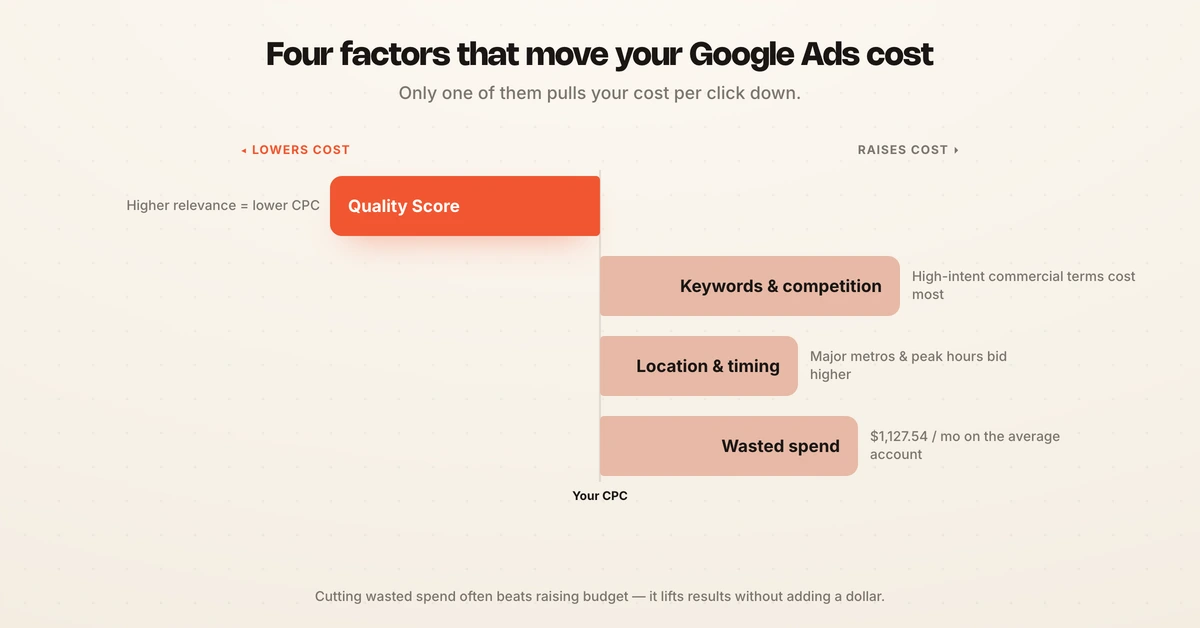
Beyond industry, four levers move your cost per click and your total spend. Understanding them is the difference between a budget that compounds and one that leaks.
- Keywords and competition. High-intent commercial keywords cost the most because everyone wants them. Long-tail, specific terms usually cost less and convert better.
- Quality Score. Higher relevance lowers your CPC directly. A poor Quality Score is a tax on every click.
- Location and timing. Bids in major metros and at peak hours run higher. Geo targeting and dayparting control this.
- Wasted spend. The average Google Ads account wastes $1,127.54 per month on irrelevant clicks, missing negative keywords, and untracked conversions. (WordStream)
That last figure is the one most teams ignore. Cutting wasted spend is often cheaper than raising budget, because it improves results without adding a dollar.
How much does Google Ads management cost?
Running Google Ads yourself costs only your ad spend and your time. Hiring help adds a management layer, and there are three common pricing models. (ALM Corp 2026 management pricing)
| Model | Typical cost | Best for |
|---|---|---|
| Percentage of ad spend | 10% to 20% (15% common) | Growing accounts scaling spend |
| Flat monthly retainer | $750 to $5,000 per month | Predictable mid-sized budgets |
| Hybrid (base plus percentage) | e.g. $750 plus 5% of spend | Teams wanting aligned incentives |
Budget agencies charge $500 to $1,500 per month, mid-tier agencies $1,500 to $5,000, and premium shops $5,000 to $20,000 or more. The loaded cost, including setup, creative, landing pages, and tracking, typically runs 30% to 50% above the quoted management fee.
The trade-off is real. A percentage-of-spend agency earns more when you spend more, which is not the same as earning more when you profit more. That misalignment is one reason teams are moving toward outcome-based pricing and AI media buying that charges on results rather than a cut of spend.
Is Google Ads worth it?
Google Ads is worth it when your customer lifetime value exceeds your fully loaded cost per acquisition, which for most businesses with a working funnel it does. The platform's strength is intent: people search when they are ready to buy, so the clicks convert better than most channels.
Whether it pays back depends less on the platform and more on execution. The cohort median across 200+ Hawky customers is +25% ROAS in the first 90 days once wasted spend is cut and creative and bidding are tuned. Compare your blended return against ROAS benchmarks by industry to judge whether your account is under or over performing.
The honest answer: Google Ads is worth it if you treat cost as something to engineer, not just pay. Accounts that monitor Quality Score, cut waste weekly, and bid to real unit economics get far more from the same budget than accounts that set it and forget it.
How agents keep Google Ads cost under control
The problem with Google Ads cost is not the auction; it is the constant attention it demands. CPCs drift, competitors change bids, keywords go stale, and wasted spend accumulates quietly. Watching all of that across campaigns is exactly the repetitive work that eats a buyer's week and lets budget leak.
This is where an agent helps. Hawky's Performance Agent plans, launches, and optimizes Google and Meta campaigns against your KPI, whether that is ROAS, CAC, or contribution margin, with spend caps and guardrails enforced continuously rather than checked once a day.
It bids to your real target, prunes wasted spend, and logs every budget and bid move with its trigger and a confidence score, all one-click reversible. Configurable autonomy keeps you in command, from shadow mode to approval-gated to fully autonomous, with a full audit trail throughout. Because it charges on outcomes, not a percentage of spend, its incentive is your profit, not your budget.
Whether you manage Google Ads by hand or with an agent, the principle holds: cost is not a fixed price you pay, it is an outcome you engineer from bids, Quality Score, and waste.
Frequently asked questions
How much do Google Ads cost per month?
Most small and mid-sized businesses spend between $1,000 and $10,000 per month on Google Ads, with local businesses typically running $2,000 to $5,000. A study of over 15,000 accounts found 24% spend under $1,000 monthly, 39% spend $1,000 to $10,000, and 37% spend over $10,000. Your monthly cost equals your average cost per click multiplied by the number of clicks you buy, so the same budget goes further in a low-CPC industry.
What is a good budget for Google Ads?
A good starting budget for most businesses is $1,000 to $2,500 per month, enough to generate the click and conversion data Google needs to optimize. Spending below roughly $1,000 per month often leaves campaigns without enough signal to learn. Set the exact figure from your target cost per acquisition and conversion rate rather than a round number, and expect competitive industries to need $3,000 to $5,000 per month.
How is Google Ads cost calculated?
Google Ads cost is calculated through a real-time auction that runs on every search. Your cost per click is set by the Ad Rank of the advertiser below you divided by your Quality Score, plus one cent, so you rarely pay your full maximum bid. A higher Quality Score, which rates your ad relevance and landing page experience, lowers what you actually pay per click.
What is the average cost per click on Google Ads?
The average cost per click across all industries is $5.42, but most Search Network clicks cost $2 to $5 and Display Network clicks average under $1. Cost per click varies most by industry: legal services average $9.87 per click while restaurants average $2.05. Your own CPC depends on your keywords, competition, and Quality Score.
How much does Google Ads management cost?
Google Ads management typically costs 10% to 20% of ad spend, with 15% a common benchmark, or a flat retainer of $750 to $5,000 per month for small to mid-sized accounts. Budget agencies charge $500 to $1,500 monthly, mid-tier agencies $1,500 to $5,000, and premium agencies $5,000 or more. The loaded cost including setup, creative, and tracking usually runs 30% to 50% above the quoted fee.
Is Google Ads worth it for a small business?
Google Ads is worth it for a small business when the lifetime value of a customer exceeds the fully loaded cost to acquire one, which holds for most businesses with a functioning funnel. Its advantage is buyer intent: people search when they are ready to act, so clicks convert better than interruptive channels. Worth comes down to execution: cutting wasted spend, tuning Quality Score, and bidding to real unit economics.
If Google Ads cost is leaking through wasted spend, drifting CPCs, and bids that never quite match your unit economics, Hawky's Performance Agent is built for that job: it optimizes against your KPI with spend caps and guardrails, cutting waste and holding efficiency, with a full audit trail keeping you in command.
Ready to hire your first AI performance team? Book Demo