PPC automation is the practice of handing repeatable paid search work to software, rules, scripts, and AI so bids, budgets, and reporting run without manual clicks. It spans native platform features, third-party tools, and autonomous agents, and the skill is knowing which layer to trust with which decision.
Paid search has more moving parts than any one person can watch in real time. This guide covers what you can automate, the tools that do it, real strategies, and an honest answer on whether PPC can run itself.
What is PPC automation?
PPC automation is the use of software to execute paid search tasks that a marketer would otherwise perform by hand. That includes setting bids, pacing budgets, pausing underperformers, adding negative keywords, sending alerts, and generating reports. The goal is to remove manual, repetitive labor so human time goes to strategy and judgment.
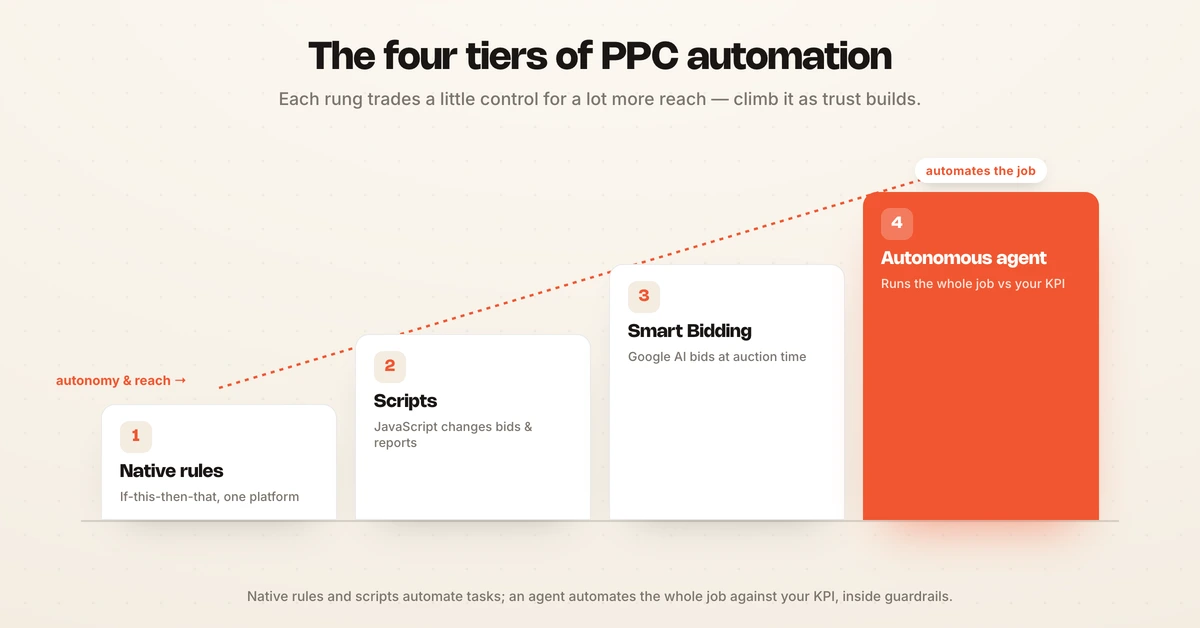
Automation runs on a spectrum. At the simplest end are native platform rules that follow explicit if-this-then-that logic. In the middle sit machine-learned systems like Google Ads Smart Bidding, which set bids at auction time using Google AI. At the far end are autonomous agents that operate the whole account against a target. For a deeper primer on the AI layer underneath, see the glossary entry on machine learning in advertising.
The key distinction to hold onto: rules and scripts automate tasks, while an agent automates the job. Most of this guide is about knowing where on that ladder each of your decisions belongs.
What you can automate in PPC
Almost every mechanical part of account management can run without you. The question is not whether a task can be automated, but whether it should be, and with what guardrails.
Here is what the common building blocks cover:
- Bidding. Smart Bidding strategies use Google AI to optimize for conversions or conversion value in every auction, a feature Google calls auction-time bidding. Target ROAS bids higher when a search is likely to lead to a high-value conversion and lower when it is not, per Google's documentation.
- Budgets. Automated rules and third-party tools pace daily spend, shift budget to winners, and cap overspend. Microsoft Advertising's automated rules adjust bids, budgets, ads, and keywords based on preset conditions, according to Microsoft.
- Rules and scripts. Google Ads scripts use JavaScript to change bids, pause ad groups, add keywords, and build custom reports directly in the account, per Google for Developers.
- Pausing losers and negatives. Condition-action rules pause ads or ad sets when a KPI threshold is breached, such as low ROAS or high CPA.
- A/B tests. Adalysis automatically A/B tests any ad group with two or more ads and can pause losing ads based on statistically significant results, per Adalysis.
- Alerts and reporting. Automated checks flag anomalies and push scheduled reports, so nothing important goes unseen for days.
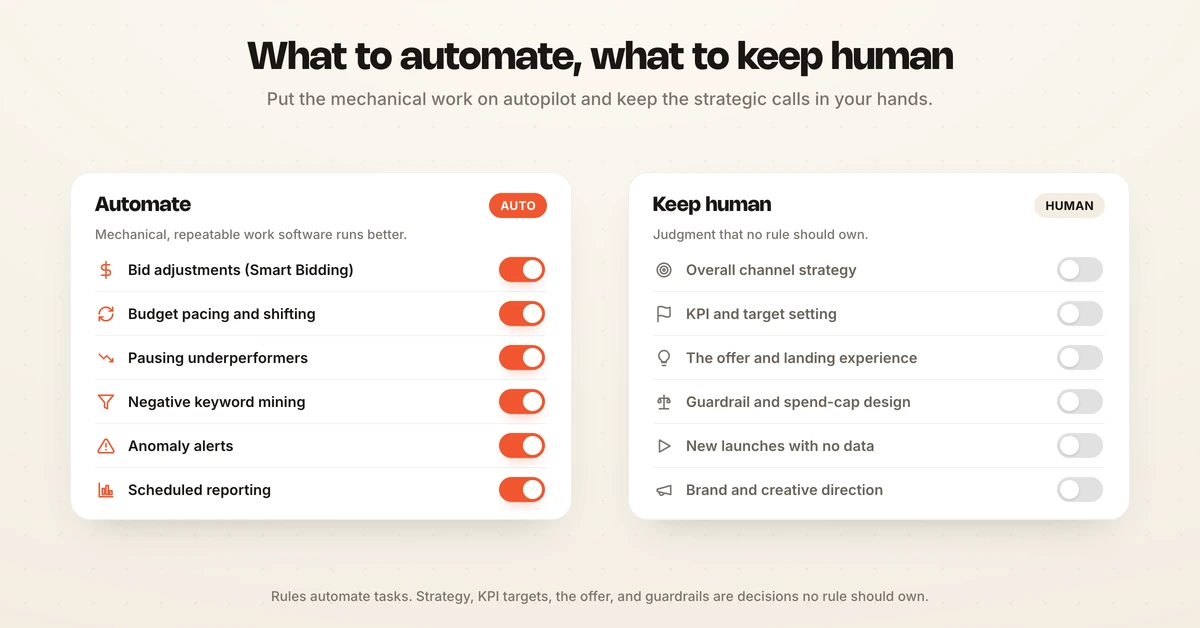
What you should keep human is smaller but heavier. Strategy, KPI targets, the offer itself, and the guardrails that constrain every automated system are decisions no rule should own.
| Automate | Keep human |
|---|---|
| Bid adjustments (Smart Bidding) | Overall channel strategy |
| Budget pacing and shifting | KPI and target setting |
| Pausing underperformers | The offer and landing experience |
| Negative keyword mining | Guardrail and spend-cap design |
| Anomaly alerts | New launches with no data |
| Scheduled reporting | Brand and creative direction |
For the budget side specifically, the campaign management approach shows how pacing and shifting fit into a single control layer.
Native vs third-party vs autonomous agents
Automation comes in three tiers, and confusing them is where most budgets get burned. Each tier trades control for reach.
Native automation lives inside the ad platform. Google Ads and Microsoft Advertising both ship automated rules, scripts, and Smart Bidding for free. Microsoft added scripts and automated rules to Performance Max in 2025, per Search Engine Land. Native tools are powerful but siloed: each platform only sees its own data.
Third-party tools sit on top of the platforms and add a cross-account control layer. Optmyzr's Rule Engine, for example, automates optimization across Google Ads, Microsoft Ads, and Amazon Ads with stacked multi-condition logic, per Optmyzr. These tools give you more nuance than native rules, but they still hand most decisions back to a human to approve.
Autonomous agents are the newest tier. Instead of surfacing recommendations, an agent executes the job end to end against a KPI. The frame that matters: rules and scripts automate tasks, an agent automates the job, with autonomy you can dial up or down as trust builds. Compare the tiers in more depth in the guide to the best ad automation software.
| Tier | What it does | Who decides |
|---|---|---|
| Native rules and Smart Bidding | Task automation inside one platform | Platform AI plus your settings |
| Third-party tools | Cross-account rules and recommendations | You approve, tool executes |
| Autonomous agent | Runs the job against a KPI | Agent acts inside your guardrails |
Best PPC automation tools
There is no single best PPC automation software. The right pick depends on whether you need free native automation, a cross-account rule layer, dedicated ad testing, or an agent that runs the account. A short, honest shortlist:
- Google Ads scripts and automated rules. The free native option. Scripts change bids, pause ad groups, add keywords, and build reports in JavaScript, per Google. Best for teams that want automation without a subscription and have someone comfortable with code.
- Optmyzr. A rule engine and optimization suite across Google, Microsoft, and Amazon Ads. Its Rule Engine uses stacked multi-condition strategies and can pull external data from Google Sheets to make context-aware changes, per Optmyzr.
- Adalysis. Focused on automated ad A/B testing and account audits. It automatically tests any ad group with two or more ads and runs over 100 automated checks with alerts, per Adalysis.
- Revealbot (Birch). A condition-action rule engine that spans social and search. You choose from more than 20 actions and group conditions with AND/OR operators to pause, scale, or adjust, per Revealbot.
- Hawky. The agent tier. Hawky's Performance Agent runs Meta, Google, and YouTube against your KPI with guardrails and an audit trail, rather than handing recommendations back to you.
For a broader comparison across categories, see the roundup of the best PPC tools.
PPC automation strategies
Tools are only as good as the strategy behind them. These are the automation strategies that hold up in practice.
Feed the machine enough data before you trust it. Smart Bidding needs volume to learn. Google recommends reaching at least 30 conversions before switching to automated bidding, preferably closer to 50 for Target ROAS since it optimizes for value, not just count. Microsoft gives similar guidance of at least 30 conversions before evaluating a bid strategy, per Microsoft.
Automate the mechanical, protect the strategic. Put bidding, pacing, pausing, and reporting on autopilot. Keep targets, offers, and guardrails in human hands. The 2025 shift in the PPC role is real: professionals now design campaign guardrails and curate inputs instead of hand-tuning bids, per Search Engine Land.
Stack conditions, do not fire single rules. A rule that only checks cost per conversion will pause a keyword mid-learning. Multi-condition logic that also checks conversion volume and time window prevents most false pauses.
Match your bidding to your goal. Target ROAS suits value-based accounts with revenue data, Maximize Conversions suits volume goals within budget. Choosing the wrong one wastes the learning period. The Google Ads bidding strategies guide breaks this down, and for the broader native picture, see Google Ads automation.
Watch Performance Max closely. Performance Max leans heavily on automation and site data, which makes it vulnerable during site migrations and tracking changes. It needs monitoring, not set-and-forget.
Can PPC be fully automated?
Tasks yes, the job no. This is the honest answer, and pretending otherwise is how accounts drift.
Every mechanical task in this guide can run without a human once configured. Bids, budgets, pausing, negatives, alerts, and reports all execute on their own. What cannot be left unattended is the whole account. PPC professionals report that no fully automated campaign runs without guardrails and regular check-ins, and that left alone, campaigns drift further from their target customers, per Search Engine Land.
The failure points are specific: new launches lack the data automation needs, low-volume accounts confuse the algorithms, and website changes break automated campaigns tied to site structure. Over-reliance also risks poor lead quality and strategic misalignment, since platform optimization goals are not always your business goals.
The realistic model is not full autonomy or full manual control. It is autonomous execution inside guardrails a human sets, with an audit trail and the ability to reverse any move. That is the agent tier.
The agent tier: automation that runs the job
Rules and scripts automate tasks. An agent automates the job. That difference is the whole reason the agent tier exists.
Hawky is an agentic performance marketing platform, and its Performance Agent is an always-on operator for paid media. It plans, launches, and optimizes Meta, Google, and YouTube campaigns against your KPI, whether that is ROAS, CAC, or contribution margin, on a closed loop of test, track, optimize, and scale. Every move is logged with trigger data and a confidence score, and every move is one-click reversible.
The control story is what makes autonomy usable rather than reckless. Autonomy is configurable: you pick the gate, from shadow mode to approval-gated to fully autonomous, and loosen it as trust builds, with the same audit trail throughout. Spend caps and guardrails keep humans in command. Across a cohort of 200+ active customers, the median lift was +25% ROAS in the first 90 days.
If your team is drowning in rule maintenance and manual optimization but does not want to hand the account to a black box, Hawky's Performance Agent is built for that job. See pricing for how the agent tier is structured.
Frequently asked questions
What is PPC automation?
PPC automation is the use of software, rules, scripts, and AI to run paid search tasks that a marketer would otherwise do by hand: adjusting bids, pacing budgets, pausing losers, flagging anomalies, and building reports. Native tools like Google Ads Smart Bidding and automated rules cover the basics, while third-party platforms and autonomous agents extend the reach across accounts and channels.
What are the best PPC automation tools?
For rule-based optimization across Google, Microsoft, and Amazon, Optmyzr's Rule Engine is a leading choice. Google Ads scripts and automated rules handle native, in-platform automation for free. Adalysis focuses on automated ad A/B testing and audits, Revealbot (Birch) handles condition-action rules for social and search, and Hawky sits at the agent tier, running campaigns against a KPI with guardrails.
Can PPC be fully automated?
Individual tasks can be fully automated: bidding, budget pacing, pausing underperformers, alerts, and reporting all run without a human once configured. The job cannot be left fully unattended. PPC professionals report that campaigns left alone drift away from target customers, and new launches, low-volume accounts, and site changes still need human judgment. The realistic model is an agent doing the labor inside guardrails a human sets.
What is the difference between automated rules and Smart Bidding?
Automated rules follow explicit if-this-then-that logic you write, such as pause a keyword if cost per conversion exceeds a threshold. Smart Bidding uses Google AI to set bids at auction time based on predicted conversion value, so it is machine-learned rather than hand-coded. Rules give you control and transparency, Smart Bidding gives you optimization at a scale no rule can match.
Do PPC automation tools work across Google and Microsoft Ads?
Many do. Optmyzr's Rule Engine covers Google Ads, Microsoft Ads, and Amazon Ads. Microsoft Advertising added support for scripts and automated rules to Performance Max in 2025, mirroring Google. Native automation is platform-specific, so third-party tools and agents are what give you one control layer across both search engines.
What is an autonomous PPC agent?
An autonomous PPC agent is software that plans, launches, and optimizes campaigns end to end against a KPI, rather than handing recommendations back to a human. The difference from rules and scripts is scope: rules automate tasks, an agent automates the job. A trustworthy agent pairs autonomy with control through guardrails, spend caps, an audit trail, and one-click reversibility, with configurable levels of autonomy.
If your team is drowning in rule maintenance and manual optimization but does not want to hand the account to a black box, Hawky's Performance Agent is built for that job.
Ready to hire your first AI performance team? Book Demo