TikTok Ads Automation: Native Rules, Smart+, and What AI Actually Runs
TikTok ads automation is real and it works at four distinct levels: native automated rules inside TikTok Ads Manager, TikTok's own AI campaign types (Smart Performance Campaign and the newer Smart+), third-party rule tools that layer more advanced logic on top, and autonomous agents that operate a channel against a KPI. Knowing which level you are actually buying is what separates a tidy demo from a system that moves your numbers.
Most teams reach for automation because manual TikTok ad management does not scale past a handful of ad groups. This guide walks the full ladder, cites what each tool officially does, and shows you the pattern to look for when you want a system that runs the account, not just a rule that fires at 2 a.m.
Can TikTok Ads be automated?
Yes. You can automate TikTok ads at several depths, from simple if-this-then-that rules to AI campaign types that handle targeting, bidding, placement, and creative selection for you. The question is not whether automation exists but how much decision-making you hand over and how much control you keep.
At the shallow end, native automated rules react to conditions you define. At the deep end, autonomous agents make ongoing optimization decisions on your behalf within guardrails. TikTok itself sits in the middle with its Smart campaign family, and third-party tools extend the rule layer across channels.
Native automated rules in TikTok Ads Manager
Automated rules are TikTok's built-in, no-cost automation layer. According to TikTok's help article on automated rules, they let you create rule-based tasks that automatically check and manage your campaigns, ad groups, and ads, so you can monitor and adjust delivery in near real time.
Each rule supports up to five conditions and one action when those conditions are met. You can pause a low-performing ad when it crosses a cost threshold, raise budget when ROAS clears a target, or get notified when a campaign spends 80% of its lifetime budget. You choose how often TikTok checks the rule: continuously every 30 minutes, on a custom schedule, or once at a set time.
Rules are powerful for guardrail-style tasks, but they are reactive by design. They fire the action you pre-wrote against the threshold you pre-set, and they do not reason about why performance shifted. For more on the manual mechanics underneath, see the walkthrough on how to run TikTok ads.
Smart Performance Campaign and Smart+
TikTok's AI campaign types are the next level up. Smart Performance Campaign (SPC) is described by TikTok as an end-to-end automation solution designed to maximize delivery outcomes with less manual input, automating targeting, bidding, and creative delivery toward your performance goal. TikTok's Smart Performance Campaign help article covers the original setup.
Smart+ is the evolution of that idea. TikTok's Smart+ overview explains that Smart+ lets you create a single AI-powered campaign that automates targeting, optimization, and creative to deliver the right ad to the right person against your goal. The upgraded Smart+ experience supports Sales, Lead Generation, App Promotion, and Traffic objectives.
The important shift in 2025 and 2026 is control. The upgraded Smart+ documentation unifies the manual and Smart+ flows into one build, so you can run a campaign as fully automated, partially automated, or fully manual, and toggle automation on specific modules like targeting, budget, and placement. That module-level control is what makes Smart+ usable for advertisers who do not want to hand over the entire account at once. For a broader mental model of what the underlying systems are doing, the primer on machine learning in advertising is a useful companion.
Automated creative and Smart Creative
Automation on TikTok is not limited to delivery. TikTok's Symphony Automation brings TikTok's generative AI creative suite directly into the Smart+ workflow, so you can generate fresh assets and enhance existing ones without leaving the campaign build.
Symphony Automation currently offers two solutions. Recommended Creatives suggests videos based on predicted performance, and Automatic Enhancements resizes, dubs, and optimizes your existing assets automatically. This matters because creative is the dominant performance lever on TikTok, and automating asset variation reduces the manual work of feeding the algorithm fresh material.
Creative automation and delivery automation are different jobs. One decides who sees the ad and at what bid; the other decides what the ad looks like. Strong TikTok automation setups use both.
Third-party TikTok ads automation tools
When native rules run out of room, third-party platforms fill the gap. Revealbot, which also operates under the Birch brand, added TikTok automation and supports rule-based pausing, budget adjustments, and scaling based on performance thresholds across Facebook, Instagram, Google Ads, TikTok, and Snapchat from one dashboard.
The pull of these tools is more sophisticated logic than TikTok exposes natively. Revealbot offers and/or operators, nested condition groups, and access to a far wider set of metrics than TikTok's built-in interface, so you can build complex automations that would be impossible with a five-condition native rule. For the wider field beyond automation, see the ranked list of the best TikTok ads tools.
Not every popular tool covers TikTok management, though. Madgicx, for example, is a Meta-focused platform in 2026 that can track TikTok performance in its dashboard but does not manage or automate TikTok campaigns, so verify management support before you buy. For a wider survey of the category, see the roundup of the best ad automation software.
The automation-levels idea
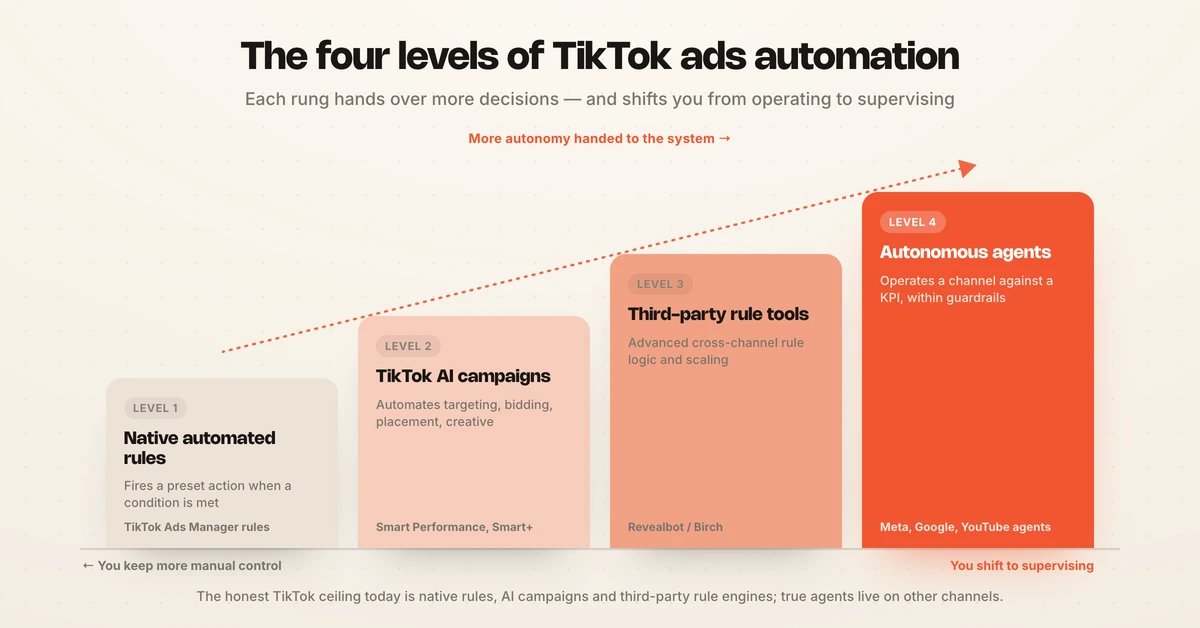
Once you have seen the options, a clean way to think about them is a ladder of increasing autonomy paired with the control you retain at each rung. The higher the rung, the more decisions the system makes and the more your job shifts from operating to supervising.
| Level | What it does | Control you keep | Example |
|---|---|---|---|
| Native automated rules | Fires a preset action when a condition is met | Full: you write every condition and action | TikTok Ads Manager rules |
| TikTok AI campaigns | Automates targeting, bidding, placement, creative | Module-level toggles in Smart+ | Smart Performance Campaign, Smart+ |
| Third-party rule tools | Advanced cross-channel rule logic and scaling | You design the rule graph | Revealbot / Birch |
| Autonomous agents | Operates a channel against a KPI, decides next actions | Guardrails and configurable autonomy | Meta, Google, YouTube agents |
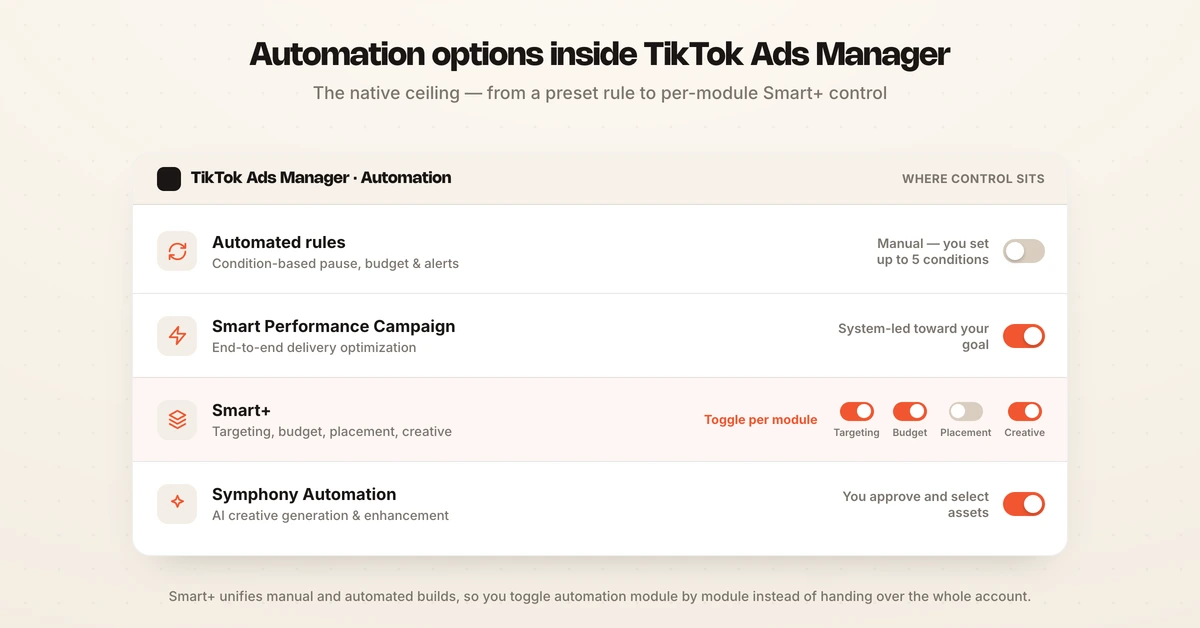
The table below maps this specifically to what TikTok Ads Manager offers today, so you can see the native ceiling before you reach for outside tools.
| TikTok Ads Manager feature | What it automates | Where control sits |
|---|---|---|
| Automated rules | Condition-based actions (pause, budget, alerts) | You define up to five conditions per rule |
| Smart Performance Campaign | End-to-end delivery optimization | System-led with your goal as input |
| Smart+ | Targeting, budget, placement, creative by module | Toggle automation per module |
| Symphony Automation (Smart Creative) | Creative generation and enhancement | You approve and select assets |
Autonomous agents: the top of the ladder
The distinction between an automated rule and an autonomous agent is not marketing. A rule reacts to a threshold you predefined. An agent decides what to do next against a KPI you set, logs each change so it is auditable, and keeps every action reversible inside guardrails you configure.
That difference matters because a threshold cannot reason about a shift it did not anticipate, while an operator that owns a KPI can. This is the pattern to look for as you evaluate any "AI" automation claim: does the tool merely execute rules, or does it actually operate the channel and remain accountable for the outcome. Autonomy without control is a liability, and control without autonomy is just a dashboard.
On TikTok specifically, the honest ceiling today is native rules and AI campaigns plus third-party rule engines. True agent-level operation currently lives on other channels, which is exactly where the next section draws the line.
Where Hawky fits, honestly
Hawky is an agentic performance marketing platform, and its Performance Agent operates Meta, Google, and YouTube, not TikTok. If TikTok is your only channel, the tools above are your automation stack, and this section is about the pattern to recognize rather than a TikTok product claim.
For the channels Hawky does cover, the Performance Agent acts as an autonomous operator that manages campaigns against your KPI with logged, reversible changes and configurable autonomy, which is the top-of-ladder model described above. Hawky reports a +25% ROAS lift in the first 90 days across more than 200 customers, detailed in its case studies. You can see how this compares to rule-based setups in the breakdown of Facebook ads automation, and review commercial terms on the pricing page.
The takeaway is simple. Match the automation level to the job: use native rules and Smart+ on TikTok, and look for autonomous, guardrailed agents on the channels where they exist. If you are budgeting TikTok spend alongside this, the guide to TikTok ads cost pairs well with any automation plan.
Frequently asked questions
Can TikTok Ads be automated?
Yes. TikTok Ads Manager includes native automated rules that check conditions and take actions like pausing ads or adjusting budgets, plus AI-driven campaign types (Smart Performance Campaign and Smart+) that automate targeting, bidding, placement, and creative selection. Third-party tools such as Revealbot add more advanced rule logic across platforms.
What automation does TikTok Ads Manager offer?
TikTok Ads Manager offers automated rules with up to five conditions per rule and scheduled checks, Smart Performance Campaign for end-to-end delivery optimization, the newer Smart+ campaigns with module-level automation controls, and Symphony Automation for AI-assisted creative generation and enhancement.
What is a Smart Performance Campaign?
Smart Performance Campaign (SPC) is TikTok's end-to-end automated campaign type that maximizes delivery outcomes with less manual input. It automates targeting, bidding, and creative delivery so the system optimizes toward your performance goal. TikTok has since introduced the upgraded Smart+ experience, which adds control over which modules stay automated.
Is Smart+ better than Smart Performance Campaign?
Smart+ is the evolution of Smart Performance Campaign. It covers more objectives, adds module-level automation controls for targeting, budget, and placement, and integrates Symphony Automation for creative. Manual and Smart+ flows are now unified, so you can run full, partial, or manual automation in one campaign build.
Do TikTok automation rules replace a media buyer?
No. Native rules and AI campaign types automate specific tasks and optimization inside one platform, but they still need a person to set conditions, judge results, and steer strategy. Autonomous agents go further by operating a channel against a KPI with guardrails, though on TikTok the automation ceiling today is native tools plus third-party rule engines.
What is the difference between automated rules and autonomous agents?
Automated rules fire a fixed action when a condition is met, so they react to thresholds you predefine. Autonomous agents decide what to do next against a KPI, log each change, and keep it reversible within guardrails you set. TikTok offers rules and AI campaigns; agent-level operation exists today on Meta, Google, and YouTube.
If you want an operator that runs your Meta, Google, and YouTube spend against a KPI with guardrails instead of one more dashboard to babysit, Hawky's Performance Agent is built for that job.
Ready to hire your first AI performance team? Book Demo