Facebook Ads Automation: From Automated Rules to Autonomous AI Agents
Facebook ads automation is any system that lets software, rather than a person, act on your Meta campaigns. It runs across four levels: native automated rules, Advantage+ and Meta's AI, third-party rule engines, and autonomous AI agents that plan, launch, and optimize an account end to end. The gap between the levels is the difference between automating a few tasks and automating the whole job.
Most advertisers already use some automation without calling it that, and most stop far short of what is possible. This guide walks the levels from bottom to top, shows real condition-action rules you can copy, and explains where an AI agent takes over the work that rules leave on the table.
Can Facebook Ads be automated?
Facebook ads can be automated at every stage of the campaign lifecycle, from launch to budget shifts to pausing losers. Meta bakes automation directly into Ads Manager, and a large ecosystem of third-party tools extends it further. The question is not whether to automate but how much of the job you hand over and how much control you keep.
Think of Facebook ads automation as a ladder. Each rung takes more off your plate, and each rung asks a different question about trust and oversight.
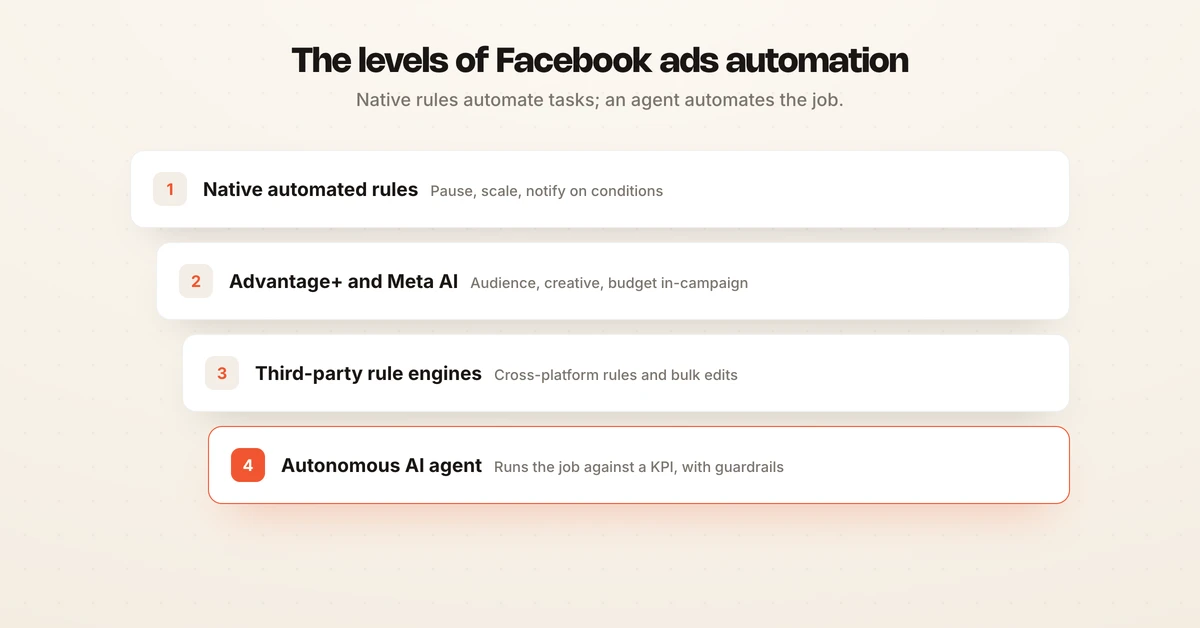
The four levels of Facebook ads automation
Facebook ads automation moves from automating single tasks to automating the entire media-buying job. Understanding the levels helps you match the tool to the outcome you actually want.
| Level | What it automates | Who decides | Best for |
|---|---|---|---|
| Native automated rules | Single tasks (pause, scale, notify) | You write every condition | Enforcing thresholds you already know |
| Advantage+ and Meta AI | Audience, creative, budget inside a campaign | Meta's machine learning | Simplified setup and scale |
| Third-party rule engines | Cross-platform rules, bulk edits, boosting | You, at higher granularity | Agencies and multi-account operators |
| Autonomous AI agent | The full job: plan, launch, optimize to KPI | The agent, within your guardrails | Teams that want an operator, not a tool |
The key frame is simple. Native rules and rule engines automate tasks. An AI agent automates the job. That distinction runs through everything below.
What are Facebook automated rules?
Facebook automated rules are condition-action instructions you configure inside Meta Ads Manager. You define a condition, such as cost per result above a target, and pair it with an action, such as turning off the ad. When the condition is true, Meta runs the action for you.
Meta's available actions include turning campaigns, ad sets, or ads on or off, adjusting daily or lifetime budget, adjusting manual bid, and sending a notification, according to the Meta Business Help Center. Rules are checked on a schedule, roughly every 30 minutes, so actions generally happen within an hour of a condition being met. You can create up to 250 automated rules on a single ad account, per Meta's documentation on rule limits.
Here are practical rules you can build today. Each is a condition mapped to an action.
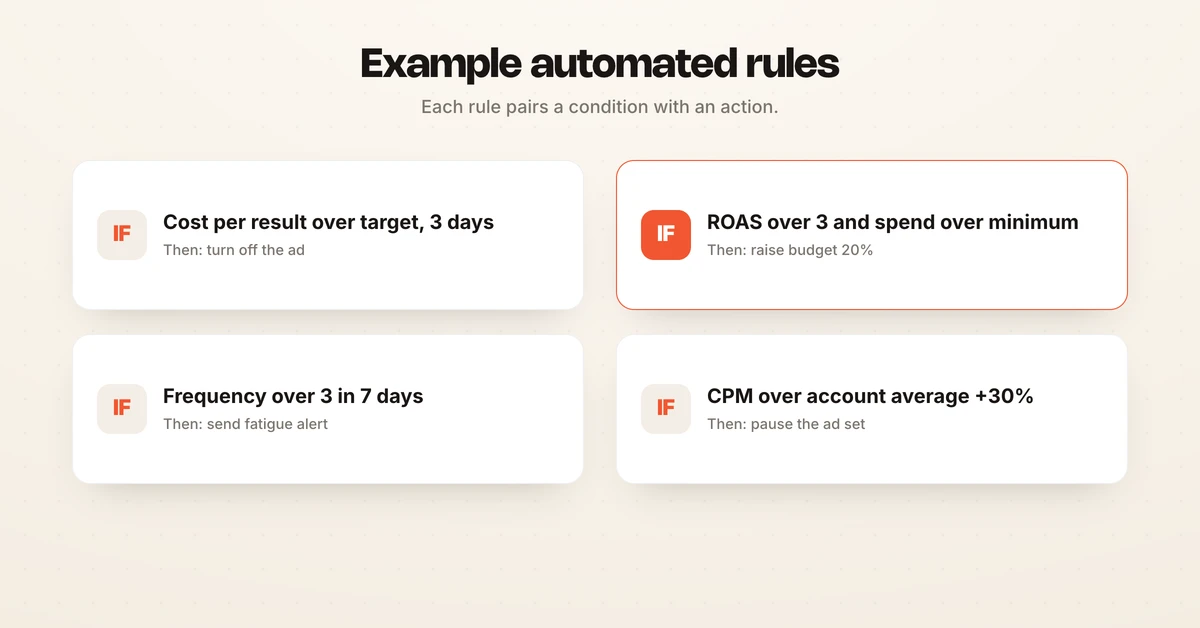
| Condition | Action | Why it helps |
|---|---|---|
| Cost per result above target for 3 days | Turn off the ad | Cuts spend on losers automatically |
| ROAS above 3 and spend above minimum | Increase ad set budget by 20% | Scales proven winners |
| Frequency above 3 in last 7 days | Send notification | Flags creative fatigue before CPMs climb |
| CPM above account average by 30% | Turn off the ad set | Protects budget from expensive placements |
| Conversions at 0 and spend above CPA target | Turn off the ad | Kills non-converting spend early |
Automated rules are powerful and free, but they only do what you tell them. They cannot decide what to test next, write new creative, or reason about why performance shifted. They enforce your logic; they do not form their own. For a deeper look at protecting spend, see Hawky's guide to Facebook ads cost caps.
Advantage+ and Meta's AI bidding
Advantage+ is Meta's suite of AI-driven automation that makes decisions inside a campaign. Rather than you setting every audience and placement, Meta's machine learning tests audiences, creative, and budget allocation in real time to hit your objective.
The suite includes Advantage+ Sales campaigns (formerly Advantage+ Shopping), which automate audience, optimization, budget, and destination levers, according to Meta for Business. Advantage+ Audiences use behavioral signals from the Meta Pixel and Conversions API to find likely converters instead of relying on manual interest targeting. Advantage+ Creative generates format and placement variations from your assets. You can read a fuller breakdown in Hawky's Meta Advantage+ glossary entry.
Advantage+ is genuine automation, but it operates within one campaign and optimizes toward Meta's model of your objective. It does not manage your account structure, arbitrate budget across campaigns you did not group together, or explain its choices in a log you can audit and reverse. Automated rules and Advantage+ also work together, since you can run rules on top of Advantage+ campaigns to enforce your own thresholds.
Third-party Facebook ads automation tools
Third-party automation software layers a more capable rule engine and workflow tools on top of the Meta API. These tools appeal to agencies and operators who manage many accounts or want conditions that go beyond what native rules allow.
Revealbot (now operating under the Birch brand) runs condition-action rules with AND/OR logic, multi-condition stacking, and execution as often as every 15 minutes, and it supports Meta, Google, Snapchat, and TikTok through direct API integrations, per its pricing and review coverage. Madgicx positions itself as a Meta-first AI platform with a creative optimizer, an autonomous budget optimizer that shifts spend toward top-performing ad sets, and audience clustering, according to Madgicx. Smartly offers optimization triggers, predictive budget allocation, and automated ad production from source documents, as summarized in this Smartly and Madgicx comparison. For a ranked comparison of these Meta tools with dated prices, see the guide to Meta ads management software.
These tools raise the ceiling on what you can automate, and they remain fundamentally rule-driven or feature-driven. You still author the rules, watch the dashboards, and decide what to do with what they surface. For a broader survey, Hawky maintains a guide to advertising automation tools.
Autonomous Facebook ads: automating the job, not the task
The top rung is autonomous automation, where an AI agent runs the media-buying job end to end against a KPI you set. This is the level where automated Facebook ads stop being a collection of rules and start behaving like an operator. Autonomous only works with control, which means guardrails, approval gates, an audit trail, and reversibility built in from the start.
The difference is one of scope. A rule pauses one ad when a number crosses a line. An autonomous agent decides which creative to test, launches the campaigns, shifts budget across ad sets, pauses fatigued creative, and reports on each move, all while chasing a target cost per acquisition or ROAS. It forms a plan rather than waiting for you to encode one.
The word autonomous should never travel alone. Safe autonomy pairs it with a control term every time: guardrails that cap spend, approval gates for high-impact changes, an audit trail that records the trigger and confidence behind each action, and one-click reversibility so any move can be undone. Without those, autonomy is just risk.
How Hawky's Performance Agent delivers autonomous Facebook ads
Hawky is an agentic performance marketing platform, and its Performance Agent is the autonomous top tier that sits above native rules, Advantage+, and third-party rule engines. The agent is an always-on operator that plans, launches, and optimizes Meta campaigns, alongside Google and YouTube, against the KPI you set. It automates the job, not a handful of tasks.
Control is designed in, not bolted on. Every move the agent makes is logged with its trigger and confidence, and every move is reversible with one click. You set spend caps and guardrails, and you can run the agent in shadow mode, where it recommends actions without executing, until you trust it. From there you move along a spectrum from approval-gated, where the agent proposes and you confirm, to fully autonomous, at whatever pace fits your risk tolerance.
That is the practical answer to the safety question. The Performance Agent does not ask you to choose between automation and oversight, because the audit trail and reversibility give you both. You can see the same optimization surface in Hawky's campaign management features.
Hawky prices on outcomes rather than seats or spend tiers, and it offers a 30-day pilot so you can measure the agent against your current setup before committing. In its first 90 days, the cohort median customer saw a 25% ROAS lift across more than 200 customers, detailed in the Hawky case study. Pricing details are on the Hawky pricing page, and the same agentic approach applies to search in Hawky's Google Ads automation coverage. For creative specifically, see automated creative testing.
Frequently asked questions
Can Facebook Ads be automated?
Yes. You can automate Facebook ads at several levels: native automated rules that pause or scale based on conditions, Advantage+ campaigns that let Meta's AI handle audience, creative, and budget, third-party rule engines like Revealbot, and autonomous AI agents that plan, launch, and optimize against a KPI end to end. Native rules automate individual tasks, while an AI agent automates the entire media-buying job with guardrails and an audit trail.
What are Facebook automated rules?
Facebook automated rules are condition-action instructions you set in Meta Ads Manager. When a rule's conditions are met, such as cost per result rising above a threshold, the rule runs an action like turning off the ad, adjusting budget, adjusting bid, or sending a notification. Meta checks rules on a schedule (roughly every 30 minutes), and you can create up to 250 rules per ad account.
What are the best Facebook Ads automation tools?
The right tool depends on how much of the job you want to automate. Meta's native automated rules and Advantage+ are free and built in. Third-party rule engines like Revealbot, Madgicx, and Smartly add cross-platform rules, bulk editing, and creative tools. For end-to-end autonomy against a KPI, an agentic platform such as Hawky's Performance Agent plans, launches, and optimizes with guardrails, approval gates, and one-click reversibility.
What is the difference between automated rules and an AI agent?
Native automated rules automate discrete tasks: if this metric crosses this line, do this one thing. An AI agent automates the job: it decides what to test, launches campaigns, shifts budget, pauses fatigued creative, and reports on every move, all against a target KPI. Rules follow your logic; an autonomous agent forms its own plan within guardrails you set and logs each decision with its trigger and confidence.
Is autonomous Facebook ads automation safe?
Autonomous automation is safe when it ships with control. Look for spend caps, a shadow mode that recommends before it acts, approval gates for high-impact changes, a full audit trail showing the trigger and confidence behind every action, and one-click reversibility. Hawky's Performance Agent includes all of these so you can move from approval-gated to fully autonomous at your own pace.
Does Meta Advantage+ replace automated rules?
No. Advantage+ automates decisions inside a campaign, such as audience expansion, creative variations, and budget allocation, using Meta's machine learning. Automated rules act on top of any campaign, including Advantage+ ones, to enforce your own thresholds like pausing when cost per acquisition spikes. Many advertisers run both together.
If you are tired of babysitting automated rules and want an operator that runs your Facebook ads against a KPI with guardrails and a full audit trail, Hawky's Performance Agent is built for that job.
Ready to hire your first AI performance team? Book Demo