Cost Caps on Facebook Ads: When to Use Them (and When Not To)
A cost cap tells Meta to keep your average cost per result around a target while still maximizing delivery, so you use it to scale a proven campaign profitably, and you avoid it during the learning phase or when you do not yet know your true target CPA. Used at the right moment it protects margin at scale; used too early it starves delivery and stalls learning.
Cost caps are one of the most misused settings in Meta Ads. Most teams either never touch them or slap one on a brand-new campaign and wonder why delivery dies. This guide explains what a cost cap actually does, exactly when to use it, when not to, and how to set it so it helps instead of hurts.
What a cost cap is on Facebook ads
A cost cap is a Meta bid strategy that sets a target average cost per result, and Meta then optimizes to keep your cost per acquisition near that number while spending as much of your budget as it profitably can. It is a control on the average outcome, not a hard ceiling on every auction.
That distinction is the whole game. A cost cap averages across results, so individual conversions can come in above or below the target as long as the average holds. The platform trades a little volatility for more delivery, which is why cost caps scale better than stricter controls. (Meta's bid strategy guide)
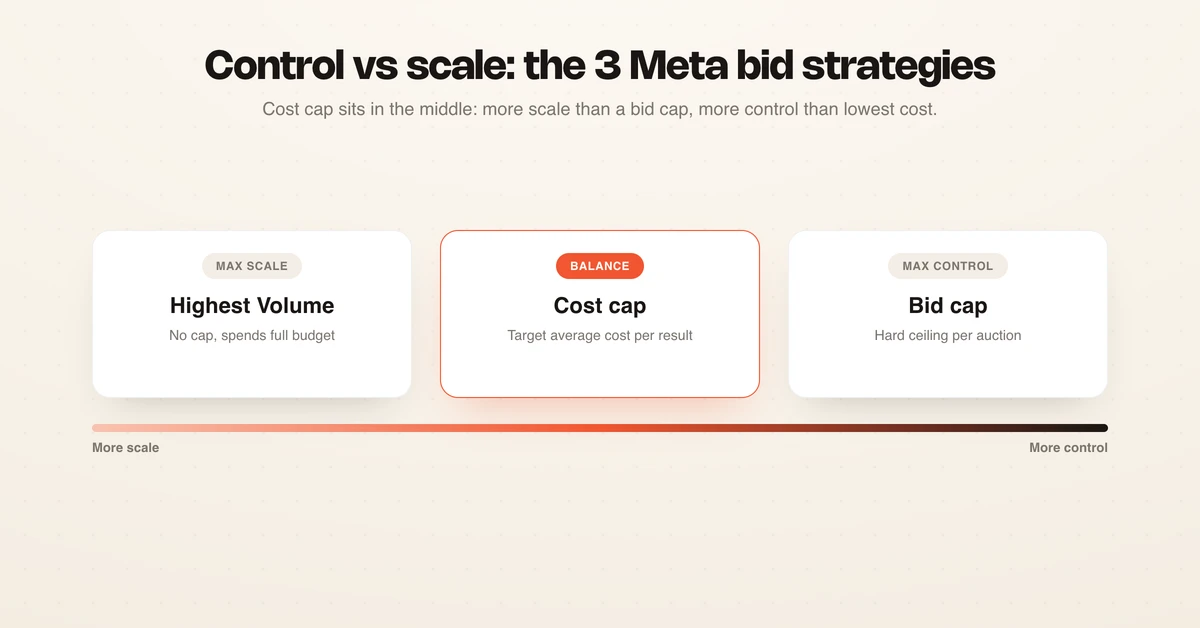
There are three bid strategies you are really choosing between, and cost cap sits in the middle on the control-versus-scale spectrum.
| Bid strategy | What it controls | Best for |
|---|---|---|
| Highest Volume (lowest cost) | Nothing, spends full budget | Learning, max volume, prospecting |
| Cost cap | Target average cost per result | Scaling a proven campaign profitably |
| Bid cap | Hard ceiling on every auction bid | Strict CPA control in competitive auctions |
When to use cost caps
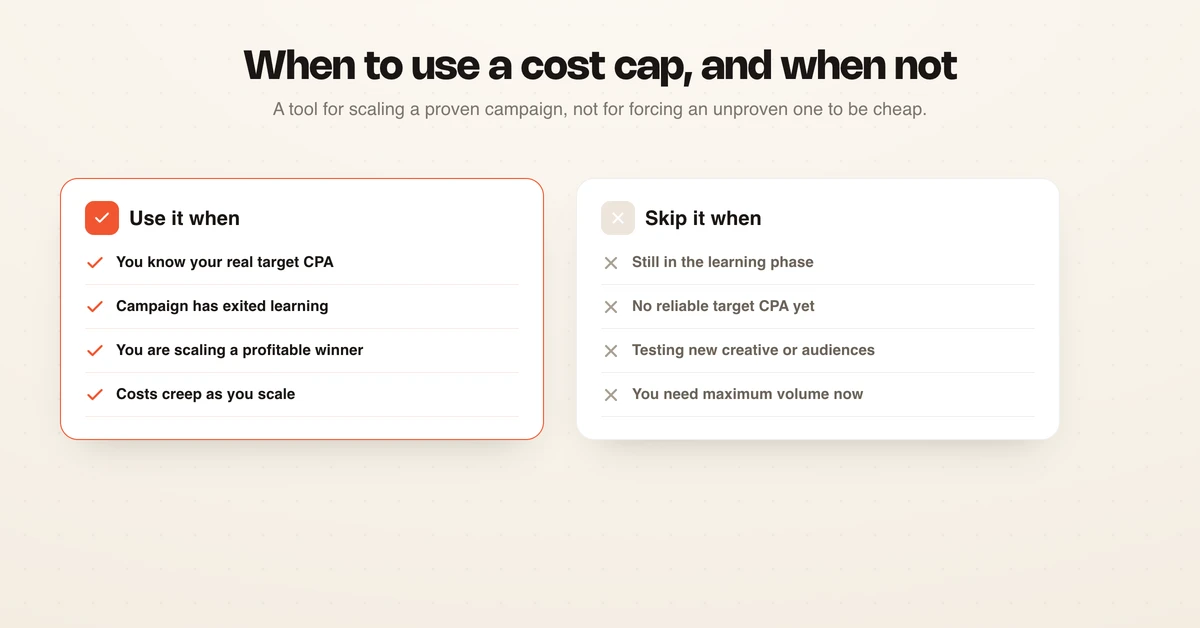
Use a cost cap when you have a proven campaign with a known, reliable target CPA and you want to scale spend without letting costs run away. Cost caps shine after a campaign has earned its baseline, not before.
The clearest green lights:
- You know your real target CPA. You have historical data showing the cost per result your margin can sustain, so the cap is grounded in reality, not a guess.
- The campaign has exited the learning phase. It has cleared roughly 50 conversions on Highest Volume, so the algorithm already understands your audience.
- You are scaling a winner. You want to push more budget into a profitable campaign while holding efficiency, which is exactly what a cost cap is built for.
- Costs creep as you scale. Without a cap, CPA often rises with spend; a cost cap holds the line so scaling stays profitable. (ROAS benchmarks by industry)
In these cases the cost cap does its job: it lets the algorithm keep finding conversions while refusing to chase the expensive ones that wreck your blended efficiency.
When NOT to use cost caps
Do not use a cost cap during the learning phase or on a campaign without a proven CPA, because the constraint starves the algorithm of the freedom it needs to learn. This is the single most common cost-cap mistake, and it is expensive.
The clearest red flags:
- You are still in the learning phase. Caps limit the algorithm's ability to explore bids and gather optimization events, which slows learning and can stall delivery entirely. Run Highest Volume until you exit learning.
- You do not know your target CPA yet. A cap pulled from thin air will be set too low (no delivery) or too high (no effect). Get a baseline first.
- You are testing new creative or audiences. Early-stage tests need volume and signal, not a cost constraint that throttles them. (The ultimate guide to creative testing)
- Your cap is set below market reality. If the target sits well under what the auction actually clears, Meta simply will not spend, and the campaign flatlines.
- You need maximum volume right now. For a launch or a time-boxed push where reach matters more than a precise CPA, Highest Volume delivers more.
The rule of thumb: a cost cap is a tool for protecting a proven thing at scale, not for forcing an unproven thing to be cheap.
Cost cap vs bid cap vs lowest cost: which to pick
Choose your bid strategy by how much control versus scale the situation demands. Lowest cost maximizes delivery, bid cap maximizes control, and cost cap balances the two.
| Situation | Use this |
|---|---|
| New campaign, still learning | Highest Volume (lowest cost) |
| Scaling a proven campaign on margin | Cost cap |
| Strict, predictable CPA in a competitive niche | Bid cap |
| Launch or max-reach push | Highest Volume |
| Protecting first-time CAC with a known ceiling | Bid cap |
Bid cap sets a hard maximum on every auction bid, which gives the tightest control but can leave budget unspent if the ceiling is too low. Cost cap gives up that per-auction precision for more delivery and easier scaling. Most accounts live on Highest Volume to learn, then graduate winners to cost cap, and reserve bid cap for genuinely competitive auctions where overspending on a single conversion is the real risk. (About bid cap, Meta Business Help)
How to set a cost cap correctly
Set a cost cap only after the campaign has exited learning, anchored to your real average CPA, and then give it time to equilibrate. Rushing any of these three steps is what makes cost caps fail.
- Exit the learning phase first. Run Highest Volume until the ad set clears about 50 conversions and your CPA stabilizes. Do not cap before this.
- Anchor the cap to history. Take your stable Lowest Cost average CPA and set the cap roughly 10 to 15% above it, so you keep delivery while tightening efficiency. Setting it at or below your average usually kills delivery.
- Give it 3 to 7 days. Changing bid strategy re-triggers a short learning period, so judge performance on a 7-day average, not day one. Cost caps need time to settle.
- Adjust gradually. If delivery is healthy and you want more efficiency, lower the cap in small steps. If delivery stalls, raise it. Big swings reset learning.
Pro tip: change one thing at a time. If you switch to a cost cap and refresh creative on the same day, you will not know which move caused the result.
What to expect after you set a cost cap
After you switch to a cost cap, expect a short dip before things settle, because the change re-triggers a brief learning period. Delivery often slows for a day or two as Meta recalibrates to the new constraint, then stabilizes if the cap has enough headroom.
Watch two things over the first week. Delivery tells you whether the cap is realistic: if spend collapses and stays down, the cap is too low for the auction to clear. Efficiency tells you whether it is working: a 7-day average CPA at or under target with healthy spend is the win condition. From there, if delivery is strong and CPA sits under target, lower the cap in small steps to tighten further; if spend stalls, raise it and let it settle before judging.
Common cost cap mistakes to avoid
Most cost-cap failures trace back to a few avoidable errors.
- Capping during learning. The top mistake. Let the campaign learn on Highest Volume first.
- Setting the cap too low. A cap under market rate means Meta will not spend. Anchor to real data and add headroom.
- Judging it on day one. Caps need 3 to 7 days to equilibrate. Read the 7-day average.
- Constant tweaking. Every change restarts learning. Adjust in small steps and wait.
- Ignoring blended results. A perfect in-platform CPA still has to map to real revenue. Cross-check against your attribution model.
How agents handle bidding and cost control
Cost caps demand constant judgment: when to apply one, where to set it, when to nudge it, and when to pull it during a downturn. That monitoring across many campaigns is exactly the repetitive work that drains a buyer's week.
This is where an agent helps. Hawky's Performance Agent optimizes Meta and Google campaigns against your KPI, ROAS, CAC, or contribution margin, with spend caps and guardrails built in, so cost control is enforced continuously rather than checked manually once a day.
It exits learning, holds efficiency as it scales, and logs every bid and budget move with its trigger, all one-click reversible. Configurable autonomy keeps you in command, from shadow mode to approval-gated to fully autonomous with a full audit trail. The cohort median across 200+ customers is +25% ROAS in the first 90 days.
Whether you manage caps by hand or with an agent, the principle holds: cost control is a tool for scaling a proven campaign, applied after learning, anchored to real data.
Frequently asked questions
What is a cost cap on Facebook ads?
A cost cap is a Meta bid strategy that sets a target average cost per result, and Meta optimizes to keep your average CPA near that number while spending as much budget as it profitably can. It controls the average outcome, not every individual auction, so some conversions come in above and some below the target. It is designed to scale a proven campaign while protecting efficiency.
What is the difference between a cost cap and a bid cap?
A cost cap targets your average cost per result and allows individual auction bids to flex around it, which favors delivery and scale. A bid cap sets a hard ceiling on every auction bid, which gives tighter control but can leave budget unspent if the ceiling is too low. Use cost cap to scale a winner profitably and bid cap when you need strict, predictable CPA in competitive auctions.
Should I use a cost cap during the learning phase?
No. Using a cost cap during the learning phase limits the algorithm's ability to explore bids and gather optimization events, which slows learning and can stall delivery. Run Highest Volume bidding until the ad set clears roughly 50 conversions and your CPA stabilizes, then introduce a cost cap to hold efficiency as you scale.
How do I set the right cost cap amount?
Anchor the cap to your stable Lowest Cost average CPA and set it about 10 to 15% above that figure, so you tighten efficiency without killing delivery. Setting the cap at or below your historical average usually causes Meta to stop spending. After setting it, judge performance on a 7-day average because a strategy change re-triggers a short learning period.
Why is my cost cap campaign not spending?
A cost cap campaign usually under-delivers because the cap is set below what the auction actually clears, so Meta cannot find results at that price. Raise the cap toward your real average CPA, confirm the campaign has exited learning, and make sure your audience is broad enough to give the algorithm room. Big, frequent cap changes also reset learning and suppress delivery.
Do cost caps work with Advantage+ campaigns?
Yes, cost caps are available as a bid strategy on Advantage+ shopping campaigns, and the same rules apply: let the campaign learn first, anchor the cap to a real CPA, and give it time to equilibrate. Because Advantage+ already automates much of delivery, many advertisers start on Highest Volume and only add a cost cap once they are scaling a proven account.
If watching every campaign to decide when to cap, where to set it, and when to adjust is eating your team's day, Hawky's Performance Agent is built for that job: it optimizes against your KPI with spend caps and guardrails, holding efficiency as it scales, with a full audit trail keeping you in command.
Ready to hire your first AI performance team? Book Demo