How to Master Meta's New Attribution Model: A Deep Dive into First-Party Data

Meta's attribution model in 2026 measures conversions using a default 7-day click and 1-day view window, with engagement now split into a separate 1-day engage-through category. Understanding how Meta attribution works, and feeding it clean first-party data, is what separates accurate reporting from guesswork in a post-iOS, post-cookie world.
Quick answer: Meta's default attribution setting is 7-day click, 1-day view. Since March 2026, only link clicks count as click-through conversions, while likes, shares, saves, and comments moved to a new 1-day engage-through window. The 7-day and 28-day view windows were removed from reporting in January 2026. To keep this model accurate, send first-party data through the Conversions API alongside the Meta Pixel and aim for a dataset quality score above 6 out of 10.
What the Meta attribution model is
The Meta attribution model is the set of rules Meta uses to decide which ad gets credit for a conversion and within what time frame. It connects a conversion event, such as a purchase or lead, back to the ad interaction that drove it, then reports that credit inside Ads Manager. An attribution model is the lens through which every ROAS and CPA number you read is calculated.
Attribution is not the same as the conversion happening. The conversion is the real-world action. Attribution is Meta's decision about whether that action falls inside a window it can claim. Two campaigns with identical real sales can report wildly different numbers if their attribution settings differ.
This matters because the model directly shapes how Meta's delivery algorithm optimizes. The events the model can see become the events the algorithm learns to chase. Starve it of signal and it optimizes blind, which is why first-party data and the attribution window are two halves of the same problem.
Meta ads attribution windows in 2026
Meta's default attribution window in 2026 is 7-day click and 1-day view, with a separate 1-day engage-through window for non-link interactions. The longer view windows that advertisers leaned on for years are gone from standard reporting, which changes how results should be read.
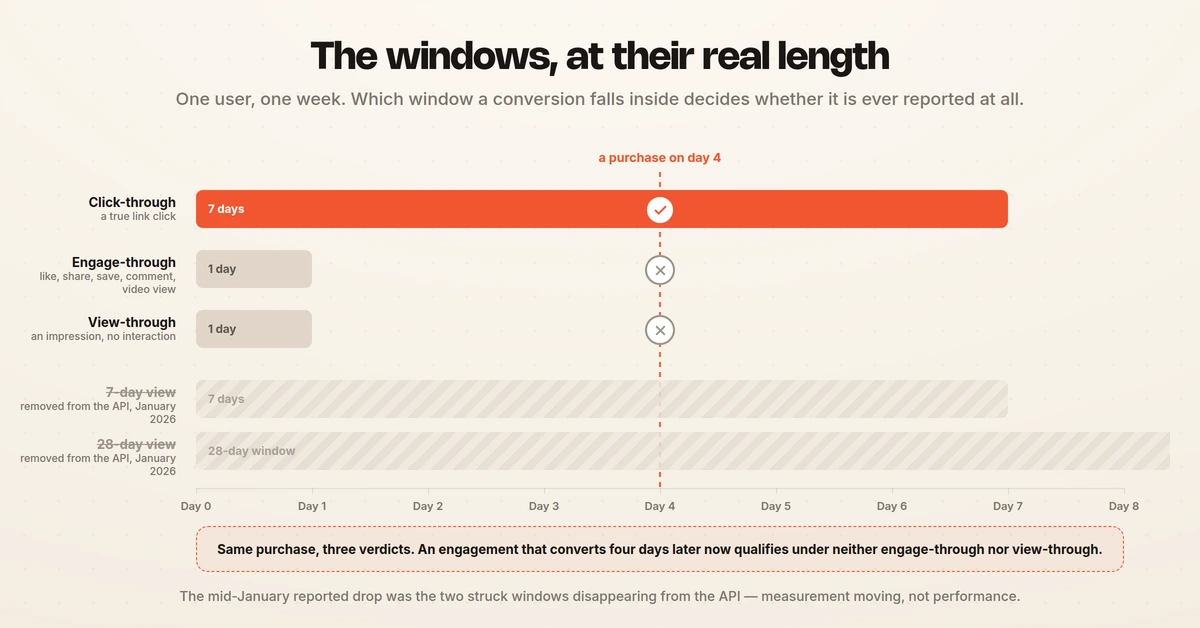
In January 2026, Meta removed the 7-day view and 28-day view options from the Ads Insights API. Conversions that previously counted within those longer view windows are no longer attributed, so many accounts saw a reported drop around mid-January that reflected measurement, not real performance. Then in March 2026, Meta restructured click attribution itself.
| Attribution type | What it credits | Window |
|---|---|---|
| Click-through | Conversions after a link click to a site, app, lead form, or shop | 7-day (default), 1-day optional |
| Engage-through | Conversions after likes, shares, saves, comments, or video views | 1-day |
| View-through | Conversions after an impression with no interaction | 1-day |
What changed with click-through attribution
Before March 2026, Meta counted likes, shares, saves, and comments as clicks. That inflated click-through conversions and created discrepancies with tools like Google Analytics. Now only true link clicks count as click-through, which gives a cleaner read on what your ads actually drive to a destination.
What engage-through attribution means
Engage-through is the renamed successor to engaged-view attribution, introduced in Meta's March 2026 attribution update. It captures conversions that follow a social interaction rather than a link click, and it carries a 1-day window. For Reels, Meta also shortened the engaged-view threshold from 10 seconds to 5 seconds, since a large share of Reels-driven purchases happen in the first few seconds.
The practical effect is a sharper but stricter model. An engagement that leads to a purchase four days later no longer qualifies under either click-through or engage-through, so total reported conversions can look lower even when sales hold steady. Read the trend, not the single number, and compare against your own back-end revenue.
How the Meta attribution model works under the hood
Meta attribution works by matching conversion events to ad interactions, then crediting the most recent qualifying touch inside the configured window. When deterministic signal is missing, Meta fills the gap with modeled conversions estimated by machine learning. The accuracy of both depends entirely on the quality of the data you send.
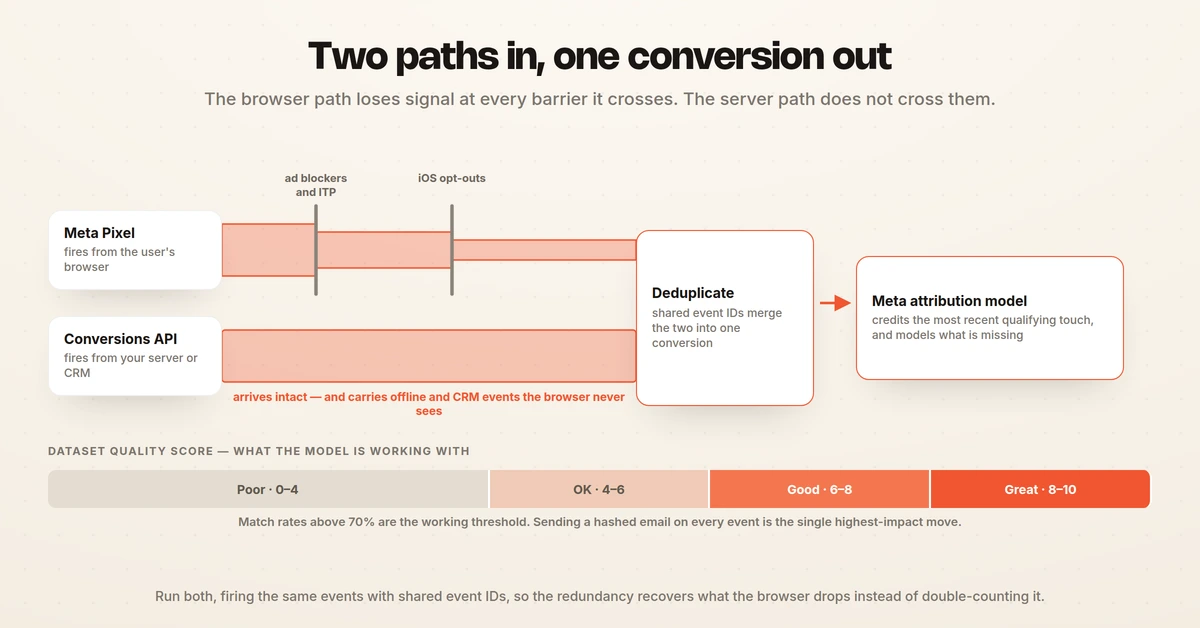
Two data paths feed the model. The browser-side Meta Pixel fires events from the user's device, and the server-side Conversions API sends events directly from your server or CRM. Since iOS App Tracking Transparency made tracking opt-in, pixel-only setups miss a meaningful share of real conversions, which is why server-side data is no longer optional.
| Capability | Meta Pixel | Conversions API |
|---|---|---|
| Where it runs | User's browser | Your server or CRM |
| Affected by ad blockers or ITP | Yes | No |
| Affected by iOS opt-outs | Heavily | Far less |
| Can send offline and CRM events | No | Yes |
| Best practice | Run both with event deduplication | Run both with event deduplication |
Meta's recommended setup is dual tracking: pixel and Conversions API firing the same events with shared event IDs so they deduplicate. That redundancy recovers conversions the browser loses and raises the signal the algorithm learns from. Apple documents the underlying constraint in its App Tracking Transparency framework, and Meta documents the server-side setup in its Conversions API reference.
Tying clean attribution to creative performance is where teams compound the gain. Hawky's Command Center pulls the events that actually attributed into one view, so the conversions feeding the algorithm and the conversions you report on stop drifting apart.
Why first-party data is the foundation of Meta attribution
First-party data is the most reliable input for the Meta attribution model because you own it, you collect it with consent, and it carries the identifiers Meta needs to match conversions to users. In a privacy-first environment, the strength of your first-party signal sets the ceiling on attribution accuracy.
Meta scores every dataset on a 0 to 10 scale through the Dataset Quality API: Poor under 4, OK from 4 to 5.9, Good from 6 to 7.9, and Great at 8 or above. Match rates above 70 percent are the working threshold, and the single highest-impact move is sending hashed email addresses with every event, which can lift event match quality by several points. The more clean identifiers you attach, the more conversions Meta can match and credit.
First-party data checklist for Meta
- Send hashed email on every event, then add phone, first and last name, city, and external ID where available.
- Run the Conversions API and the Pixel together with shared event IDs and deduplication.
- Import offline conversions such as in-store purchases, calls, and booked demos to train the algorithm on revenue, not proxies.
- Pass an external ID from your CRM to stitch repeat customers across sessions and devices.
- Build custom audiences and lookalikes from buyers and high-value segments rather than all traffic.
- Collect data through clear opt-in forms with a real value exchange, and honor consent end to end.
Where first-party data comes from
The richest sources are the touchpoints you already control: website and app activity such as add-to-cart and purchase events, CRM records of purchase history and loyalty status, email engagement, and account sign-ups. Each adds an identifier or a behavioral signal that raises match quality and feeds better modeled conversions when deterministic data is missing.
How to read Meta attribution against the bigger picture
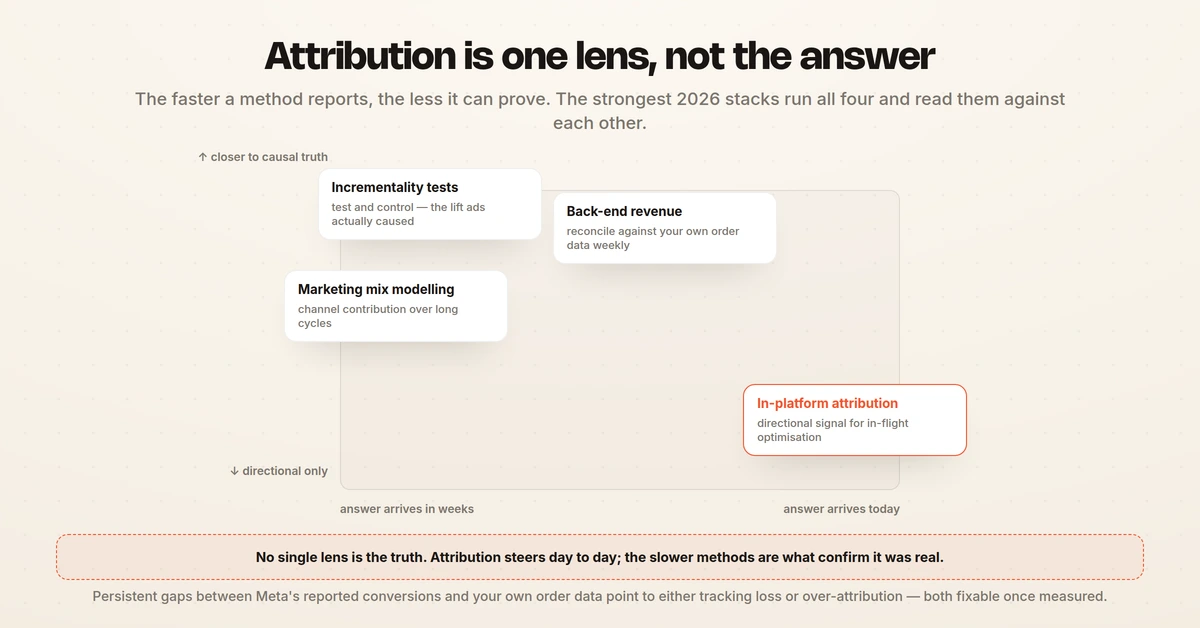
No single attribution model tells the whole truth, so the strongest 2026 measurement stacks pair Meta's in-platform attribution with independent validation. Attribution is the directional signal for in-flight optimization, while incrementality and modeling confirm what is actually incremental.
- Incrementality testing: Split audiences into test and control groups to measure the lift ads actually caused. Meta Conversion Lift and geo-based studies isolate true causal impact rather than correlated conversions.
- Marketing mix modeling: Open-source frameworks like Meta's Robyn use statistical analysis of spend and revenue over time to assess channel contribution, which is valuable for top-of-funnel and long purchase cycles the window cannot capture.
- Back-end revenue reconciliation: Compare Meta's reported conversions against your own order data weekly. Persistent gaps point to either tracking loss or over-attribution, and both are fixable once measured.
Cleaner attribution only pays off when it points back at creative. For the creative side of the same problem, Hawky's creative analysis scores the hook, visual, and CTA at the element level, so once your data is trustworthy you can act on which creative actually drives the attributed conversions. For a related diagnostic walkthrough, see why your Facebook ads are not converting, and for cost-side reporting see CPR in Meta ads.
Common Meta attribution mistakes to avoid
The most expensive attribution mistake in 2026 is comparing 2026 numbers to pre-January reports as if the windows never changed. Several traps recur across accounts.
- Treating the mid-January reported drop as a performance problem rather than the removal of 7-day and 28-day view windows.
- Running pixel-only tracking and accepting the iOS signal loss as normal.
- Optimizing for a shallow event like AddToCart while measuring success on Purchase, so the model learns the wrong goal.
- Sending events with thin identifiers, capping dataset quality below 6 and starving the match.
- Reading a single attribution number in isolation instead of triangulating with incrementality and back-end revenue.
Frequently asked questions
What is Meta's default attribution window in 2026? Meta's default attribution setting is 7-day click and 1-day view, with a separate 1-day engage-through window for non-link interactions. The 7-day view and 28-day view windows were removed from reporting in January 2026, so conversions that fell only inside those longer view periods are no longer attributed.
How does the Meta attribution model work? It matches conversion events to ad interactions and credits the most recent qualifying touch inside the configured window. When deterministic signal is missing, Meta estimates the gap with modeled conversions. Accuracy depends on the first-party data you send through the Pixel and Conversions API.
What is engage-through attribution? Engage-through is the renamed engaged-view category introduced in March 2026. It credits conversions that follow non-link interactions such as likes, shares, saves, comments, and video views, and it carries a 1-day window. Link clicks now count separately under click-through attribution.
Why did my Meta conversions drop in January 2026? Most accounts that saw a drop around mid-January were affected by the removal of the 7-day view and 28-day view windows, not by a real decline in sales. Conversions that previously counted within those longer view windows stopped being attributed. Compare against your own back-end revenue to confirm.
How does first-party data improve Meta attribution? First-party data carries the identifiers Meta needs to match conversions to users, which raises event match quality and dataset quality. Sending hashed email with every event, adding phone and external ID, and running the Conversions API alongside the Pixel are the highest-impact moves. Aim for a dataset quality score above 6 and a match rate over 70 percent.
Do I still need the Meta Pixel if I use the Conversions API? Yes. Meta recommends running both with shared event IDs so events deduplicate. The Pixel captures browser context the server cannot, and the Conversions API recovers conversions the browser loses to ad blockers and iOS opt-outs. Together they give the most complete signal.
The bottom line
Meta's attribution model in 2026 is sharper and stricter: shorter windows, link-only click credit, and a separate engage-through category mean the numbers only stay trustworthy when fed clean first-party data. Get the Conversions API, dataset quality, and consent foundations right, then read attribution alongside incrementality and back-end revenue rather than in isolation.
If your attribution signal and your creative decisions keep drifting apart, Hawky's Command Center is built for that job, tying the conversions the algorithm sees to the creative that earned them.
Ready to Stop Guessing and Start Winning with Creative Intelligence? Book a demo.