Mastering Marketing in 2026: AI Tools, Creative Trends, and the Human Touch
AI marketing in 2026 has moved from experiment to default, with creative quality and human judgment now deciding which campaigns scale. This guide covers the tools, the creative trends, and the human-in-the-loop balance that separate winners from the noise.
Quick answer: AI marketing in 2026 works best as a partnership, not a replacement. Use AI to handle research, production, reporting, and creative testing at scale, then keep humans in the loop for strategy, taste, and brand judgment. The teams winning right now are not the ones using the most AI tools. They are the ones who pair AI volume with creative intelligence and a clear point of view.
The state of AI marketing in 2026
AI is no longer a competitive edge in marketing. It is table stakes. According to HubSpot's State of Marketing research, the share of marketing teams using AI in some part of their workflow has climbed past 86 percent, up from roughly 41 percent two years earlier. The question for 2026 is not whether you use AI. It is how well you use it.
That shift changes where advantage comes from. When every competitor can generate copy, edit video, and build dashboards in minutes, the differentiator moves to the parts AI cannot fake on its own: original strategy, emotional resonance, and the judgment to know which AI output is actually good. The broader marketing statistics on AI adoption tell the same story, with creative and media production now among the most common AI use cases. Performance marketers who treat AI as a force multiplier for taste, not a substitute for it, are the ones pulling ahead.
This article covers three pillars shaping marketing success in 2026: the AI tools doing real work, the creative trends redefining campaigns, and the human roles that still drive strategy.
AI marketing tools in 2026, organized by job to be done
The most useful way to think about AI tools is not by feature list but by the job they do. A bloated stack of overlapping apps slows teams down. A tight stack mapped to specific jobs compounds. The table below groups the categories performance marketers actually rely on in 2026.
| Job to be done | What AI handles | Example tool types |
|---|---|---|
| Creative intelligence | Element-level analysis, fatigue prediction, what to scale | Hawky, creative analytics platforms |
| Creative production | Static ads, short-form video, image variations | Generative image and video tools |
| Copy and content | Ad copy, landing pages, SEO drafts, email | LLM writing assistants |
| Research and analysis | Competitor scans, sentiment, market data | AI research agents |
| Workflow automation | Lead syncing, reporting, alerts, hand-offs | No-code automation platforms |
| Personalization | Dynamic creative, audience-level swaps | DCO and predictive tools |
The single most valuable category for paid teams is creative intelligence, because creative is now the biggest driver of media performance. Generic generation tools make more ads. Creative intelligence tells you which of those ads will work and why. Hawky's AI creative generation sits in the first two rows of that table, producing on-brand variations and then scoring them on the hooks, narrative structure, and on-screen elements that move results.
What to automate and what to keep human
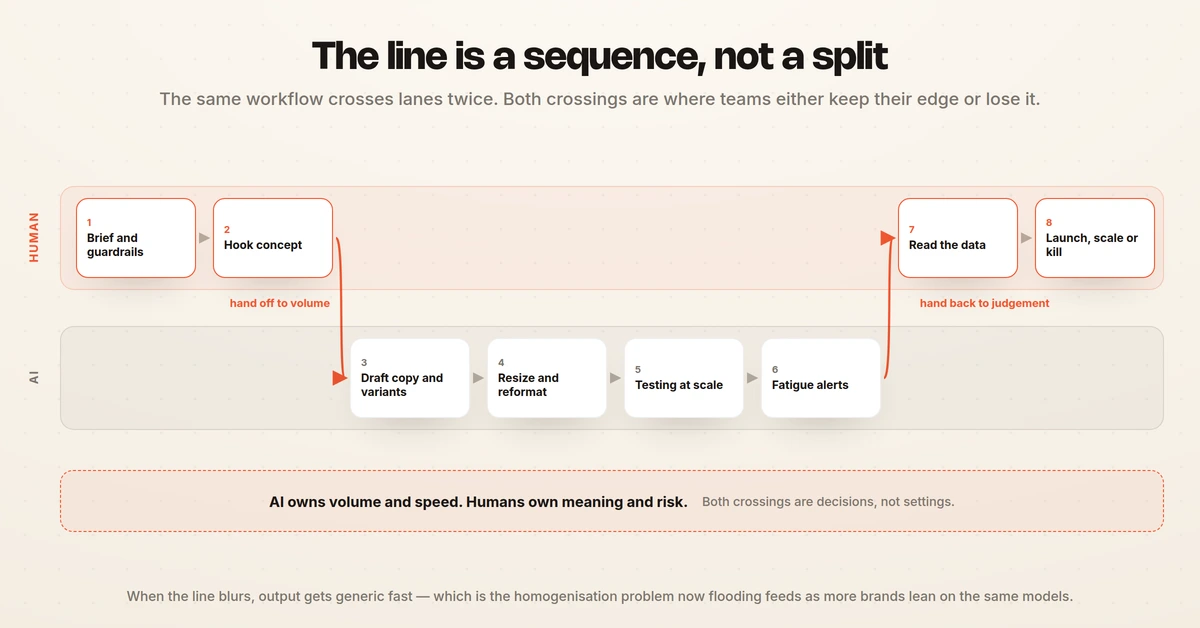
Not every job belongs to AI. The fastest teams draw a clear line. Automate the repetitive, high-volume, and easily measured work. Keep humans on the calls that require taste, context, and accountability.
| Hand to AI | Keep with humans |
|---|---|
| First-draft copy and variations | Brand voice and final approval |
| Reporting and dashboarding | Strategic interpretation of the data |
| Creative testing at scale | The creative idea and the hook concept |
| Background removal and resizing | Art direction and emotional intent |
| Competitor data collection | Positioning and the response to it |
| Fatigue detection and alerts | The decision on what to launch next |
The pattern is consistent. AI owns volume and speed. Humans own meaning and risk. When that line blurs, output gets generic fast, which is exactly the homogenization problem flooding feeds as more brands lean on the same models.
Creative trends shaping 2026 campaigns
Creative is the most underpriced lever in paid media, and 2026 rewards teams that ship more of it, faster, without losing distinctiveness. The trends below are where attention and conversions are concentrating this year. Think with Google's guidance on marketing in the AI era points to the same direction: video and personalization, accelerated by generative tools.
| Trend | Why it matters in 2026 | What to do about it |
|---|---|---|
| Short-form video first | Short-form dominates mobile attention and now drives direct response | Hook in three seconds, one message, 15 to 60 seconds |
| AI-accelerated production | Generative video and image cut production cost and time sharply | Generate many variations, then filter on data |
| Lo-fi and UGC-style | Raw, native creative outperforms the polished "ad look" | Mix creator-style assets into every test |
| Dynamic personalization | Creative adapts to location, behavior, and funnel stage | Use DCO to swap hooks, offers, and visuals |
| Distinctiveness over volume | Sameness is the new risk as everyone uses the same models | Anchor every asset to a sharp point of view |
Short-form video keeps winning
Short-form video remains the dominant format for paid attention in 2026, and generative tools have removed the production bottleneck that used to cap output. Ad platforms now build AI video generation directly into their interfaces, so a single brief can produce dozens of cuts. The winning formula has not changed: a hook inside the first three seconds, a single clear message, and a runtime built for the feed.
AI-accelerated production, human-filtered output
The cost of making a creative variation has collapsed. The cost of making a good one has not. That is the central tension of 2026. Teams that generate fifty variations and ship them all flood their accounts with mediocrity and trigger creative fatigue faster. Teams that generate fifty and launch the five their data predicts will win get the volume benefit without the noise.
Lo-fi authenticity and UGC
Raw, creator-style production continues to outperform glossy brand films on short-form platforms. The reason is trust. A polished ad signals "advertisement" and raises a viewer's guard. A native-looking clip earns attention before the brand has to ask for it. The smart play in 2026 is not choosing between AI production and authentic UGC. It is using AI to scale and test both, then letting performance data decide the mix.
The human touch: roles that still drive strategy
Even with AI embedded in every workflow, the human role is not shrinking. It is shifting up the value chain. Creative directors and strategists are becoming the people who set the brief, define the limits, and judge the output, the directors of an AI-assisted production line rather than the line itself.
What the human-in-the-loop model actually means
Human-in-the-loop marketing means AI does the work and a human owns the decision. The model is not about reviewing every asset by hand. It is about placing human judgment at the points that carry the most risk and the most upside: the strategic brief, the brand voice, the final go or no-go on what gets spend behind it.
The core responsibilities for creative leaders in 2026:
- Translating performance data into creative ideas that match growth goals
- Setting the brief, the guardrails, and the prompts that steer AI output
- Maintaining brand consistency across channels while adapting to local context
- Making the final call on what to launch, scale, or kill
The essential skills behind those responsibilities:
- Strategic taste: knowing which AI output is genuinely good, not just usable
- Clear communication: bridging creative vision and business objectives
- Agility: adapting fast as platforms and audience behavior shift
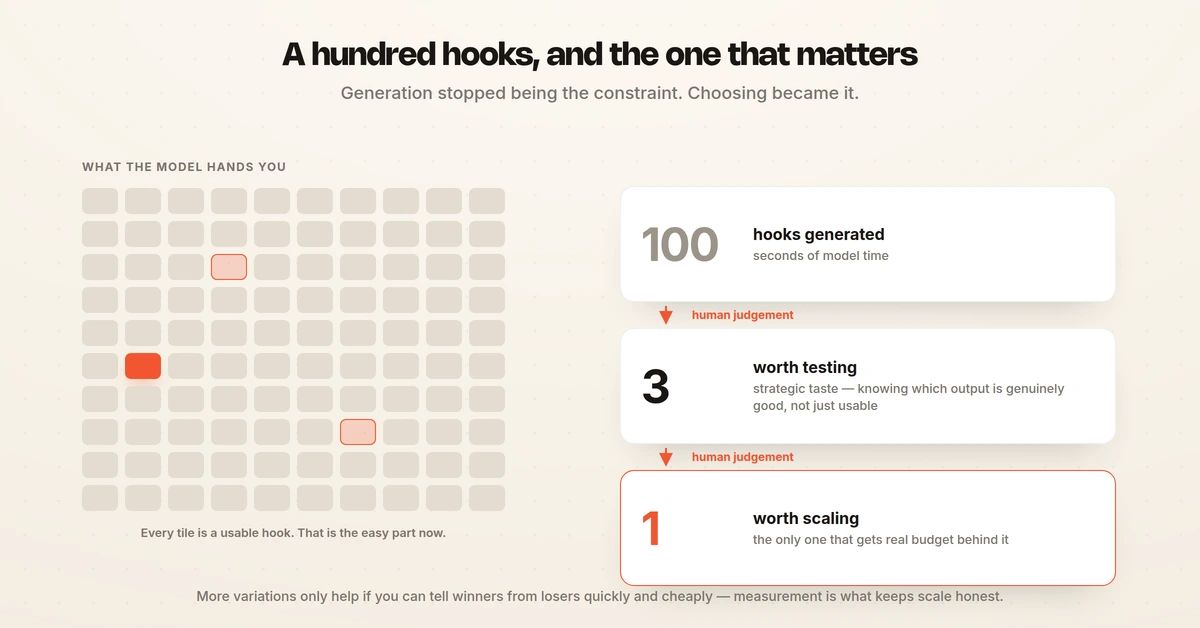
This is where AI volume and human judgment meet. AI can produce a hundred hooks. A strong creative leader knows the three worth testing and the one worth scaling. Search Engine Journal's coverage of generative AI in marketing keeps returning to the same conclusion: the strongest results come from hybrid systems where AI handles efficiency and humans inject empathy and lived experience.
How to measure creative in an AI-first workflow
When AI lets you produce creative at scale, measurement stops being optional and becomes the constraint that keeps the system honest. More variations only help if you can tell winners from losers quickly and cheaply. The teams getting ROAS gains from AI are the ones who measure creative as rigorously as they measure spend.
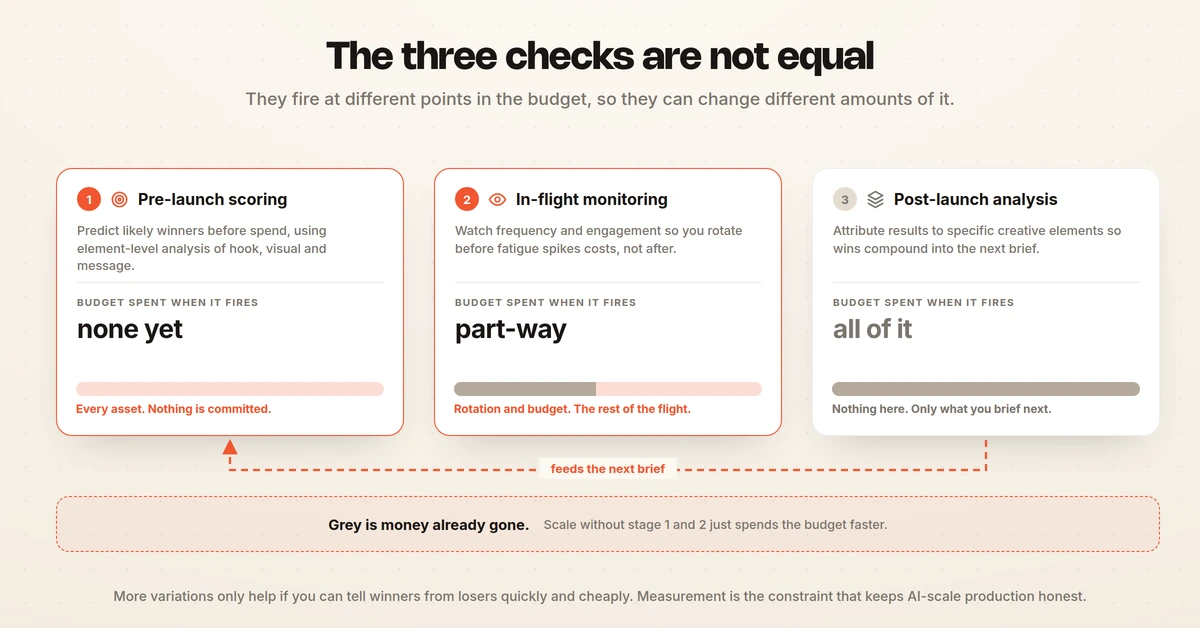
Three approaches anchor a sound creative measurement loop:
- Pre-launch scoring. Predict likely winners before spend, using element-level analysis of hook, visual, and message.
- In-flight monitoring. Watch frequency and engagement so you rotate before fatigue spikes costs, not after.
- Post-launch analysis. Attribute results to specific creative elements so wins compound into the next brief.
This is the job Hawky's creative analysis and Command Center are built for: scoring assets at the element level, predicting fatigue early, and ranking the next fix by expected impact. The point of AI scale is wasted without a system that tells you which of the scaled assets actually earned their spend.
For the deeper foundation behind this approach, see what is creative intelligence, to compare the category of tools doing this work, see the best creative intelligence platforms, and to understand how this differs from dynamic personalization, see creative intelligence vs DCO.
Building your 2026 AI marketing stack
A good AI stack is small, mapped to jobs, and connected. Start with the job that drives the most value, which for paid teams is almost always creative. Add tools only where they replace real manual hours or unlock a capability you did not have.
A practical sequence for 2026:
- Anchor on creative intelligence. It governs the single biggest performance lever, so it earns the center of the stack.
- Add production capacity. Generative image and video tools to feed testing volume.
- Layer automation. No-code workflow tools to remove reporting and hand-off drudgery.
- Connect the pieces. Pipe AI output into your ad platforms, CRM, and analytics so nothing lives in a silo.
- Keep a human gate. Put a person on brief, brand voice, and final approval at every stage.
The goal is not the most tools. It is the tightest loop from idea to live creative to measured result, with judgment at the points that matter.
Frequently asked questions
What are the best AI marketing tools in 2026? The best AI marketing tools in 2026 are the ones mapped to a specific job rather than a long feature list. The most valuable category for paid teams is creative intelligence, which scores ads at the element level and predicts fatigue, because creative is the biggest driver of media performance. Around it, most teams add generative production tools, an LLM writing assistant, and a no-code automation platform, all connected to their ad platforms and CRM.
Will AI replace marketers in 2026? No. AI is replacing repetitive tasks, not marketers. In 2026 the human role shifts up the value chain to strategy, brand voice, taste, and the final decision on what to launch. AI owns volume and speed, while humans own meaning, judgment, and accountability. The marketers at risk are the ones who only do work AI now does for free.
What does human-in-the-loop marketing mean? Human-in-the-loop marketing means AI handles the production and analysis while a human owns the decision. It places human judgment at the highest-risk and highest-upside points: the strategic brief, the brand voice, and the go or no-go on spend. The goal is not to review every asset by hand but to keep accountability and taste with a person, not a model.
What creative trends matter most for performance marketers in 2026? The trends that matter most in 2026 are short-form video as the dominant paid format, AI-accelerated production paired with data-based filtering, lo-fi and UGC-style creative that outperforms polished ads on social, and dynamic personalization that adapts creative to the viewer. Cutting across all of them is distinctiveness, since sameness is the new risk as more brands use the same generative models.
How do you measure creative when AI produces so many variations? Measure creative in a loop: score variations before launch to predict winners, monitor frequency and engagement in flight to rotate before fatigue, and attribute results to specific elements after launch so wins compound. Element-level analysis is what makes AI-scale production safe, because it separates the variations worth spend from the ones quietly draining it.
How much of marketing should be automated with AI? Automate the repetitive, high-volume, easily measured work: first drafts, reporting, creative testing, resizing, and data collection. Keep humans on brand voice, strategic interpretation, the creative idea, and the decision on what to launch. A useful rule is to hand AI the volume and speed, and keep the meaning and risk with people.
The bottom line
AI marketing in 2026 is not a contest of who deploys the most tools. It is a contest of who pairs AI volume with sharp human judgment and rigorous creative measurement. Use AI to research, produce, and test at scale, then keep people on strategy, taste, and the final call. If you need to know which of your AI-generated creatives will actually win before you spend on them, Hawky's creative analysis is built for that job.
Ready to Stop Guessing and Start Winning with Creative Intelligence? Book a demo.