Meta Ads updates 2026 mark the year the platform finished turning paid social into an AI-run auction, where automated delivery, generative creative, and new measurement rules replaced most of the manual controls advertisers leaned on for a decade.
Last updated: July 2026
Meta shipped changes across five areas this year: Advantage+ automation, the Andromeda and GEM delivery engines, generative creative tools, measurement and attribution, and targeting and policy. Some arrived as quiet defaults inside Ads Manager, others as public statements from Meta's engineering team and its Cannes Lions stage. This roundup covers confirmed changes from late 2025 through mid-2026, each with a source and an approximate date. Because Facebook and Instagram run on one ad system, these Facebook ads updates 2026 apply across both platforms.
In this guide:
- The AI automation shift (Advantage+ as the default)
- Andromeda and GEM (the delivery engines)
- New creative and generative AI tools
- Measurement and attribution changes
- Targeting changes
- Policy updates and deprecations
Summary of Meta Ads updates in 2026
| Update | What changed | Effective date/quarter | Source |
|---|---|---|---|
| Andromeda retrieval engine | New AI ad-retrieval engine on NVIDIA Grace Hopper; +6% recall, +8% ad quality reported | Announced Dec 2024, rollout through 2025 | Meta Engineering |
| GEM ranking model | Generative Ads Recommendation Model; +5% Instagram conversions, +3% Facebook Feed reported | Detailed Nov 2025 | Meta Engineering |
| Advantage+ as default | Sales, App, and Leads default to Advantage+; manual and AI flows merged into one | 2025 rollout, unified early 2026 | Jon Loomer |
| Generative creative suite | Image-to-video, AI music, AI dubbing, virtual try-on, business AI agents | Previewed Jun 2025, expanding 2026 | Social Media Today |
| Advantage+ Audience default | Detailed targeting inputs treated as suggestions, not hard constraints | Early 2026 | Jon Loomer |
| Fully automated ads goal | Stated goal: AI creates the ad, picks the audience, sets the budget | Targeted end of 2026 | WSJ report |
| Live Video Ads, Brand Memory | Interactive live-broadcast ad units; generative creative trained on a brand's library | Reported mid-2026 | Common Thread Co |
| Special Ad Category enforcement | Tighter multimodal HEC detection; expanded identity verification | Rolling through 2026 | Common Thread Co |
What are the latest Meta Ads updates in 2026?
The latest Meta Ads updates in 2026 center on one theme: Meta moved automation from an option to the default, and rebuilt delivery around two AI systems named Andromeda and GEM. Advertisers now hand Meta a budget, a KPI, and creative, and the system decides who sees which ad and when. Manual control over placements, audiences, and creative rotation has narrowed across the Sales, App, and Leads objectives.
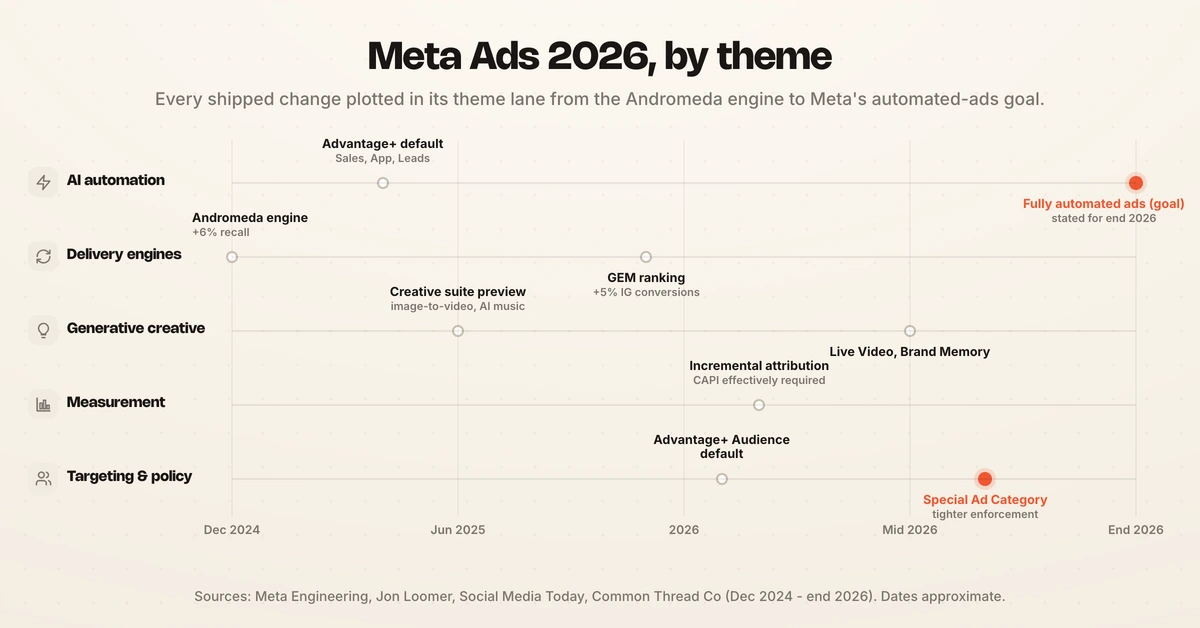
The pace is fast, and most Meta ads news 2026 coverage has tracked the same AI shift. Meta's engineering team published the technical detail behind its new ad models in late 2025, and the company used its Cannes Lions stage in June 2025 to preview a generative creative suite that kept growing through 2026. The sections below group the confirmed changes by theme, so you can see what actually shipped versus what Meta has only stated as a goal.
[DIAGRAM: 2026 Meta Ads change timeline]
Meta Ads updates 2026: the AI automation shift
Advantage+ is now the default way to run Meta ads, not a separate product you opt into. Meta began defaulting Sales, App, and Leads campaigns to Advantage+ in 2025, replacing manual placement, audience, and creative controls with single-step Advantage+ settings, per Jon Loomer's changelog. By early 2026, Meta had merged the manual and Advantage+ creation flows into one interface, so AI optimization applies to nearly every new campaign across the standard Facebook ad objectives.
The longer arc is full automation. In mid-2025, Meta signaled a goal to let advertisers generate an entire ad from a product image and a budget, with the system producing visuals, video, and copy and choosing the audience, targeted for the end of 2026, per a Wall Street Journal report on the plan. Mark Zuckerberg framed the vision as a business stating an objective and a cost per result, connecting a bank account, and letting Meta handle the rest.
That level of automation raises an obvious question: who keeps control. Autonomous delivery only works for a performance team when it comes with guardrails, spend caps, and an audit trail of every change. Hawky's Performance Agent is built on that principle, pairing autonomous media buying with configurable approval gates so humans stay in command of the KPI. New to the platform mechanics behind these changes, start with Hawky's guide on how to run Facebook ads and its primer on Facebook ads automation.
Andromeda and GEM: the AI engines behind 2026 delivery
Two AI systems now decide which ads Meta shows and which one wins each auction. Andromeda is Meta's ad-retrieval engine, built on the NVIDIA Grace Hopper Superchip with model complexity Meta describes as roughly 10,000 times higher than the system it replaced. Meta's engineering team reported a +6% recall improvement and +8% ad-quality improvement on tested segments, with the global rollout completing through 2025, per the Meta Engineering blog.
GEM, the Generative Ads Recommendation Model, handles ranking. Meta detailed GEM in November 2025 and reported a +5% increase in ad conversions on Instagram and +3% on Facebook Feed, describing it as about four times more efficient at turning data and compute into performance than its previous ranking models, per Meta Engineering. Together, the two systems explain why detailed targeting matters less and creative variety matters more in 2026.
| Engine | Its job | Reported gain | Detailed |
|---|---|---|---|
| Andromeda | Ad retrieval: which ads are eligible to show a user | +6% recall, +8% ad quality | Dec 2024 |
| GEM | Ranking: which eligible ad wins the auction | +5% Instagram conversions, +3% Facebook Feed | Nov 2025 |
For a plain-language primer on the terms in this section, Hawky's glossary defines the core delivery and measurement concepts.
New creative and generative AI tools
Meta's biggest 2026 push is generative creative built directly into Ads Manager. Most of the year's new Meta ads features sit in this suite. At Cannes Lions in June 2025, Meta previewed tools to turn product images into multi-scene video ads, add AI-generated music, and dub creative into other languages for multilingual audiences, per Social Media Today. The suite also included virtual try-on for apparel, business AI chat agents inside ad formats, and custom branding controls for AI-generated images.
Meta kept shipping through late 2025 and into 2026. In October 2025, it launched a business AI agent that learns from a brand's posts, ads, and website to recommend products across Facebook, Instagram, and messaging, per Marketing Dive. Industry trackers reported further 2026 additions, including Live Video Ads for interactive live broadcasts and Brand Memory, which trains generative creative on a brand's existing ad library, per Common Thread Co.
Confirmed generative tools in the 2026 suite include:
- Image-to-video ads built from product photos
- AI-generated music and AI dubbing for translation
- Virtual try-on for apparel using generative models
- Business AI agents inside ads and messaging threads
- Brand Memory for on-brand generative variations
Volume is now the creative strategy, because the delivery engines reward more distinct variations rather than one hero asset. More variations also blunt creative fatigue, since fresh assets rotate in before CTR decays and CPM climbs. Producing that volume on-brand is where an autonomous creative pipeline, kept on a seat-level approval gate, earns its keep. For a deeper walkthrough of squeezing more from each asset, see Hawky's guide to Facebook ads optimization.
Measurement and attribution changes
Measurement moved toward incremental, model-based attribution in 2026. Meta expanded incremental attribution, which uses holdout testing and machine learning to estimate only the conversions an ad actually caused rather than every conversion inside the window, building on a rollout that began in 2025, per Jon Loomer. The Conversions API also became effectively mandatory for accurate optimization, since browser-pixel signal alone captures a shrinking share of conversions.
Advertisers also reported changes to how Meta counts engagement inside its attribution windows during early 2026, including a new engagement-based attribution category. These reports come from practitioner coverage rather than a single Meta press release, so treat the specifics as evolving and confirm the settings inside your own Ads Manager. For background on how Meta's model shifted, see Hawky's explainer on the new Meta attribution model.
Targeting changes
Detailed targeting is now a suggestion, not a rule. As of early 2026, Advantage+ Audience is the default, and Meta treats interest and demographic inputs as signals that inform where delivery starts, then expands beyond them when the system predicts better performance, per Jon Loomer's targeting guide. Location and a minimum age remain the hard constraints.
Meta also consolidated many narrow interest categories into broader groups starting in mid-2025, reducing the granularity of manual targeting. The practical takeaway lines up with the Andromeda shift: creative and offer now do the targeting work that detailed interests used to. To judge where your results should land after these changes, compare against Hawky's Facebook ads benchmarks.
Policy updates and deprecations
Meta tightened enforcement and verification in 2026. Coverage of the platform's policy direction points to stricter Special Ad Category enforcement, with multimodal detection that flags housing, employment, and credit imagery automatically, plus expanded identity verification that reaches more advertisers beyond political ads. European advertisers also saw targeting and fee adjustments tied to Digital Markets Act compliance, per Common Thread Co.
Because policy details vary by region and account, treat these as directional and verify the current rules for your categories in Meta's Help Center before launching. Compliance mistakes surface faster under automated review now, which raises the cost of a missed disclosure or a restricted claim.
What the Meta Ads updates 2026 mean for performance teams
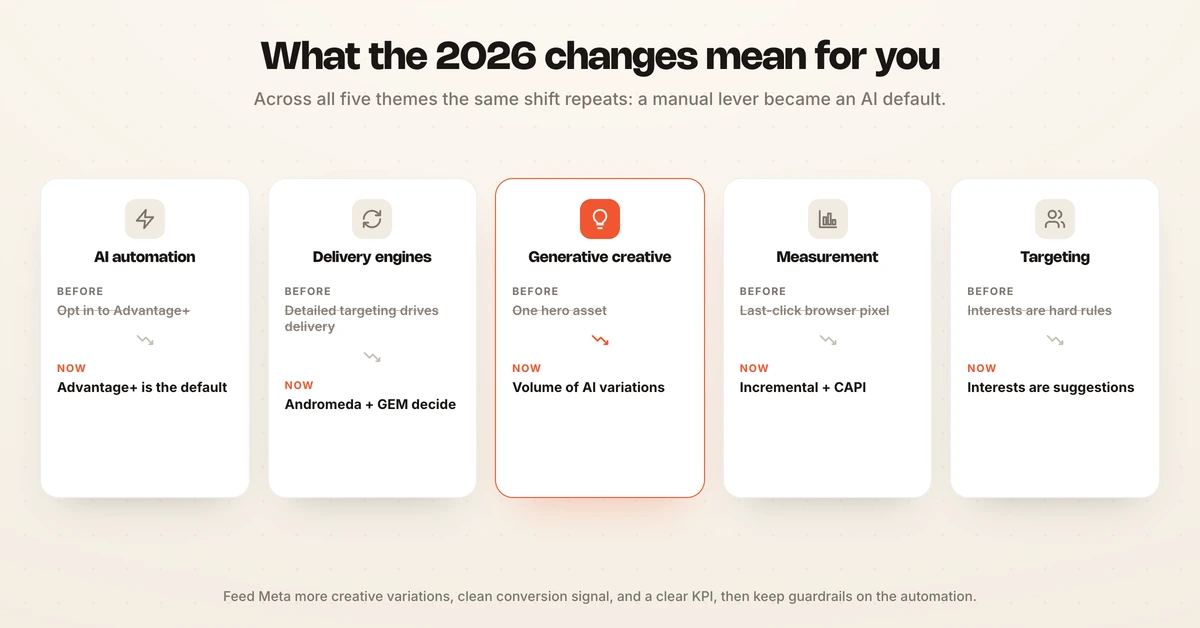
The through-line across every 2026 change is the same: Meta rewards teams that feed the system strong creative volume, clean conversion signal, and a clear KPI, then let automated delivery handle the pacing. Manual levers like placement control and detailed interest targeting matter less each quarter, while creative testing velocity and measurement hygiene matter more. Teams still running legacy manual structures are competing against accounts that already adapted.
This is where an always-on operator helps. Hawky's Performance Agent plans, launches, and optimizes Meta campaigns against a KPI around the clock, logging every move with trigger data and a confidence score and keeping each action one-click reversible. It runs alongside a Command Center where humans set guardrails and approve or roll back changes, so autonomy stays trustable rather than reckless. For pricing tied to outcomes rather than seats, see Hawky's pricing.
[DIAGRAM: Five themes of Meta Ads 2026 updates]
Frequently asked questions
What are the latest Meta Ads updates?
The latest Meta Ads updates in 2026 include Advantage+ becoming the default campaign type, the Andromeda retrieval engine and GEM ranking model powering delivery, a generative creative suite (image-to-video, AI music, dubbing, virtual try-on), a shift to incremental attribution, and Advantage+ Audience treating detailed targeting as suggestions rather than rules.
What is the Meta Andromeda update?
Andromeda is Meta's AI ad-retrieval engine, announced in December 2024 and rolled out through 2025. Built on NVIDIA Grace Hopper hardware, Meta reported a +6% recall and +8% ad-quality improvement on tested segments. It decides which ads are eligible to show a user, which shifts emphasis from precise targeting toward creative relevance.
What is Meta GEM?
GEM, the Generative Ads Recommendation Model, is Meta's foundation model for ad ranking, detailed by its engineering team in November 2025. Meta reported a +5% increase in ad conversions on Instagram and +3% on Facebook Feed, and described GEM as about four times more efficient than its previous ranking models.
Is Advantage+ now required on Meta?
Advantage+ is the default for Sales, App, and Leads campaigns, and Meta merged manual and Advantage+ creation into one flow by early 2026. Advertisers keep some controls, but placements, audiences, and creative optimization now default to Meta's AI. Meta has stated a goal of fully automated ad creation and targeting by the end of 2026.
What creative AI tools did Meta launch for ads?
Meta's generative creative suite, previewed at Cannes Lions in 2025 and expanded through 2026, includes image-to-video ads, AI-generated music, AI dubbing for translation, virtual try-on for apparel, business AI chat agents, and Brand Memory for on-brand variations trained on a brand's ad library.
How should advertisers adapt to the 2026 Meta Ads changes?
Feed Meta more distinct creative variations, install the Conversions API for complete signal, set a clear KPI, and lean on Advantage+ defaults while using guardrails and incremental measurement to verify results. Manual targeting and placement control matter less than creative volume and clean measurement.
If keeping up with Meta's constant changes while still hitting ROAS is stretching your team thin, Hawky's Performance Agent is built for that job.
Ready to hire your first AI performance team? Book Demo