Facebook Ads Optimization: The Complete Playbook to Improve Performance and Lower Costs
Facebook ads optimization is the ongoing work of tightening account structure, audiences, creative, the learning phase, and budget allocation so every dollar buys more conversions at a lower cost. It is not a one-time setup. It is a loop you run every week: read what the auction is telling you, cut what is wasting spend, feed budget to what is working, and replace creative before it fatigues.
Most guides treat this as a checklist you complete once. In practice, the levers move constantly, and the accounts that win are the ones where someone (or something) works them every day.
The Facebook ads optimization levers, ranked
Before you touch a single setting, know which levers actually move performance and in what order. Fixing them out of sequence wastes effort, because structure and audience decide how much signal every downstream test gets.
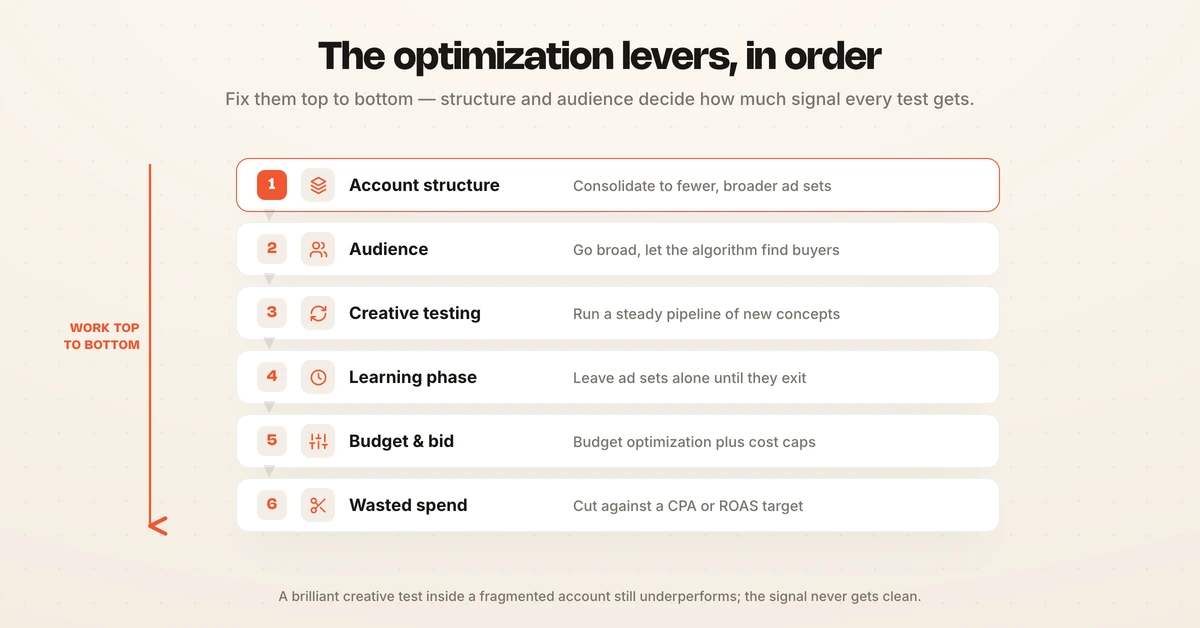
| Lever | What it controls | Biggest mistake | First move |
|---|---|---|---|
| Account structure | How signal concentrates | Too many tiny ad sets | Consolidate to fewer, broader ad sets |
| Audience | Auction inventory available | Over-narrow targeting | Go broad, let the algorithm find buyers |
| Creative testing | What the auction rewards | Testing one ad at a time | Run a steady pipeline of new concepts |
| Learning phase | Delivery stability | Editing mid-learning | Leave ad sets alone until they exit |
| Budget and bid | Where money flows | Manual rebalancing | Use budget optimization plus cost caps |
| Wasted spend | Your cost floor | Leaving losers on | Cut against a CPA or ROAS target |
Work top to bottom. A brilliant creative test inside a fragmented account that never exits learning will still underperform, because the algorithm never gets enough clean signal to optimize.
Campaign structure: consolidate for signal
The single most common structural error is too many ad sets, each with its own tiny budget, splitting your conversions into pieces too small for the algorithm to learn from. Meta's delivery system optimizes per ad set, so ten ad sets with five conversions each is a far worse position than two ad sets with twenty-five each.
Consolidate. Fewer, broader ad sets pool your conversion events, which helps each one reach the volume it needs to exit the learning phase and stabilize. This is also why Advantage+ shopping campaigns tend to stabilize in practice: they consolidate signal across a broad audience by design rather than asking you to slice it manually.
A clean starting structure is one campaign per objective, a small number of ad sets, and multiple creatives per ad set. Resist the urge to build a new ad set for every audience idea. Test audiences through creative and messaging inside a consolidated structure instead.
Audience: go broad and let the algorithm work
Narrow targeting felt precise in the era of detailed interest stacks. Today it mostly starves the auction. When you hand Meta a tiny audience, you shrink the inventory it can bid on, which drives up your CPM and gives the model fewer people to learn from.
Broad targeting plus a strong conversion signal now outperforms manual interest stacking in most accounts. Meta's Advantage+ audience options are built for this, letting delivery expand beyond your defined parameters to find users likely to convert (Meta Business Help Center). Your creative and your offer do the targeting work that interests used to do.
Keep your custom audiences for retargeting and exclusions, where intent is already established. For prospecting, give the algorithm room. The pixel and Conversions API signal is what steers delivery, so invest there before you invest in audience granularity.
Creative testing and fatigue
Creative is the variable that moves results most, and it is the one that decays fastest. A winning ad does not stay a winner. After a user sees an ad around four times, click-through rate drops and cost per click rises (Search Engine Land).
The fix is a pipeline, not a hero ad. Ship new concepts on a schedule so you always have a fresh challenger ready when the incumbent fades. Use structured A/B testing to isolate one variable at a time (hook, format, offer) so you learn why something won, not just that it did.
Watch for creative fatigue before it wrecks your CPA. The reliable signals are frequency climbing past 3.0, CTR falling 10 to 15 percent week over week, and CPM rising as relevance slips. For active prospecting, plan to refresh every 10 to 14 days or whenever frequency exceeds 3.0, whichever comes first, since Reels fatigue faster than static feed images (AdStellar). Ignore the signs and CPA can climb roughly 40 percent inside two weeks.
The learning phase, protected
Every ad set re-enters the learning phase after a significant edit, and during learning your delivery is unstable and your costs are less predictable. Meta's guidance is that an ad set needs roughly 50 optimization events within a 7-day window to exit learning, though Purchase and App Install objectives can stabilize on fewer (Meta, via Modern Marketing Institute).
Two rules protect the phase. First, do not make major edits (budget swings above 20 percent, new creative, targeting changes) while an ad set is learning, because each one resets the clock. Second, make sure your budget and structure can actually produce 50 conversions a week; if an ad set cannot hit that volume, consolidate it into one that can.
Signal quality matters as much as the count. Fifty conversions pulled from wildly different segments at random times builds a noisier model than the same 50 concentrated in a consolidated ad set. Clean, consistent signal is what lets delivery settle.
Budget and bid optimization
Once you have ad sets that have exited learning, let the algorithm move money for you. Campaign budget optimization, now folded into Advantage+ campaign budget, reallocates spend across ad sets toward the best performers automatically, which beats manual rebalancing in most accounts.
The rule of thumb: reach for campaign-level budget once you have three or more ad sets that have each exited learning with roughly 50 conversions in the last 7 days and a broad enough audience for the algorithm to optimize across (Cropink). When you scale, raise budgets by 10 to 20 percent every 2 to 3 days. Jumps larger than about 20 percent inside 48 hours tend to reset learning and spike CPM.
Bidding is the guardrail on top. Cost caps hold your average cost per result under a ceiling while the system chases volume, and they are the cleanest way to scale spend without letting CPA drift. For a deeper walkthrough of caps and bid strategy, see Facebook ad cost caps.
Lowering cost: attack relevance, not bids
The instinct when costs rise is to lower bids or budgets. That usually just throttles volume. Real cost reduction comes from relevance: the more the auction likes your ad, the less you pay for the same result.
Fresh creative lifts CTR, which improves relevance, which pulls CPM down, which lowers your effective cost per result. If your CPM is well above your industry line, the lever is almost always creative and structure, not your bid.
Then cut the dead weight. Set a CPA or ROAS threshold and pause anything sitting below it after it has had enough spend to prove itself, and reallocate that budget to your winners. This cutting-and-feeding loop, run consistently, does more for cost than any single settings change.
Why your ads may not convert (in brief)
Optimization assumes conversions are being tracked and the offer holds up. When ads get clicks but no conversions, the usual culprits are a broken or misfiring pixel and Conversions API setup, a landing page that does not match the ad's promise, or fatigued creative sending low-intent traffic.
Confirm tracking first, then message match, then signal volume. For the full diagnostic on this specific problem, read the dedicated deep dive: why your Facebook ads are not converting.
A diagnostic table: symptom to fix
Most optimization problems announce themselves through a metric. Read the symptom, then apply the fix.
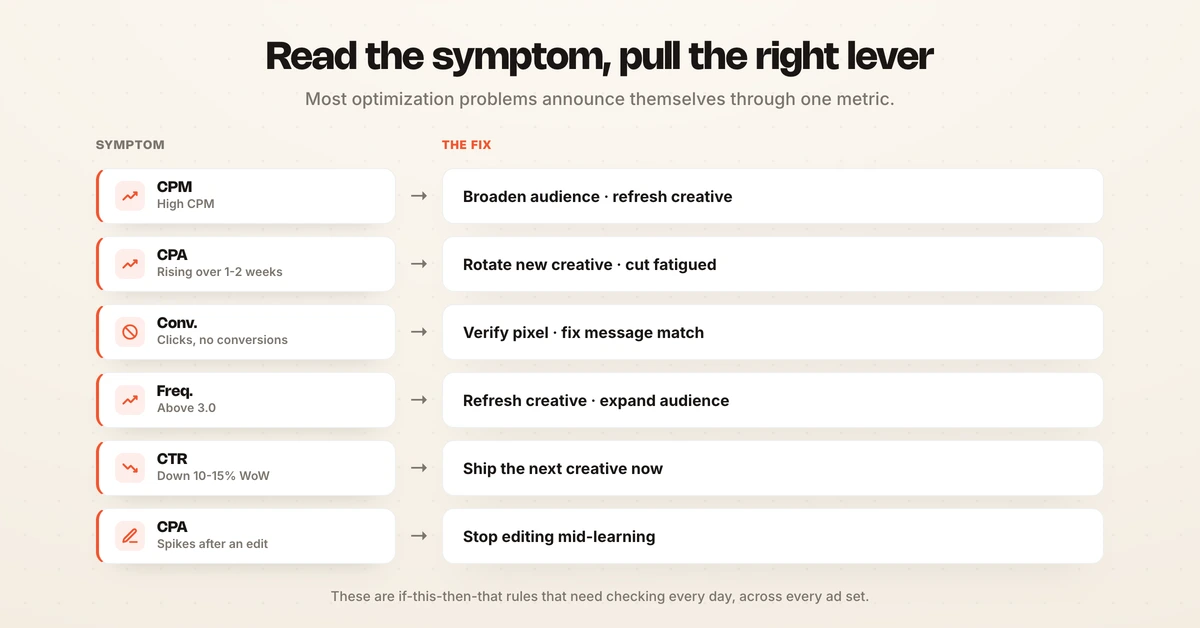
| Symptom | Most likely cause | Fix |
|---|---|---|
| High CPM | Narrow audience or stale creative | Broaden targeting, refresh creative |
| Rising CPA over 1-2 weeks | Creative fatigue | Rotate in new concepts, cut fatigued ads |
| Clicks but no conversions | Pixel or offer or landing page | Verify tracking, fix message match |
| Ad set stuck in learning | Too little conversion volume | Consolidate ad sets, raise budget to hit ~50/wk |
| Frequency above 3.0 | Audience saturation | Refresh creative or expand audience |
| CTR down 10-15% week over week | Early fatigue | Ship the next creative before it worsens |
| CPA spikes after an edit | Learning phase reset | Stop editing mid-learning, wait it out |
The Facebook ads optimization checklist
A Facebook ads optimization checklist is only useful if it has a cadence attached, because the levers move on different clocks. Run the daily items in minutes, the weekly items in half an hour, and the monthly items properly.
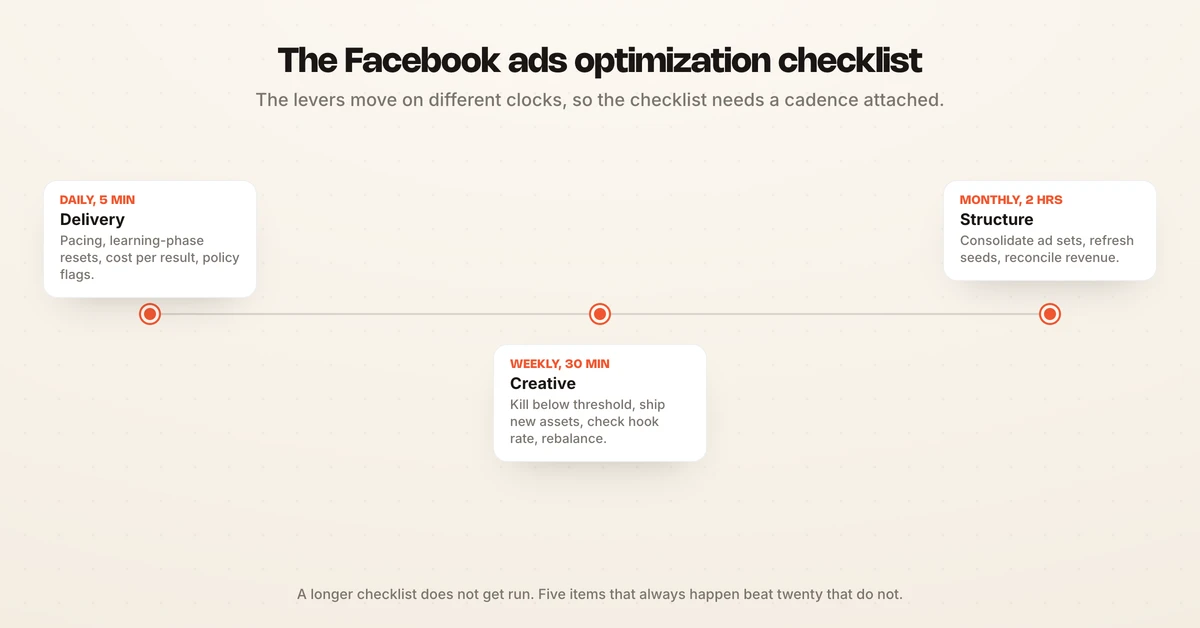
Daily (5 minutes)
- Spend pacing against target, by campaign
- Any ad set that re-entered the learning phase
- Cost per result against your break-even, not against yesterday
- Delivery errors, rejections or policy flags
- Frequency on retargeting audiences
Weekly (30 minutes)
- Kill ads below the cost-per-result threshold you set in advance
- Ship new creative against the winning concept, not against a blank page
- Check hook rate on every new asset in its first 48 hours
- Rebalance budget toward ad sets clearing target, in increments under 20%
- Compare prospecting and retargeting separately, never blended
- Review audience overlap between active ad sets
Monthly (2 hours)
- Consolidate ad sets that are splitting signal
- Audit the account against the levers ranked at the top of this guide
- Refresh lookalike seeds from recent purchaser data
- Reconcile platform-reported revenue against actual revenue
- Review landing pages for the ads carrying the most spend
- Check whether your target cost per result still reflects current margin
The three rules that make the checklist work
- Change one thing at a time. Simultaneous budget and creative changes make the result unreadable.
- Respect the learning phase. Editing an ad set mid-learning restarts it, so batch changes rather than trickling them.
- Write your thresholds down before you need them. A kill rule decided in the moment is a kill rule decided emotionally.
The checklist is deliberately short. A longer one does not get run, and an optimization checklist that gets skipped in a busy week is worth less than five items that always happen.
How an agent optimizes continuously
Read that diagnostic table again and notice what it is: a set of if-this-then-that rules that need checking every day, across every ad set, forever. Pausing a fatigued creative, nudging budget toward a winner, catching a frequency ceiling before CPM climbs. None of it is hard. All of it is relentless, and humans do it late because they are asleep, in meetings, or watching a different campaign.
This is the repetitive, high-frequency work an agent is built to own. Hawky's Performance Agent operates Meta, Google, and YouTube against your KPI around the clock, continuously reallocating budget and pausing fatigued creative the moment the signal turns. Every move is logged with the trigger data behind it and is one-click reversible, and it runs inside your guardrails and spend caps, so autonomy never means loss of control.
That control is the point. You set the KPI and the ceilings; the agent runs the loop underneath them and shows its work. Across a cohort of 200+ customers, that continuous optimization has driven a median +25% ROAS in the first 90 days, and you can see how the pricing ties to outcomes rather than seats.
Frequently asked questions
How do I optimize my Facebook Ads?
A Facebook ads optimization checklist works best split by cadence. Work six levers in order: consolidate account structure, widen audiences so the algorithm has room, run a structured creative testing program, protect the learning phase from resets, let budget optimization reallocate spend, then cut wasted spend against a CPA or ROAS target. Fix them in that sequence, because structure and audience decide how much signal every downstream test gets. Run spend pacing and learning-phase checks daily, creative and budget work weekly, and structural consolidation monthly.
Why are my Facebook Ads not converting?
The usual causes are a broken or misfiring pixel and Conversions API setup, an offer or landing page that does not match the ad, too many fragmented ad sets that never exit the learning phase, and creative that has fatigued. Confirm tracking first, then check message match, then look at signal volume. For the full breakdown, read Hawky's dedicated post on why Facebook ads are not converting.
How do I lower my Facebook ad costs?
Lower cost by improving relevance, not by cutting bids. Refresh fatigued creative to push CTR up and CPM down, consolidate ad sets so each accumulates enough conversions to exit learning, broaden targeting so the auction has more inventory, and set cost caps to enforce your ceiling. Rising CPM with flat CTR is almost always creative fatigue, not audience size.
How many conversions does the learning phase need?
Meta's guidance is roughly 50 optimization events per ad set within a 7-day window to exit the learning phase, though Purchase and App Install objectives can stabilize on fewer. Signal quality matters as much as the raw count. Fifty conversions spread across many fragmented ad sets builds a noisier model than a consolidated structure that concentrates the same volume.
Should I use CBO or ABO on Facebook?
Use campaign budget optimization (now Advantage+ campaign budget) once you have three or more ad sets that have exited learning with roughly 50 conversions each in the last 7 days and you want the algorithm to reallocate spend automatically. Use ad-set budgets when you are testing new audiences or creatives and need to guarantee each one gets enough spend to gather data.
How often should I refresh Facebook ad creative?
Refresh prospecting creative roughly every 10 to 14 days, or whenever frequency climbs past 3.0, whichever comes first. Reels tend to fatigue faster than static feed images. The reliable trigger is a week-over-week CTR decline of 10 to 15 percent paired with rising CPM, which signals your audience has seen the ad too many times.
If the relentless daily loop of pausing fatigued creative, reallocating budget, and protecting the learning phase is the work eating your team's time, Hawky's Performance Agent is built for that job.
Ready to hire your first AI performance team? Book Demo