Lead Generation Ads: The Complete Guide for 2026
Lead generation ads are paid ads designed to collect contact information from potential customers, usually through a native form or a landing page. Facebook delivers the cheapest leads at roughly $23 to $28 each, while Google delivers higher-intent leads at $66 to $70 that often close at 2 to 3 times the rate. The right platform depends on whether you optimize for lead volume or lead quality.
Lead generation is where paid media meets your sales pipeline, and it is the one objective where a cheap result can be the worst result. This guide covers what lead gen ads are, how they work, which platform fits your business, and how to stop paying for leads that never buy.
What are lead generation ads?
Lead generation ads are ads built to capture a prospect's contact details rather than drive an immediate sale. Instead of sending someone to buy, they collect a name, email, or phone number so your sales team can follow up. They power the top of the sales funnel for B2B, high-consideration services, real estate, education, and any business where the purchase happens after a conversation.
The format solves a specific problem: many valuable purchases are too considered to happen on a first click. A $30,000 software contract or a home purchase does not close from an ad, so the ad's job is to start the relationship by capturing a qualified contact. From there, nurturing and sales close the deal.
The trap is that lead gen is easy to do cheaply and hard to do well. Getting a low cost per lead is simple; getting leads that actually convert into customers is the real challenge, and the two goals often pull in opposite directions.
How lead generation ads work
Lead gen ads work through one of two mechanisms: native instant forms or landing pages. Each trades volume against quality in a predictable way.
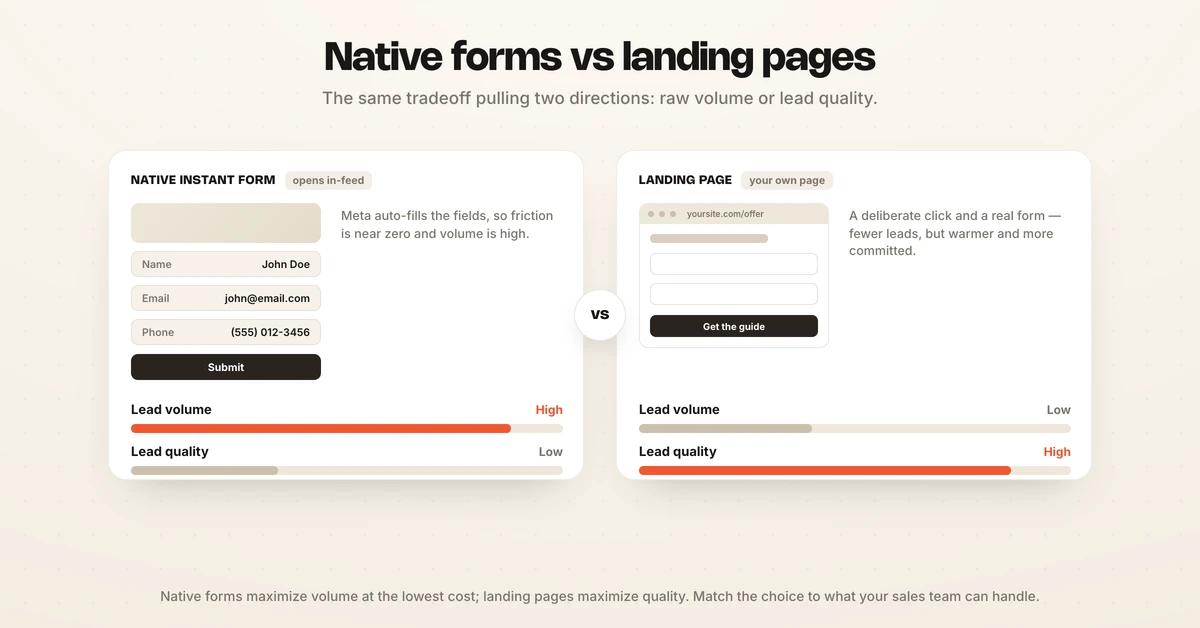
Native instant forms, like Meta's Lead Ads and Google's lead form extensions, open a pre-filled form inside the platform when someone taps the ad. Meta auto-fills name, email, and phone from the user's profile, so friction is near zero and lead volume is high at a low cost per lead. The downside is that easy leads are often low-intent, because the person never left the feed or demonstrated much commitment.
Landing pages send the click to your own page with a form. This adds friction, which lowers volume and raises cost per lead, but the leads are warmer because they took a deliberate action and saw more of your offer. As a rule, native forms maximize volume and landing pages maximize quality, and the right choice depends on what your sales team can handle.
Which platform is best for lead generation?
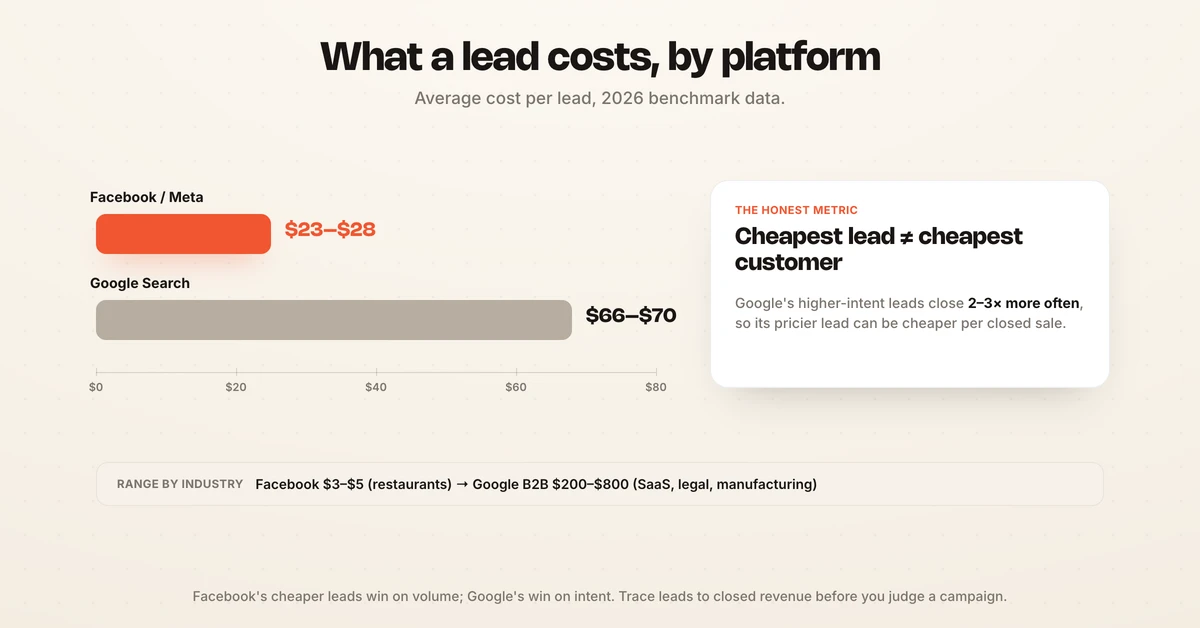
The best platform for lead generation depends on your economics: Facebook for cheap volume, Google for high-intent quality. Facebook generates demand and captures leads at a low cost, while Google captures people already searching for your solution, per Stackmatix 2026 benchmark data.
| Platform | Avg cost per lead | Lead intent | Best for |
|---|---|---|---|
| Facebook / Meta | $23 – $28 | Lower (interrupted) | Volume, B2C, local services |
| Google Search | $66 – $70 | Higher (searching) | High-intent, B2B, services |
| Facebook (by industry) | $3 – $80 | Varies | Restaurants low, legal/dental high |
| Google B2B | $200 – $800 | Highest | SaaS, legal, manufacturing |
Facebook's lower cost per lead is attractive, but Google's higher-intent leads often close at 2 to 3 times the rate, which can make its steeper CPL cheaper per actual customer. The honest comparison is cost per closed deal, not cost per lead. For the full platform breakdown, see Facebook Ads vs Google Ads, and for B2B specifics, Google Ads for SaaS.
Lead volume vs lead quality: the core tension
The central decision in lead gen is where to sit on the volume-quality spectrum, because you cannot maximize both at once. Optimizing for the lowest cost per lead pulls in high volume, but a chunk of those leads will be curious, mistaken, or unqualified. Optimizing for quality raises your cost per lead but hands sales a shorter, better list.
The right position depends on your sales capacity and deal value. A high-volume inside sales team that thrives on quantity can work cheaper, lower-quality leads profitably. A small team selling high-value deals should pay more per lead to protect its time, because chasing junk leads is more expensive than a higher CPL. Judge the tradeoff against your break-even ROAS and close rate, not the CPL alone.
This is why platform-reported cost per lead is a misleading headline metric. A campaign showing a $15 CPL can be worse than one showing a $60 CPL if the cheap leads close at a fraction of the rate. Always trace leads through to closed revenue before judging a campaign.
In real estate a site visit means walking the property, so Kapil Arora judges a campaign by whether qualified leads actually show up.
Velocity podcast
“The number one metric what I would look every day is my qualified lead to site visit ratio. If my qualified lead is not visiting the site, that means my marketing has failed, no matter how good my campaign is.”
How to improve lead quality
Improving lead quality starts with adding friction on purpose. A single qualifying question on your form, screening by company size, budget, or timeline, filters out unqualified prospects before they ever reach sales, using conditional logic on Meta Lead Forms or matching fields on Google. You trade a little volume for a much cleaner list.
First-party data is the second lever. Advertisers using their own email lists, CRM records, and purchase history to build and seed audiences achieve 20% to 35% lower cost per lead than those relying on platform targeting alone, per Cometly. Feeding closed-won data back to the platform also teaches the algorithm to find more people like your best customers.
Speed of follow-up decides whether good leads convert at all. A lead contacted within five minutes closes far more often than one contacted an hour later, so the ad is only half the system; the response behind it is the other half. Retargeting non-converting leads keeps them warm, which is where a retargeting layer earns its place.
Running lead gen across platforms
The strongest lead programs run Facebook and Google together as a full-funnel system, and this combination outperforms single-platform campaigns for budgets above roughly $3,000 to $5,000 per month. Facebook creates awareness and captures early interest cheaply, and Google captures the high-intent searches that interest later produces.
Coordinating that across platforms, each with its own forms, bidding, and lead flow, is operationally heavy. Hawky's Performance Agent runs lead campaigns across Meta, Google, and YouTube against a cost-per-qualified-lead or pipeline KPI, shifting budget to the platform delivering the best leads and refreshing creative before it fatigues, with guardrails and a full audit trail. Hiveminds cut CPL by 27% and saved 160+ hours per brand monthly running exactly this kind of cross-platform program. For the wider view, see the AI media buying guide.
How to measure lead generation ads
Measuring lead gen ads well means tracking past the lead to the outcome, because the platform only shows you half the funnel. Cost per lead is the metric every dashboard reports, but it says nothing about whether those leads become customers. The numbers that matter live in your CRM, not the ad account.
Track three metrics together: cost per lead, lead-to-opportunity rate, and cost per closed customer. A campaign with a high CPL but a strong close rate can be your most profitable, while a cheap-CPL campaign that never closes is pure waste, per cost-per-lead benchmark analysis from LeadSync. Feeding closed-won data back to the ad platform, the same offline-conversion loop that fixes B2B search accounts, teaches the algorithm to optimize toward customers instead of raw leads.
The takeaway is to close the loop between ads and CRM. Without it, you are flying on cost per lead alone, which is the metric most likely to reward the wrong campaigns.
Frequently asked questions
What are lead generation ads?
Lead generation ads are paid ads designed to collect contact information from potential customers, such as a name, email, or phone number, rather than to drive an immediate sale. They power the top of the sales funnel for businesses where the purchase happens after a conversation, like B2B, real estate, and high-consideration services. The captured lead is then nurtured and closed by sales.
Which platform is best for lead gen ads?
It depends on your priority. Facebook delivers the cheapest leads, averaging $23 to $28, making it strong for volume and B2C. Google delivers higher-intent leads at $66 to $70 that often close at 2 to 3 times the rate, making it strong for B2B and high-value services. Most businesses above $3,000 to $5,000 per month in spend run both as a full-funnel system.
How much do lead generation ads cost?
Facebook lead ads average $23 to $28 per lead, ranging from $3 to $5 for restaurants up to $50 to $80 for legal and dental. Google Ads average $66 to $70 per lead across industries, and competitive B2B sectors like SaaS, legal, and manufacturing can run $200 to $800 per lead. Cost per lead varies widely by industry, intent, and lead quality.
How do I improve lead quality from ads?
Add a qualifying question to your form to screen out unqualified prospects by budget, company size, or timeline, trading a little volume for a cleaner list. Use first-party data like CRM records to target and to teach the algorithm what a good lead looks like, which can lower CPL 20% to 35%. Then follow up within minutes, because response speed decides whether good leads convert.
Are native lead forms or landing pages better?
Native instant forms, like Meta Lead Ads, maximize volume at the lowest cost per lead because they are frictionless and pre-filled, but the leads tend to be lower intent. Landing pages add friction that lowers volume and raises cost per lead, but produce warmer, more committed leads. Choose native forms when you need volume and your team can qualify fast, and landing pages when quality matters more than quantity.
If capturing qualified leads across Facebook and Google without drowning your sales team in junk is the problem, Hawky's Performance Agent is built for that job.
Ready to hire your first AI performance team? Book Demo