Facebook Ads vs Google Ads: Which Is Better in 2026?
Neither Facebook Ads nor Google Ads is universally better. Google captures existing demand from people actively searching, while Facebook creates demand among people who were not looking yet. The right choice depends on whether buyers are already searching for what you sell. Most brands past the startup stage should run both, because they solve different halves of the funnel.
The Facebook Ads vs Google Ads debate is really a question about intent. This guide breaks down how each platform works, what they cost, how fast they deliver, and exactly when to pick one over the other, with real 2026 benchmarks throughout. For the other side of the search question, Bing Ads vs Google Ads compares the two search platforms on reach, cost and targeting.
Facebook Ads vs Google Ads at a glance
The core difference is demand capture versus demand generation. Google Ads meets people at the moment they search, so it captures intent that already exists. Facebook Ads appears in feeds based on interests and behavior, so it generates demand among people who were not actively looking. Everything else flows from that one distinction.
| Factor | Google Ads | Facebook Ads |
|---|---|---|
| Intent | Demand capture (active search) | Demand generation (interest-based) |
| Best funnel stage | Bottom (ready to buy) | Top and middle (discovery) |
| Average CPC | ~$5.42 (Search) | ~$1.14 – $1.72 |
| Average CPL | ~$66 – $70 | ~$23 – $28 |
| Time to results | 24 – 72 hours | 7 – 14 days (learning phase) |
| Creative format | Text and Shopping, some visual | Visual-first (image, video) |
| Best for | Existing search demand | Visual products, new demand |
How Google Ads works: capturing demand
Google Ads is intent-based demand capture. Your ad appears when someone types a query that matches your keywords, which means you reach people at the exact moment they have identified a need and are looking for a solution. That timing is why Google converts high-intent traffic so efficiently.
The trade-off is cost and ceiling. Because you bid against competitors for the same high-intent keywords, the average Google Search CPC sits around $5.42 in 2026, far above social, per WebFX benchmarks. You are also capped by search volume: you can only capture as much demand as people are already searching for, so Google cannot manufacture new interest in a product nobody knows to look for.
Google Search Ads also work fast. Because the intent is immediate, campaigns can produce conversions within 24 to 72 hours, with no long learning phase. For a step-by-step setup, see how to run Google Ads.
How Facebook Ads works: creating demand
Facebook Ads is interest-based demand generation. Your ad appears in feeds based on demographics, interests, and behavior, reaching people before they are searching, which makes Meta the engine for discovery and brand building. This is how visual products find buyers who did not know they wanted them.
The economics are the mirror image of Google. Facebook's average CPC runs far lower at roughly $1.14 to $1.72, so you buy attention cheaply, but that attention is colder because you are interrupting rather than answering. Meta also needs time: campaigns spend 7 to 14 days in the learning phase before performance stabilizes, so patience and creative volume matter more here.
Creative is the whole game on Facebook. Because the platform is visual and the audience is not actively shopping, the ad itself has to earn the stop, the interest, and the click. For a setup walkthrough, see how to run Facebook Ads.
Targeting: keywords vs audience signals
The two platforms find people in opposite ways, and that shapes everything downstream. Google targets by keyword and intent: you choose the searches you want to show up for, so the audience selects itself by typing a query. Your control is over which intent you buy, not who the person is.
Facebook targets by who the person is and how they behave. You define audiences by demographics, interests, behaviors, and lookalikes built from your existing customers, then Meta's algorithm expands from there, per Meta's own audience documentation. The audience is precise on attributes but agnostic on immediate intent, so you reach the right person at possibly the wrong moment.
This is why the platforms suit different products. If demand is expressed through search, Google's keyword targeting captures it cleanly. If your buyer is defined by who they are rather than what they are searching, such as a lifestyle brand's ideal customer, Facebook's audience signals reach them where search never could. In 2026, Meta's advantage has grown as its AI-driven Advantage+ audiences lean less on manual targeting and more on the algorithm finding buyers from your creative and pixel signals, per Stackmatix 2026 analysis.
Cost and conversion: the real numbers
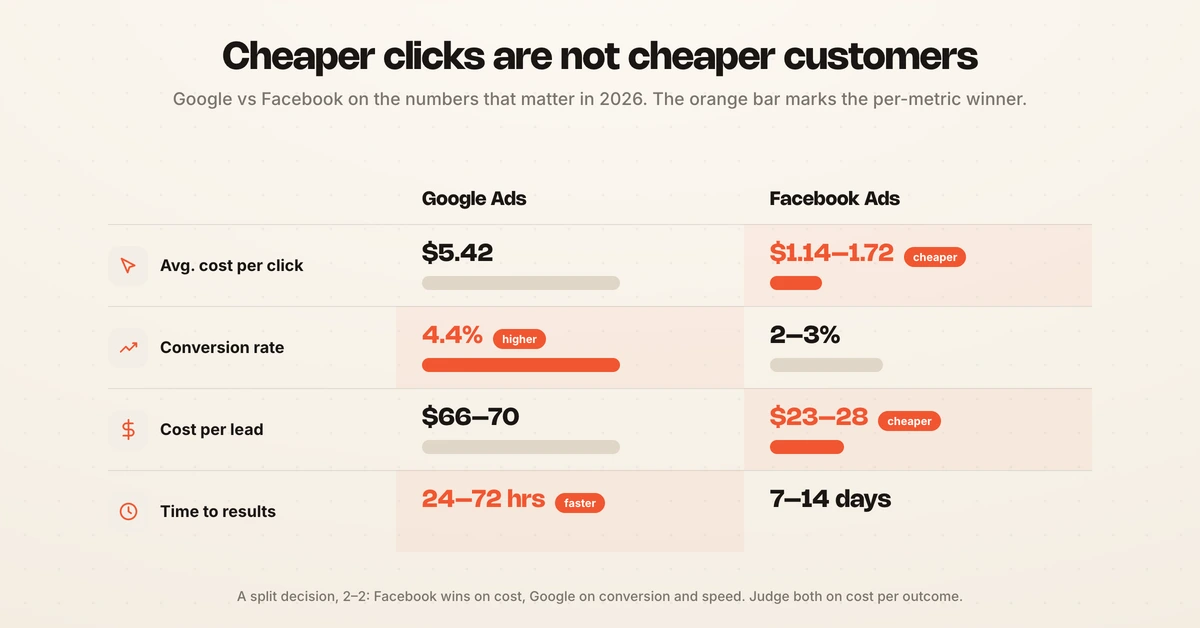
On raw cost per click, Facebook wins decisively, but cost per click is the wrong metric to compare across such different platforms. Google's clicks cost more because they carry more intent, and that intent shows up in conversion quality. The honest comparison is cost per outcome, not cost per click.
| Metric | Google Ads | Facebook Ads |
|---|---|---|
| Average CPC | ~$5.42 | ~$1.14 – $1.72 |
| Search conversion rate | ~4.4% | 2 – 3% (ecommerce) |
| Cost per lead | ~$66 – $70 | ~$23 – $28 |
| ROAS tendency | Higher on high-intent | Higher on retargeting |
Facebook's lower cost per lead makes it attractive for volume, but those leads are often colder and need more nurturing. Google's higher-intent clicks convert at a stronger rate for bottom-funnel actions, which can make its higher CPL worthwhile when each customer is valuable. Judge both against your break-even ROAS, not against each other. For deeper platform data, see Facebook Ads benchmarks and Google Ads benchmarks.
When to choose Facebook Ads
Choose Facebook when you need to create demand rather than capture it. It is the stronger platform for these situations:
- Visual-first products: apparel, beauty, home, food, and lifestyle brands that sell on how the product looks.
- New or category-defining products: items with little existing search volume, where no one is typing your keyword yet.
- Brand and top-of-funnel discovery: building awareness and filling the pipeline for later conversion.
- Precise audience targeting: reaching people by interest, behavior, or lookalike audience rather than by query.
If your growth is capped because not enough people search for what you sell, Facebook is where you manufacture new demand.
When to choose Google Ads
Choose Google when demand already exists and you can capture it at the decision point. It is the stronger platform when:
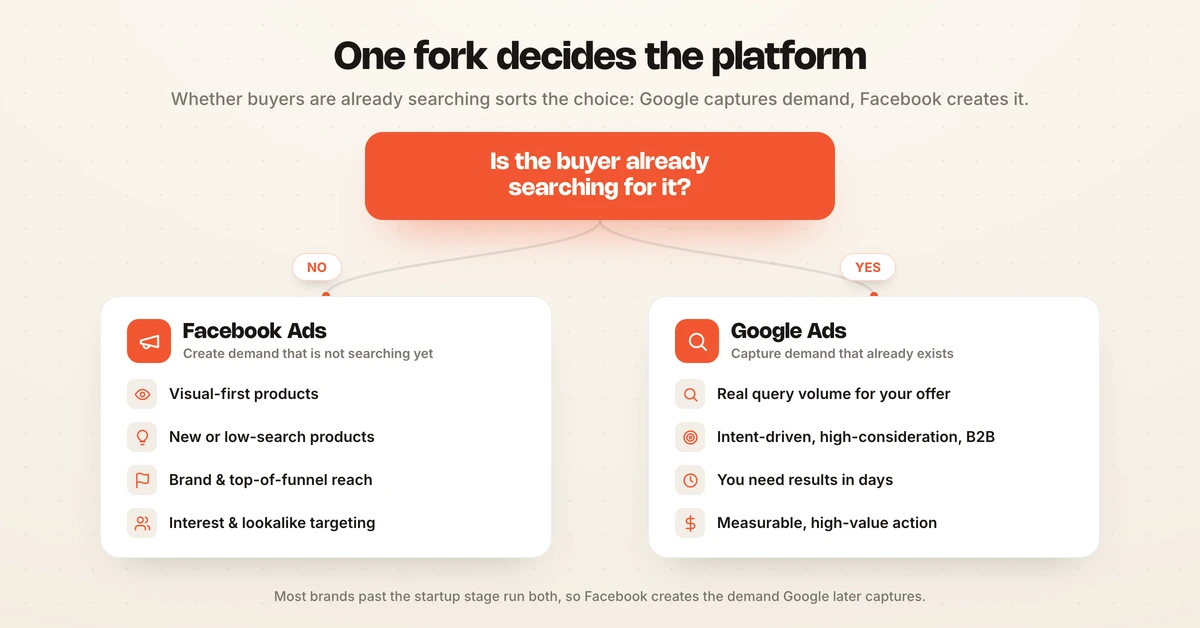
- People search for your solution: there is real query volume for what you offer.
- The purchase is intent-driven: high-consideration services, B2B, local services, and replacement purchases.
- You need fast results: immediate intent produces conversions in days, not weeks.
- The action is measurable and valuable: a lead or sale worth a higher cost per click.
If buyers already know they have the problem and are hunting for a fix, Google puts you in front of them at the moment of decision.
Why the best answer is usually both
The advertisers who win in 2026 do not pick a side; they run a full-funnel system where Facebook creates demand and Google captures it. Facebook introduces the product and builds interest, then Google catches those same people when they search for it later, often by brand name. The two platforms compound instead of competing.
Running both well is harder than running either alone, because each has its own auction, learning behavior, creative format, and optimization rhythm. That operational load is exactly what agents are built to carry. Hawky's Performance Agent plans, launches, and optimizes across Facebook, Google, TikTok, and YouTube against a single KPI, so budget flows to whichever platform is returning best at any moment, with spend caps, guardrails, and a full audit trail. Hiveminds cut CPL by 27% and saved 160+ hours per brand monthly running exactly this kind of cross-platform operation.
For the full picture of running paid media across channels, see the AI media buying guide.
Frequently asked questions
Is Facebook Ads or Google Ads better?
Neither is universally better; they solve different problems. Google Ads captures existing demand from people actively searching, which makes it stronger for high-intent, bottom-funnel conversions. Facebook Ads generates demand among people who are not yet searching, which makes it stronger for discovery, brand building, and visual products. Most established brands should run both as a full-funnel system.
Should I use Facebook or Google Ads for my business?
Start with Google if people already search for what you sell and the purchase is intent-driven, such as services or B2B. Start with Facebook if your product is visual, new, or has little search volume and you need to create demand. If you can afford both, use Facebook to build awareness and Google to capture the demand it generates.
Which is cheaper, Facebook or Google Ads?
Facebook has a much lower cost per click, roughly $1.14 to $1.72 versus about $5.42 for Google Search in 2026. But cheaper clicks are not always cheaper customers. Google's higher-intent traffic often converts at a stronger rate, so the better comparison is cost per lead or cost per acquisition against your margins, not cost per click.
Which platform converts better?
Google Search tends to convert intent-driven traffic at around 4.4%, while Facebook's in-platform conversion rates can look higher but include colder leads that need more nurturing. For ecommerce, Google often edges out Facebook on conversion rate because the click carries more intent. The right answer depends on your funnel stage and offer.
Can I run Facebook and Google Ads at the same time?
Yes, and most successful advertisers do. The two platforms complement each other: Facebook creates demand and Google captures it when people search later. The main challenge is managing two different systems at once, which is why many teams use an agent or a unified platform to keep budget flowing to whichever channel performs best.
If running Facebook and Google together against one KPI without babysitting two ad managers is the problem, Hawky's Performance Agent is built for that job.
Ready to hire your first AI performance team? Book Demo