Media buying is the process of purchasing ad inventory across channels like Meta, Google, YouTube, and the open web, then managing that spend so it hits a performance goal such as ROAS, CPA, or reach. It covers planning where ads run, negotiating or bidding for the placement, launching campaigns, and optimizing spend as results come in. AI media buying adds an agent that runs that optimization loop continuously against your KPI instead of leaving it to manual check-ins.
This guide explains what media buying is, how it works channel by channel, the six-step process buyers follow, what a media buyer actually does, and how automated and AI media buying change the job. It links out to deeper guides on tools, benchmarks, and specific channels so you can go one level down wherever you need to.
What is media buying?
Media buying is the act of acquiring advertising space and paying for it to reach an audience. In digital media, that space is auction-based and priced by the impression, click, or action, so buying is less about a one-time purchase and more about managing bids and budgets over time.
The goal is efficiency. A media buyer wants the most valuable outcome, whether that is a sale, a lead, or reach, for the lowest cost. Every decision, from which platform to use to how much to bid, ladders up to a target like ROAS, CPA, or CPM.
Media buying is not the same as media planning. Planning decides the strategy, the audience, the channel mix, and the budget split. Buying executes it: securing the inventory, launching the campaigns, and steering spend once ads are live.
Media buying vs media planning
Planning answers where the budget should go and why. Buying answers how you get that spend live and make it perform. On small teams one person does both. On larger teams and at agencies, planners set the media mix and buyers run the accounts day to day.
How does media buying work?
Most digital media buying runs through a real-time auction. When someone loads a page or opens an app, an auction decides which ad shows in the available slot, and it resolves in milliseconds. You are not buying a fixed placement so much as instructing a system how much a given impression is worth to you.
There are two broad ways to buy. Direct buys are negotiated deals with a publisher for specific placements, common in premium video, out-of-home, and connected TV. Programmatic buys use software to bid on inventory automatically across many publishers at once, which is how most social, search, and display spend runs today, as the Interactive Advertising Bureau documents across its programmatic standards. What programmatic advertising is walks through the auction, the acronyms and the four deal types in full.
The three main auction structures you will meet are the open auction, where anyone can bid; the private marketplace, or PMP, where select buyers bid on reserved inventory; and programmatic guaranteed, where you lock a fixed volume at a fixed price. Each trades reach for control in a different way.
The channels you buy on
Media buying spans several channel types, and most performance teams run more than one at a time. The channel you pick shapes the auction, the targeting, and the creative you need.
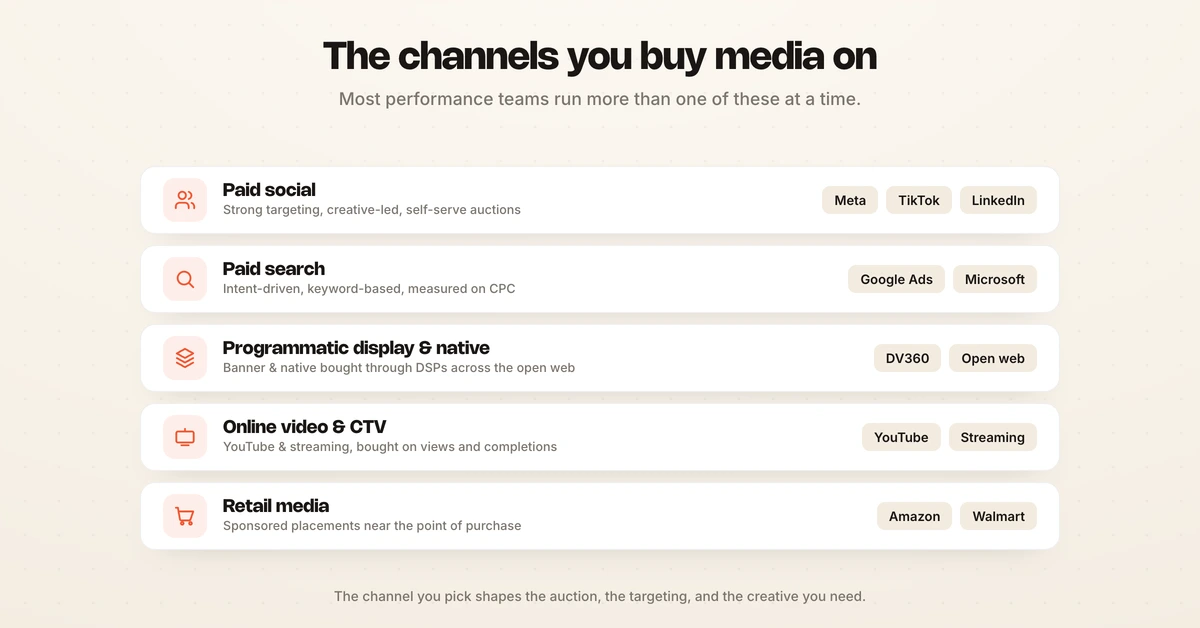
- Paid social: Meta, TikTok, LinkedIn, and others. Strong targeting, creative-led, self-serve auction buying.
- Paid search: Google Ads and Microsoft Ads. Intent-driven, keyword-based, measured by CPC and conversion value.
- Programmatic display and native: banner and native placements bought through demand-side platforms like Google DV360 across the open web.
- Online video and CTV: YouTube and streaming inventory, bought on views and completions.
- Retail media: sponsored placements on Amazon, Walmart, and other retailers, close to the point of purchase.
The media buying process
The media buying process is a repeatable loop. Strong buyers treat it as a cycle, not a one-time launch, because the auction and the audience keep moving.
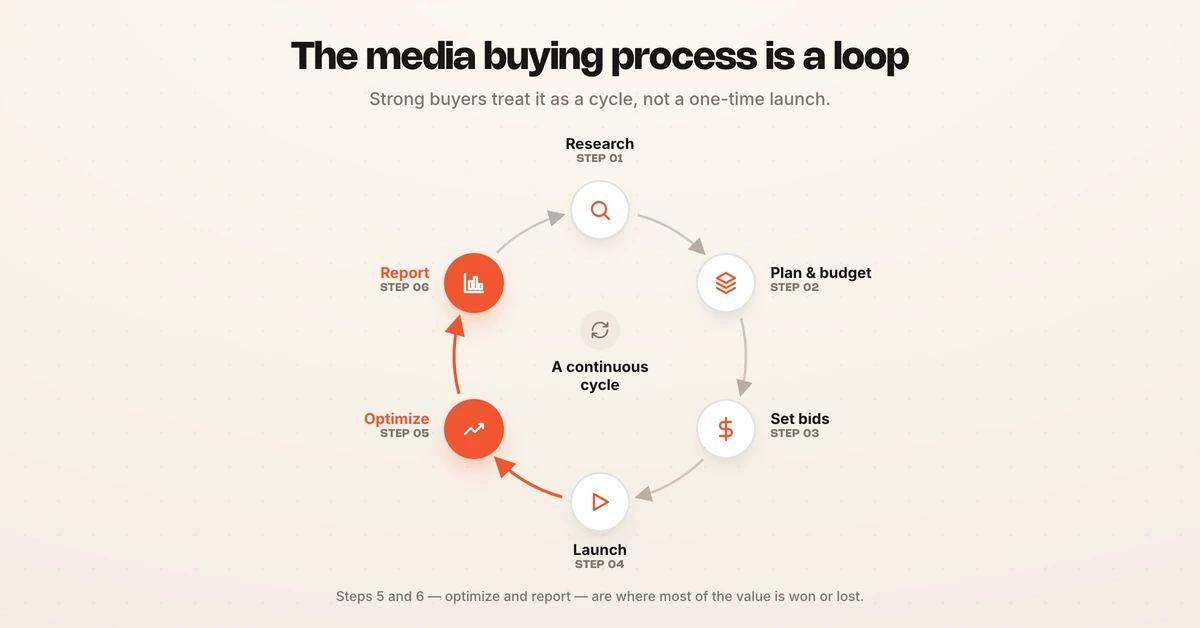
- Research: define the audience, the goal, and the benchmark. Know your target CPA or ROAS before you spend.
- Plan and budget: choose the channel mix and split the budget across platforms and campaigns.
- Negotiate or set bids: agree direct-deal terms, or configure bid strategies and caps for auction buying.
- Launch: build campaigns, load creative, set targeting, and go live.
- Optimize: shift budget to winners, pause losers, refresh creative, and adjust bids as data arrives.
- Report: measure against the goal, document what worked, and feed it into the next cycle.
Steps five and six are where most of the value is won or lost. Launching is quick. Optimizing well, day after day across dozens of ad sets, is the hard part, and it is exactly where automation and AI now do the heavy lifting.
What does a media buyer do?
A media buyer plans, buys, and optimizes paid advertising to hit a business goal. The role blends analysis, negotiation, and hands-on account management, and it looks different at a brand than at an agency.
Day to day, a media buyer sets budgets and bids, launches and structures campaigns, monitors pacing so spend lands evenly, watches for creative fatigue, and reallocates spend toward what is working. They report on performance and defend the numbers to clients or leadership.
The skills that matter are numeracy, platform fluency across Meta and Google, a feel for creative, and disciplined testing. A good buyer treats budget as a portfolio: concentrate it where the return is proven, cut it where it is not, and always keep a slice testing new angles.
The role is shifting. As platforms automate bidding and AI takes over routine optimization, the buyer's edge moves toward strategy, creative direction, and judgment about which bets to make, rather than manual bid tweaks.
AI media buying and automated media buying
Automated media buying uses software to execute buying tasks that a person used to do by hand. AI media buying goes further: it uses an agent that reads performance, decides what to change, makes the change, and reads the result, running that loop continuously against your KPI.
The difference is where the decision sits. Rules-based automation follows conditions you write in advance, like "pause any ad set above a 50 dollar CPA." An AI agent reasons about the account, weighs tradeoffs, and acts within the guardrails you set, then logs why.
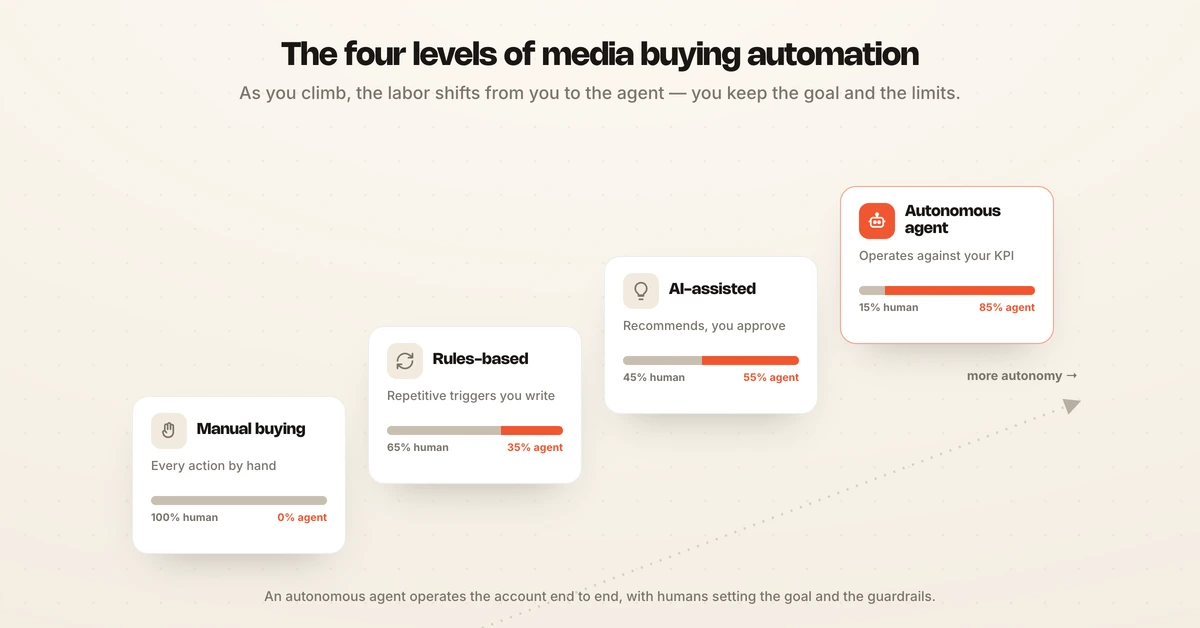
Think of automation as a ladder. Manual buying is every action by hand, and rules automation handles repetitive triggers. AI-assisted tools recommend changes for you to approve. An autonomous agent operates the account end to end, with humans setting the goal and the limits.
What to look for in AI media buying
The value of AI media buying is speed and consistency: it can optimize hundreds of ad sets around the clock without fatigue or bias. The risk is losing visibility and control. Judge any AI buying tool on four things.
- KPI alignment: does it optimize toward your actual business goal, not just platform proxy metrics.
- Control: can you set spend caps, guardrails, and an approval gate, and run it in shadow mode first.
- Auditability: is every action logged with the trigger that caused it, and is it reversible.
- Transparency: can you see why a decision was made, not just that spend moved.
Autonomy is only useful when it is paired with control. The point is not to hand the account to a black box; it is to let an agent do the labor while you keep the judgment, the limits, and a full audit trail.
Media buying strategy: getting more from the same budget
Strategy is what separates spending money from buying results. A few principles hold across channels.
Match the channel to the goal. Search captures existing demand; social and video create it. Do not judge a top-of-funnel video campaign by last-click ROAS, and do not expect search to build awareness.
Treat budget as a portfolio and let performance decide allocation. Concentrate spend where return is proven, keep a testing budget live at all times, and use budget pacing so you are not front-loading or starving campaigns by accident.
Creative is the biggest lever in modern auctions. When targeting is largely automated, the ad itself decides who the algorithm can find and how long a campaign keeps working. Refresh creative before fatigue sets in, and read ROAS benchmarks by industry so your targets are grounded in reality rather than hope.
Media buying tools
The tool you buy through depends on the channel and how much of the work you want automated. Native platform managers like Meta Ads Manager and Google Ads handle self-serve buying. Demand-side platforms handle programmatic. Automation and agentic tools sit on top to optimize the accounts.
For a full, sourced comparison, see the guide to the best media buying tools. For search specifically, the best PPC tools guide covers Google and Microsoft Ads platforms. If your focus is cross-channel management and automation, the guides to the best ad management software and best ad automation software go deeper. For Google specifically, see Google Ads automation.
Where an agent fits
Most tools report on media or automate a single task. An agent operates the account. Hawky is an agentic performance marketing platform whose Performance Agent plans, launches, and optimizes campaigns across Meta, Google, and YouTube against the KPI you set, whether that is ROAS, CAC, LTV, or contribution margin.
It runs as a closed loop: test, track, optimize, scale. Every move is logged with the trigger that caused it and a confidence score, and every move is reversible in one click. You set guardrails, spend caps, and your level of autonomy, from shadow mode to approval-gated to fully autonomous, so the agent does the labor while you keep command. You can see how campaign management and the command center work across accounts, or read how the outcome-based model works on the pricing page.
The results are documented. Hawky reports a 25 percent median ROAS lift in the first 90 days across a cohort of more than 200 customers (case studies), and agency Hiveminds cut CPL by 27 percent while saving more than 160 hours per brand each month (Hiveminds case study).
Bringing it together
Media buying is the discipline of turning budget into outcomes: plan where to spend, buy the inventory, and optimize relentlessly against a goal. The mechanics are auctions and channels, but the edge is in the optimization loop, which is why AI media buying is reshaping the job.
The teams that win treat buying as a continuous cycle, keep creative fresh, and use automation to run the loop faster than a human can. If you want an agent to operate that loop across Meta, Google, and YouTube against your KPI, with every move logged and reversible, Hawky's Performance Agent is built for that job.
Ready to hire your first AI performance team? Book Demo