Best Media Buying Tools in 2026: 9 Platforms Compared
The best media buying tools in 2026 are Hawky for agentic, outcome-based operation across Meta, Google, and YouTube, The Trade Desk and Google DV360 for enterprise programmatic buying, and channel-specific platforms like Smartly, StackAdapt, Madgicx, and Revealbot for automation and activation. The right choice depends on whether you want a tool that reports on media, a demand-side platform that buys inventory, or an agent that operates the account against a KPI.
Media buying now spans planning, buying, and optimization across social, search, video, the open web, and connected TV. This guide compares nine real media buying tools so you can match one to your channels, budget, and how much of the buying you want automated. If you are still deciding whether the open web belongs in your mix at all, start with what programmatic advertising is and how programmatic buying works.
How we picked
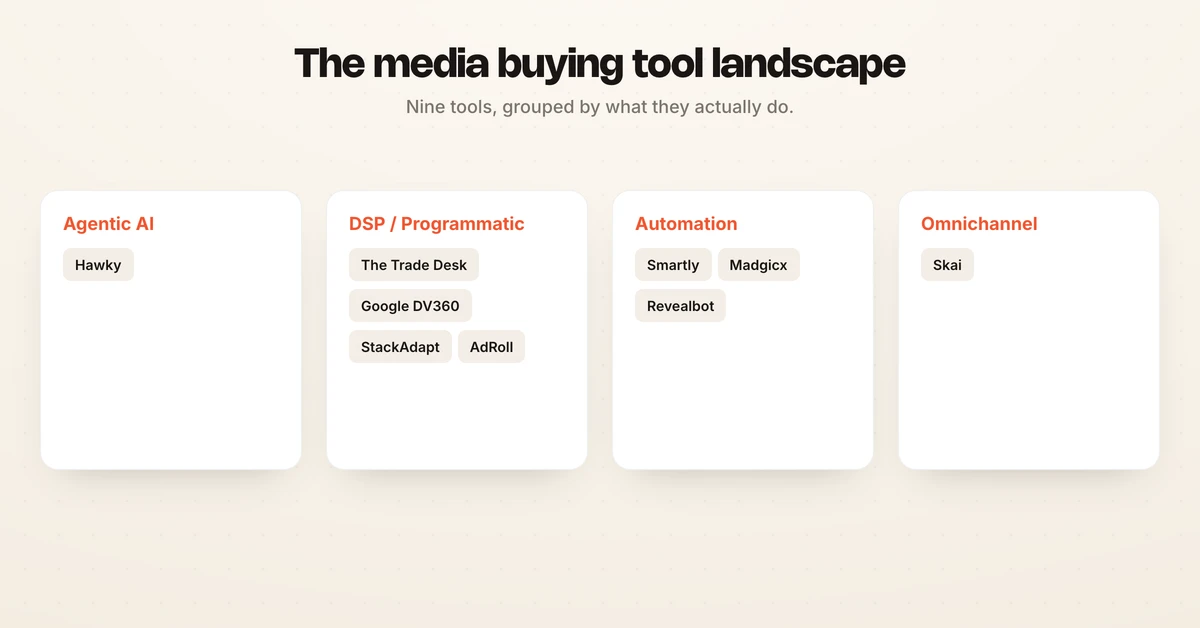
We looked at tools that either buy media directly or operate and automate the accounts where media runs. Each one below is grouped by type: agentic AI, demand-side platforms, social and creative automation, rules automation, and omnichannel activation. Every capability and price for a competitor is stated only where a public source confirms it, and each claim links to that source.
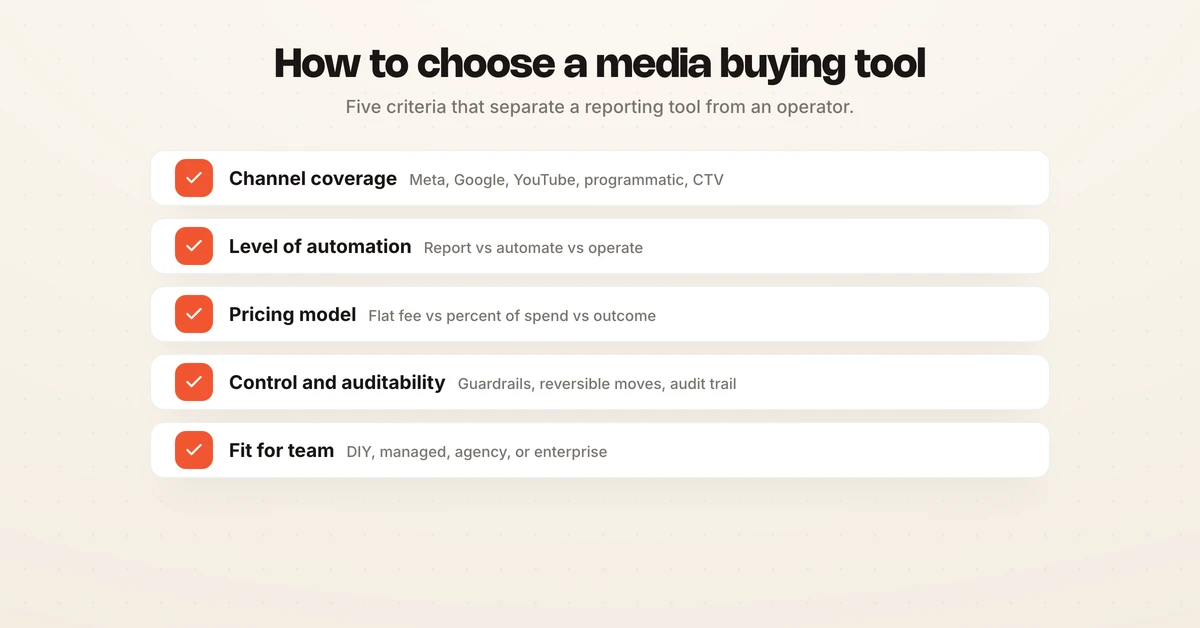
When you evaluate media buying software, five things matter most. Channel coverage tells you which platforms a tool can actually buy on. Level of automation tells you whether it reports, automates single tasks, or operates the account. Pricing model tells you whether you pay a flat fee, a percentage of spend, or for outcomes. Control and auditability tell you whether you can see and reverse what the tool does. Fit for team tells you whether it suits a DIY operator, a managed engagement, an agency, or an enterprise.
Comparison table
| Tool | Best for | Key strength | Pricing model (sourced) |
|---|---|---|---|
| Hawky | Teams that want an agent to operate paid media | Plans, launches, and optimizes against a KPI with every move logged and reversible | Outcome-based pricing (Hawky) |
| The Trade Desk | Enterprise programmatic at scale | Broad inventory, identity, and measurement across the open web and CTV | Percentage of media spend, roughly mid-teens to 20% loaded (Media Planning Tool) |
| Google DV360 | Agencies and enterprises in the Google stack | End-to-end programmatic across display, video, TV, and audio | Enterprise, spend-based (Google) |
| StackAdapt | Self-serve multichannel programmatic | Native, display, CTV, audio, and DOOH in one self-serve DSP (StackAdapt) | Managed/self-serve, spend-based (Capterra) |
| Smartly | Social-first creative and media at scale | Creative automation plus cross-channel social buying (Smartly) | Custom/enterprise (Smartly) |
| Madgicx | Meta-only ad optimization | Agentic Meta ad management and creative tools (Madgicx) | From ~$49/month (Capterra) |
| Revealbot (Birch) | Rules-based ad automation | Condition-action rules across Meta, Google, TikTok, Snapchat (Birch) | From $49/month, scaled to spend (Birch) |
| AdRoll | SMB retargeting and cross-channel | Pixel-based retargeting across display and social (AdRoll) | From $36/month plus media margin (Capterra) |
| Skai | Omnichannel commerce media | Retail media, search, and social in one platform (Skai) | Enterprise, custom (Gartner) |
The best media buying tools
1. Hawky
Hawky is an agentic performance marketing platform. Its Performance Agent is an always-on operator that plans, launches, and optimizes campaigns across Meta, Google, and YouTube against the KPI you set, whether that is ROAS, CAC, LTV, or contribution margin. This is the difference that puts it at the top of the list: most tools here report on media or automate a single task, while Hawky operates the account.
The agent works as a closed loop. It reads performance, decides on an action, executes it, and reads the result, then repeats. Every move is logged with the trigger that caused it and a confidence score, and every move is reversible in one click. You are never guessing why spend shifted or a campaign paused.
Control is built in rather than bolted on. You set guardrails and spend caps, run the agent in shadow mode to watch it before it acts, and choose your level of autonomy. Configurable autonomy runs from shadow, to approval-gated, to fully autonomous, and every stage keeps an audit trail. You can read how the Performance Agent is structured and how campaign management works across accounts.
Hawky fits both DIY teams and fully managed engagements, and pricing is outcome-based rather than a flat license or a cut of spend, with a 30-day pilot to prove it. The results are documented. Hawky reports a 25 percent median ROAS lift in the first 90 days across a cohort of more than 200 customers (case study), and agency Hiveminds cut CPL by 27 percent (Hiveminds case study). If you want to move from watching dashboards to having the account operated for you, Hawky is built for that. See pricing for how the outcome-based model works.
2. The Trade Desk
The Trade Desk is a demand-side platform built for programmatic buying at scale. It gives large advertisers and agencies access to inventory across the open web, connected TV, audio, and more, along with identity and measurement layers.
Its pricing is a percentage of media spend rather than a seat license. Once data, identity, and feature layers are added, the effective platform fee can run from the mid-teens to roughly 20 percent of gross spend, according to Media Planning Tool. The same source notes significant minimum spend requirements that put it out of reach for smaller advertisers. The Trade Desk is best when you are managing large programmatic budgets and want breadth of inventory and measurement.
3. Google DV360
Google Display and Video 360 is Google's enterprise DSP. It lets teams manage reservation, programmatic, and programmatic guaranteed campaigns across display, video, TV, audio, and other channels in one place, per Google.
DV360 supports open auction, private marketplace, and programmatic guaranteed buying, which gives buyers flexibility on how they secure inventory. It is deeply integrated with the wider Google Marketing Platform, so it suits agencies and enterprises already invested in the Google stack. Like other enterprise DSPs, it is aimed at teams with significant budgets rather than small advertisers. What DV360 is covers the account hierarchy, how it differs from Google Ads, and what the platform fee actually buys.
4. StackAdapt
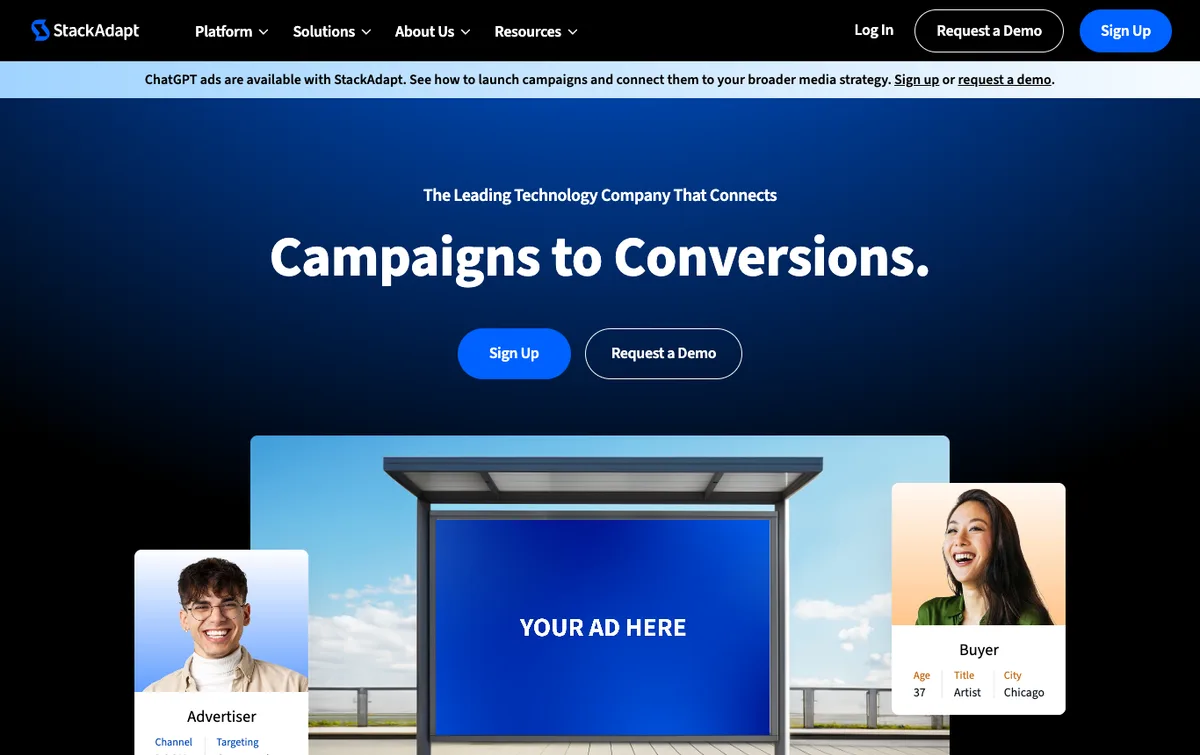
StackAdapt is a self-serve DSP known for ease of use. It reaches audiences across native, display, connected TV, video, audio, in-game, digital out-of-home, and email from one platform, according to StackAdapt.
The platform pairs real-time bidding and machine-learning optimization with a contextual engine for cookieless targeting. Its main draw is a simpler interface than heavier enterprise DSPs, which shortens onboarding. Pricing is spend-based and typically arranged through the platform, as noted on Capterra. StackAdapt fits teams that want multichannel programmatic reach without a long ramp.
5. Smartly
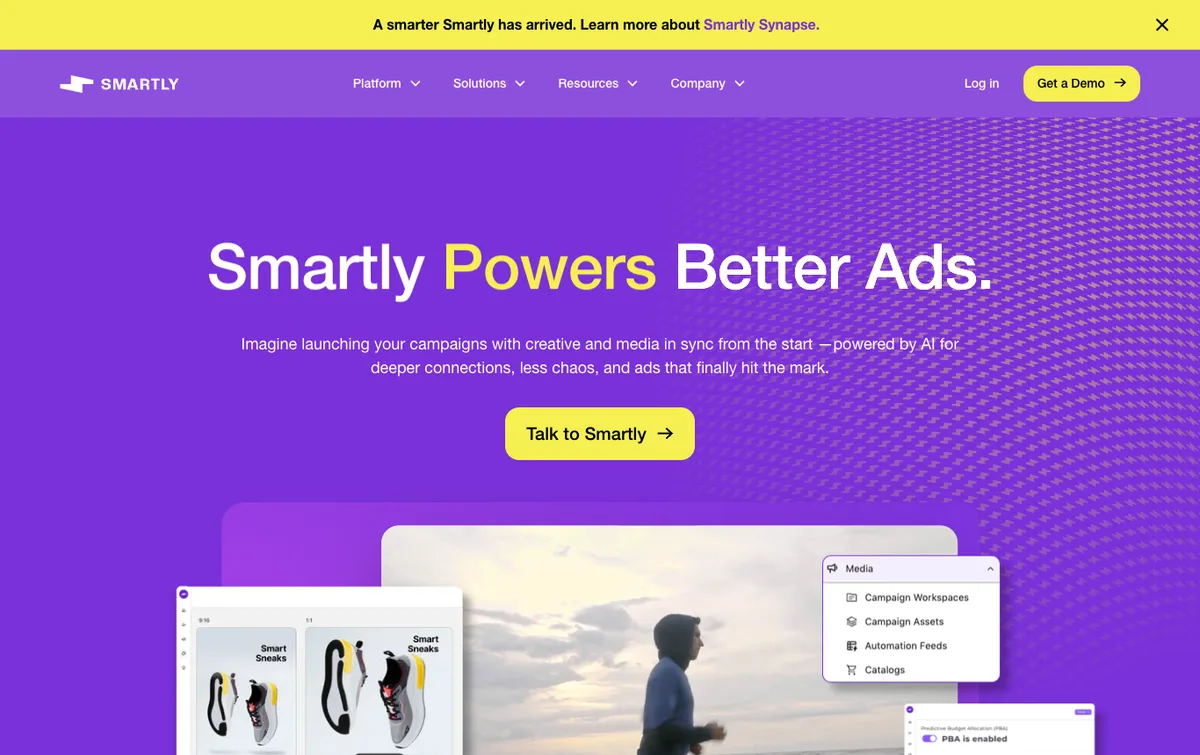
Smartly is an end-to-end advertising platform focused on social. It brings creative production, media buying, and optimization into one interface across major social channels, per Smartly.
Its strength is creative automation at scale. Dynamic templates and bulk editing turn a single creative into many localized variations by language, format, and product feed, which is useful for global campaigns. Smartly also automates cross-channel social buying and shifts spend toward better performers. It is aimed at performance and creative teams, agencies, and enterprise brands, with custom pricing described on the Smartly site.
6. Madgicx
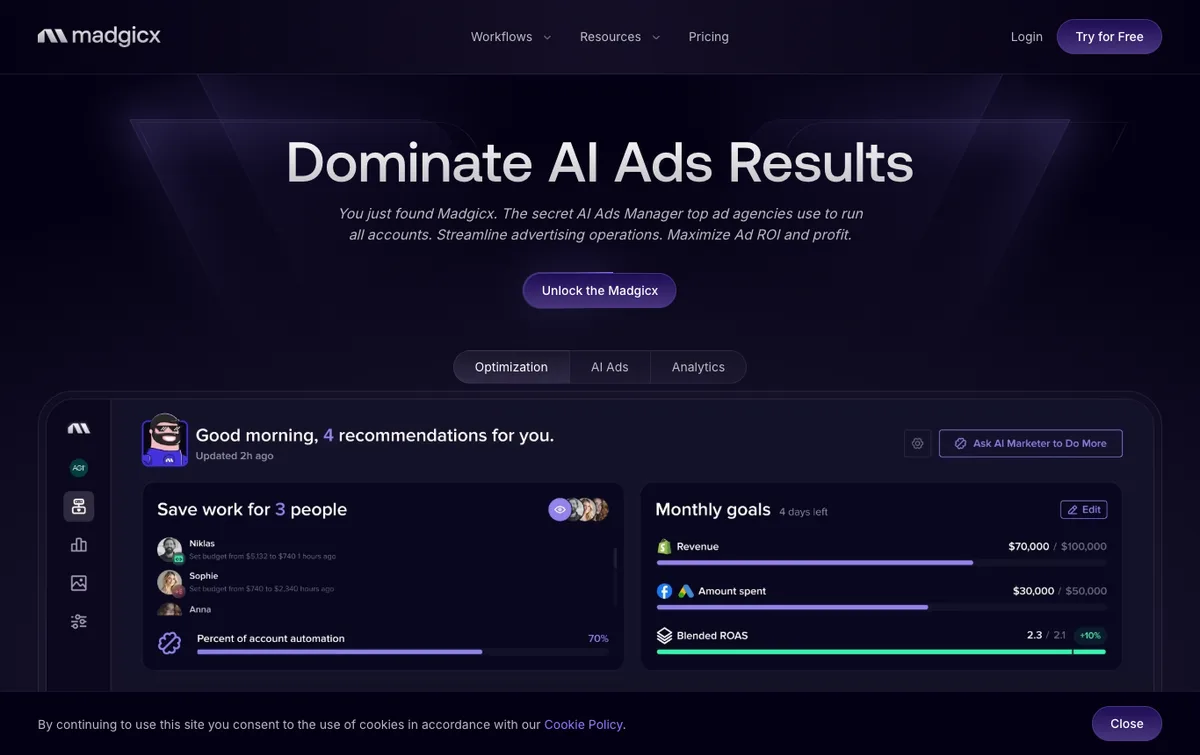
Madgicx describes itself as an agentic Meta ads management AI platform, per Madgicx. It combines an AI Marketer, bidding and budget optimization, and creative tools for generating and deploying ads. For a Meta-only shortlist ranked by how much of the job each tool does, see the guide to Meta ads management software.
The important limitation is scope. Madgicx is Meta-only and does not support Google, TikTok, LinkedIn, or YouTube as of 2026, according to AdLibrary's review. Pricing starts at roughly 49 dollars per month and scales toward agency tiers, as listed on Capterra. Madgicx fits teams whose paid media lives almost entirely on Meta and who want optimization and creative in one tool.
7. Revealbot (Birch)
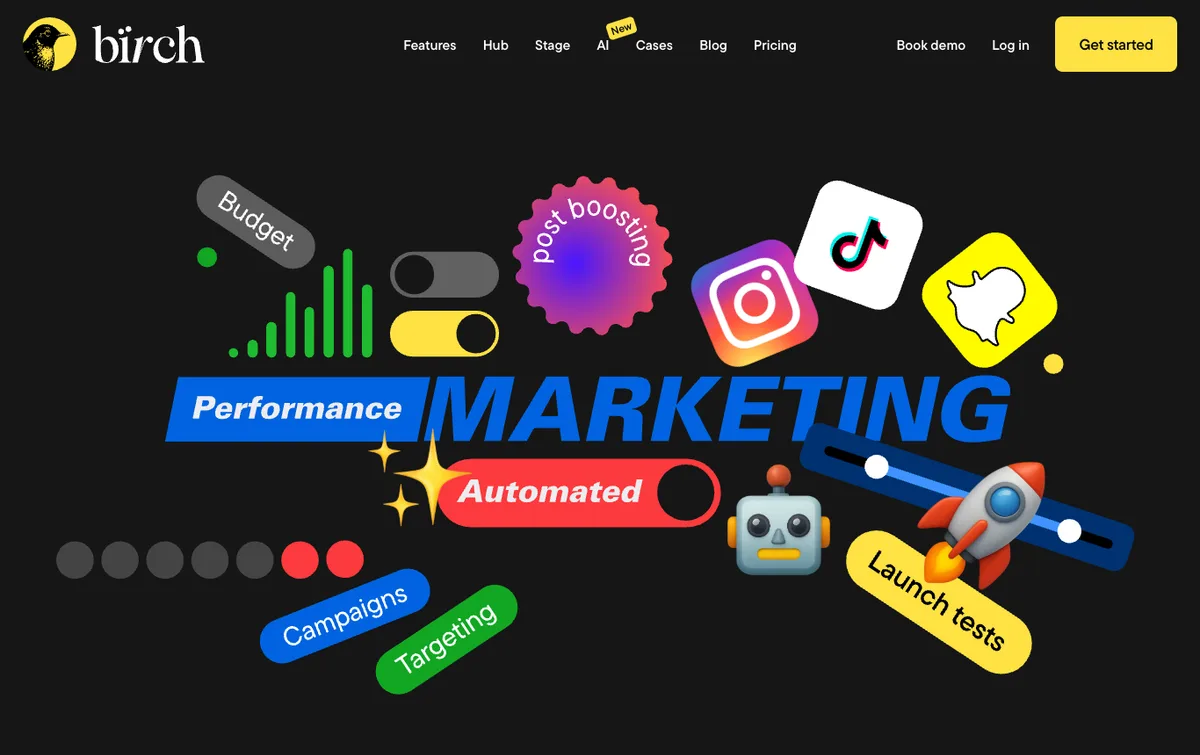
Revealbot, now operating as Birch, is a rules-based ad automation platform. You define condition-action rules such as pausing ads when ROAS drops below a threshold or increasing budget when CPA is under a target, and the platform runs them on a schedule.
It supports Meta, Google, Snapchat, and TikTok from one interface, per Birch. Pricing starts at 49 dollars per month and scales based on the monthly ad spend across the accounts you connect, also per Birch. Revealbot fits buyers who know the exact rules they want enforced and want them executed automatically rather than by hand. It automates tasks rather than operating the account for you.
8. AdRoll
AdRoll is a retargeting and cross-channel platform aimed at smaller and mid-market advertisers. Its pixel tracks site visitors and serves them ads across display networks and social platforms like Meta, TikTok, and Pinterest, per AdRoll.
It builds granular audience segments by integrating with your CRM and ecommerce platforms, and its BidIQ engine allocates budget across bids in real time. Pricing starts at 36 dollars per month, plus a margin on the underlying media spend, according to Capterra. AdRoll fits ecommerce and SMB teams that want approachable retargeting without an enterprise DSP.
9. Skai
Skai, formerly Kenshoo, is an omnichannel commerce media platform. It lets brands manage retail media, paid search, and paid social from one platform and centralize their media data, per Skai.
Its focus on commerce and retail media sets it apart, with first-party advertiser data, publisher insights, and digital shelf data combined in one place. It also includes an assistant, Celeste AI, for recommendations. Skai is an enterprise platform with custom pricing, reviewed on Gartner. It fits large brands and agencies that need retail media alongside search and social.
How to choose
Start with your channels. If your budget is concentrated on Meta, Google, and YouTube, an agentic operator like Hawky or a channel tool covers it. If you buy across the open web and connected TV, you need a DSP like The Trade Desk, Google DV360, or StackAdapt. If retail media is central, Skai is built for it.
Then decide how much of the buying you want the tool to do. A DSP buys inventory but still needs a person deciding strategy. A rules engine like Revealbot automates the actions you define. An agentic platform like Hawky plans, launches, and optimizes against your KPI and logs each move so you keep control. For deeper reading on adjacent categories, see the guides to the best PPC tools, the best ad management software, and the best ad automation software.
Finally, weigh pricing against control. Percentage-of-spend models like The Trade Desk get more expensive as you scale, while flat monthly tools stay predictable but cap what they do. Outcome-based pricing ties cost to results. If rising media cost is your pressure point, the guide to Google Ads cost is a useful companion, and Hawky's pricing shows how an outcome-based model changes the math.
Frequently asked questions
What are the best media buying tools?
The best media buying tools in 2026 include Hawky for agentic, outcome-based operation across Meta, Google, and YouTube, The Trade Desk and Google DV360 for enterprise programmatic and DSP buying, and Smartly, StackAdapt, Madgicx, Revealbot, AdRoll, and Skai for channel-specific automation and activation. The right pick depends on whether you want a tool that reports, a platform that buys inventory, or an agent that operates the account against a KPI.
What software do media buyers use?
Media buyers use demand-side platforms like The Trade Desk and Google DV360 to buy programmatic inventory, social and creative automation platforms like Smartly and Madgicx for paid social, rules engines like Revealbot for automated actions, and omnichannel platforms like Skai and StackAdapt for activation. A growing group also uses agentic tools like Hawky that plan, launch, and optimize campaigns against a target KPI rather than only reporting on them.
What is the best media buying platform?
There is no single best media buying platform for every team. The Trade Desk and Google DV360 lead enterprise programmatic buying at scale, per Media Planning Tool, while Hawky leads for teams that want an agent to operate Meta, Google, and YouTube accounts against ROAS, CAC, or contribution margin with outcome-based pricing. Match the platform to your channels, budget, and how much of the buying you want automated.
How much do media buying tools cost?
Pricing models vary widely. DSPs like The Trade Desk use a percentage of media spend, often in the mid-teens to roughly 20 percent once data and features are layered in, per Media Planning Tool. Automation tools like Madgicx start around 49 dollars per month per Capterra, Revealbot starts at 49 dollars per month scaled to ad spend per Birch, and AdRoll starts at 36 dollars per month plus a media margin per Capterra. Hawky uses outcome-based pricing tied to results.
What is the difference between a DSP and a media buying automation tool?
A demand-side platform, or DSP, like The Trade Desk or Google DV360 is the system that actually buys programmatic ad inventory across the open web, connected TV, and other channels through real-time bidding. A media buying automation tool like Revealbot or Madgicx sits on top of ad accounts and automates specific tasks such as pausing underperformers or shifting budget. An agentic platform like Hawky goes further by operating the account end to end against a KPI.
Are AI media buying tools worth it?
AI media buying tools are worth it when they reduce manual work and improve results without removing your control. Rules-based automation saves time on repetitive actions, while agentic platforms like Hawky plan, launch, and optimize campaigns and log every move with its trigger and confidence so you can reverse it in one click. Hawky reports a 25 percent median ROAS lift in the first 90 days across a cohort of more than 200 customers (case study).
If you want to stop watching dashboards and have your paid media planned, launched, and optimized against a KPI across Meta, Google, and YouTube, Hawky's Performance Agent is built for that job.
Ready to hire your first AI performance team? Book Demo