Autonomous performance marketing is a system where an AI agent operates your paid media against a defined business KPI, making and executing decisions on its own inside guardrails you set. It runs a continuous perceive, decide, act, and learn loop, and every action it takes carries a logged trigger, a confidence score, and one-click reversal. The word autonomous only earns trust when it is paired with control: spend caps, approval gates, shadow mode, and a full audit trail.
Most marketing software describes what already happened and then waits for a person to act on it. This article defines autonomous performance marketing, explains how an AI marketing agent actually works, and answers the honest question of whether letting software buy media is safe.
What is autonomous performance marketing?
Autonomous performance marketing is the practice of delegating the operation of paid campaigns to an AI agent that owns an outcome rather than a task. You give the agent a KPI, a budget, and a set of guardrails, and it perceives performance, decides what to change, executes the change, and learns from the result. The agent works continuously, not on a schedule you trigger.
The distinction that matters is between a tool you operate and an agent that operates for you. A rules engine pauses an ad when cost per acquisition crosses a line you drew. An agent decides whether pausing that ad, shifting its budget, or changing its bid best serves the KPI, then does it and records why.
Autonomy here is never absolute. It is bounded by spend caps, by the KPI you defined, and by an audit trail that shows every action with its trigger and confidence. That pairing of autonomy with control is the entire premise, and the rest of this article keeps returning to it.
How does an AI marketing agent work?
An AI marketing agent runs a loop that mirrors how any autonomous system operates: it perceives its environment, reasons about options, acts, and observes the result before deciding what comes next (AWS Prescriptive Guidance). Applied to media buying, that loop has four stages against a single KPI.
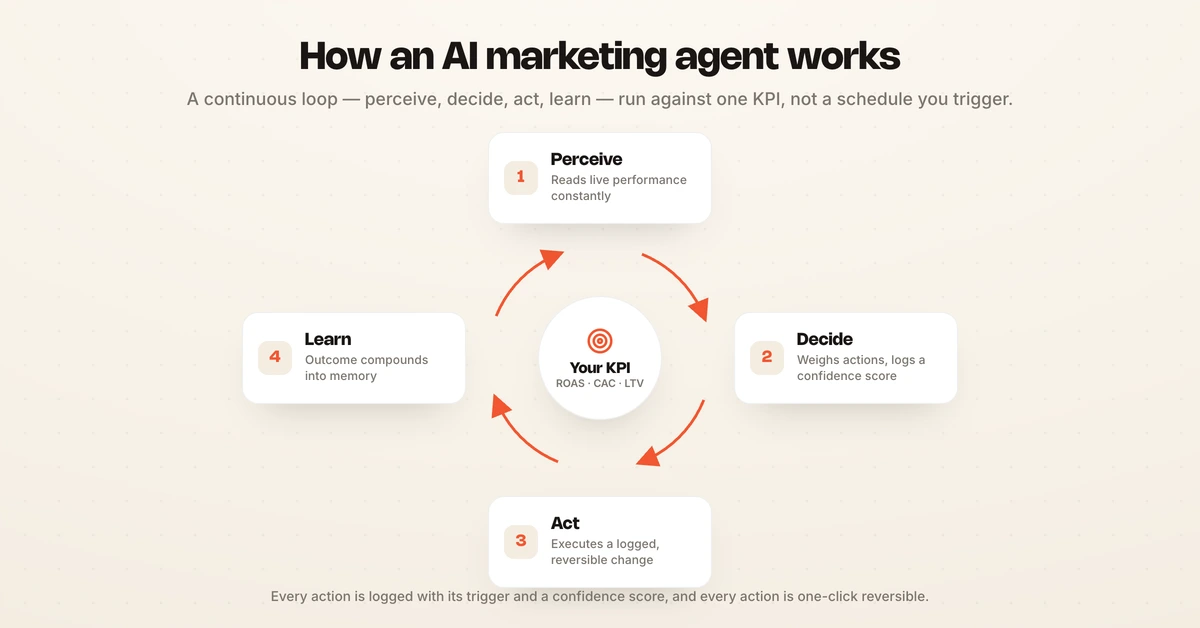
Perceive. The agent reads live performance across your accounts: spend, conversions, ROAS, CAC, creative fatigue, audience saturation. This is the same data a human buyer would open a dashboard to check, except the agent reads it constantly.
Decide. The agent evaluates possible actions against the KPI and picks the one with the strongest expected effect. It does not fire a preset trigger; it weighs shifting budget, adjusting a bid, pausing an asset, or launching a new variant, and it records a confidence score for the choice.
Act. The agent executes the change on the platform, whether that is Meta, Google, or YouTube. The action is logged with its trigger and confidence, and it is one-click reversible, so nothing the agent does is a black box or a one-way door.
Learn. The outcome feeds back into memory, so the next pass starts smarter than the last. Over weeks this is where compounding happens, and it is the part rules-based automation cannot do, because a rule never updates itself.
This loop is why an agent is categorically different from the automation most teams already run. You can see how Hawky structures campaign operation on its campaign management page, and a broader primer lives in the media buying guide, with the agent compared against DSPs and rule engines in the best media buying tools.
The autonomy spectrum: shadow mode to fully autonomous
Autonomy is not a switch you flip to on. It is a spectrum, and the safest deployments climb it gradually as trust is earned. The industry has moved from strict human-in-the-loop control, where a person signs off on every action, toward human-on-the-loop supervision, where the agent acts and the human oversees and intervenes when needed (ByteBridge).
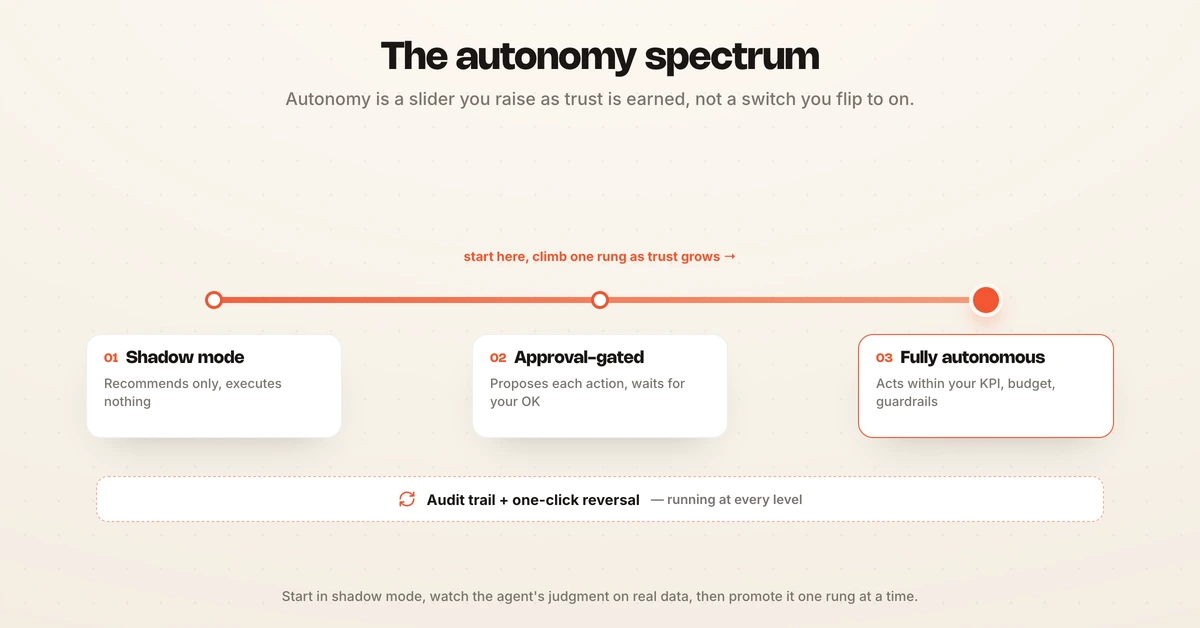
Each level trades convenience for oversight, and the control that makes it safe is different at each step.
| Autonomy level | What the agent does | The control at this level |
|---|---|---|
| Shadow mode | Watches your accounts and recommends actions, but executes nothing | You see the agent's judgment on real data with zero risk before granting any authority |
| Approval-gated | Proposes each action and waits for you to confirm before it runs | A human-in-the-loop approval gate on every change, with the trigger and confidence shown |
| Fully autonomous | Executes within the KPI, budget, and guardrails you set | Spend caps, an audit trail, and one-click reversal on any action, with escalation for edge cases |
Guardrails and human approval gates are what allow autonomy to increase safely. Research on agent design is explicit that approval gates should be built in from the start, deciding which actions need human sign-off based on their importance and reversibility, rather than bolted on later (MarTech). A well-built platform lets you start in shadow mode, watch, and promote the agent one rung at a time.
Is autonomous media buying safe?
The honest answer is that autonomous media buying is as safe as its controls, and no safer. Gartner predicts that over 40% of agentic AI projects will be canceled by the end of 2027, driven by escalating costs, unclear value, and inadequate risk controls (Gartner). The failures are rarely the model; they are the governance around it.
That is why the controls are not optional features. A trustworthy autonomous system needs spend caps so a runaway action cannot drain a budget, an audit trail so every decision is inspectable, one-click reversal so mistakes are recoverable, and human-in-the-loop approval for high-stakes moves. Guardrail frameworks for agents list rollback mechanisms and real-time monitoring as baseline requirements, not extras (Galileo).
Skepticism is warranted for another reason. In a Gartner survey, 45% of martech leaders said vendor-offered AI agents did not meet their expectations of promised business performance (Gartner). The right response is to demand proof and to keep control: run shadow mode first, insist on reversibility, and judge the agent on outcomes.
Automated bidding is already the norm, which tells you the market has crossed this bridge before. More than 80% of Google advertisers now use automated bidding, and advertisers on Smart Bidding see 20 to 40% better performance than manual bidding (Google Ads). Autonomous performance marketing extends that trusted delegation from a single bid decision to the operation of the whole campaign, with the same need for guardrails around it. For a deeper look at safe automation, see the guide to ad automation software and Google Ads automation.
Autonomous vs automated vs manual
The three approaches are often blurred, and the difference decides what you actually get. Manual buying puts a human in every loop. Automation scripts a task in advance. An autonomous agent owns the job and adapts.
| Manual | Automated | Autonomous | |
|---|---|---|---|
| Who acts | A person, every time | A rule you scripted | An AI agent, against a KPI |
| Scope | One change at a time | One predefined task | The whole job |
| Adapts to new data | Only when a person looks | No, the rule is fixed | Yes, it learns each pass |
| Speed | Human hours | Instant on trigger | Continuous |
| Control mechanism | Full manual control | The rule's threshold | Guardrails, caps, reversal, audit trail |
The cleanest way to hold the difference in your head is this. A dashboard describes the past and hands you a decision. Automation automates a task you already defined. An agent automates the job and changes the present, then shows you what it changed and why. Machine learning is the engine underneath all of it, and the glossary entry on machine learning in advertising covers that layer.
Velocity podcast
“What they are doing is rule-based AI: marketing automation is a rule engine… That is not AI native. AI native means marketing automation has to be a reasoning engine.”
Why memory and compounding matter
The stage that separates a real agent from a clever script is learning. An agent that forgets everything between actions is just automation with a language model attached. An agent with memory gets better because each decision informs the next.
This is where a shared context layer changes the outcome. When the agent operating your campaigns and the agent generating your creative draw from the same living memory, a lesson learned in one place improves the other. A creative that fatigued last month is not proposed again, and an audience that converted is remembered.
Compounding is also why autonomy pays off over a pilot rather than a single day. The loop that reads, decides, acts, and learns is only as valuable as the memory it writes to, and memory is what turns weeks of small correct decisions into a measurable lift.
How Hawky delivers autonomous performance marketing
Hawky is an agentic performance marketing platform built around two always-on agents and a Copilot, all powered by FeatherDB, a shared living-context memory that lets the agents learn from each other. The design puts autonomy and control in the same system rather than treating safety as an afterthought.
The Performance Agent operates Meta, Google, and YouTube against the KPI you choose, whether that is ROAS, CAC, LTV, or contribution margin. Every action it takes is logged with its trigger and confidence score, is one-click reversible, and stays inside your guardrails and spend caps. You can run it in shadow mode first, so you watch its judgment on real data before it touches a live budget.
The Creative Agent generates on-brand creative and routes it through your approval before anything ships, so autonomy on the media side never means unreviewed assets on the creative side. You supervise both agents from the command center, where the audit trail lives.
The results are grounded in outcomes. Across more than 200 customers, Hawky reports a 25% ROAS improvement in the first 90 days, and up to a 43% reduction in CAC in competitive categories (case study). Pricing is outcome-based and starts with a 30-day pilot, so you judge the agent on results before you commit, with details on the pricing page.
Frequently asked questions
What is autonomous performance marketing?
Autonomous performance marketing is a system where an AI agent operates paid media against a defined business KPI, deciding and executing changes on its own inside guardrails you set. Every action carries a logged trigger and confidence score and is one-click reversible, so autonomy always comes with an audit trail and human control.
How does an AI marketing agent work?
An AI marketing agent runs a continuous loop: perceive current performance, decide the best action against a KPI, act by executing that change within guardrails, and learn from the outcome into shared memory. Each pass logs what triggered the action and how confident the agent was, and every change is reversible.
Is autonomous media buying safe?
It is safe when autonomy is paired with control: spend caps, guardrails, approval gates for large moves, shadow mode to observe before acting, an audit trail, and one-click reversible actions. Gartner expects over 40% of agentic AI projects to be canceled by 2027 mostly for weak governance, so the controls are what make autonomy trustworthy.
How is an agent different from rules or automation?
Rules and automation execute a fixed task you scripted in advance, like pausing an ad below a threshold. An agent owns the job, not the task: it decides which action serves the KPI, sequences several moves, and adapts as conditions change, rather than firing a predefined trigger.
How is an agent different from a dashboard?
A dashboard describes the past. It shows you what happened and waits for a human to interpret it and act. An agent changes the present: it reads the same data, decides, and executes the change against your KPI, then reports what it did and why.
Do I lose control with an autonomous agent?
No. You set the KPI, the spend caps, and the guardrails, and you choose the autonomy level from shadow mode to approval-gated to fully autonomous. You can review the audit trail, approve or reject creative, and reverse any action with one click, so control stays with you at every level.
If your team is spending its days reading dashboards and making the same media-buying decisions by hand, Hawky's Performance Agent is built for that job.
Ready to hire your first AI performance team? Book Demo