Google Ads work for SaaS when you optimize for revenue instead of form fills, feed the algorithm offline conversion data from your CRM, and manage the long sales cycle and high cost per click. SaaS is one of the hardest verticals to run profitably on Google because keywords are expensive, intent is ambiguous, and deals close months after the click. The teams that win connect ad spend to pipeline, not to lead volume.
Google Ads is the highest-intent channel a SaaS company can buy, but it punishes the default setup harder than any other vertical. This guide covers keyword strategy, bidding, the sales-cycle problem, and the single change that separates profitable SaaS accounts from unprofitable ones.
Is Google Ads good for SaaS?
Yes, but only when the account is built for revenue rather than leads. Google Ads captures buyers at the moment they search for a solution, which is exactly when a SaaS prospect is evaluating tools, so the intent is unmatched. The problem is that the default configuration optimizes for cheap form fills, and cheap form fills in SaaS are usually researchers, students, and competitors, not buyers.
The economics are demanding. SaaS non-brand CPCs run $8.50 to $14 on average in 2026, and competitive categories like CRM, HR, or cybersecurity push $15 to $50 or more per click, per Growth Spree benchmarks. At those prices, wasting clicks on the wrong searcher is expensive fast.
The upside is that a SaaS customer's lifetime value is high, so a properly configured account can pay back a steep CPC many times over. The whole game is making sure Google learns to find the clicks that become paying customers.
Why SaaS Google Ads is different
Three structural challenges make SaaS unlike ecommerce or local services on Google. Each one breaks the default setup, and each has a specific fix.
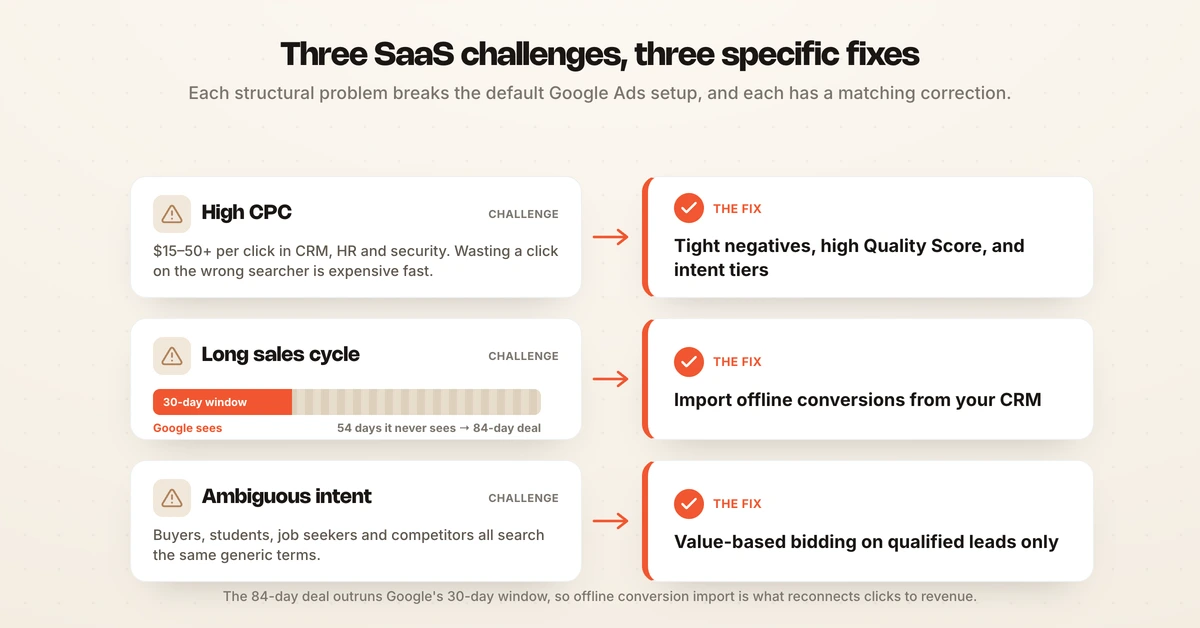
| Challenge | Why it hurts | The fix |
|---|---|---|
| High CPC | $15 – $50+ per click wastes budget fast | Tight negatives, high Quality Score, intent tiers |
| Long sales cycle | 84-day average; Google's 30-day window misses revenue | Offline conversion import from CRM |
| Ambiguous intent | Buyers, students, and competitors search alike | Value-based bidding on qualified leads |
The sales cycle is the quiet killer. SaaS deals take 84 days on average and enterprise deals 6 to 12 months, but Google's default conversion window is 30 days, so the algorithm never sees which clicks became revenue. It optimizes toward whatever converts inside the window, which is usually low-value form fills, and quietly trains itself to find more of the wrong people.
Keyword strategy: buy intent, not traffic
SaaS keyword strategy is about buying the right intent at a price the lifetime value can support. Not all high-volume keywords are worth having, and some low-volume ones are worth a premium. Structure your keywords into intent tiers and fund them accordingly.
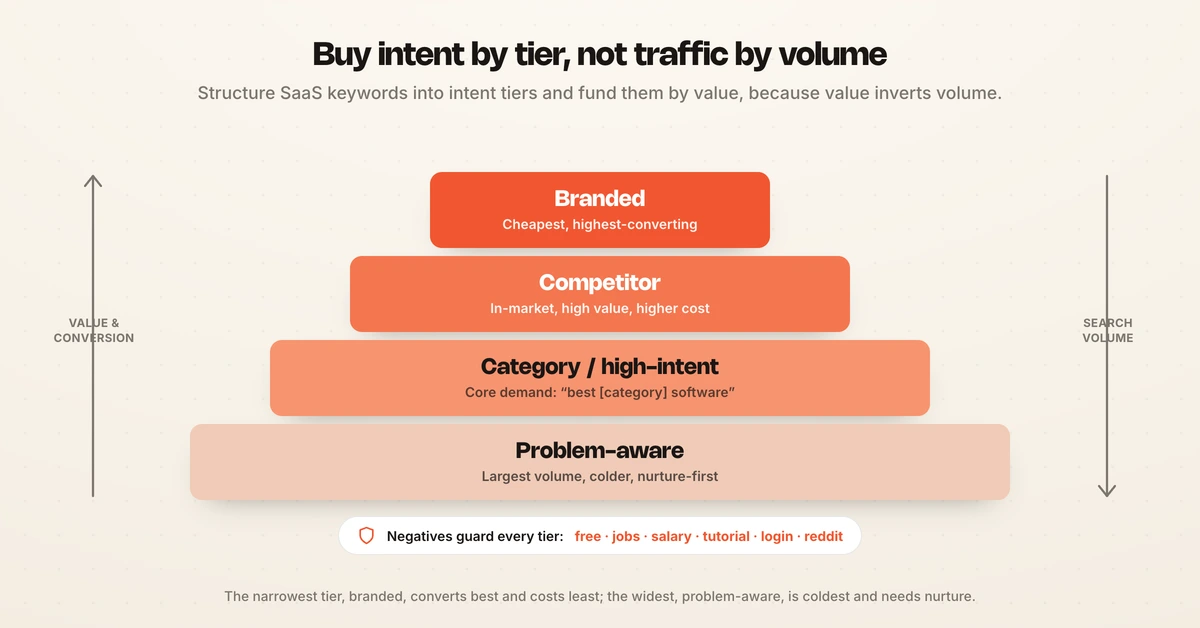
- Branded: cheapest and highest-converting; always defend your brand terms.
- Competitor: people searching rival tools are in-market; high value, higher cost.
- Category / high-intent: "best [category] software", "[category] tool"; core demand.
- Problem-aware: "how to [solve problem]"; larger volume, colder, nurture-first.
The discipline that makes SaaS accounts profitable is negative keywords. Because generic category terms attract students, job seekers, and researchers, aggressive negative lists (free, jobs, salary, tutorial, login, reddit) protect budget from clicks that will never buy. For the setup mechanics, see how to run Google Ads.
The bidding change that fixes SaaS accounts
The single most important decision in SaaS Google Ads is whether the account optimizes for form fills or for revenue. Companies that import offline conversions from their CRM and use value-based bidding generate roughly 3x more pipeline at 31% lower cost per lead, per Growth Spree. This is the change that turns a leaky account profitable.
The mechanism is offline conversion tracking, which Google supports natively by importing conversions from your CRM. You feed qualified-lead and closed-won data back to Google, so the algorithm learns that a click producing an SQL worth $500 matters more than a form fill worth $25. Then you shift bidding from Maximize Conversions to Maximize Conversion Value, telling Google to chase revenue rather than raw lead count.
The results compound. Target CPA with offline data delivers 18% to 38% lower CPA than Manual CPC once the account has 30-plus conversions per month, and value-based bidding reduces cost per SQL by 30% to 50% within 60 days. For the full breakdown of each strategy, see Google Ads bidding strategies.
Handling the long sales cycle
The long SaaS sales cycle requires giving Google signals it can learn from inside its window, then correcting with revenue data outside it. Micro-conversions bridge the gap: track demo requests, trial starts, and qualified-lead milestones as intermediate conversions so the algorithm has enough volume to optimize before deals close.
Then import the real outcomes. When a trial converts to paid or a lead becomes an SQL months later, push that back to Google as an offline conversion so the model reconnects the click to the revenue it eventually produced. Without this loop, the algorithm optimizes blind to what actually pays.
This is also why SaaS accounts need patience and clean measurement more than most. A change made today shows its real effect on pipeline weeks later, so judging campaigns on same-week form-fill cost leads you to cut the exact keywords driving your best customers.
Trial vs demo: the landing page decision
The offer on your landing page shapes lead quality as much as the keyword does. Self-serve SaaS usually points paid traffic to a free trial or freemium signup, which converts at a higher rate but brings lower-intent users who need product-led nurturing. Sales-led SaaS points traffic to a demo request, which converts at a lower rate but delivers higher-intent, sales-ready leads.
Match the offer to the price point and sales motion. Low-ACV, self-serve products do best sending high-intent search traffic straight to a trial, because the product sells itself. High-ACV, enterprise products should push to a demo, because the deal needs a human and a low-quality trial signup wastes the expensive click entirely.
Whatever the offer, the landing page must match the ad's promise and keyword intent tightly, since message match lifts Quality Score and conversion rate while lowering CPC. A generic homepage is the most common reason a well-targeted SaaS campaign still converts poorly.
Common SaaS Google Ads mistakes
Most unprofitable SaaS accounts share the same errors. Optimizing for lead volume instead of lead quality fills the CRM with junk. Ignoring negative keywords bleeds budget to non-buyers. Using Google's default 30-day window hides the revenue that justifies the spend.
The deepest mistake is treating Google Ads for SaaS like a set-and-forget channel. High CPCs and long cycles mean small misconfigurations cost real money over months, and the account needs constant negative-keyword mining, bid adjustment, and creative testing. Hawky's Performance Agent runs that optimization loop against a revenue KPI across Google, Meta, and YouTube, with guardrails, spend caps, and a full audit trail, so a high-CPC SaaS account stays tuned to pipeline instead of drifting toward cheap, worthless clicks. For channel context, see Facebook Ads vs Google Ads and the AI media buying guide.
Frequently asked questions
How do you run Google Ads for SaaS?
Run Google Ads for SaaS by optimizing for revenue, not lead volume. Structure keywords into intent tiers (branded, competitor, category, problem-aware), build aggressive negative keyword lists to block researchers and students, and import offline conversions from your CRM so Google learns which clicks become paying customers. Then use value-based bidding to chase pipeline rather than cheap form fills.
Is Google Ads good for SaaS?
Yes, when configured for revenue. Google Ads captures SaaS buyers at the exact moment they evaluate tools, giving it unmatched intent. But the default setup optimizes for cheap form fills, which in SaaS are often non-buyers, so accounts must import CRM data and bid on value. Done right, high lifetime value pays back steep CPCs many times over.
How much do Google Ads cost for SaaS?
SaaS non-brand CPCs average $8.50 to $14 in 2026, while competitive categories like CRM, HR, and cybersecurity run $15 to $50 or more per click. Top-quartile accounts reach $5 to $8.50 through strong Quality Scores and disciplined negative keywords. Because lifetime value is high, the question is not the CPC itself but whether each click connects to revenue.
What is the best bidding strategy for SaaS?
Target CPA or Target ROAS with offline conversion data imported from your CRM is the standard recommendation for B2B SaaS. Once an account has 30-plus conversions per month and revenue data flowing back to Google, value-based bidding outperforms manual CPC significantly, cutting cost per SQL by 30% to 50%. The key is feeding Google real revenue signals so it optimizes for buyers, not form fills.
How do you handle SaaS long sales cycles in Google Ads?
Bridge the gap with micro-conversions and offline import. Track demo requests, trial starts, and qualified-lead milestones as intermediate conversions so Google has enough signal to optimize before deals close. Then push closed-won and SQL data back as offline conversions so the algorithm reconnects each click to the revenue it eventually drove, weeks or months later.
If keeping a high-CPC SaaS account optimized to pipeline instead of junk leads, without watching it every day, is the problem, Hawky's Performance Agent is built for that job.
Ready to hire your first AI performance team? Book Demo