Google Ads Bidding Strategies: A Complete Guide for 2026
Google Ads bidding strategies fall into two groups: manual bidding, where you set cost-per-click yourself, and automated bidding, where Google's AI sets bids for you against a goal. The automated group includes Maximize clicks, Maximize conversions, Maximize conversion value, Target CPA, Target ROAS, and Target impression share, and the four conversion-focused ones together form what Google calls Smart Bidding. Choosing the right one comes down to your objective, your control preference, and how much conversion data your account has.
Most advertisers do not lose money on a bad strategy pick. They lose it because the strategy they picked stops matching their goal the moment the account changes, and nobody adjusts it. This guide walks through every current option, when to use each, and where an AI agent takes the work past the bid itself.
What Google Ads bidding strategies are
A bidding strategy tells Google how to compete in the ad auction each time your ad is eligible to show. Every impression is decided by a real-time auction, and your bid is one of the inputs that determines whether your ad appears and where.
You can set that bid manually for each keyword, or you can hand the decision to Google's algorithms and give them a target instead. Google's automated bid strategies each optimize toward a different outcome, so the strategy you pick is really a statement of what you want the campaign to produce.
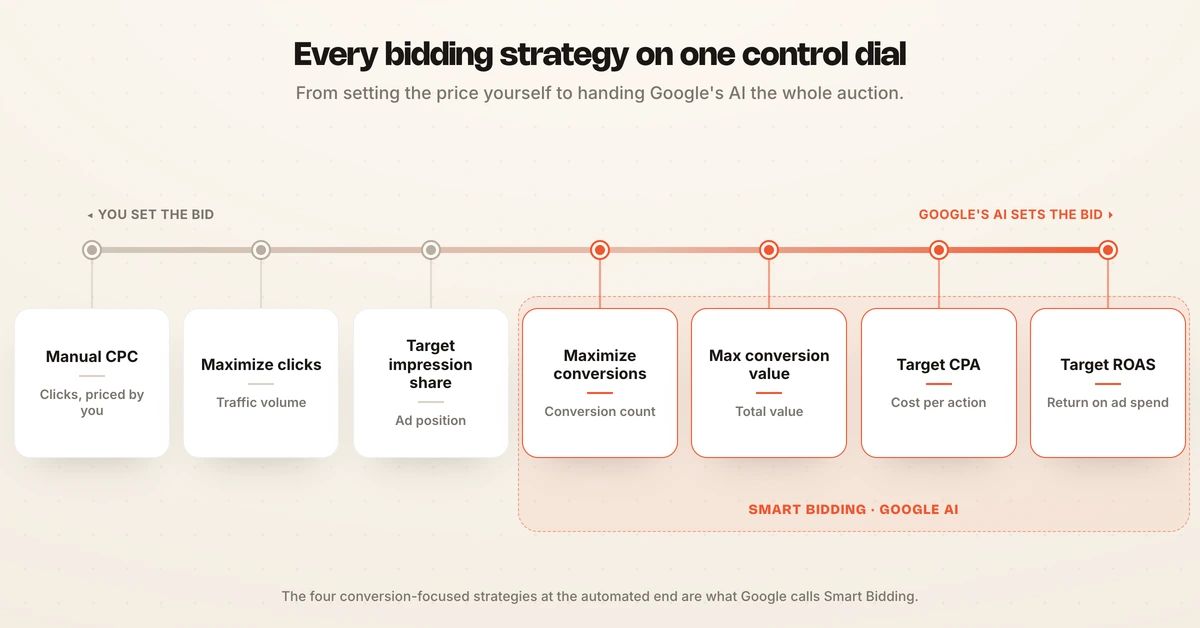
Manual CPC vs Smart Bidding
Manual CPC means you set the maximum cost-per-click for each ad group or keyword yourself. It gives you complete control over bids, which can be useful on brand-new accounts with almost no conversion history or on very small budgets where you want to cap spend tightly.
Smart Bidding is the opposite approach. Instead of setting a price per click, you set a goal, such as a cost per action or a return target, and Google's AI sets the bid in every single auction to hit it. Google calls this auction-time bidding, and it reads signals like device, location, time of day, and browser that a person cannot weigh manually at scale, according to Google Ads Help.
The manual cpc vs smart bidding decision usually resolves in favor of Smart Bidding once you have reliable conversion tracking and enough volume for the model to learn. Note that Enhanced CPC, the old hybrid that let Google adjust manual bids up or down, was retired for Search and Display campaigns as of March 31, 2025, per Google's automated bidding documentation.
| Strategy | What it optimizes | Best for | Control level |
|---|---|---|---|
| Manual CPC | Cost per click you set | New or tiny accounts with little data | Full manual |
| Maximize clicks | Clicks within budget | Driving traffic and site visits | Automated, budget-capped |
| Maximize conversions | Conversion volume within budget | Lead volume without a fixed CPA | Automated |
| Maximize conversion value | Total conversion value within budget | Revenue when values differ | Automated |
| Target CPA | Conversions at a set cost per action | Steady cost-per-lead goals | Automated with target |
| Target ROAS | Conversion value at a set return | Revenue and profit goals | Automated with target |
| Target impression share | Ad position and visibility | Brand terms and awareness | Automated with target |
Maximize clicks
Maximize clicks is the simplest automated strategy. It sets bids to get as many clicks as possible within your budget, so it optimizes for traffic rather than outcomes.
It fits early-stage campaigns where you are gathering data, testing landing pages, or trying to build enough volume to graduate to a conversion strategy later. It does not care what happens after the click, so it is a poor fit once conversions are your real goal.
Maximize conversions
Maximize conversions uses Google's AI to get the most conversions possible while spending your budget. You do not set a cost target, so the algorithm spends the full budget chasing volume.
This works well when you have a fixed daily budget you intend to spend and you care about conversion count more than cost per conversion. If you later want to control cost, you can add a Target CPA to this strategy, which shifts it toward the Target CPA behavior described below.
Maximize conversion value
Maximize conversion value optimizes for the total value of conversions rather than the raw count. It suits accounts where different conversions are worth different amounts, such as ecommerce stores with a wide range of order sizes.
The strategy requires that you pass conversion values back to Google, usually through ecommerce tracking. Without accurate values, the algorithm has nothing to maximize, so value tracking is a prerequisite, not an optional extra.
Target CPA
Target CPA bidding sets bids to get as many conversions as possible at the average cost per action you specify. It treats every conversion as equal, which makes it a strong choice for lead generation where each lead has roughly the same worth.
You can start Target CPA with no conversion history, but Google recommends evaluating performance over at least 30 conversions in the last 30 days, according to Google Ads Help. Below that, the target may swing because the model has too little data to price each auction reliably.
Target ROAS
Target ROAS bidding sets bids to get as much conversion value as possible at the return on ad spend you target. It favors higher-value conversions, so it fits revenue and profit goals where a sale worth USD 500 should outweigh one worth USD 20.
For Search and Shopping campaigns, Google recommends at least 15 conversions in the past 30 days before using target roas bidding, and several other campaign types recommend around 50 conversions in a recent window, per Google Ads Help. More history gives the model a better read on which searches lead to valuable conversions.
Target impression share
Target impression share sets bids to show your ad at a position you choose: the absolute top of the page, the top, or anywhere on the results page. It optimizes for visibility rather than clicks or conversions.
It is most useful on brand terms you want to dominate, or in competitive categories where being seen matters for awareness. Because it chases position, it can raise costs quickly, so it needs a bid cap and monitoring.
How to choose the best bidding strategy for Google Ads
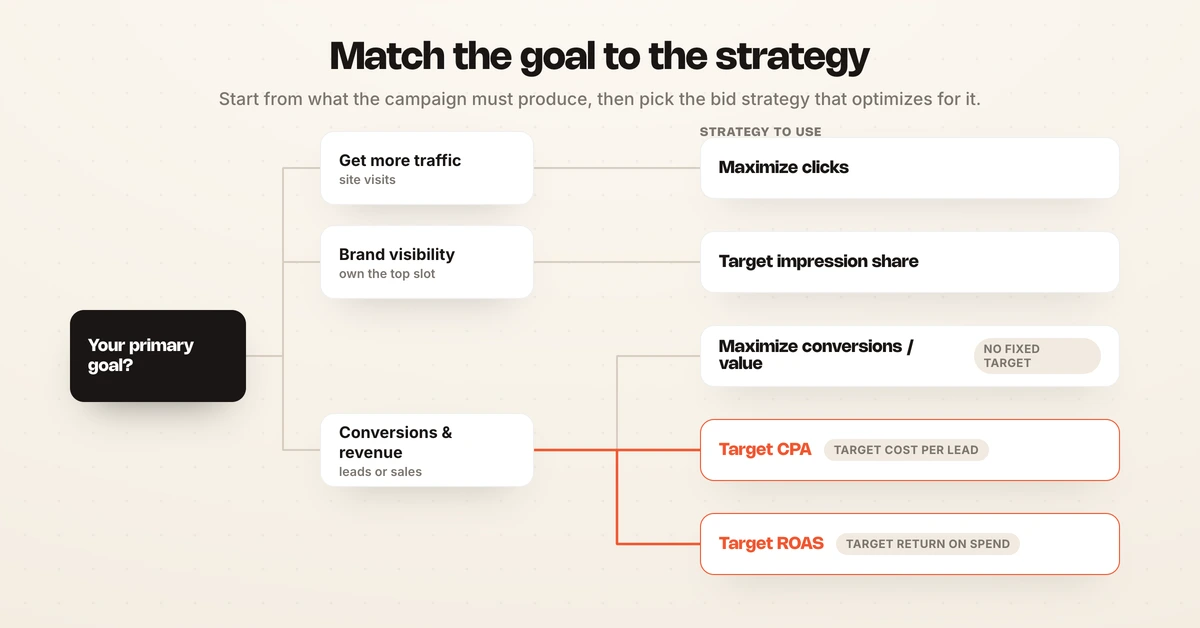
The best bidding strategy for Google Ads is the one that matches your primary goal and the data you have. Start from the objective, then check whether your account has the conversion volume that strategy needs to perform.
If you are still building data, Maximize clicks or Maximize conversions keeps things moving. Once you have consistent conversions and a clear cost or value target, Target CPA or Target ROAS usually produces better results because they optimize toward the number that actually matters to your business.
| Your goal | Strategy to use | Why |
|---|---|---|
| Get more site traffic | Maximize clicks | Optimizes for clicks within budget |
| Maximum brand visibility | Target impression share | Targets ad position on the page |
| More leads, no fixed cost | Maximize conversions | Chases conversion volume with your budget |
| Leads at a set cost | Target CPA | Holds an average cost per action |
| Revenue when values vary | Maximize conversion value | Optimizes total conversion value |
| Revenue at a set return | Target ROAS | Optimizes value against a ROAS target |
For campaign types like Performance Max and Responsive Search Ads, the bidding choice interacts with how the format itself is built. It helps to understand Performance Max and Responsive Search Ads before locking a strategy, since both lean heavily on machine learning in advertising to fill the gaps you leave open.
What Smart Bidding requires to work
Smart Bidding is only as good as the conversion data feeding it. Accurate conversion tracking is the baseline, because the algorithm is optimizing toward events it can measure. Weak or missing tracking produces weak bidding, no matter which strategy you choose.
Volume matters too. The four Smart Bidding strategies, Target CPA, Target ROAS, Maximize conversions, and Maximize conversion value, all improve with more conversions to learn from, which is why Google publishes recommended thresholds like at least 30 conversions in 30 days for Target CPA evaluation. Frequent target changes reset the learning, so stability in your goals helps the model settle.
If you want the wider context on where automated bidding fits in a Google account, our guide to Google Ads automation covers the surrounding levers, and our breakdown of Google Ads cost explains how bidding choices flow through to what you actually pay.
Where an AI agent goes beyond Smart Bidding
Smart Bidding automates one thing well: the bid. It answers the question "what should I pay for this auction" thousands of times a day, but it does not decide which strategy to run, when to switch, how to split budget across campaigns, or whether the target you set is still the right one.
That larger loop is still a human job in most accounts, and it is the job that drifts. A Target ROAS set in January can quietly underperform by April because the market shifted and nobody revisited it. Smart Bidding will keep optimizing toward the wrong number without complaint.
An AI agent works one level up. Rather than automating the bid inside a strategy you chose, it automates the whole optimization job against a KPI you set: it selects the strategy, watches performance across campaigns, and adjusts, with guardrails, an audit trail, reversible actions, and configurable autonomy so you decide how much it can do on its own. This is the difference between automating a task and delegating an outcome.
Hawky's Performance Agent is built for that tier. It runs across Meta, Google, and YouTube, sets and adjusts strategy against your goal, and keeps you in control through campaign management with a full record of every change it makes. Early customers have seen a 25% ROAS lift in the first 90 days, and more than 200 teams now run on the platform, detailed in the Hawky case studies.
You can see how that maps to your account structure and budget on the pricing page. The point is not to replace Smart Bidding but to put a decision-maker above it that never forgets to check whether the strategy still fits.
Frequently asked questions
What is the best bidding strategy for Google Ads?
There is no single best bidding strategy for Google Ads. The right choice depends on your goal and your conversion data. Maximize clicks suits traffic goals, Maximize conversions and Target CPA suit lead-volume goals, and Target ROAS suits value or revenue goals once you have enough conversion history for Google's AI to model.
What is Smart Bidding?
Smart Bidding is a set of Google Ads bid strategies that use Google AI to optimize for conversions or conversion value in every auction, a feature Google calls auction-time bidding. The four Smart Bidding strategies are Target CPA, Target ROAS, Maximize conversions, and Maximize conversion value.
When should I use Target ROAS?
Use Target ROAS when your conversions carry different values and you want to hit a specific return on ad spend. Google recommends at least 15 conversions in the past 30 days for Search and Shopping campaigns, though higher volumes give the algorithm more data to model value accurately.
What is the difference between Target CPA and Target ROAS?
Target CPA optimizes for the number of conversions at a set average cost per action, so every conversion is treated as equal. Target ROAS optimizes for conversion value at a set return target, so it favors higher-value conversions. Use Target CPA for lead volume and Target ROAS for revenue or profit goals.
Is Manual CPC better than Smart Bidding?
Manual CPC gives you full control over each bid, which can help on very small or new accounts with little conversion data. Smart Bidding usually outperforms manual bidding once you have consistent conversion tracking, because it adjusts bids in every auction using signals a person cannot process manually.
How many conversions do you need for Smart Bidding?
Google recommends measuring Target CPA over at least 30 conversions in the last 30 days, and at least 15 conversions in the past 30 days for Target ROAS on Search and Shopping. You can start Target CPA with no conversion history, but more data produces more stable results.
If your bidding strategy is set correctly but nobody has time to keep it correct as the account changes, Hawky's Performance Agent is built for that job.
Ready to hire your first AI performance team? Book Demo