Responsive Search Ads (RSA)
Last updated
Google Search ads where you provide multiple headlines and descriptions, and Google's AI automatically tests combinations to find what performs best for each query.
Responsive Search Ads (RSA)
Master Google's Responsive Search Ads. Learn how to use AI to test headlines and descriptions, and how Hawky helps you generate winning search copy.
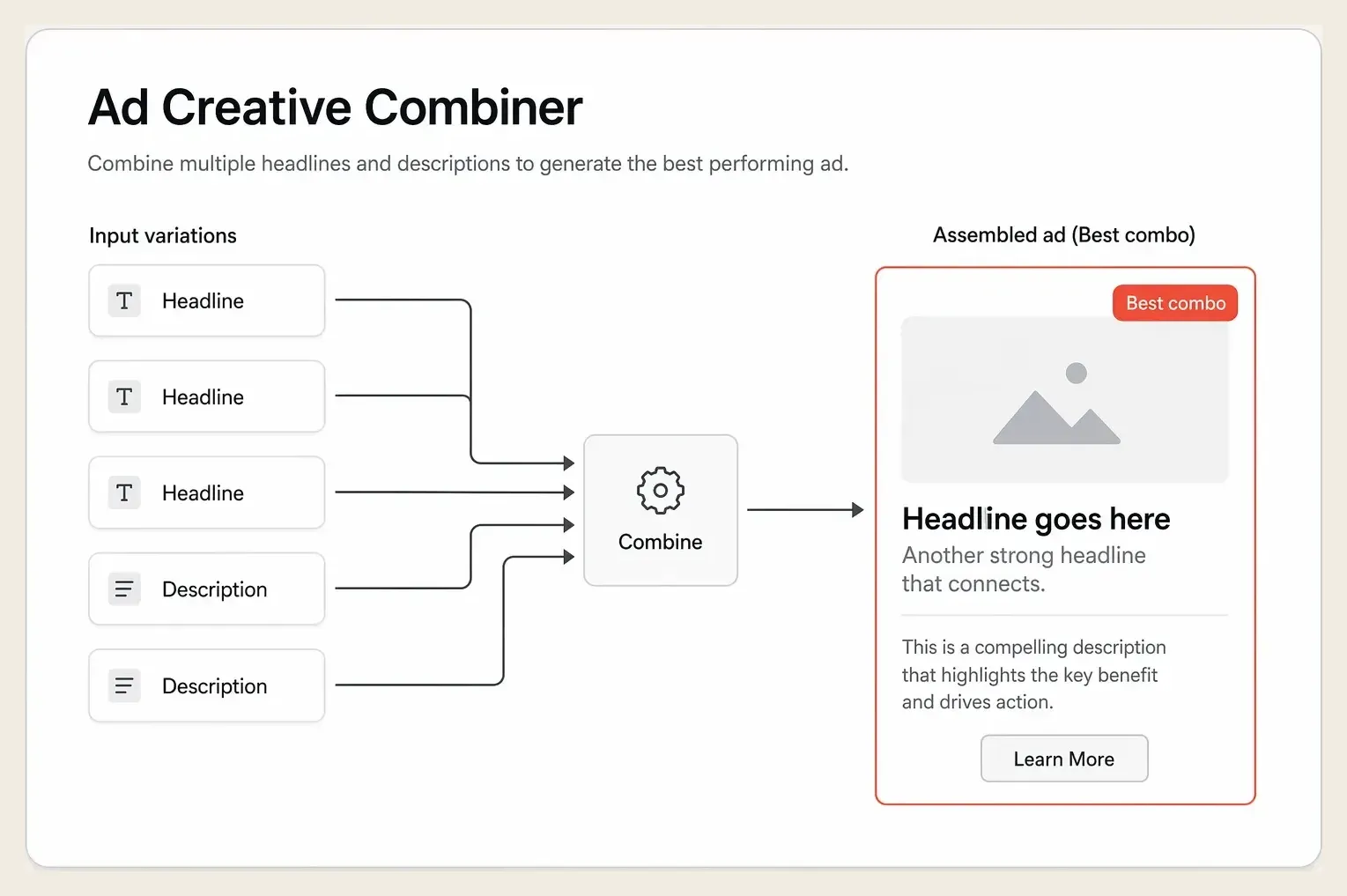
Responsive Search Ads (RSA) are a flexible Google Ads format that uses machine learning to assemble multiple headlines and descriptions into a single text ad. You provide up to 15 headlines and 4 descriptions, and Google automatically tests different combinations to determine which one performs best for specific users and search terms. RSAs are now the only standard search ad type Google offers, having fully replaced the older Expanded Text Ad in 2022.
Why It Matters
RSAs let your ads adapt to the near-infinite variety of ways people phrase a search. Because the ad is responsive, it competes in more auctions and matches a wider range of queries than any static ad could. Google reports that advertisers who switch to RSAs in their ad groups see up to 7% more conversions at a similar cost, driven by better query coverage and higher relevance.
That flexibility compounds with Quality Score. A more relevant ad earns a higher CTR, which lifts Quality Score, which in turn lowers your CPC and improves ad rank. The format rewards advertisers who feed it diverse, high-quality assets and punishes those who treat it like a static ad with extra slots.
How It Works
- Asset pooling: you input up to 15 headlines (30 characters each) and 4 descriptions (90 characters each), and Google builds combinations from that pool.
- Automated testing: Google's AI serves different combinations and predicts which will perform best based on the user's device, location, past behavior, and search intent.
- Pinning control: you can pin a specific headline (a legal disclaimer or brand name) to a fixed position, though heavy pinning limits the system's ability to optimize.
- Ad Strength scoring: Google grades each ad from Poor to Excellent based on the quantity, diversity, and relevance of your assets before the ad goes live.
The system needs raw material to work with. The more distinct angles you supply (features, benefits, offers, social proof, urgency), the more combinations Google can test and the faster it converges on winners. Thin or repetitive asset pools starve the algorithm and cap your performance.
A Real Example
An e-commerce brand selling eco-friendly yoga mats sets up an RSA with headlines including "Eco-Friendly Yoga Mats," "Non-Slip Grip Technology," "Save 10% on Your First Order," and "Free Shipping Over $50."
For a user searching "best non-slip yoga mat," Google surfaces the "Non-Slip" headline first. For a user searching "cheap sustainable yoga mat," it prioritizes "Eco-Friendly" and "Save 10%." The same ad shows two very different faces depending on intent.
By running this RSA instead of a static ad, the brand saw a 32% increase in conversions and watched its Ad Strength climb from Average to Excellent. The ad self-optimized for every unique shopper, and the wider query coverage pulled in long-tail searches the old static copy never matched.
Common Mistakes
| The Mistake | ❌ The Wrong Way | ✅ The Hawky Way |
|---|---|---|
| Repetitive Messaging | Writing 10 headlines that all say "Buy Yoga Mats Now." | Providing diverse angles: features, benefits, offers, and social proof. |
| Over-Pinning | Pinning every headline to a fixed spot, turning the RSA into a static ad. | Pinning only what is legally or brand-critical so the system can optimize. |
| Ignoring Asset Labels | Keeping "Low" performing assets active for months. | Replacing underperforming headlines with fresh hooks generated by Hawky. |
How Hawky Helps
When your RSA assets hit ad saturation and a strong Ad Strength rating still isn't translating into sales, the problem is usually the copy itself. Hawky's Creative Agent generates new headline and description variants built on the angles that actually win auctions in your category, then feeds them back into your asset pool so Google has stronger raw material to test.
The Creative Agent does not just report which assets are weak. It writes the replacements, drawing on patterns across millions of search and social ads stored in FeatherDB, so each new variant is grounded in what has converted before rather than guesswork. That turns the slow grind of manual headline rewriting into a continuous supply of tested copy.
Frequently Asked Questions
How many headlines should I use for a Responsive Search Ad?
Use all 15 headline slots and all 4 description slots whenever possible. Google's machine learning needs a deep, varied asset pool to test enough combinations, and ad groups with fewer assets almost always earn a lower Ad Strength. Make the headlines genuinely different from each other rather than 15 rewordings of the same idea.
What is a good Ad Strength for an RSA?
Aim for "Good" or "Excellent." Google's data shows that improving Ad Strength from Poor to Excellent can lift conversions by around 9%. Ad Strength is a diagnostic of asset diversity and relevance, not a guarantee of results, but ignoring a Poor rating almost always leaves performance on the table.
Should I pin headlines in Responsive Search Ads?
Pin only when you must, such as a required legal line or a brand name that has to appear first. Every pin you add removes combinations Google can test, which usually lowers Ad Strength and slows optimization. If you need tight control over messaging, consider running a second unpinned RSA alongside it to compare.
Are Responsive Search Ads better than Expanded Text Ads?
Yes, and the comparison is moot because Expanded Text Ads were retired in 2022. RSAs are now the default search ad format, and their dynamic assembly consistently outperforms static copy by matching more queries and adapting to user intent in real time.
Quick Takeaway
Responsive Search Ads use Google's AI to build the best ad for every search. Feed the system diverse, high-quality assets and let it optimize the combinations, and use a Creative Testing Framework to keep replacing weak headlines with fresh ones.
Stop guessing which headlines will win and let an agent generate the copy that does. Ready to hire your first AI performance team? Book Demo