Retargeting Ads: How They Work and How to Run Them in 2026
Retargeting ads are paid ads shown to people who already interacted with your brand, such as site visitors, cart abandoners, or past customers. Because these audiences are warm, retargeting converts 3 to 5 times higher than prospecting to cold audiences. In 2026, retargeting runs on a two-layer tracking setup (browser pixel plus server-side Conversions API) to survive privacy changes that broke the old model.
Retargeting is the highest-efficiency spend in most paid media accounts, but privacy shifts have changed how it works. This guide explains what retargeting ads are, how they function, which audiences to build, and how to run them profitably now that identifier-based tracking is shrinking.
What are retargeting ads?
Retargeting ads are advertisements served specifically to people who have already shown interest in your brand, rather than to new, cold audiences. If someone visits your site, views a product, or adds an item to cart and then leaves, retargeting brings your ad back in front of them on Meta, Google, or YouTube to pull them back toward a purchase. For a quick definition, see the retargeting glossary entry.
The logic is simple: warm audiences convert far better than cold ones. Someone who already browsed your product is closer to buying than a stranger, so a dollar spent reminding them is more efficient than a dollar spent finding someone new. Retargeting consistently delivers 3 to 5 times higher conversion rates than cold prospecting, per Flighted, which is why it posts the highest ROAS of any campaign type.
Retargeting and remarketing are often used interchangeably. Technically, retargeting usually refers to paid ads shown to past visitors, while remarketing sometimes refers to re-engagement over email, but in everyday use they mean the same thing: winning back people who did not convert the first time.
How retargeting ads work
Retargeting works by tracking who interacts with your brand, storing them in an audience, and then serving ads to that audience. The process runs in three steps, and each depends on clean tracking.
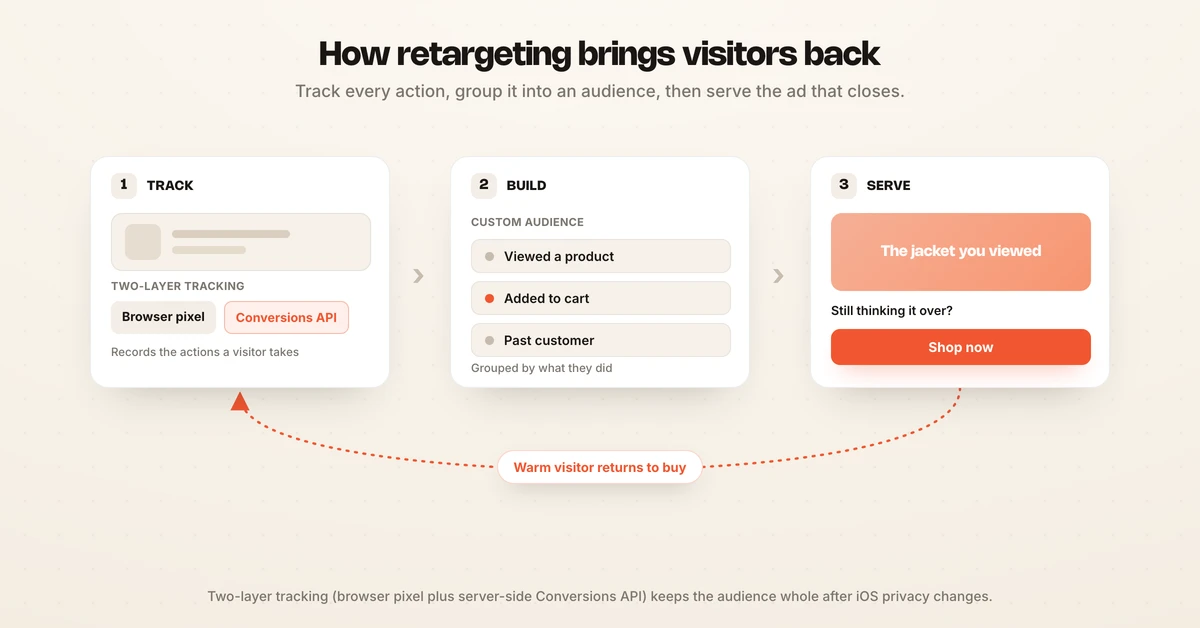
- Track: a pixel or tag (like the Meta Pixel) and the server-side Conversions API record actions people take on your site.
- Build: those actions feed a Custom Audience, a list of people grouped by what they did, such as viewed a product or abandoned a cart.
- Serve: the ad platform shows tailored ads to that audience, often featuring the exact products they viewed through dynamic product ads.
The tighter the audience definition, the better the result. A generic "all site visitors" audience wastes spend on bounced traffic, while a "viewed product but did not purchase in the last 7 days" audience concentrates budget on people with real intent.
Types of retargeting audiences
Retargeting is only as good as the audiences you build, and different actions signal different intent. Segmenting by behavior lets you match the message to how close someone is to buying. Warmer audiences deserve stronger offers.
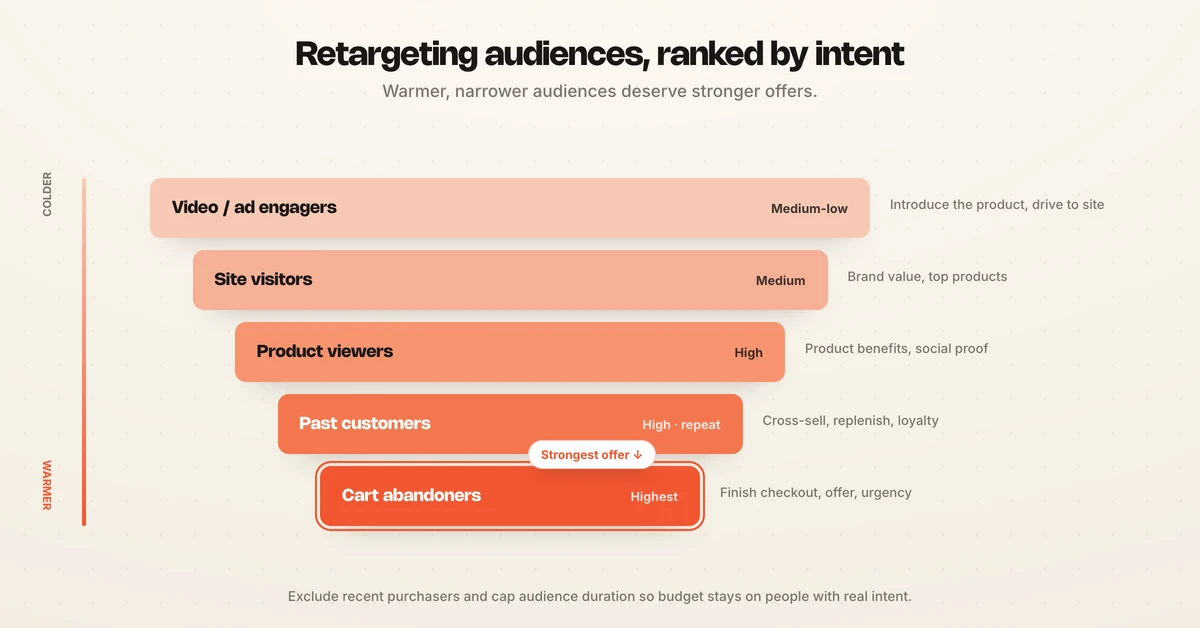
| Audience | Intent level | Typical message |
|---|---|---|
| Cart abandoners | Highest | Finish checkout, offer, urgency |
| Product viewers | High | Product benefits, social proof |
| Site visitors (non-product) | Medium | Brand value, top products |
| Video / ad engagers | Medium-low | Introduce product, drive to site |
| Past customers | High (for repeat) | Cross-sell, replenishment, loyalty |
Layering exclusions matters as much as the audiences themselves. Always exclude recent purchasers from acquisition retargeting so you do not pay to convert someone who already bought, and cap how long people stay in an audience so you are not chasing visitors who lost interest weeks ago.
Velocity podcast
“If you do that without excluding properly, you're going to end up with the same person in three stages, and now your campaign and your ad sets are competing with each other.”
The privacy shift: why retargeting changed
Retargeting broke and then rebuilt after Apple's privacy changes, and understanding that shift is essential to running it now. Apple's App Tracking Transparency framework opts roughly 75% of iOS users out of identifier-based tracking, which shrinks browser-pixel audiences and starves campaigns of signal, per Cometly. The old pixel-only model no longer sees most of your traffic.
The fix is two-layer tracking. Modern retargeting runs the browser-side pixel and the server-side Conversions API in parallel, so when the pixel misses an event, the server-side connection still reports it. Per Meta's Conversions API documentation, the server-side connection recovers a double-digit percentage of otherwise-lost conversions, which is why it is the single most important setup step in the post-privacy era.
Without server-side tracking, your retargeting audiences are a fraction of their true size and your campaigns underperform for reasons that never show up in the dashboard. Setting up the Conversions API is no longer optional for any brand serious about retargeting.
Retargeting best practices for 2026
Profitable retargeting comes down to a few disciplines that prevent waste and fatigue. The warm audience is small and valuable, so how you treat it decides the return.
- Control frequency: keep impressions to roughly 3 to 7 per week. Beyond that, retargeting turns from helpful reminder to annoying stalker and fatigues fast.
- Budget proportionally: allocate around 20% to 30% of paid budget to retargeting, adjusting for audience size and conversion speed. Over-spending exhausts a small audience.
- Segment by intent: run separate campaigns for cart abandoners, viewers, and past customers rather than one blended audience.
- Refresh creative: warm audiences see your ads often, so they fatigue faster; rotate creative to keep them fresh.
The frequency and fatigue problem is where retargeting quietly bleeds money. Because the audience is small and sees ads repeatedly, creative wears out in days, and a stale retargeting ad both stops converting and irritates your warmest prospects. For the broader fatigue mechanics, this is the same dynamic that hits every warm-audience campaign.
Retargeting across platforms
Retargeting works on every major ad platform, but each does it differently. Meta is the most common home for retargeting, with mature Custom Audiences, dynamic product ads, and the deepest behavioral signal, which makes it the default for ecommerce re-engagement. Its two-layer pixel and Conversions API setup is the reference standard.
Google retargets across Search, Display, and YouTube through remarketing lists and dynamic remarketing, letting you follow a visitor with a banner while they browse or a video ad on YouTube. Because Google's inventory is so broad, frequency control matters even more, since the same person can see your ad across many sites in a day.
The strongest programs retarget across platforms in a coordinated way rather than treating each in isolation. A shopper who browsed on your site might be retargeted on Instagram, then reminded by a YouTube ad, then closed by a Google Shopping ad on a branded search. Running that sequence without over-serving any one person is where cross-platform coordination pays off, and where a single agent controlling all channels beats managing each ad account separately. See how the platforms compare in Facebook Ads vs Google Ads.
How to measure retargeting: incrementality
The hardest question in retargeting is whether it drives new revenue or just claims credit for sales that would have happened anyway. Because retargeting reaches people already close to buying, standard attribution over-credits it, making it look better than it is. Incrementality testing settles the question.
An incrementality or holdout test suppresses ads from a random slice of your retargeting audience, then compares conversion rates between the exposed group and the held-out group. The difference is the true lift, the conversions retargeting actually caused. Without this, you cannot know if your retargeting budget is generating revenue or harvesting it.
Running this well across audiences and platforms is more than most teams can manage by hand. Hawky's Performance Agent manages retargeting alongside prospecting across Meta, Google, TikTok, and YouTube, controlling frequency, refreshing creative before fatigue, and optimizing against your true KPI with guardrails and a full audit trail. For where retargeting fits in the ecommerce funnel, see Facebook Ads for ecommerce.
Frequently asked questions
What are retargeting ads?
Retargeting ads are paid ads shown to people who have already interacted with your brand, such as visiting your site, viewing a product, or abandoning a cart. Instead of reaching cold strangers, they re-engage warm audiences who are closer to buying. Because of that warmth, retargeting typically converts 3 to 5 times higher than prospecting to new audiences.
How do retargeting ads work?
Retargeting works in three steps: a pixel and server-side Conversions API track what people do on your site, those actions build a Custom Audience grouped by behavior, and the ad platform serves tailored ads to that audience. Often the ads show the exact products someone viewed through dynamic product ads. The tighter the audience definition, the more efficient the spend.
Do retargeting ads still work with privacy changes?
Yes, but the setup changed. Apple's App Tracking Transparency opts out roughly 75% of iOS users from identifier tracking, which shrinks pixel-only audiences. The fix is two-layer tracking: run the browser pixel and the server-side Conversions API together so the server connection recovers events the pixel misses. With the Conversions API in place, retargeting remains one of the highest-ROAS tactics available.
What is the difference between retargeting and remarketing?
The terms are mostly used interchangeably. Technically, retargeting refers to paid ads shown to past site visitors, while remarketing sometimes refers to re-engaging existing contacts through email. In everyday marketing conversation, both describe the same goal: bringing back people who showed interest but did not convert the first time.
How much of my budget should go to retargeting?
A common starting point is 20% to 30% of your total paid media budget, adjusted for audience size and conversion velocity. Retargeting audiences are small, so spending too much exhausts them and drives up frequency and fatigue. Most of your budget should still go to prospecting to keep filling the funnel that retargeting later converts.
If keeping retargeting and prospecting balanced across platforms, with frequency controlled and creative refreshed before it fatigues, is the problem, Hawky's Performance Agent is built for that job.
Ready to hire your first AI performance team? Book Demo