Facebook Ads work for ecommerce when you run a simple account structure, feed the algorithm a clean product catalog, and ship a high volume of creative. In 2026, Meta's AI does most of the targeting through Advantage+ Shopping Campaigns, so the winning brands compete on creative and catalog quality, not on manual audience building. Facebook remains one of the highest-ROAS channels for visual, considered-purchase products.
Ecommerce is the use case Facebook Ads were built for. This guide covers the account structure, campaign types, catalog setup, creative cadence, and budget that drive revenue on Meta in 2026, plus the mistakes that quietly burn spend.
Are Facebook Ads good for ecommerce?
Yes. Facebook Ads are one of the strongest paid channels for ecommerce because the platform pairs visual, feed-native formats with the largest interest-and-behavior targeting system in advertising. For products people buy on sight, apparel, beauty, home, and lifestyle, Meta puts the product in front of the right buyer before they even search for it.
The economics fit ecommerce well. Facebook generates demand rather than waiting for it, which lets stores scale beyond the ceiling of existing search volume. Its retargeting is the most mature in the market, so the warm-audience campaigns that close most ecommerce sales run efficiently, often at ROAS well above break-even.
The catch is competition and creative fatigue. Because every ecommerce brand is on Meta, creative is the battleground, and ads tire fast. Winning is less about a clever audience and more about a steady stream of fresh, on-brand creative feeding a clean catalog.
The 2026 Facebook ecommerce account structure
Simple account structures outperform complex ones on Meta in 2026, because the algorithm now finds buyers better than manual segmentation does, but only when given room to operate. The old approach of dozens of tightly segmented ad sets starves the algorithm of data and should be retired.
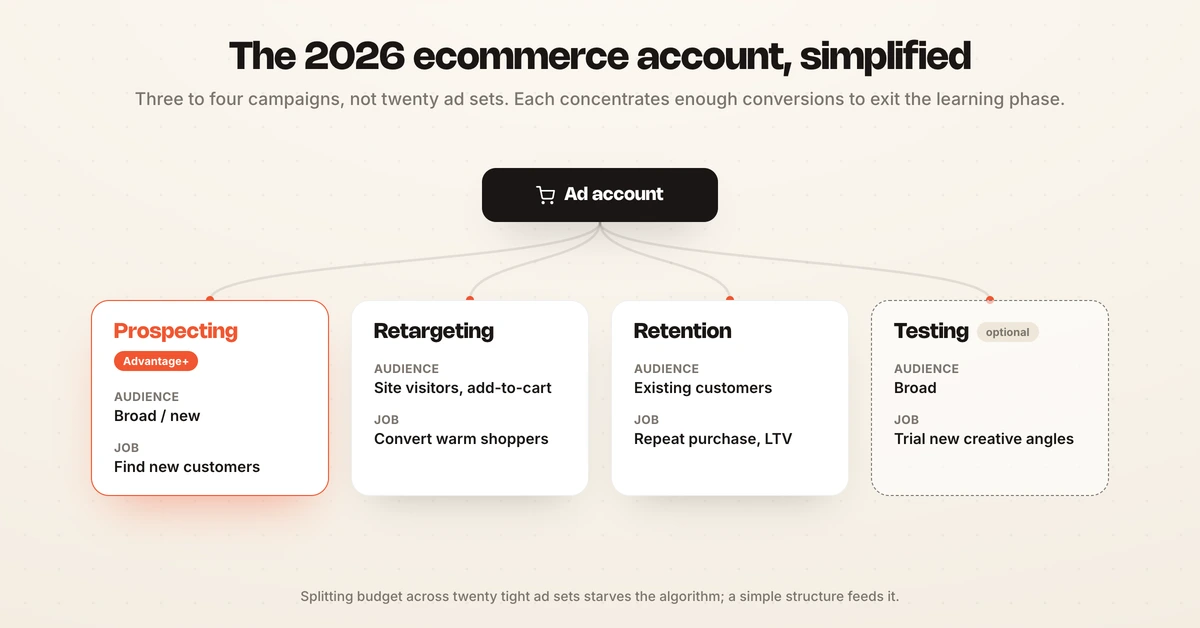
Run three to four campaigns maximum:
- Prospecting: one broad Advantage+ Shopping campaign to find new customers.
- Retargeting: one campaign for warm audiences (site visitors, add-to-carts, engagers).
- Retention: one campaign for existing customers and repeat purchase.
- Testing (optional): one campaign to trial new creative angles before promoting winners.
| Campaign | Audience | Job |
|---|---|---|
| Prospecting (Advantage+) | Broad / new | Find new customers |
| Retargeting | Site visitors, add-to-cart | Convert warm shoppers |
| Retention | Existing customers | Repeat purchase, LTV |
| Testing (optional) | Broad | Trial new creative angles |
This structure concentrates data instead of fragmenting it. Each campaign accumulates enough conversion events to exit the learning phase and optimize, which is impossible when budget is split across twenty ad sets, per OptiFOX 2026 best-practice analysis. For a full setup walkthrough, see how to run Facebook Ads.
Advantage+ Shopping Campaigns
Advantage+ Shopping Campaigns (ASC) are Meta's AI-driven campaign type for ecommerce, and they outperform manual structures for most stores in 2026. ASC consolidates prospecting and retargeting into one campaign that automatically tests up to 150 creative combinations and lets the algorithm allocate budget to what converts, per Meta.
The trade is control for performance. You give up granular audience and placement control, and in return the algorithm optimizes across the full funnel faster than a human can. For most ecommerce brands past the data threshold, that trade pays off, which is why Meta has made ASC the default and is phasing manual shopping structures out.
ASC needs fuel to work: enough budget and conversion volume to exit the learning phase, which now requires roughly 50 optimization events per week. Below that, the algorithm never stabilizes, so undersized budgets are the most common reason ASC underdelivers.
Product catalog and dynamic product ads
Your product catalog is the engine behind ecommerce retargeting, and its quality directly caps your performance. Dynamic Product Ads (DPA) pull from the catalog to show each shopper the exact products they viewed or added to cart, which is the highest-ROAS format most stores run. A messy catalog breaks that entire system.
Keep the catalog clean and current:
- Images: high quality, at least 500x500 pixels, consistent framing.
- Titles and descriptions: accurate, at least 100 characters, keyword-relevant.
- Pricing and availability: exact and synced, so out-of-stock items stop serving.
- Feed updates: at least daily, more often for fast-moving inventory.
Out-of-stock products and price mismatches cause wasted spend and ad disapprovals, so feed hygiene is not optional. Brands with large or fast-changing catalogs should automate feed updates rather than manage them by hand.
Creative strategy: volume is the lever
Creative is the single biggest driver of ecommerce ad performance on Meta, and volume is how you win. Top-performing ecommerce accounts test 15 to 25 new creatives per month, though that means variations across hooks, formats, and angles, not 25 unrelated concepts. One strong concept yields four or five testable variations through different opening hooks, CTAs, and treatments.
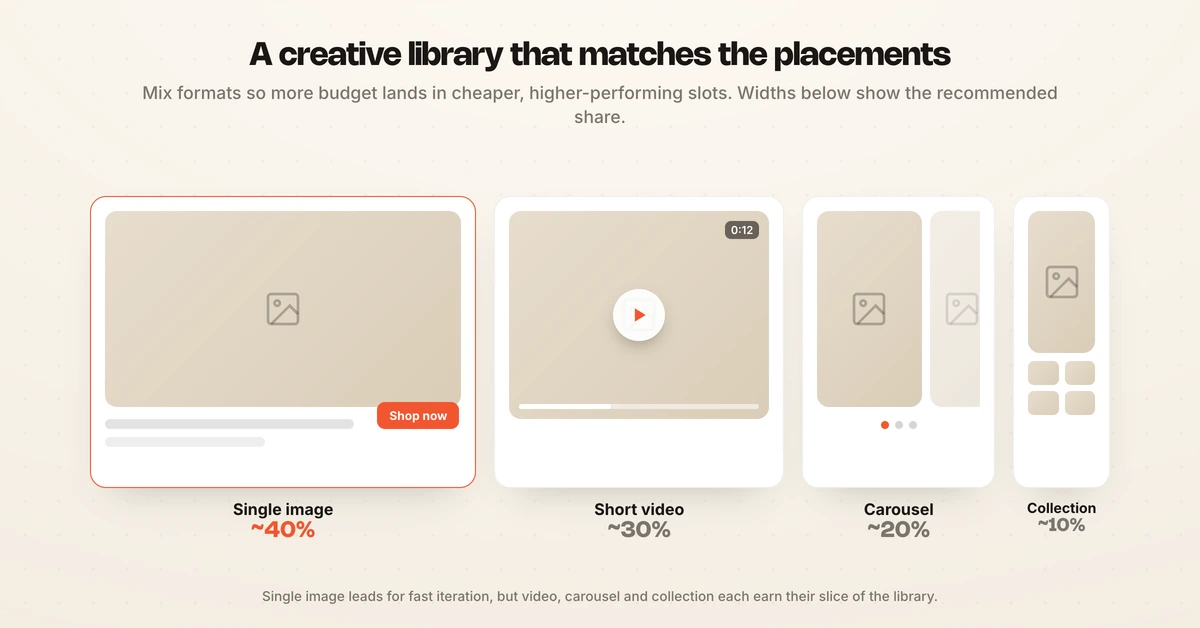
Mix formats to match how Meta serves inventory, per Stackmatix 2026 DTC data. Different placements reward different formats, so a varied library gets more of your budget into cheaper, higher-performing slots.
| Format | Share of library | Best for |
|---|---|---|
| Single image | ~40% | Fast iteration, clean product shots |
| Short video (6-15s) | ~30% | Hooks, demos, native feel |
| Carousel | ~20% | Multiple products or benefits |
| Collection | ~10% | Catalog-driven shopping |
The problem is production. Shipping 20 fresh creatives a month by hand overwhelms most in-house teams, which is exactly where a Creative Agent earns its place, reading your past winners and generating on-brand variations bound to specific ad sets, routed through approval before they ship. The Man Company doubled creative performance and cut iteration cycles 50% working this way. For scaling proven winners, see how to scale Facebook Ads.
Budget and scaling for ecommerce
Facebook's algorithm needs a minimum budget to learn, so undersized spend is self-defeating. Start with at least $50 per day per campaign, enough to generate one to two conversions daily, which is the floor for the system to gather signal. If your target CPA is $30, a $50 daily budget gives the algorithm room to work; a $15 budget never exits learning.
Scale by loosening, not by piling on complexity. Raise budgets gradually (roughly 20% every few days) so you do not reset the learning phase, and let Advantage+ expand audiences rather than building new ad sets. When ROAS holds as spend rises, keep going; when it drops, the constraint is usually creative fatigue, not audience saturation. For the full method, see how to scale Facebook Ads and diagnose stalls with why Facebook Ads are not converting.
Common Facebook ecommerce mistakes
Most ecommerce accounts underperform for a handful of repeatable reasons, not mysterious ones. Over-segmenting the account into too many ad sets starves the algorithm. Running too little creative lets winners fatigue with nothing to replace them. Neglecting the catalog serves out-of-stock or mispriced products.
The subtler mistake is judging campaigns on platform-reported ROAS alone. Meta over-credits itself on last-click, so reconcile against actual store revenue before scaling or cutting. Watching creative fatigue too late is the most expensive error, because a tiring ad costs more to serve and returns less every day it runs. Hawky's Performance Agent catches that decline early and refreshes creative against your KPI with guardrails and an audit trail, so spend stays productive without constant manual checks.
Frequently asked questions
How do you run Facebook Ads for ecommerce?
Run a simple account structure of three to four campaigns: one broad Advantage+ Shopping campaign for prospecting, one retargeting campaign for warm audiences, one retention campaign for existing customers, and optionally one testing campaign. Feed the algorithm a clean product catalog with accurate images, prices, and availability, and ship a steady volume of fresh creative. Let Meta's AI handle targeting while you compete on creative and catalog quality.
Are Facebook Ads good for ecommerce?
Yes. Facebook Ads are one of the highest-performing channels for ecommerce, especially for visual products in apparel, beauty, home, and lifestyle. The platform generates demand rather than waiting for search, and its retargeting and Dynamic Product Ads close warm shoppers efficiently. Success in 2026 depends more on creative volume and catalog quality than on manual audience targeting.
What budget do I need for Facebook ecommerce ads?
Start with at least $50 per day per campaign, which lets the algorithm generate one to two conversions daily and exit the learning phase. Advantage+ Shopping campaigns work best above roughly $10,000 per month, where the algorithm can test its full range of creative combinations. Spend under $5,000 per month often struggles to exit learning reliably, so smaller budgets should keep the account structure very simple.
What is a good ROAS for ecommerce Facebook Ads?
A good ecommerce ROAS on Facebook is any return above your break-even point, which most brands set between 2x and 4x depending on margin. The blended ecommerce average sits around 2.87x, but retargeting campaigns often exceed 6x while cold prospecting runs lower. Calculate break-even as 1 divided by your gross margin, then target 1.5 to 3 times that.
Should I use Advantage+ Shopping or manual campaigns?
For most ecommerce brands in 2026, Advantage+ Shopping outperforms manual campaigns and is now Meta's default. It consolidates targeting into one AI-driven campaign that tests up to 150 creative combinations. Manual campaigns still help for tightly controlled tests or unusual audiences, but the algorithm generally allocates budget better than manual segmentation, provided you feed it enough budget and conversion events.
If shipping enough fresh creative and catching fatigue before it drains your ecommerce ROAS is the problem, Hawky's Creative Agent and Performance Agent are built for that job.
Ready to hire your first AI performance team? Book Demo