How to Scale Facebook Ads Without Losing ROAS: A Practical Playbook
Scaling Facebook ads means putting more budget behind proven winners without resetting the learning phase or dragging down ROAS. The safest version raises spend gradually on ad sets that have already cleared learning and held their targets, then expands into new audiences and creative as the first winners fatigue.
Most advertisers do not lose money because they cannot find a winning ad. They lose it because they scale the winner wrong: too fast, too many changes at once, or long after the audience stopped responding. This playbook walks through when to scale, the two methods that matter, and how to hold efficiency while spend climbs.
When a Facebook campaign is ready to scale
Scaling amplifies whatever is already happening. Pour budget into a shaky ad set and you get a bigger, more expensive version of shaky. So the first question is never "how much," it is "is this actually ready."
An ad set is a scaling candidate when it has exited the learning phase, held above your target ROAS (or below your target CPA) for at least five to seven days, and shows steady frequency and CPM. Meta's own guidance is that an ad set needs roughly 50 optimization events in a seven-day window to leave learning, which is the point where delivery stabilizes enough to trust (Meta Business Help Center).
If the ad set is still bouncing day to day, it is not ready. A profitable Tuesday is not a signal; a profitable week is.
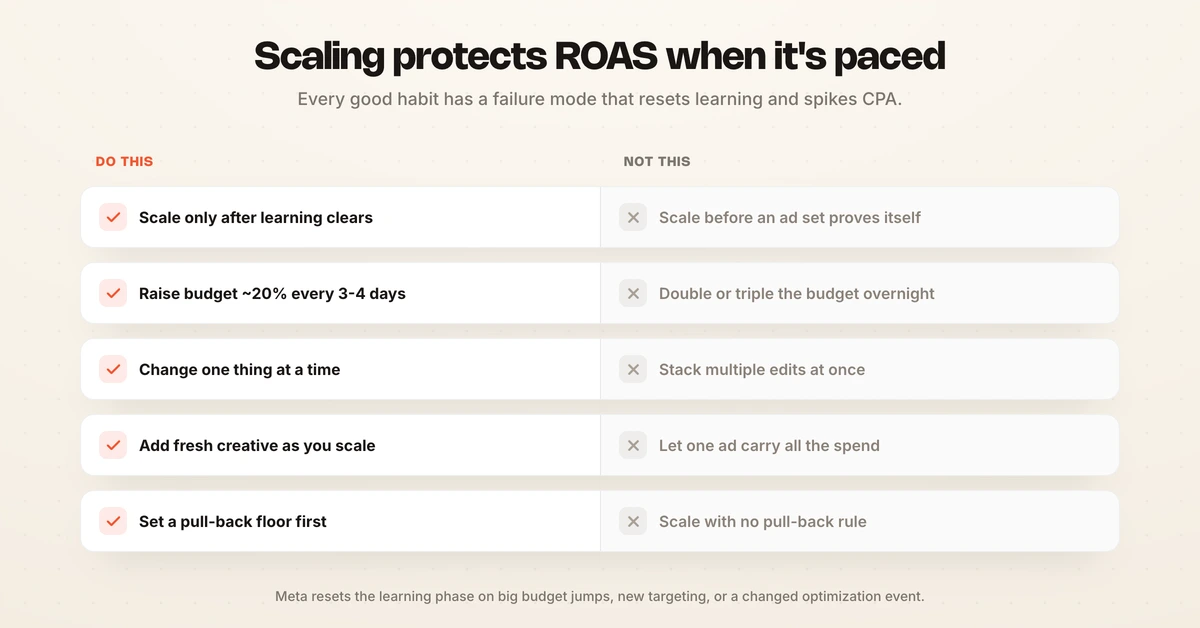
Use this readiness check before touching a budget.
| Signal | Ready to scale | Hold or fix first |
|---|---|---|
| Learning phase | Exited (about 50 events in 7 days) | Still "Learning" or "Learning limited" |
| ROAS / CPA vs target | At or better for 5-7 days | Below target or swinging daily |
| Frequency | Stable, room to grow | Rising fast, audience saturating |
| CPM trend | Flat or improving | Climbing week over week |
| Creative freshness | New variants ready | Only one ad carrying the set |
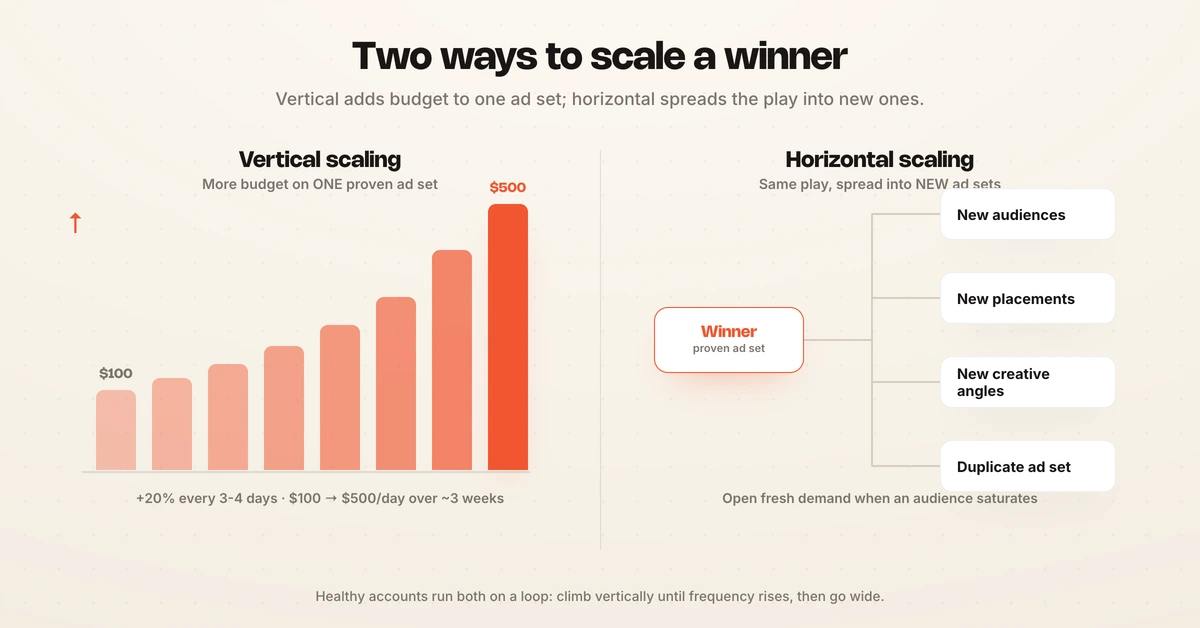
Vertical scaling: raising the budget
Vertical scaling is the simple move: increase the budget on an ad set that already works. It is fast, and when a winner has headroom it is the highest-return action you can take.
The constraint is the learning phase. Large budget jumps can push an ad set back into learning and spike CPA while the algorithm re-optimizes. A widely used rule of thumb is to raise budget by no more than about 20% every three to four days, which keeps delivery stable (Cropink). If you are moving a $100/day ad set to $500/day, that looks like a staged climb over roughly three weeks, not an overnight change.
When you need to add budget faster than gradual steps allow, duplicate the winning ad set at the higher budget and let the copy build its own learning, or move the winner into an Advantage+ or CBO structure where Meta reallocates spend for you. Both avoid slamming a single ad set with a change large enough to reset it.
Horizontal scaling: going wider
Vertical scaling eventually hits a ceiling. As you push more budget into the same audience, frequency rises, the freshest buyers convert first, and marginal CPA climbs. Horizontal scaling is how you get past that: instead of spending more in the same place, you open new places to spend.
The main horizontal moves are new audiences (fresh lookalikes, interest layers with low overlap, broad targeting), new placements (Reels, Stories, Audience Network beyond the ones already running), and new creative angles that speak to a different motivation. Each new ad set carries its own learning phase, so treat every one as a fresh test, not a guaranteed win.
Creative is usually the highest-leverage lever here. Advantage+ Shopping accounts are advised to run 10 to 15 active creatives and add three to five fresh ones each week, because variety is what lets the algorithm match the right ad to the right person (ATTN Agency). More on the mechanics of testing and trimming creative is in the Facebook ads optimization guide.
Here is how the two methods compare in practice.
| Vertical scaling | Horizontal scaling | |
|---|---|---|
| What you change | Budget on an existing winner | New ad sets, audiences, placements, creative |
| Best when | Winner still has headroom | Audience saturating, frequency rising |
| Main risk | Big jumps reset learning | Many ad sets split event volume, slower learning |
| Speed of impact | Fast | Slower, each set relearns |
| Ceiling | Audience saturation | Creative and audience supply |
| Tactics | 20% steps, duplicate winner, Advantage+/CBO | Fresh lookalikes, interest layers, broad, new formats |
Most healthy accounts run both on a loop: scale a winner vertically until frequency or CPA rises, expand horizontally to find fresh demand, validate the new ad sets, then scale those vertically. The two methods feed each other.
How to scale without losing ROAS
Losing ROAS while scaling is almost always a pacing problem, not an audience problem. A few habits keep efficiency intact.
Change one thing at a time. Meta resets learning when you alter targeting, the optimization event, or bid strategy, so stacking three changes at once makes it impossible to tell which one hurt you. Move budget, wait, read the result, then move again.
Watch the leading indicators, not just ROAS. Rising frequency and climbing CPM show up before ROAS drops, so they give you a chance to expand horizontally before efficiency actually breaks. Pair budget scaling with tight cost controls; if you are unsure how bid caps and cost caps behave under scale, the cost caps guide and the Facebook ads cost breakdown cover the mechanics.
Keep a floor you will not cross. Decide the ROAS or CPA at which you pause a scaled ad set before you scale it, and honor it. Scaling without a pull-back rule is how a good week turns into a bad month.
How fast can you scale Facebook ad budgets
Faster than the 20% rule is possible, but it changes the method. Within a single ad set, gradual steps protect the learning phase. When you need real speed, you buy it structurally: duplicate winners, consolidate into Advantage+ campaign budget so Meta shifts spend toward the strongest ad sets, or lean on Advantage+ Shopping, which tends to exit learning faster because event volume is not fragmented across many ad sets (Madgicx).
Speed also depends on event volume. An account generating 200 conversions a day can absorb budget increases an account doing 20 a day cannot, because it clears the 50-event learning threshold far faster. Scale to your data, not to a calendar.
Common scaling mistakes
Most scaling failures come from a short list of avoidable moves.
- Scaling too early, before an ad set has cleared learning or proven itself for a week.
- Doubling or tripling budget overnight, which resets learning and spikes CPA.
- Stacking multiple changes at once, so you cannot diagnose what broke.
- Ignoring frequency until ROAS has already collapsed.
- Scaling budget without scaling creative, so a single fatiguing ad has to carry a much larger spend.
- Having no pre-set pull-back rule, so a scaled loser keeps running.
How an agent scales continuously
Scaling is not a one-time decision. It is a daily judgment call about when a winner has headroom, how much to add today, when frequency has crept too high, and when to pull spend back before ROAS slips. Doing that well across dozens of ad sets, every day, is more attention than most teams can spare.
That continuous judgment is what an agentic system is built for. Hawky's Performance Agent operates Meta, Google, and YouTube against a KPI you set, scaling winners while holding efficiency, and it makes those calls with guardrails, spend caps, and a full audit trail so every move is visible and reversible. It raises budget in safe increments, expands horizontally when an audience saturates, and pulls back the moment a scaled ad set drops below your floor.
Because it works against a target rather than a fixed budget, the agent treats scaling as a control problem, not a gut feel. Hawky reports a +25% ROAS lift in the first 90 days across 200+ customers (case study), and you can see how it maps to your spend on the pricing page.
Frequently asked questions
How do you scale Facebook Ads profitably?
Scale only ad sets that have exited the learning phase and held a target ROAS or CPA for at least a week. Raise budgets in small steps (around 20% every three to four days) so delivery stays stable, and expand horizontally into new audiences and creative once a winner starts to fatigue. Watch ROAS, CPA, frequency, and CPM at every step and pull back the moment efficiency slips.
What is the best way to scale Facebook Ads?
There is no single best method. Vertical scaling (raising budget on a proven ad set) is fastest when a winner has headroom, and horizontal scaling (new audiences, placements, and creative) protects you when audiences saturate. Most accounts use both: scale vertically until frequency or CPA rises, then go wide to find fresh demand.
How fast can I scale Facebook ad budgets?
A common rule is to raise budget by no more than about 20% every three to four days so you do not reset the learning phase. Larger jumps can push an ad set back into learning and spike CPA. If you need to move faster, duplicate the ad set or use Advantage+ campaign budget so the algorithm reallocates spend without a hard reset.
When is a Facebook campaign ready to scale?
A campaign is ready when the ad set has exited the learning phase (roughly 50 optimization events in seven days per Meta), has held above your target ROAS or below your target CPA for at least five to seven days, and shows stable frequency and CPM. Scaling before those signals are in place usually just spends money faster at a worse return.
Does raising the budget reset the Facebook learning phase?
Small increases (under about 20%) usually do not reset learning, while large jumps often do. Changes to targeting, optimization event, or bid strategy also restart it. That is why gradual budget steps and one change at a time are the safer path when scaling.
Should I use Advantage+ or CBO to scale Facebook ads?
Advantage+ campaign budget (the successor to CBO) lets Meta move spend toward the ad sets producing the most efficient results, which suits scaling because you are not manually fixing budgets per ad set. Many accounts test in ABO ad sets, then consolidate winners into an Advantage+ or CBO structure to scale. Advantage+ Shopping in particular tends to exit the learning phase faster because event volume is not split across many ad sets.
If scaling winners while holding efficiency is eating your day, Hawky's Performance Agent is built for that job.
Ready to hire your first AI performance team? Book Demo