How Much Do Facebook Ads Cost? (2026 Pricing Guide)
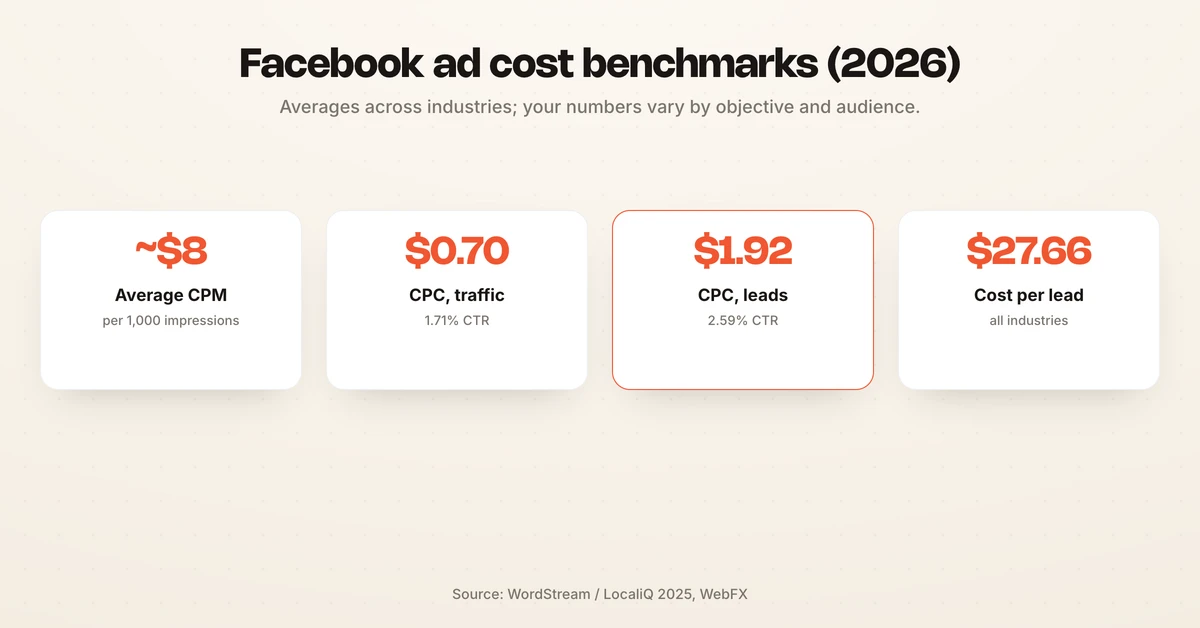
Facebook ads cost about $0.70 per click for traffic campaigns and $1.92 per click for lead campaigns, with CPM averaging roughly $8 per thousand impressions and cost per lead near $27.66 in 2026 (WordStream, WebFX). Those are averages, though. What you actually pay depends on your objective, industry, audience and creative, and Meta's auction sets a different price for every impression.
This guide breaks down current Facebook advertising cost by metric, objective and industry, using sourced 2026 figures. It also covers how Meta's auction decides your price, what to budget, and how to keep cost under control.
How much do Facebook Ads cost in 2026?
Facebook ads cost is best understood as three separate prices: what you pay per thousand views (CPM), per click (CPC), and per result such as a lead or purchase (CPA). Each one moves independently based on your setup.
Across all industries, traffic campaigns average a CPC of $0.70 and a click-through rate of 1.71%, while lead generation campaigns average a CPC of $1.92 and a 2.59% CTR (LocaliQ). On the impression side, CPM sits around $8, with a typical range of $3 to $20 (WebFX).
Here is how the headline numbers line up.
| Metric | Average | Typical range | Source |
|---|---|---|---|
| CPM (per 1,000 impressions) | ~$8 | $3 to $20 | WebFX |
| CPC, traffic objective | $0.70 | $0.34 to $1.22 | WordStream |
| CPC, leads objective | $1.92 | varies by industry | WordStream |
| CPL (cost per lead) | $27.66 | $3.16 to $76.71 | WordStream |
| Lead conversion rate | 7.72% | varies by industry | LocaliQ |
One trend matters for planning. Facebook ad costs jumped in 2025, with lead campaign cost per lead up about 21% year over year, though Facebook still runs cheaper than search on a per-lead basis (Search Engine Land).
What is the average CPM on Facebook?
The average CPM on Facebook is around $8 per thousand impressions, with most accounts landing between $3 and $20 depending on objective and audience (WebFX). CPM is the base cost of reaching people, so it drives every downstream number.
CPM changes with your objective. Reach and awareness campaigns sit at the low end because Meta shows your ad to almost anyone. Conversion campaigns push CPM higher because Meta works to find the smaller set of people likely to buy, and those impressions cost more to win.
Seasonality moves CPM too. Costs climb through Q4 as retailers flood the auction ahead of the holidays, then reset lower in January. If your CPM spikes in November, competition is usually the reason, not a problem with your account.
How does Meta's auction set your cost?
Meta does not sell impressions at a fixed rate. It runs an auction for every single impression and ranks competing ads by total value, not by raw bid (Meta Business Help Center).
Total value is calculated from three inputs: your advertiser bid, the estimated action rate (how likely a user is to take the action you optimized for), and ad quality (relevance and post-click experience) (Disruptive Digital). The ad with the highest total value wins the placement.
The practical takeaway is direct. If your creative earns more engagement and your landing page performs, your estimated action rate and ad quality rise, so you can win impressions while bidding less than competitors. Strong creative is a discount on media cost, not a nice-to-have.
Facebook advertising cost by industry and objective
Facebook advertising cost varies widely by industry because audience value and competition are not equal. A restaurant and a law firm are bidding for very different customers, so their prices diverge sharply.
The spread is clearest in cost per lead. Restaurants and Food generate leads at $3.16, while Dentists and Dental Services pay $76.71 for the same objective (WordStream).
| Industry / objective | Metric | Cost | Source |
|---|---|---|---|
| Restaurants and Food (leads) | CPL | $3.16 | WordStream |
| Dentists and Dental Services (leads) | CPL | $76.71 | WordStream |
| Shopping, Collectibles, Gifts (traffic) | CPC | $0.34 | WordStream |
| Finance and Insurance (traffic) | CPC | $1.22 | WordStream |
| All industries (leads) | CPL | $27.66 | WordStream |
Objective matters as much as industry. Optimizing for cheap traffic will always show a lower CPC than optimizing for leads or purchases, but the cheaper click is worth less. Judge cost against the result you actually need, then compare it to your target CPA.
How much should I budget for Facebook Ads?
Most small businesses spend between $1 and $500 per month on Facebook ads, and 53% keep Facebook to 15% or less of their total ad budget (WebFX). For meaningful testing, a common starting point is at least $500 per month, or roughly $10 to $50 per day, so campaigns gather enough data to make a decision within a week or two (Zeely).
Budget is easier to reason about when you translate spend into expected results. The math below uses an $8 CPM, a 1.71% CTR and a $1.92 leads CPC as rough planning inputs.
| Monthly budget | Approx. impressions (at $8 CPM) | Approx. clicks (at 1.71% CTR) | Approx. leads (at $1.92 CPC) |
|---|---|---|---|
| $500 | ~62,500 | ~1,069 | ~260 |
| $1,500 | ~187,500 | ~3,206 | ~781 |
| $5,000 | ~625,000 | ~10,688 | ~2,604 |
Treat those figures as a starting frame, not a promise. Real performance shifts with creative, audience and offer, which is exactly why cost needs active management, not a set-and-forget budget. For a side-by-side with search spend, see the Google Ads cost breakdown.
Is Facebook advertising worth it?
Facebook advertising is worth it when your cost per result stays below the profit each new customer produces. The raw price of a click is not the question; the ratio between spend and return is.
On a per-lead basis, Facebook is often cheaper than search. Its average cost per lead of $27.66 sits well under the roughly $70 average for Google Ads lead campaigns (WordStream). That gap is one reason many businesses lean on Meta for volume.
Worth is measured by ROAS and contribution margin, not CPM or CPC in isolation. A $50 lead can be a bargain if it closes at high value, and a $2 click can be a waste if it never converts.
The factors that actually move your cost
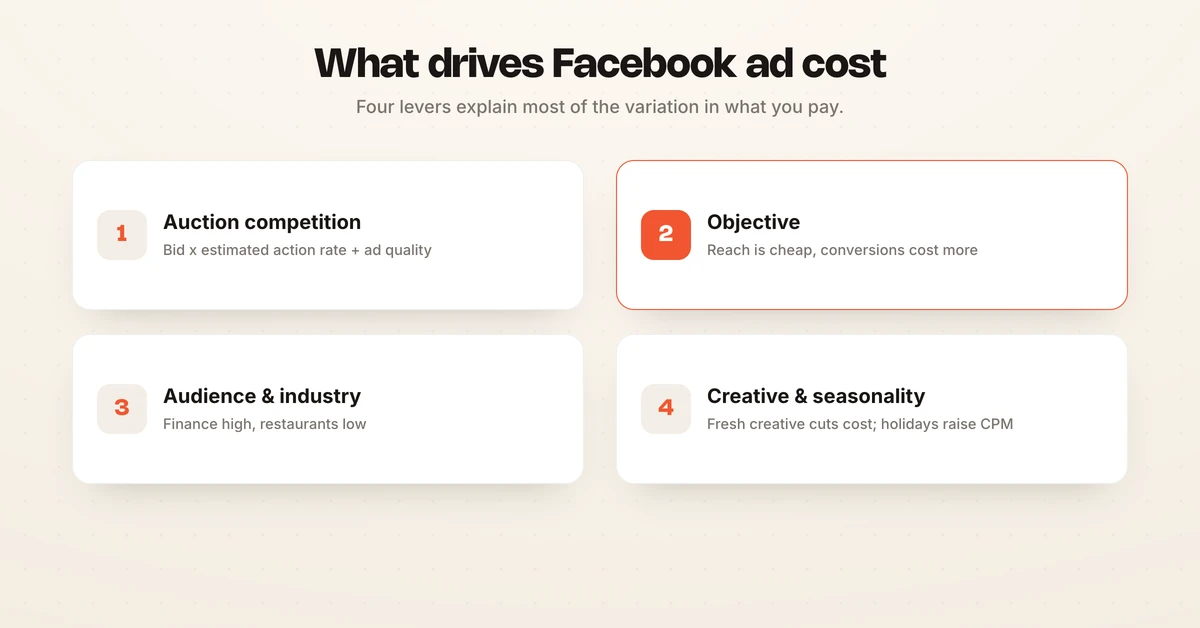
Four levers explain most of the variation in Facebook ad cost. Understanding them tells you where to act when a campaign gets expensive.
- Auction competition. More advertisers targeting your audience raises the winning total value, so your effective price climbs.
- Objective. Reach and traffic are cheap, conversions and leads cost more because Meta targets higher-value users.
- Audience and industry. High-value verticals like finance and dental pay far more per result than restaurants or retail.
- Creative and seasonality. Fresh, relevant creative lifts your estimated action rate and cuts cost, while holiday demand pushes CPM up.
The uncomfortable part is that these levers change daily. A creative that lowered your cost last week fatigues, competition shifts overnight, and budgets drift toward audiences that already stopped converting. Most waste comes from reacting too slowly.
How Hawky's Performance Agent controls Facebook ad cost
Hawky is an agentic performance marketing platform, and its Performance Agent is an always-on paid-media operator that plans, launches and optimizes Meta, Google and YouTube against the KPI you set. You lock it to ROAS, CAC, LTV or contribution margin, and it manages cost toward that target instead of chasing cheap clicks.
Because it watches every campaign continuously, it acts on the same levers that move cost the moment they shift. It pauses fatigued creative, reallocates budget away from audiences that stopped converting, and holds spend inside the caps you define. Every move is logged with its trigger and a confidence score, and every action is one-click reversible.
Control is the point, not just automation. The Performance Agent runs with configurable autonomy, from shadow mode where it only recommends, to approval-gated changes, to fully autonomous execution, always inside guardrails, spend caps and a complete audit trail. Pricing is outcome-based, and there is a 30-day free pilot, with a cohort median of +25% ROAS in the first 90 days across 200+ customers (Hawky case study).
If you want to cap and control spend at the campaign level, the Facebook ads cost caps guide covers the mechanics, and Hawky pricing explains the outcome-based model.
Frequently asked questions
How much do Facebook Ads cost in 2026?
Facebook ads cost roughly $0.70 per click for traffic campaigns and $1.92 per click for lead campaigns, with CPM averaging around $8 per thousand impressions. Cost per lead sits near $27.66 on average. Your actual cost depends on industry, objective, audience and creative quality.
What is the average CPM on Facebook?
The average Facebook CPM is around $8 per thousand impressions, though it commonly ranges from $3 to $20. Reach and awareness objectives tend to sit at the low end, while conversion objectives push CPM higher because Meta targets more valuable users. Competitive industries and holiday periods raise CPM further.
How much should I budget for Facebook Ads?
Most small businesses spend between $1 and $500 per month, and experts suggest at least $500 per month for meaningful testing. A daily budget of $10 to $50 gathers enough data to make decisions within a week or two. Scale spend only after your cost per result clears your target ROAS or CAC.
Why did my Facebook ad costs go up?
Facebook ad costs rose across most industries in 2025, with lead campaign CPL up about 21% year over year. Rising costs usually come from more advertisers competing in the auction, seasonal demand, audience fatigue or a drop in ad quality and estimated action rate. Refreshing creative and tightening targeting often brings costs back down.
Is Facebook advertising worth it?
Facebook advertising is worth it when your cost per result stays below the profit each customer generates. Its cost per lead of $27.66 is well under Google Ads' average of about $70, which makes it attractive for many businesses. Worth is measured by ROAS and contribution margin, not by the raw cost of a click.
How does Meta decide how much I pay?
Meta runs an auction for every impression and ranks ads by total value, calculated as your bid multiplied by estimated action rate plus ad quality. The highest total value wins, not the highest bid. You typically pay just enough to beat the next competitor, so strong creative and relevance can lower your cost.
If keeping Facebook ad cost under control while hitting a hard ROAS or CAC target is the problem you are trying to solve, Hawky's Performance Agent is built for that job.
Ready to hire your first AI performance team? Book Demo