Conversions API (CAPI)
Last updated
A Meta tool that sends conversion events server to server, recovering data the browser-based Pixel loses to ad blockers and privacy changes. Advertisers who add it commonly see lower cost per result because the algorithm optimizes on fuller data.
Conversions API (CAPI)
The Conversions API (CAPI) is a Meta tool that sends conversion events directly from your server to Meta, rather than relying only on the browser-based Meta Pixel. Because it transmits data server to server, it captures conversions that browser tracking misses due to ad blockers, cookie restrictions, and privacy changes like Apple's App Tracking Transparency. CAPI is now the standard way advertisers recover the measurement signal lost after iOS 14 and keep Meta's algorithm optimizing on accurate data.
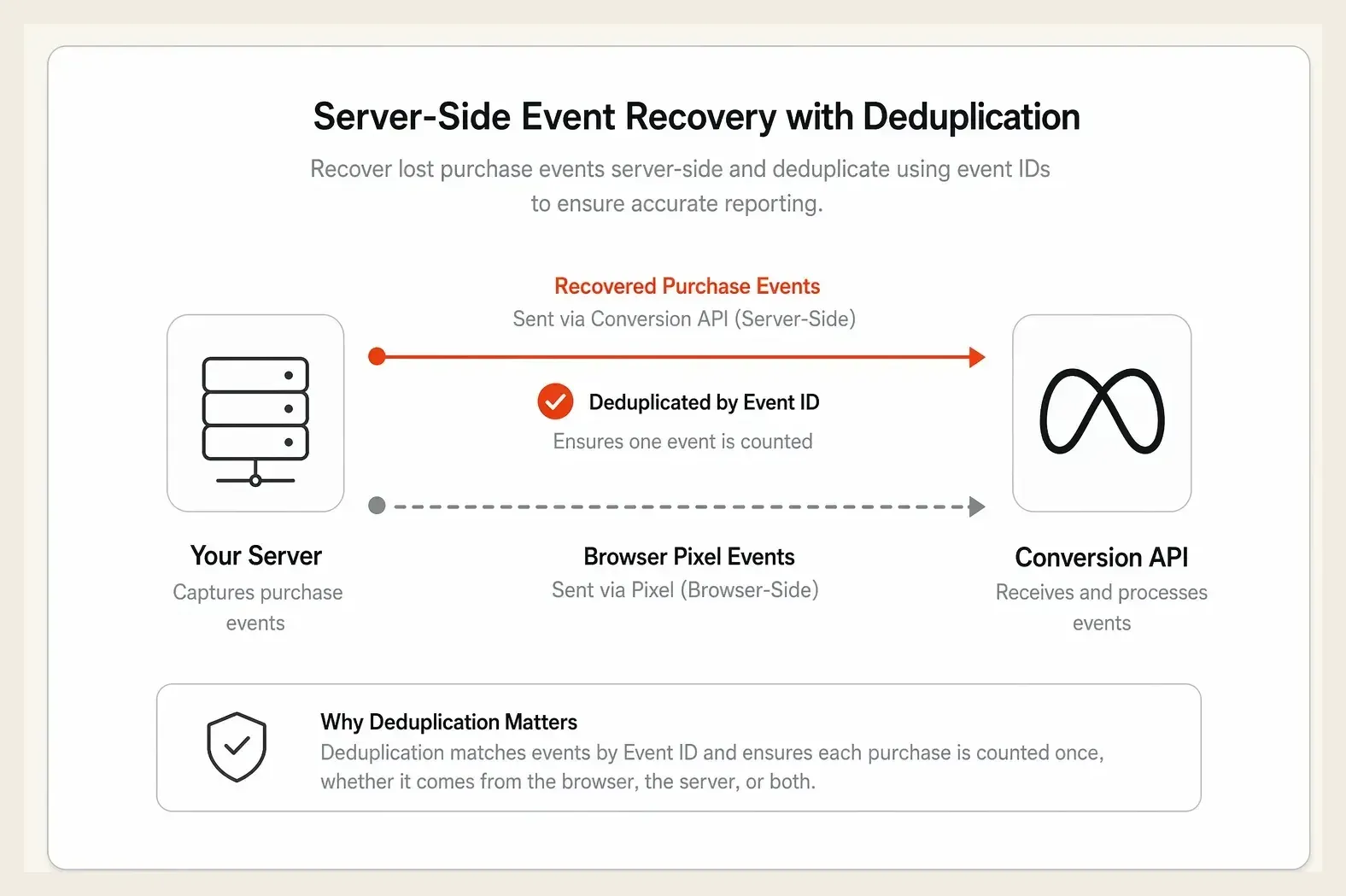
Where the Meta Pixel runs in the user's browser and depends on cookies and client-side scripts, CAPI fires from your own server when an event happens, such as a completed purchase. The two work best together, with CAPI filling the gaps the browser can no longer see and a deduplication key preventing the same event from being counted twice.
Why It Matters
After the iOS 14 update impact, browser-only tracking became unreliable, and a meaningful share of conversions stopped reaching Meta. When the algorithm cannot see conversions, it optimizes on incomplete data, audiences shrink, and reported ROAS understates the truth. CAPI restores much of that lost signal, which directly improves both measurement accuracy and optimization quality.
The benefit shows up in the numbers. Meta has reported that advertisers adding the Conversions API alongside the Pixel commonly see lower cost per result, with reductions often cited in the range of double digit percentages, because the system finally has fuller conversion data to optimize against. The practical stakes are simple. An account running on browser tracking alone is feeding the algorithm a partial picture, and a partial picture produces partial performance. Recovering the missing events is one of the highest-leverage technical fixes available on Meta today.
How It Works
CAPI works by sending events from your server to Meta's servers, in parallel with the Pixel, then matching and deduplicating them so each conversion is counted once.
- An event happens, such as a purchase on your site or a lead in your CRM, and your server sends it to Meta with customer information parameters like hashed email or phone.
- Meta matches that server event to a real person and to any corresponding Pixel event using a shared event ID for deduplication.
- The matched, deduplicated event feeds Meta's optimization and reporting, recovering conversions the browser could not transmit.
- You monitor Event Match Quality in Events Manager, which scores how well your customer parameters let Meta match events to people.
The detail that decides whether CAPI helps or just adds noise is data quality. Sending events without rich, accurate customer parameters produces low match quality, so the events arrive but cannot be tied to people reliably. The advertisers who get the full benefit pass strong identifiers, deduplicate cleanly, and treat Event Match Quality as a metric to actively improve, not a number to ignore.
A Real Example
A footwear brand spends $25,000 a month on Meta and runs on the Pixel alone. After iOS 14, their reported conversions sit well below what their checkout system records, and the algorithm has started under-delivering because it cannot see enough purchases to optimize confidently.
The team implements CAPI through their ecommerce platform, sends purchase and add-to-cart events server-side with hashed email and phone, and configures a shared event ID so server and browser events deduplicate. Within two weeks, Event Match Quality climbs into a strong range and reported conversions rise sharply as server events fill the gap.
With fuller signal, Meta's optimization improves, and their cost per purchase falls 18 percent over the following month while spend stays flat. The creative and audiences did not change. The algorithm simply got to see most of the conversions again, which let it spend the same budget against the right buyers. That recovery is the core reason CAPI has become standard infrastructure.
Common Mistakes
| ❌ Mistakes | ✅ Better Approach |
|---|---|
| Run CAPI without a shared event ID for deduplication | Use a consistent event ID so server and browser events are counted once, not twice |
| Send server events with thin customer data | Pass rich hashed identifiers so Event Match Quality stays high and events match to people |
| Treat CAPI as a replacement for the Pixel | Run both together, since the Pixel and CAPI cover different gaps and reinforce each other |
How Hawky Helps
CAPI restores the conversion signal, and Hawky's Performance Agent puts that recovered signal to work, optimizing budget and delivery against the fuller, more accurate conversion data rather than the partial picture browser tracking leaves behind. When the measurement layer is solid, the agent can act with confidence, scaling what genuinely converts and pulling back on what does not.
Because Hawky operates as a team of agents, FeatherDB holds the account's living memory of conversion patterns over time, so decisions are informed by a consistent history rather than a single noisy week. The Creative Agent connects that clean conversion signal back to which hooks and formats actually drove buyers, so creative and media optimization both run on real outcomes instead of guesses.
Frequently Asked Questions
What is the difference between the Meta Pixel and the Conversions API?
The Meta Pixel runs in the user's browser and depends on cookies and client-side scripts, while the Conversions API sends events directly from your server to Meta. The Pixel is easier to set up but loses data to ad blockers and privacy changes, whereas CAPI captures those missed events server-side, which is why running both together is the recommended setup.
Why do I need the Conversions API after iOS 14?
After App Tracking Transparency, browser-based tracking lost a meaningful share of conversions because many users opted out and cookies became less reliable. CAPI recovers that lost signal by sending events from your server, which restores Meta's ability to optimize accurately and brings reported conversions back closer to what actually happened.
Does the Conversions API double-count conversions?
Not when it is set up correctly. You assign a shared event ID to matching server and browser events so Meta can deduplicate them and count each conversion once. Skipping deduplication is the main cause of inflated numbers, so a consistent event ID is essential.
What is Event Match Quality in CAPI?
Event Match Quality is a score in Events Manager that reflects how well your customer parameters, such as hashed email and phone, let Meta match server events to real people. Higher match quality means more events are correctly attributed, which improves both optimization and reporting, so it is a metric worth actively improving.
Quick Takeaway
The Conversions API sends conversion events server to server, recovering the signal that browser tracking loses to privacy changes and ad blockers, and advertisers who add it commonly see lower cost per result because the algorithm finally optimizes on fuller data.
When missing conversion signal is starving your optimization, an agent should be acting on the recovered data the moment it lands. Ready to hire your first AI performance team? Book Demo