First-Party Data
Last updated
First-party data is the information a business collects directly from its own audience through owned channels, making it the most accurate and durable targeting asset as third-party tracking disappears. Brands that use it well see up to a 2.9x lift in marketing outcomes.
First-Party Data
First-Party Data is the information a business collects directly from its own audience and customers, with their consent, through its own channels. It includes website behavior captured by a pixel, purchase history, email and phone lists, app activity, survey responses, and CRM records. Because the brand owns this data and gathers it firsthand, it is the most accurate, most durable, and most defensible targeting asset a company has, especially as third-party data and tracking continue to disappear.
Why It Matters
First-party data matters because the entire targeting landscape is shifting toward it. As third-party cookies are deprecated and privacy rules tighten, the signals advertisers borrowed from external sources are vanishing, leaving data you own as the reliable foundation.
The business impact is well documented. Studies have found that brands using first-party data for key marketing functions can generate substantially higher revenue and cost efficiency, with figures often cited around a 1.5x to 2.9x lift in outcomes versus those relying on third-party data. First-party data also powers the highest-performing parts of an account, since it builds the warm and hot audiences that convert far better than the cold traffic at the top of the funnel.
How It Works
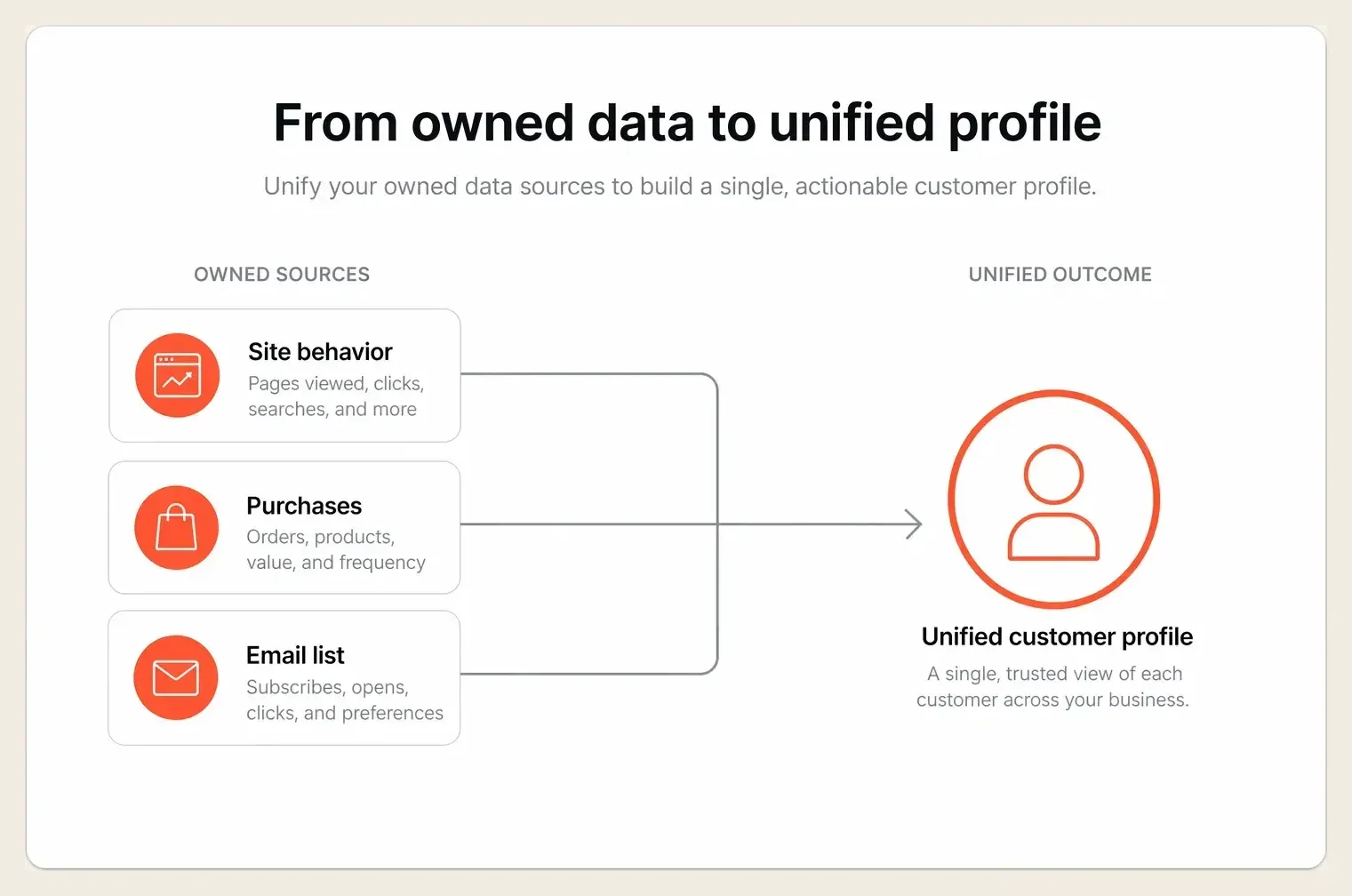
First-party data works by collecting signals across your owned channels, unifying them into a single view of each customer, and activating that view for targeting, exclusion, and modeling. The more complete and clean the data, the more every downstream campaign benefits.
- Collection: pixels, the conversions API, checkout systems, email platforms, and CRMs capture behavior and transactions.
- Unification: those signals are stitched into customer profiles so the same person is recognized across touchpoints.
- Activation: profiles become a custom audience for retargeting warm traffic, or a seed for a lookalike audience to prospect.
- Measurement: server-side first-party signals also feed cleaner attribution and conversion tracking after signal loss.
The compounding advantage is that first-party data improves with every customer interaction. Each purchase and visit enriches your profiles, so targeting, exclusions, and lookalikes all get sharper over time rather than decaying like borrowed data does.
A Real Example
A growing apparel brand consolidates its first-party data instead of leaning on third-party audiences.
- The setup: it connects its pixel through a server-side conversions API, syncs its 80,000-person customer list, and unifies email and purchase history.
- The activation: it excludes recent buyers from prospecting, retargets browsers, and seeds lookalikes from its top 10 percent of spenders.
- The numbers: match rates on its retargeting audiences rise from 62 percent to 88 percent, retargeting ROAS improves by 40 percent, and the lookalike from high-value buyers cuts cold CPA by a third.
By treating first-party data as an owned asset to develop rather than a byproduct, the brand strengthens every audience in the account at once, from prospecting to retention.
Common Mistakes
| The Mistake | ❌ Wrong Approach | ✅ Better Approach |
|---|---|---|
| Letting data sit in silos | Keeping email, pixel, and CRM data separate and unmatched. | Unify sources into one customer view for cleaner activation. |
| Skipping server-side tracking | Relying on browser pixels alone after signal loss. | Add a conversions API to recover and own the data accurately. |
| Ignoring consent and hygiene | Collecting data without clear consent or letting lists go stale. | Gather data transparently and refresh it to keep match rates high. |
How Hawky Helps
First-party data is only an advantage if the account actually acts on it, so Hawky's Performance Agent operates on your owned signals, building and excluding audiences, seeding lookalikes, and shifting budget by funnel stage based on what your data shows is converting. It treats first-party data as the live foundation of targeting rather than a static list uploaded once.
The Performance Agent works with the Creative Agent to match creative to the segments your data defines, from new prospects to lapsed buyers. All of it is anchored in FeatherDB, the living memory where your account's audiences, results, and winning patterns are stored, so the system compounds the value of your first-party data instead of relearning it every campaign.
Frequently Asked Questions
What is first-party data?
First-party data is information a business collects directly from its own audience through its owned channels, such as website behavior, purchases, email lists, and CRM records. Because the brand gathers it firsthand with consent, it is the most accurate and durable data available, and it is owned outright rather than rented from a third party.
What is the difference between first-party and third-party data?
First-party data is collected directly by a business from its own customers and channels, while third-party data is aggregated by outside companies and sold to advertisers. First-party data is more accurate, privacy-compliant, and durable, whereas third-party data is broader but declining fast as cookies and identifiers are deprecated.
Why is first-party data so important now?
First-party data is critical because third-party cookies and tracking are disappearing, removing the borrowed signals advertisers long relied on. Data you own keeps working regardless of those changes, powers your highest-converting warm and hot audiences, and has been shown to drive significantly higher revenue and efficiency than third-party data.
How do you collect first-party data?
You collect first-party data through owned channels: a pixel and server-side conversions API on your site, checkout and purchase systems, email and SMS sign-ups, loyalty programs, surveys, and your CRM. The key is gathering it with clear consent, then unifying these sources into one customer view you can activate for targeting.
Quick Takeaway
First-party data is the audience asset you own outright, and it only grows more valuable as borrowed data disappears. Collect it across owned channels, unify it, and it strengthens every audience from prospecting to retention.
Sitting on customer data that is scattered and never fully activated? Ready to hire your first AI performance team? Book Demo