Behavioral Targeting
Last updated
Behavioral targeting reaches people based on their actual actions, like pages browsed and products viewed, rather than stated interests, making it one of the strongest predictors of conversion. Built on first-party data, it can roughly double conversion rates over broad targeting.
Behavioral Targeting
Behavioral Targeting is an advertising method that reaches people based on their past actions and digital behavior, such as the pages they browsed, the products they viewed, the searches they ran, and the purchases they made. Instead of guessing who might care based on stated interests, behavioral targeting uses what people actually did to predict what they will do next. It is one of the most powerful ways to align an ad with real intent, because behavior is a far stronger signal of buying readiness than a self-described interest.
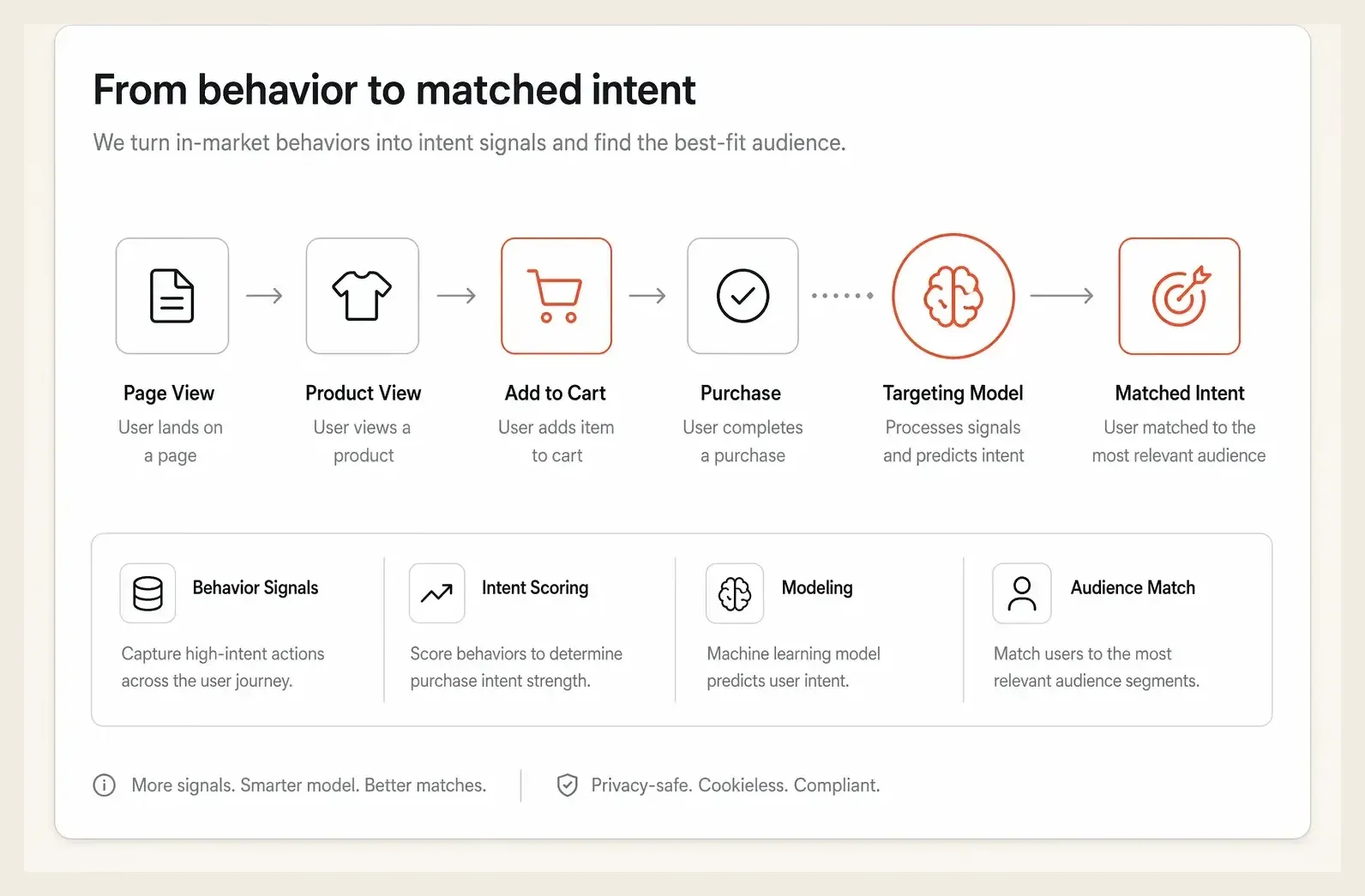
Why It Matters
Behavioral targeting matters because intent predicts conversion better than demographics or interests do. Someone who viewed running shoes three times this week is far closer to buying than someone who simply likes a running page, and behavioral signals capture that difference.
This precision shows up directly in performance. Behaviorally targeted campaigns consistently outperform broad demographic ones, with many studies citing roughly 2x stronger conversion rates when ads are matched to recent actions rather than static traits. As privacy changes erode some signals, first-party behavioral data has become one of the most defensible targeting assets a brand can build, because it comes from your own audience rather than a third party.
How It Works
Behavioral targeting works by collecting signals about how users interact with sites, apps, and ads, then grouping users by patterns that indicate intent. The richer and more recent the behavior, the sharper the targeting.
- Tracking signals: pixels, the conversions API, and platform engagement record actions like product views, add-to-cart, and content consumption.
- Audience building: those actions form a custom audience, for example everyone who viewed a category page in the last 14 days.
- Intent scoring: platforms weight recency and depth, so a recent checkout-starter ranks higher than a month-old page view.
- Funnel alignment: behavior maps cleanly onto temperature, separating cold traffic from warm traffic and hot traffic.
The strategic advantage is that behavioral targeting lets you match the message to the moment, serving a discovery ad to a browser and a closing ad to a cart abandoner from the same underlying data.
A Real Example
An outdoor gear retailer wants to improve its prospecting and retargeting using behavioral signals instead of broad interests.
- The setup: it builds segments from on-site behavior, separating "viewed hiking boots," "added to cart," and "completed a purchase in the last 90 days."
- The creative: cart viewers get a product-specific ad, while category browsers get a comparison guide.
- The numbers: the behavioral retargeting segment delivers a 5.4 percent CVR and a $6 CPA, versus a 1.8 percent CVR and $24 CPA on its interest-only campaign.
By acting on what users did rather than what they like, the retailer cuts acquisition cost by roughly 75 percent on the behaviorally targeted segment while improving message relevance.
Common Mistakes
| The Mistake | ❌ Wrong Approach | ✅ Better Approach |
|---|---|---|
| Ignoring recency | Treating a 6-month-old product view like a fresh one. | Weight recent behavior heavily and let stale signals decay. |
| One message for all behaviors | Showing the same ad to browsers and cart abandoners. | Match creative to the specific action and funnel stage. |
| Relying only on third-party data | Building behavior segments you do not own or control. | Prioritize first-party behavioral data from your own pixel and CRM. |
How Hawky Helps
Behavioral signals only create value if something acts on them quickly, so Hawky's Performance Agent operates the account on those signals, reading where conversions actually land across behavioral segments and shifting budget toward the actions that predict purchase. It treats targeting as a continuous decision by audience temperature, not a fixed set of segments chosen once at launch.
When a behavioral segment needs a tailored message, the Performance Agent works with the Creative Agent to generate creative matched to the specific action a user took, from category browsing to cart abandonment. Every pattern, which behavior responded to which angle, is written to FeatherDB, so the system targets future audiences from your account's own behavioral history rather than starting cold each time.
Frequently Asked Questions
What is behavioral targeting?
Behavioral targeting is an advertising method that reaches users based on their past actions, such as pages browsed, products viewed, and purchases made, rather than stated interests or demographics. It uses real behavior to predict buying intent, which makes it one of the most accurate ways to align an ad with a user's likelihood to convert.
What is the difference between behavioral and interest-based targeting?
Interest-based targeting reaches people by topics and pages they like, while behavioral targeting reaches them by what they actually did, like viewing a product or abandoning a cart. Behavior is a stronger intent signal than interest, so behavioral targeting typically converts at a higher rate, though many advertisers combine both.
Is behavioral targeting still possible after privacy changes?
Yes, behavioral targeting remains effective, especially when built on first-party data you collect from your own pixel, server-side tracking, and CRM. Privacy changes have weakened some third-party behavioral signals, which is exactly why owning your behavioral data through tools like the conversions API has become more important.
What data does behavioral targeting use?
Behavioral targeting uses signals like page views, product and category browsing, add-to-cart and checkout events, search activity, video consumption, and past purchases. These actions are captured by pixels and server-side connections, then grouped into audiences weighted by how recent and how deep the behavior is.
Quick Takeaway
Behavioral targeting reaches people based on what they did, not just what they like, which makes it one of the strongest predictors of conversion. Build it on first-party data and match creative to the action for the sharpest results.
Sitting on behavioral data nobody is acting on fast enough to convert? Ready to hire your first AI performance team? Book Demo