Contextual Targeting
Last updated
Contextual targeting places ads based on the content of the page being viewed rather than data about the user, making it both relevant and privacy-safe. As third-party cookies disappear, it has become a durable scalable channel rather than a fallback.
Contextual Targeting
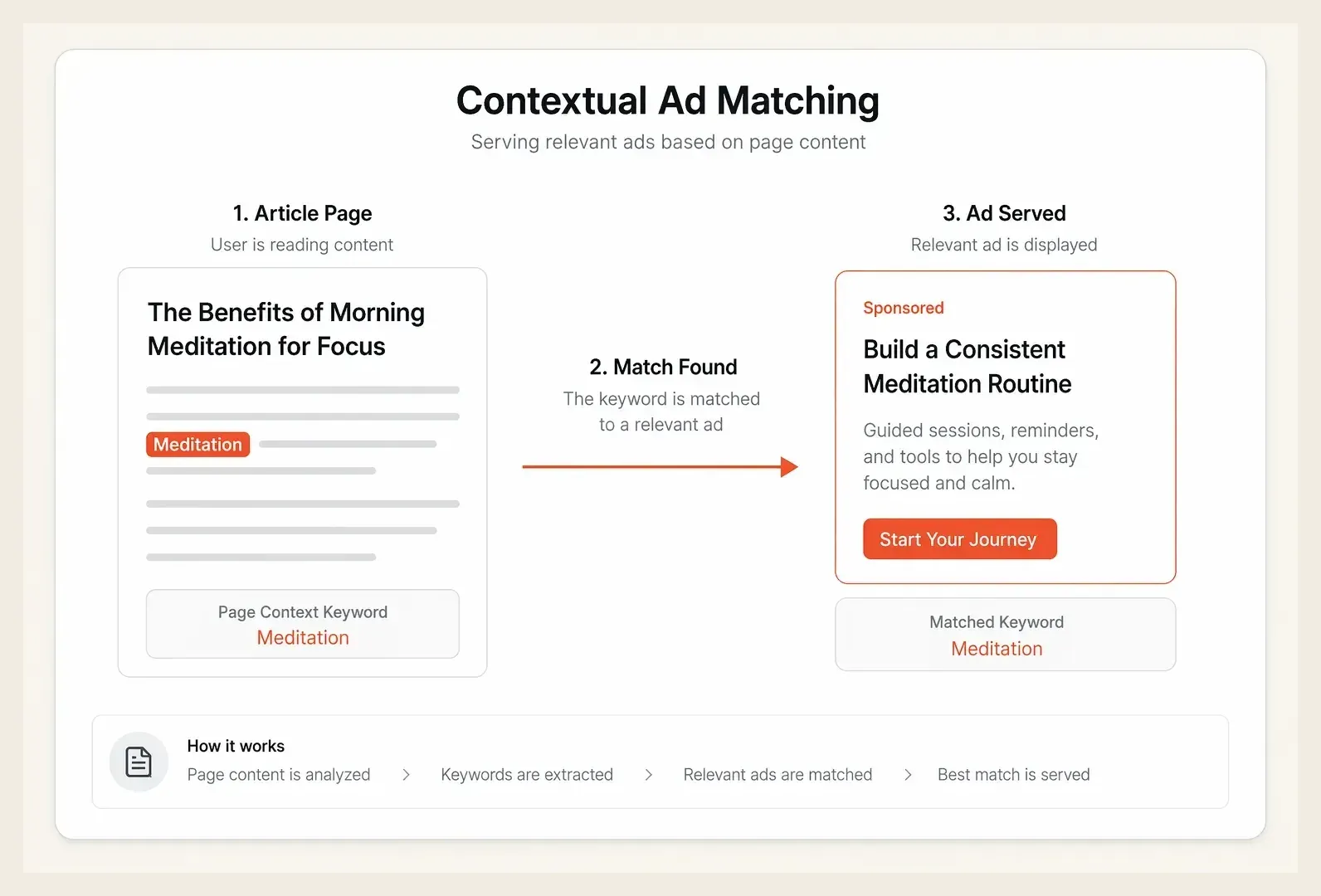
Contextual Targeting is an advertising method that places ads based on the content of the page a user is viewing rather than on data about the user. If someone is reading an article about home espresso machines, contextual targeting serves a coffee-related ad because the surrounding content signals relevance in that moment. It relies on what the person is looking at right now, not on a tracked history of who they are, which makes it privacy-safe and increasingly central as third-party cookies disappear.
Why It Matters
Contextual targeting matters because the open web is moving away from individual tracking, and context does not depend on it. Where behavioral targeting follows the person, contextual targeting follows the content, so it keeps working even as cookies and identifiers are deprecated.
It also performs because relevance in the moment drives attention. Industry research has shown contextually relevant ads can lift purchase intent and recall meaningfully over non-contextual placements, often cited in the range of a 30 to 40 percent improvement in attention metrics. Reaching someone while they are actively engaged with a related topic captures intent that broad demographic targeting misses entirely.
How It Works
Contextual targeting works by analyzing the content of a page, classifying its topics, and matching ads to that classification in real time. Modern systems read far more than a single keyword.
- Content analysis: engines scan page text, keywords, and increasingly the full meaning of the content to assign topic categories.
- Keyword and topic matching: advertisers target categories like "personal finance" or specific keywords, and ads serve where the content fits.
- Placement control: this is the backbone of much display targeting on the GDN and across native ads.
- Brand safety: contextual analysis also screens out unsafe content so ads do not appear beside the wrong material.
The strategic value is alignment without surveillance. You reach someone whose immediate attention is on a relevant subject, which often signals more intent than a stale interest tag tied to their profile.
A Real Example
A premium cookware brand wants to scale prospecting without relying on shrinking third-party audience data.
- The setup: instead of behavioral segments, it targets cooking and recipe content, food blogs, and culinary publications using topic and keyword contextual targeting.
- The creative: a short demo ad showing a sear in a cast-iron pan, placed directly beside recipe articles.
- The numbers: the contextual campaign delivers a 0.9 percent CTR, well above the brand's 0.4 percent display average, and a $19 CPA competitive with its retargeting.
By matching the ad to what readers were already focused on, the brand reaches high-intent cooks at scale without depending on any individual user data, future-proofing its prospecting against further privacy restrictions.
Common Mistakes
| The Mistake | ❌ Wrong Approach | ✅ Better Approach |
|---|---|---|
| Keyword-only matching | Targeting a single word and landing on off-topic pages. | Use topic-level and meaning-based contextual categories. |
| Ignoring brand safety | Letting ads appear beside any content with the keyword. | Apply contextual exclusions to protect brand placement. |
| Treating it as a cold fallback | Using context only when behavioral data runs out. | Build context as a durable, privacy-safe channel of its own. |
How Hawky Helps
Contextual placements still need active management to stay efficient, so Hawky's Performance Agent operates contextual campaigns by reading which topics and placements actually convert and reallocating budget toward them. It treats context as a channel to optimize continuously, not a static keyword list set once and forgotten, and balances it against behavioral and retargeting spend by funnel stage.
Because context rewards creative that fits the surrounding content, the Performance Agent works with the Creative Agent to generate ads tuned to specific content environments, so the message matches the moment a reader is in. Which topic categories and creative pairings performed is stored in FeatherDB, so future contextual buys start from your account's proven matches rather than broad guesses.
Frequently Asked Questions
What is contextual targeting?
Contextual targeting is an advertising method that serves ads based on the content of the page being viewed rather than data about the individual user. For example, a running-shoe ad appears next to a marathon-training article because the page topic signals relevance, making it a privacy-safe way to reach engaged audiences.
What is the difference between contextual and behavioral targeting?
Contextual targeting matches ads to the content a person is currently viewing, while behavioral targeting matches ads to a person's past actions and tracked history. Contextual follows the content and needs no personal data, whereas behavioral follows the user, which is why contextual has grown as third-party tracking declines.
Is contextual targeting better for privacy?
Yes, contextual targeting is inherently privacy-friendly because it relies on the page content rather than personal data, cookies, or cross-site tracking. This makes it durable against privacy regulations and cookie deprecation, which is a major reason advertisers are shifting budget back toward contextual placements.
Does contextual targeting still work without cookies?
Yes, contextual targeting works entirely without cookies because it analyzes the page a user is on in real time rather than their browsing history. As third-party cookies are phased out, contextual has become one of the most reliable scalable targeting methods on the open web.
Quick Takeaway
Contextual targeting reaches people by what they are reading, not who they are, which makes it both relevant and privacy-safe. As tracking declines, it has become a durable channel rather than a fallback.
Worried your targeting depends on user data that is about to disappear? Ready to hire your first AI performance team? Book Demo