TikTok Ad Campaign Types & Objectives Explained (2026)
TikTok ad campaign types are the objectives you pick inside TikTok Ads Manager, grouped into three funnel stages, Awareness, Consideration, and Conversion, and each one tells the algorithm which action to optimize for.
The objective you choose at campaign creation is the single most consequential setting in the whole account. It decides which auction you enter, which users TikTok serves your ad to, and how every dollar gets billed. Pick the wrong one and you can run a technically flawless campaign that still misses the outcome you needed.
This guide explains every TikTok campaign objective in plain language, maps each to its funnel stage and optimization goal, and shows you how to match the objective to the result you actually want.
What are TikTok ad campaign types?
TikTok ad campaign types are the eight advertising objectives available in TikTok Ads Manager: Reach, Traffic, Video Views, Community Interaction, Lead Generation, Website Conversions, Product Sales, and App Promotion. Each objective is a distinct optimization mode, not a label you attach after the fact.
TikTok organizes these objectives into three families that follow the marketing funnel. Awareness objectives get your brand in front of people. Consideration objectives earn attention, clicks, and follows. Conversion objectives push for a completed action like a purchase, a lead, or an install (TikTok Ads Manager).
The reason this structure matters is mechanical, not cosmetic. When you select an objective, TikTok builds a delivery model around the users most likely to take that specific action. A Reach campaign hunts for people who will see the ad cheaply, while a Product Sales campaign hunts for people who will buy. Those are different audience pools drawn from the same platform.
TikTok is also consolidating a few objectives in 2026. Website Conversions and Catalog Sales are merging into a single Product Sales objective for shopping advertisers, and a mid-funnel Brand Consideration objective is in beta for select accounts (Mega Digital). Availability varies by account eligibility and region, so your exact menu may differ.
How do TikTok campaign objectives map to the funnel?
Every TikTok campaign objective maps to one funnel stage and one optimization goal, and reading that map is the fastest way to choose correctly. The funnel runs from broad reach at the top to specific conversions at the bottom, and each objective sits at the level where its optimization signal lives.
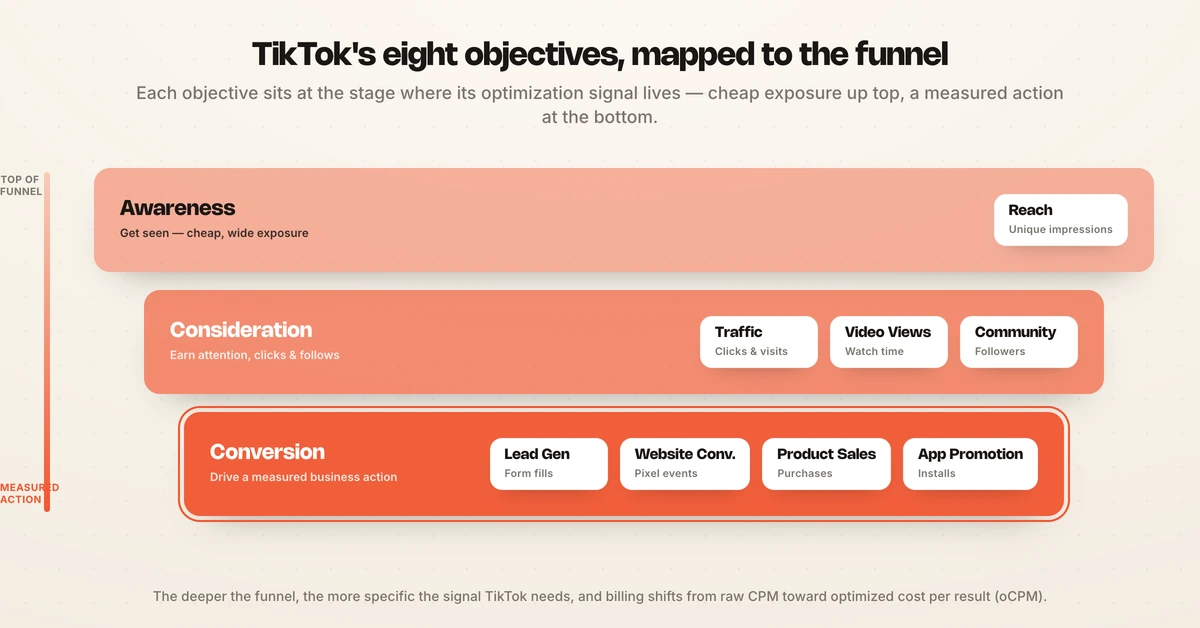
Awareness sits at the top, where the goal is exposure. Consideration sits in the middle, where the goal is interest and engagement. Conversion sits at the bottom, where the goal is a measurable business action tied to your pixel, your Instant Form, or your app.
The table below maps all eight objectives to their funnel stage, what TikTok optimizes each one for, and how the spend is typically billed.
| Objective | Funnel stage | Optimizes for | Typical billing / bid |
|---|---|---|---|
| Reach | Awareness | Unique impressions | CPM |
| Traffic | Consideration | Landing-page clicks and visits | CPC |
| Video Views | Consideration | 2-second and 6-second views, watch time | CPV or oCPM |
| Community Interaction | Consideration | Followers and profile visits | CPM or CPC |
| Lead Generation | Conversion | Instant Form submissions | oCPM |
| Website Conversions | Conversion | Pixel events (purchase, sign-up) | oCPM |
| Product Sales | Conversion | Purchases across Shop, catalog, and web | oCPM |
| App Promotion | Conversion | Installs and in-app events | oCPM or CPC |
A quick way to read the table: the further down the funnel you go, the more specific the signal TikTok needs and the more your billing shifts from raw impressions (CPM) toward optimized cost per result (oCPM). If you want a refresher on how these buying terms fit together, the Hawky glossary defines CPM, oCPM, and related metrics.
Awareness objectives: how does the Reach campaign work?
Awareness campaigns exist to put your brand in front of as many relevant people as possible, and TikTok currently offers Reach as the core awareness objective. Reach shows your ad to the maximum number of unique users in your target audience at the lowest possible CPM (TikTok Ads Manager).
Reach optimizes for impressions, not clicks or purchases. TikTok serves the ad widely and controls how often each person sees it, which keeps frequency in check and cost per thousand impressions low. No pixel or conversion event is required.
Use Reach when a launch, a rebrand, or a seasonal moment needs broad visibility fast. The trade-off is honest: you are buying eyeballs, so measure success on reach, frequency, and impressions rather than expecting clicks or sales from the same campaign.
Consideration objectives: how do you earn attention and clicks?
Consideration campaigns optimize for people who take an action beyond seeing the ad, and TikTok groups three objectives here: Traffic, Video Views, and Community Interaction. Each one targets a different mid-funnel signal.
- Traffic sends people to a destination, usually a website or landing page, and optimizes for clicks and visits on a CPC basis. It is the standard way to warm a cold audience before a conversion push. One warning from practitioners: Traffic finds clickers, not buyers, so it is the wrong choice when a purchase is the real goal (MBADV).
- Video Views maximizes plays and watch time among users most likely to pay attention, billed as CPV or oCPM against 2-second or 6-second views. Reach for it when your creative needs a few seconds to land a story, a demo, or a hook.
- Community Interaction grows followers, profile visits, and page visits, or promotes a livestream. Use it to build an owned audience you can retarget and nurture over time rather than renting attention campaign by campaign.
The common thread is that consideration objectives buy engagement, not revenue. They are the bridge between a stranger seeing your brand and a customer completing a purchase, and skipping them entirely often makes conversion campaigns more expensive.
Conversion objectives: what is a TikTok conversion campaign?
A TikTok conversion campaign optimizes for a completed business action, such as a purchase, a lead, or an app install, and TikTok groups four objectives at this stage: Lead Generation, Website Conversions, Product Sales, and App Promotion. These objectives require a signal source, usually the TikTok Pixel, the Events API, an Instant Form, or an app SDK.
- Lead Generation collects contact details through a native Instant Form or an external page, optimizing for form submissions on an oCPM basis. It suits services, B2B, and any offer where the next step is a sign-up rather than a checkout.
- Website Conversions drives pixel-tracked actions on your own site, such as purchases, sign-ups, or add-to-carts. It requires the TikTok Pixel or Events API and optimizes toward the specific event you select.
- Product Sales is the unified shopping objective that runs catalog and Shop ads and, in 2026, absorbs Website Conversions for commerce advertisers. It optimizes for purchases across TikTok Shop, product catalogs, and your website in one place.
- App Promotion drives installs and post-install in-app events, optimizing beyond the download to the actions that signal a valuable user.
Conversion campaigns carry a real constraint: the algorithm needs data density to stabilize. An ad group generally needs roughly 50 conversions within about seven days to exit the learning phase, and below that signal volume, cost per result stays volatile (TikTok Ads Manager). That is why budget and event volume matter as much as the objective itself.
TikTok reach vs conversion campaign: what actually changes?
The difference between a TikTok reach vs conversion campaign is not the wording, it is the auction you enter and the audience TikTok builds for you. A Reach campaign optimizes for cheap, wide exposure. A conversion campaign optimizes for a measurable action and pays more per result to get qualified users.
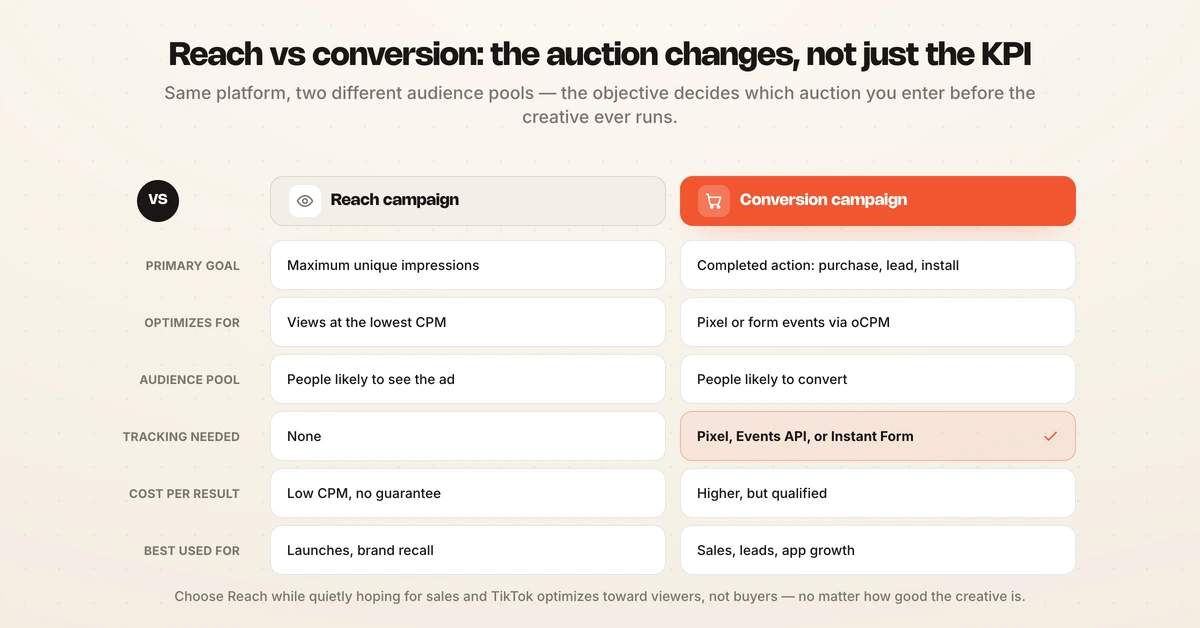
The table below shows what changes when you move from one to the other.
| Factor | Reach campaign | Conversion campaign |
|---|---|---|
| Primary goal | Maximum unique impressions | Completed action (purchase, lead, install) |
| Optimizes for | Views at lowest CPM | Pixel or form events via oCPM |
| Audience pool | People likely to see the ad | People likely to convert |
| Tracking required | None | TikTok Pixel, Events API, or Instant Form |
| Cost per result | Low CPM, no result guarantee | Higher, but qualified |
| Best used for | Launches, brand recall | Sales, leads, app growth |
The practical lesson is that the objective sets the auction pool, not merely the KPI you report on later (MBADV). If you choose Reach or Traffic while quietly hoping for sales, TikTok optimizes toward viewers or clickers and your conversion rate suffers, no matter how good the creative is.
Which TikTok ad campaign type should you use?
The right TikTok ad campaign type is the one whose optimization goal matches the business outcome you can actually measure right now. Work backward from the action you want, then pick the objective that optimizes for exactly that action.
- Define the single action that counts. A view, a click, a follow, a lead, and a purchase are five different objectives. Name the one that moves your business this quarter.
- Check that you can track it. Conversion objectives need the TikTok Pixel, the Events API, or an Instant Form live before launch. No signal, no optimization.
- Confirm you can feed the learning phase. Aim for enough budget to generate around 50 conversions per ad group per week, and remember TikTok requires a campaign daily budget above $50 and an ad group daily budget above $20 (TikTok Ads Manager).
- Sequence the funnel if the audience is cold. New brands often run Reach or Video Views first to build an audience, then retarget with Website Conversions or Product Sales.
- Change the objective by rebuilding, not editing. You cannot switch a live campaign's objective, so plan it up front.
For a full walkthrough of setup, targeting, and creative, see the Hawky guides on how to run TikTok ads and TikTok ads optimization. If budget planning is the open question, the breakdown of TikTok ads cost and current TikTok ads benchmarks will help you size each objective. Weighing the channel against Meta first is covered in TikTok ads vs Facebook ads.
How autonomous agents handle campaign selection
Choosing an objective is a one-time decision, but running the right mix across a growing account is a continuous one, and this is where autonomous tooling changes the job. As you scale, you are not picking one campaign type, you are balancing awareness, consideration, and conversion budgets against a moving KPI every day.
Hawky's Performance Agent is an always-on operator that plans, launches, and optimizes TikTok campaigns against a locked KPI like ROAS or CAC. It runs a closed loop of test, track, optimize, and scale, and it works across Meta, Google, YouTube, and TikTok from one place. The point is not automation for its own sake, it is autonomy you can govern.
Governance is the difference between reckless and reliable. The Performance Agent keeps humans in command through spend caps, shadow mode, and configurable approval gates, and every move is logged with its trigger data and a confidence score, so any change is one-click reversible. You decide how much autonomy to grant, from shadow mode to fully autonomous, with the same audit trail throughout.
That structure lets a small team run more objectives well. Instead of manually watching learning phases and reallocating budget across a dozen ad groups, you set the KPI and the guardrails, and the Performance Agent handles the execution while you keep the judgement. For teams juggling channels and objectives at once, the Command Center gives one view of what every campaign is doing and why. Deeper automation patterns are covered in the guide to TikTok ads automation, and larger accounts will find more in scaling TikTok ads.
Frequently asked questions
What are the TikTok campaign objectives?
The TikTok campaign objectives are the eight goals in TikTok Ads Manager, grouped into three funnel stages. Awareness holds Reach, and Consideration holds Traffic, Video Views, and Community Interaction. Conversion holds Lead Generation, Website Conversions, Product Sales, and App Promotion. Each objective optimizes delivery for a different action.
Which TikTok campaign type should I use?
Use the campaign type whose optimization goal matches the action you can measure. Choose Reach or Video Views to build awareness, Traffic or Community Interaction to earn engagement, and Website Conversions, Product Sales, Lead Generation, or App Promotion when you need a purchase, lead, or install. Match the objective to the outcome, not the other way around.
What is a TikTok conversion campaign?
A TikTok conversion campaign optimizes for a completed action, such as a purchase, a lead, or an app install, rather than views or clicks. It requires a signal source like the TikTok Pixel, the Events API, or an Instant Form, and it uses oCPM bidding. An ad group generally needs about 50 conversions within seven days to stabilize its cost per result.
Can you change a TikTok campaign objective after it launches?
No. TikTok locks the objective when the campaign goes live, because the objective defines the underlying optimization and auction model. To run a different objective, duplicate the campaign, select the new objective, and relaunch rather than editing the existing one.
What is the minimum budget for a TikTok campaign?
TikTok requires a campaign-level daily or total budget above $50 and an ad group daily budget above $20, with lifetime budgets calculated as $20 multiplied by the number of scheduled days (TikTok Ads Manager). Conversion objectives usually need more than the minimum to gather the roughly 50 weekly events that stabilize delivery.
If picking the right objective is easy but running the right mix across awareness, consideration, and conversion every day is eating your team's week, Hawky's Performance Agent is built for that job.
Ready to hire your first AI performance team? Book Demo