Scaling TikTok Ads Without Losing ROAS: A Step-by-Step Guide
Scaling TikTok ads without losing ROAS means raising budgets in small steps, expanding audiences and creatives in parallel, and never letting one change knock a winning campaign back into the learning phase.
Most teams scale by doubling a budget the moment a campaign looks profitable. TikTok's delivery system reads that as a shock, resets its optimization, and cost per acquisition climbs while ROAS falls. The fix is a repeatable process: prove the campaign is stable, add spend in controlled increments, widen reach through new audiences, and keep fresh creative in the pipeline so fatigue never catches up with your budget.
This guide walks through that process step by step, with the numbers that keep scaling profitable.
What you need before you scale TikTok ads
Scaling amplifies whatever a campaign already does, so a shaky campaign scales its losses just as fast as a strong one scales its wins. Confirm these four things are in place before you touch a budget.
- A campaign out of the learning phase. A TikTok ad group needs at least 50 conversions in a rolling seven-day window to exit the learning phase and stabilize delivery, per TikTok For Business and Emplicit. Below that, the data is too thin to trust.
- A CPA margin below breakeven. Scaling typically lifts CPA by 10 to 15 percent, so your current CPA should already sit 20 to 30 percent under your breakeven target, according to Coinis. Without that buffer, the first budget bump erases your profit.
- A creative bank ready to rotate. Plan for 10 to 15 active creatives per campaign before you ramp, since TikTok creative fatigues within 3 to 5 days at high spend (AdManage).
- Clean conversion tracking. The TikTok Pixel or Events API has to fire reliably, or every scaling decision rests on broken data.
If these are missing, fix them first. A stable base is the difference between compounding wins and burning cash. For the fundamentals, review how to run TikTok ads before scaling on top of them.
When should you scale TikTok ads?
Scale when the account gives you a clear readiness signal, not when revenue targets make you impatient. The strongest signal is a campaign that has cleared 50 conversions in seven days and is holding a stable CPA against your target day over day.
Three conditions tell you a campaign is ready:
- Learning phase cleared. Delivery has settled and CPA no longer swings wildly between days.
- ROAS above target with margin. The campaign beats your ROAS goal consistently, not on a single lucky day.
- CPA sitting under breakeven. You have the 20 to 30 percent buffer that absorbs the CPA lift scaling brings.
Timing also matters within the week. Give any budget change two to three days to settle before you judge it, because a temporary dip in the first 48 hours is normal recovery, not failure. Reading what a good ROAS looks like for your margin helps you set the target you scale against.
Vertical vs horizontal scaling: what is the difference?
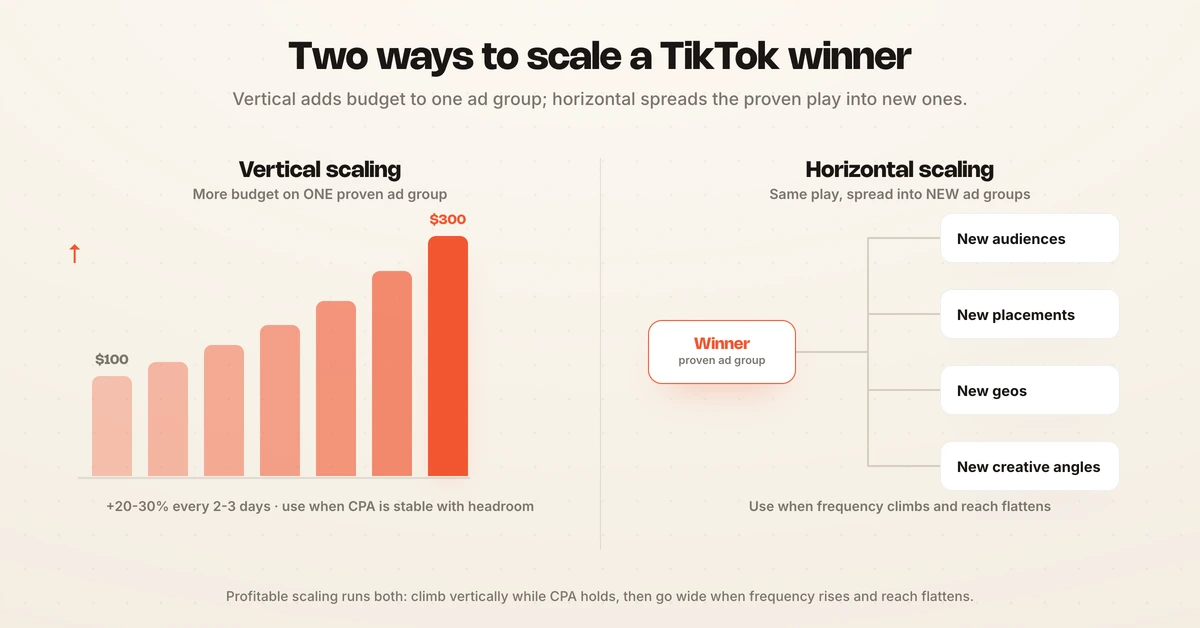
Vertical scaling adds budget to a proven winner, while horizontal scaling adds new audiences, placements, geographies, or creative angles around it. Profitable scaling uses both, because budget alone eventually saturates an audience and drives frequency past the point where ROAS holds.
| Dimension | Vertical scaling | Horizontal scaling |
|---|---|---|
| What changes | Budget on existing winning ad groups | New audiences, placements, geos, creatives |
| Best for | Fast growth on a proven audience | Durable growth and lower saturation risk |
| Main risk | Re-entering the learning phase, CPA spikes | Audience overlap, fragmented data |
| Pace | 20-30% every 2-3 days | 1-2 new duplicates or angles per week |
| Signal to use it | Stable CPA with headroom | Rising frequency, flattening reach |
Sources: Onramp Funds, AdManage.
Lean vertical when an audience still has room and CPA is stable. Shift horizontal when frequency climbs and reach flattens, which is TikTok telling you the current audience is tapped out.
Step 1: Scale TikTok ads budget vertically with the 20% rule
Raise a winning budget by 20 to 30 percent, then wait two to three days before the next increase. Onramp Funds and Emplicit both land on this range because it adds meaningful spend without triggering a full re-learn.
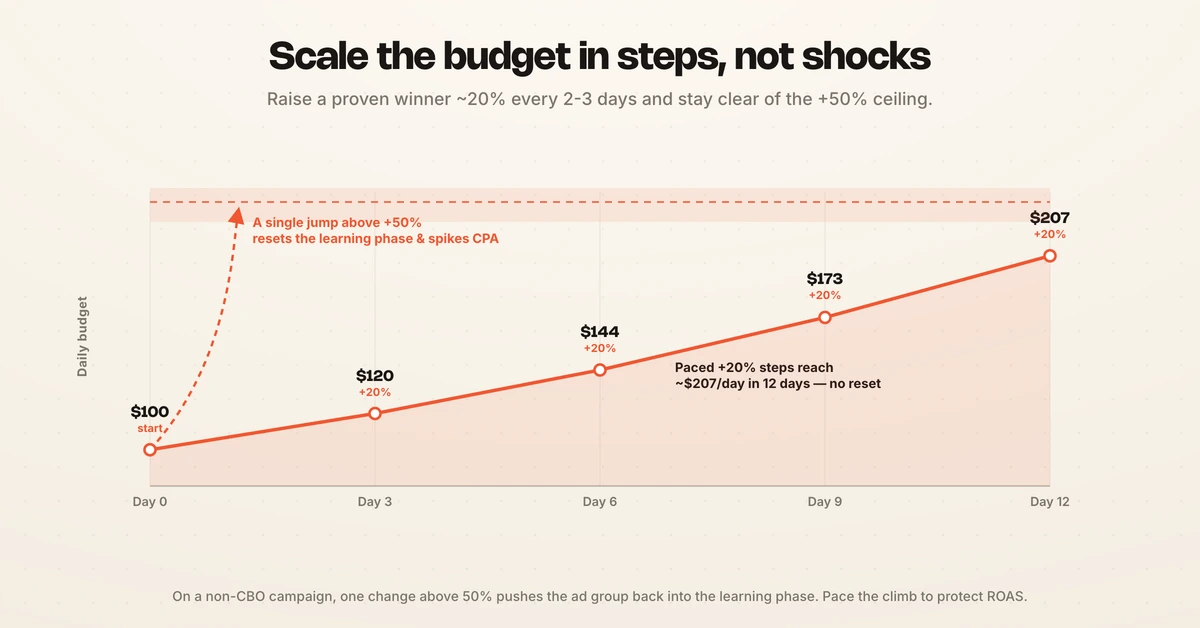
The hard ceiling matters as much as the increment. A single non-CBO budget change above 50 percent pushes the ad group back into the learning phase, which resets optimization and spikes CPA (Coinis). Staying at or below the 20 to 30 percent step keeps you clear of that line.
Compounded, a 20 percent step every three days grows a budget quickly without shocking delivery. Starting at $100 per day, the ladder reaches roughly $207 per day inside two weeks.
| Day | Daily budget |
|---|---|
| Day 0 | $100 |
| Day 3 | $120 |
| Day 6 | $144 |
| Day 9 | $173 |
| Day 12 | $207 |
Done right, each step-up holds CPA within your buffer. If CPA breaks past breakeven after a raise, step the budget back down, let it recover for two to three days, and resume at a smaller increment.
Pro tip: Use ABO to test audiences and CBO once you are scaling proven winners, so TikTok pushes budget to the best performers automatically instead of splitting it evenly.
Step 2: Scale horizontally across audiences and placements
Duplicate a winner into new audiences rather than forcing all growth through one ad group. When a proven campaign is stable, copy it at the same budget and point the duplicate at a fresh segment, a broader interest set, a lookalike built from your best customers, or a new region.
Horizontal moves protect ROAS because they spread spend across more inventory instead of raising frequency on a saturated audience. Keep audience overlap in check with exclusions so your duplicates do not bid against each other and inflate CPM.
Placements and formats are horizontal levers too. Test Spark Ads against in-feed video, and open TikTok's automatic placements once a creative proves out, so delivery finds cheaper impressions. For the campaign structures worth duplicating, see TikTok ad campaign types, and pair that with TikTok ads optimization to tighten each new duplicate before it scales.
The playbook mirrors what works on Meta. If you already run there, scaling Facebook ads covers the same vertical-and-horizontal logic on a slower-fatiguing platform.
Step 3: Keep creative ahead of fatigue
Feed the algorithm fresh creative faster than your audience burns out on it, because on TikTok that happens fast. TikTok creative fatigues roughly four times faster than Meta, and at high spend a single video can decay within 3 to 5 days (AdManage).
Watch two signals to know when to rotate. Refresh a creative when CTR drops around 20 percent from its peak or when frequency climbs past 3, since a healthy TikTok frequency sits between 2 and 3 and negative sentiment rises once users see an ad four or more times (Strike Social).
Volume is the defense. Maintain 10 to 15 active creatives per campaign and produce two to three new variations each week, so a fatigued ad always has a fresh one to hand budget to. Modular production makes that cheap: film one core body, then shoot several three-second hooks and a few CTAs, and swap only the hook when performance dips.
Catch fatigue early instead of after ROAS falls. Element-level creative analysis shows which hook, visual, or CTA is decaying inside an ad set, so creative rotation happens on signal, not on a guess.
Step 4: Guard ROAS with structure and monitoring
Scaling profitably is a monitoring discipline, not a one-time budget push. TikTok CPMs trended upward through 2025 and into 2026, so a campaign that ignores delivery costs quietly loses margin even while spend grows.
Keep an eye on the benchmarks your ROAS depends on. WordStream puts 2026 TikTok CPM in the $4 to $10 range and CPC at $0.30 to $1.50, with ecommerce CPMs running higher (WordStream). Rising CPM against flat conversion rate is an early warning that a raise went too far.
| Guardrail | Rule of thumb | Source |
|---|---|---|
| Vertical budget step | 20-30% every 2-3 days | Onramp / Emplicit |
| Max single non-CBO change | Under 50% | Coinis |
| Learning-phase exit | 50 conversions / 7 days | TikTok For Business |
| CPA margin before scaling | 20-30% under breakeven | Coinis |
| Active creatives at scale | 10-15+ | AdManage |
| Healthy frequency | 2-3 | Strike Social |
Structure keeps the data clean while you monitor. Hold to a handful of ad groups per account and a few ads per ad group so delivery is not fragmented across dozens of thin segments. A single command center view across campaigns makes it obvious which raise moved CPA and which creative is dragging the average down. For a full metric baseline, keep TikTok ads benchmarks and TikTok ads cost next to your dashboard.
Common mistakes when scaling TikTok ads
Most ROAS collapses during scaling trace back to a handful of avoidable errors.
- Doubling budgets overnight. A jump above 50 percent resets the learning phase and spikes CPA. Stay inside 20 to 30 percent steps instead.
- Scaling before 50 conversions. Raising spend on an ad group still in learning burns budget on unstable delivery. Wait for the signal.
- Ignoring the CPA buffer. Scaling adds 10 to 15 percent to CPA, so a campaign that is only breakeven turns unprofitable on the first raise.
- Letting creative go stale. One or two ads at scale fatigue in days. Rotate on a CTR drop or a frequency above 3, not on a monthly calendar.
- Only scaling vertically. Budget alone saturates an audience and pushes frequency up. Pair every vertical raise with horizontal expansion.
The pattern behind all five is the same: moving faster than the algorithm and the audience can absorb. A TikTok ads automation layer that watches these signals continuously catches the miss before it costs you a week of spend.
Tools that make scaling TikTok ads easier
The right stack turns scaling from a manual, error-prone routine into a monitored system. A few options cover different parts of the job.
- TikTok Ads Manager. The native platform handles budget changes, CBO, and automatic placements. It reports the past well but leaves the cadence and creative-rotation decisions to you.
- Creative and analytics tools. Reporting layers and creative libraries help you spot fatigue and track benchmarks. Compare the field in best TikTok ads tools.
- Hawky's Performance Agent. Hawky's Performance Agent runs the scaling loop as autonomous media buying kept under human command. It buys against your KPI across TikTok, Meta, Google, and YouTube, steps budgets inside safe increments, and expands audiences and creatives on signal, 24/7.
What separates the agent from a rules engine is configurable autonomy paired with control. You pick the gate, from shadow mode to approval-gated to fully autonomous, and every move is logged with its trigger data and a confidence score and stays one-click reversible under spend caps and guardrails. The agent watches the 50-conversion threshold, the 20 percent budget step, and creative fatigue at once, so scaling stays profitable without a human refreshing dashboards. Pricing is outcome-based, so review the pricing before a pilot, and check the glossary for any term above you want defined.
Frequently asked questions
How do you scale TikTok ads? Scale TikTok ads by raising the budget on a proven winner in 20 to 30 percent steps every two to three days (vertical scaling), and by duplicating that winner into new audiences, placements, and creatives (horizontal scaling). Only scale after the ad group clears 50 conversions in a seven-day window, and keep 10 to 15 fresh creatives rotating so fatigue never catches your budget.
When should I scale my TikTok ad budget? Scale once the ad group has exited the learning phase with 50 conversions in a rolling seven-day window, holds a stable CPA against your target, and sits 20 to 30 percent under your breakeven CPA. That buffer matters because scaling usually raises CPA by 10 to 15 percent, so scaling a breakeven campaign turns it unprofitable.
How to scale TikTok ads without losing performance? Keep every budget increase at or below 20 to 30 percent and never exceed a 50 percent single change on a non-CBO campaign, which resets the learning phase. Give each raise two to three days to settle, pair vertical budget raises with horizontal audience expansion, and rotate creative when CTR drops about 20 percent or frequency passes 3.
What is the 20% rule for TikTok ads? The 20 percent rule is the practice of increasing a campaign budget by only 20 to 30 percent per adjustment so TikTok's delivery system can recalibrate without re-entering the learning phase. Larger jumps shock optimization and spike CPA, which is why gradual steps protect ROAS.
How much budget do you need to scale TikTok ads? There is no fixed number, but conversion campaigns generally need enough daily budget to clear 50 conversions in seven days, which many advertisers support with a budget several times their target CPA. Set the budget high enough to gather stable data, then grow it in 20 to 30 percent steps rather than starting high.
If your TikTok scaling keeps stalling because manual budget steps, audience expansion, and creative rotation cannot all be watched at once, Hawky's Performance Agent is built for that job.
Ready to hire your first AI performance team? Book Demo