TikTok Ads Optimization: The Complete 2026 Playbook
TikTok ads optimization is the repeatable process of fixing conversion tracking, structuring budgets to clear the learning phase, winning the first three seconds of every video, and cutting spend from creatives that miss benchmarks, so each dollar buys more conversions than the last.
Most teams treat optimization as a bidding tweak they make once and forget. That is why campaigns stall in the learning phase, burn budget on ads nobody watches past second two, and quietly plateau. This playbook walks through the exact sequence that moves the numbers, then troubleshoots the most common failure (TikTok ads not spending) with a fix for each cause.
In this guide:
- What you need before you start
- The six-step optimization sequence
- Why your TikTok ads are not spending
- Common mistakes and the tools that make this easier
What you need before you start
TikTok ads optimization only works when the account can measure a conversion cleanly. Before touching bids or creative, confirm three things are in place.
- A firing pixel or Events API connection. If your TikTok Pixel or Events API is not sending events correctly, the algorithm gets no feedback and the learning phase never completes.
- Budget headroom above the minimums. TikTok enforces a $50 minimum per campaign per day and a $20 minimum per ad group per day, per the official Budget and Bidding FAQ.
- At least a handful of creative variants. One ad cannot be optimized. You need volume to find a winner, which the steps below explain.
If you are launching from scratch rather than tuning a live account, get the fundamentals in place first, then come back here to optimize.
How does TikTok ads optimization actually work?
TikTok ads optimization works by feeding the delivery algorithm enough clean conversion signal, fast enough, that it can find your buyers and hold cost steady. Everything below serves that one goal. Work the steps in order, because each one unblocks the next.
Step 1: Fix conversion tracking before anything else
Nothing else matters if the algorithm cannot see a sale. A misconfigured event is the quiet killer behind most underperforming accounts, because TikTok optimizes toward whatever it can measure, and measures nothing when the pixel is broken.
Verify that your key event (Purchase, Complete Payment, or Lead) fires once per action, deduplicated between the Pixel and the Events API. Fire a test conversion and confirm it lands in Events Manager within minutes. If you sell through TikTok Shop, keep on-platform checkout events wired in, since in-app conversion paths report far more reliably than off-platform redirects.
Done looks like: a live event showing recent, deduplicated conversions in Events Manager, matched to real orders.
Step 2: Structure budgets to clear the learning phase
Your single most important optimization lever is getting each ad group past the learning phase. TikTok's conversion algorithm needs roughly 50 optimization events per ad group per 7-day window to exit learning and stabilize delivery and cost, according to Coinis.
Work backwards from that number. If your target cost per acquisition is $25, fifty conversions a week is about $1,250, or roughly $179 per ad group per day. Fund fewer, better-resourced ad groups rather than spreading a thin budget across many, since a starved ad group never gathers enough signal to optimize. Set daily budgets slightly above the floor (around $55 to $60 at the campaign level) so delivery is never throttled by the minimum.
Pro tip: do not pause an ad group mid-learning to "save money." Pausing resets accumulated signal, and the phase starts over.
Done looks like: each conversion ad group pacing toward 7 to 10 conversions per day, untouched for the first 24 hours.
Step 3: Win the first three seconds
On TikTok the creative is the targeting, and the hook is the creative. TikTok for Business reports that 63% of the highest click-through videos hook viewers within the first three seconds, per Stackmatix. A viewer who does not stop scrolling in that window is gone, and delivery shifts away from the ad.
Measure this with hook rate, the share of impressions that reach a three-second view. Average hook rate sits near 30.7%, while top-quartile ads hold 40% or higher. Open on motion or a pattern break, add a text overlay in the first two seconds for sound-off viewers, and lead with the payoff instead of a slow build. Hawky's hook rate guide breaks down how to calculate and lift it.
Done looks like: your top creatives clear a 30% hook rate, with a clear gap between winners and the rest.
Step 4: Test creative volume, then consolidate
You cannot optimize your way out of one tired video. High-volume creative testing is how you find the two or three ads that carry the account, so launch 10 to 20 variations across different hooks, formats, and angles rather than polishing a single hero.
Let the data name the winners, then concentrate budget on them and retire the losers. Refresh creative every 7 to 10 days to counter fatigue, which shows up as a rising CPM and a falling CTR on a previously strong ad. Spark Ads, which run from organic posts, tend to earn roughly 2.4x the click-through of standard in-feed ads according to Mega Digital, so test them alongside your studio-made variants.
Done looks like: two to three proven winners taking the majority of spend, with a fresh test batch always in rotation.
Step 5: Read the benchmarks and cut what underperforms
Optimization is a series of cut decisions, and you cannot cut without a yardstick. The table below gives current TikTok averages you can hold each ad group against.
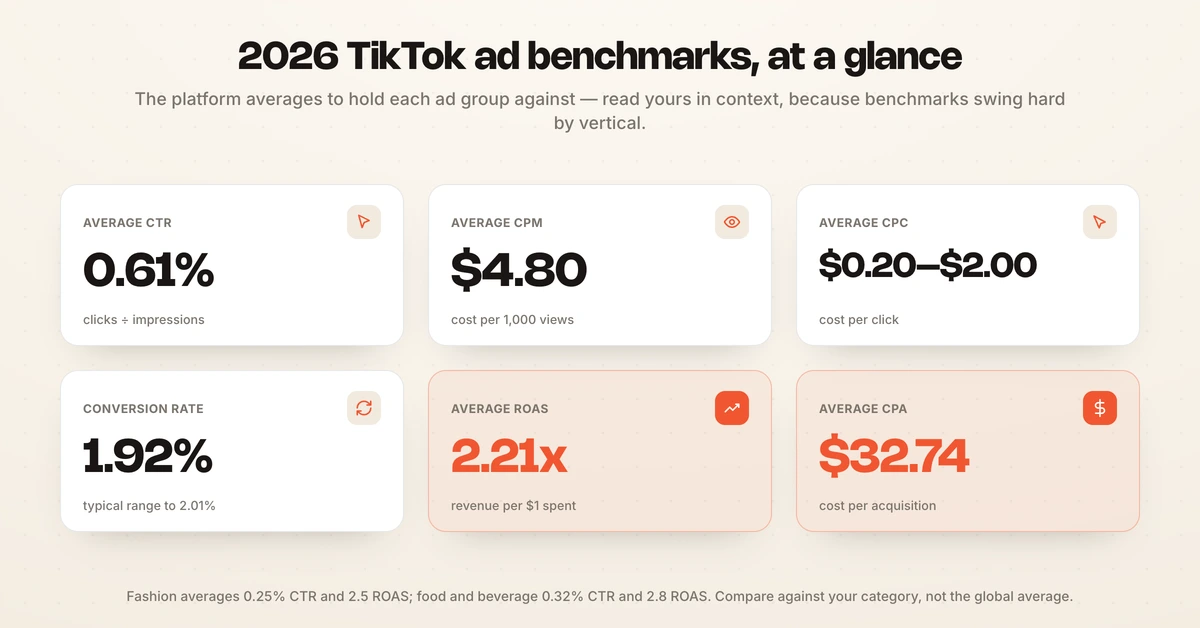
| Metric | 2026 benchmark | Source |
|---|---|---|
| Average CTR | 0.61% | Mega Digital |
| Average CPM | $4.80 | Lebesgue |
| Average CPC | $0.20 to $2.00 | Lebesgue |
| Conversion rate | 1.92% to 2.01% | Mega Digital |
| Average ROAS | 2.21 | Mega Digital |
| Average CPA | $32.74 | Mega Digital |
Benchmarks swing hard by vertical, so read yours in context. Fashion averages a 0.25% CTR and a 2.5 ROAS, while food and beverage runs a 0.32% CTR and a 2.8 ROAS. Financial services sits lower at a 0.1% CTR and a 1.2 ROAS on a $15 CPM. Compare full-vertical detail in Hawky's TikTok ads benchmarks breakdown, then pause any ad group trailing its category on both CTR and conversion rate.
Done looks like: every active ad group meeting or beating its vertical benchmark, with laggards paused.
Step 6: Scale winners without resetting the algorithm
Scaling is where most gains are lost, because a big budget jump throws an ad group back into learning. Raise budgets by 20% to 30% at a time, then wait 24 to 48 hours for delivery to settle before the next increase.
When you have squeezed one ad group, duplicate the winning creative into a fresh ad group with a new broad audience rather than piling spend into the original. For the full ladder from first winner to poured-on budget, see Hawky's guide to scaling TikTok ads.
Done looks like: budget climbing in steady steps while CPA holds inside your target range.
Why are my TikTok Ads not spending?
TikTok ads not spending is almost always one of seven fixable causes, not a platform bug. Zero or stalled delivery means the ad cannot enter the auction, win it, or clear review. Work down this table in order.
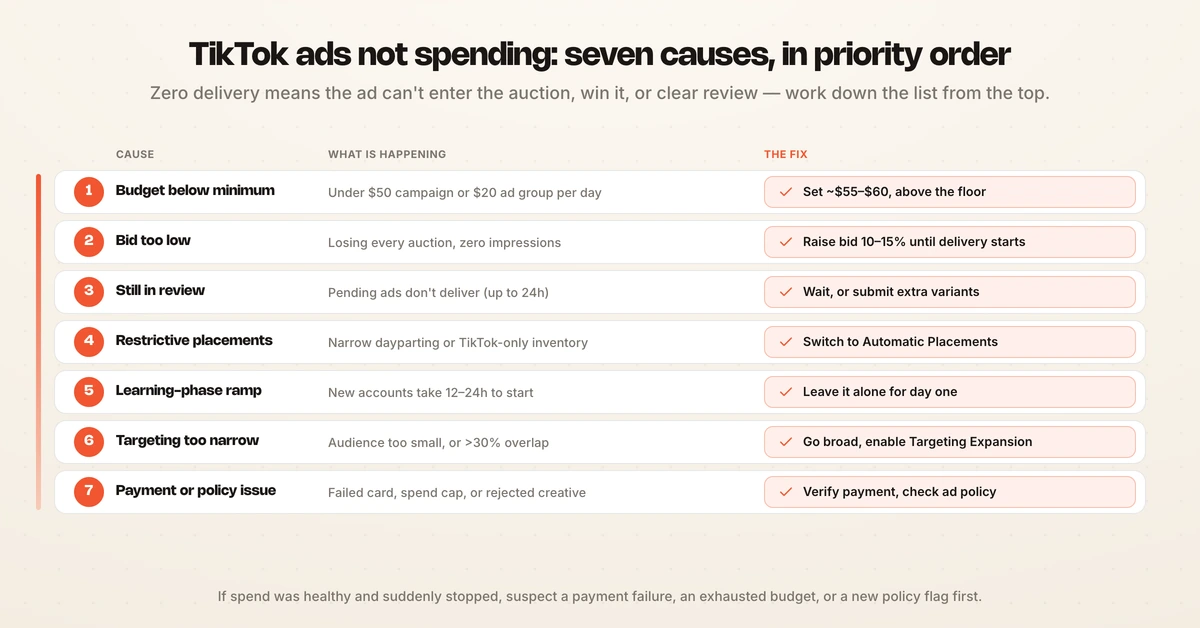
| Cause | What is happening | Fix |
|---|---|---|
| Budget below minimum | Under $50 campaign or $20 ad group per day | Set slightly above the floor, around $55 to $60 |
| Bid too low | Losing every auction, zero impressions | Raise the bid 10% to 15% until delivery starts |
| Still in review | Pending ads do not deliver (up to 24h) | Wait, or submit extra variants to speed approval |
| Restrictive placements or schedule | Narrow dayparting or TikTok-only inventory | Switch to Automatic Placements while troubleshooting |
| Learning-phase calibration | New or fresh accounts take 12 to 24h to ramp | Leave it alone for the first day |
| Targeting too narrow | Audience too small, or overlap above 30% self-competes | Go broad, enable Targeting Expansion |
| Payment or policy issue | Failed card, spend cap, or rejected creative | Verify payment, review against ad policy |
The budget floors above come from the official TikTok Budget and Bidding FAQ. If spend was healthy and suddenly stopped, suspect payment failure, an exhausted budget, or a new policy flag first.
Common TikTok ads optimization mistakes to avoid
Even careful accounts repeat the same errors. These are the ones that quietly cap performance.
- Editing ad groups mid-learning. Every meaningful edit or pause can reset the learning phase and wipe accumulated signal. Batch changes and make them before launch, not after.
- Judging ads on day one. Early CPA reads high by design while the algorithm calibrates. Give each ad group 24 to 48 hours and 50 events before you rule.
- Over-narrow targeting. Stacking interests starves the algorithm of the data it needs. Broad targeting with a strong creative outperforms tight targeting with a weak one on TikTok.
- Ignoring creative fatigue. A rising CPM and falling CTR on a once-strong ad is fatigue, not bad luck. Refresh every 7 to 10 days.
- Chasing cheap CPMs over profitable CPAs. A low CPM on an ad that never converts is expensive. Optimize toward CPA and ROAS, and use a cheaper CPM only as a tiebreaker. Hawky's guide to lower TikTok ad costs covers where real savings come from.
Tools that make TikTok ads optimization easier
The steps above are doable by hand, but they demand daily attention across tracking, budgets, creative, and benchmarks. A few categories of tool reduce that load.
- TikTok Ads Manager is the free native home for setup, bidding, and reporting, and where every optimization ultimately lands.
- Third-party analytics (such as Lebesgue or benchmark trackers) give you the vertical comparisons TikTok's own dashboard does not surface.
- Hawky's Performance Agent runs the loop for you. It plans, launches, and optimizes TikTok, Meta, Google, and YouTube campaigns against your KPI, 24/7, watching for learning-phase stalls, fatigue, and spend that drifts off target. Its optimization is autonomous but not unsupervised: every move is logged with the trigger data and a confidence score, gated by the approval level you set, and one-click reversible, so the audit trail and guardrails stay intact. See the Performance Agent for how autonomous media buying keeps humans in command.
Frequently asked questions
How do I optimize TikTok Ads?
Fix conversion tracking first, then fund each ad group to clear roughly 50 conversions a week and exit the learning phase. From there, win the first three seconds of each video, test 10 to 20 creatives to find winners, cut ad groups that trail their vertical benchmark, and scale survivors in 20% to 30% steps. Optimize toward CPA and ROAS, not cheap CPMs.
Why are my TikTok Ads not spending?
The usual causes are a budget below the $50 campaign or $20 ad group minimum, a bid too low to win the auction, an ad still in review, over-restrictive placements or targeting, or a payment and policy issue. Work through them in that order. New campaigns also need 12 to 24 hours to start delivering while the algorithm calibrates.
How do I improve TikTok ad performance?
Improve TikTok ad performance by raising hook rate, since 63% of the highest click-through videos hook viewers in the first three seconds. Refresh creative every 7 to 10 days to beat fatigue, concentrate budget on proven winners, and keep targeting broad so the algorithm has room to find buyers. Measure against current benchmarks (0.61% CTR, 2.21 ROAS) and cut what trails.
What is a good CTR for TikTok ads?
The platform average CTR is about 0.61%, so anything above that is solid, and Spark Ads often reach roughly 2.4x higher. CTR varies by vertical: fashion averages 0.25% while food and beverage nears 0.32%. Read your CTR against your category, not the global average.
How long does the TikTok learning phase take?
An ad group exits the learning phase after about 50 optimization events within a 7-day window. Budget to drive 7 to 10 conversions a day to reach that pace, and avoid pausing or heavily editing the ad group, since either action resets the phase and forces it to start over.
If TikTok campaigns stalling in the learning phase and bleeding budget while you sleep is the part of the job you want off your plate, Hawky's Performance Agent is built for that job.
Ready to hire your first AI performance team? Book Demo