What Is a Good CPA? Cost-Per-Acquisition Benchmarks (2026)
A good CPA is any cost per acquisition that sits below your maximum allowable CPA, the ceiling set by your customer lifetime value and profit margin, and that also holds up against your platform and industry benchmark. There is no single dollar figure that is universally good, because a $40 CPA that prints profit for one brand quietly bankrupts another.
Benchmarks still matter as a sanity check. If your cost per acquisition runs far above the median for your channel and vertical, something in your targeting, creative, or landing page is leaking money. This guide defines CPA, gives current platform and industry benchmark tables, and shows how to set the CPA ceiling your business can actually afford.
What is CPA?
CPA, or cost per acquisition, is the average amount you pay to turn one prospect into a customer or a qualified lead. You calculate it by dividing total campaign spend by the number of conversions in the same window. Spend $5,000 and get 100 purchases, and your CPA is $50.
The word "acquisition" carries weight here. On an ecommerce account a conversion is usually a purchase, so CPA maps to cost per purchase. On a lead-gen account a conversion might be a form fill or a demo booking, which sits earlier in the funnel and costs less than a closed sale. Always confirm what event your CPA is counting before you compare it to anyone else's number.
CPA is close to CAC (customer acquisition cost), but the two are not identical. CPA measures the media cost of a single tracked conversion inside an ad platform, while CAC divides your full sales and marketing cost by new customers won. For a plain-language breakdown of these and related metrics, the Hawky glossary keeps definitions in one place.
What is a good CPA?
A good CPA is one that lets you acquire customers profitably, meaning the value a customer returns over their lifetime clearly exceeds what you paid to win them. The cleanest way to judge this is the LTV to CPA ratio. A 3:1 ratio, where lifetime value is three times acquisition cost, is the widely used benchmark for healthy unit economics after cost of goods, fulfilment, service, and overhead, per Triple Whale's CPA guide (2026).
Read the ratio in bands. Below 2:1 the math is usually unsustainable and you either cut CPA or raise LTV. Above 5:1 you are efficient but probably underinvesting in growth, leaving volume on the table that a competitor will take.
Context is everything, and one example makes it plain. A $100 CPA is excellent for a brand selling $500 products at 70% margin, and a death sentence for a brand selling $80 products at 25% margin, as Triple Whale (2026) frames it. That is why chasing a competitor's CPA is a trap, and why the benchmark tables below are a starting point, not a target.
What is the average cost per acquisition?
The average cost per acquisition depends heavily on the channel, because intent and auction pressure differ across platforms. High-intent search traffic tends to convert cheaper per action than cold social prospecting, while some emerging channels sit cheapest of all on a median basis. The table below shows median CPA by ad platform across a large ecommerce dataset.
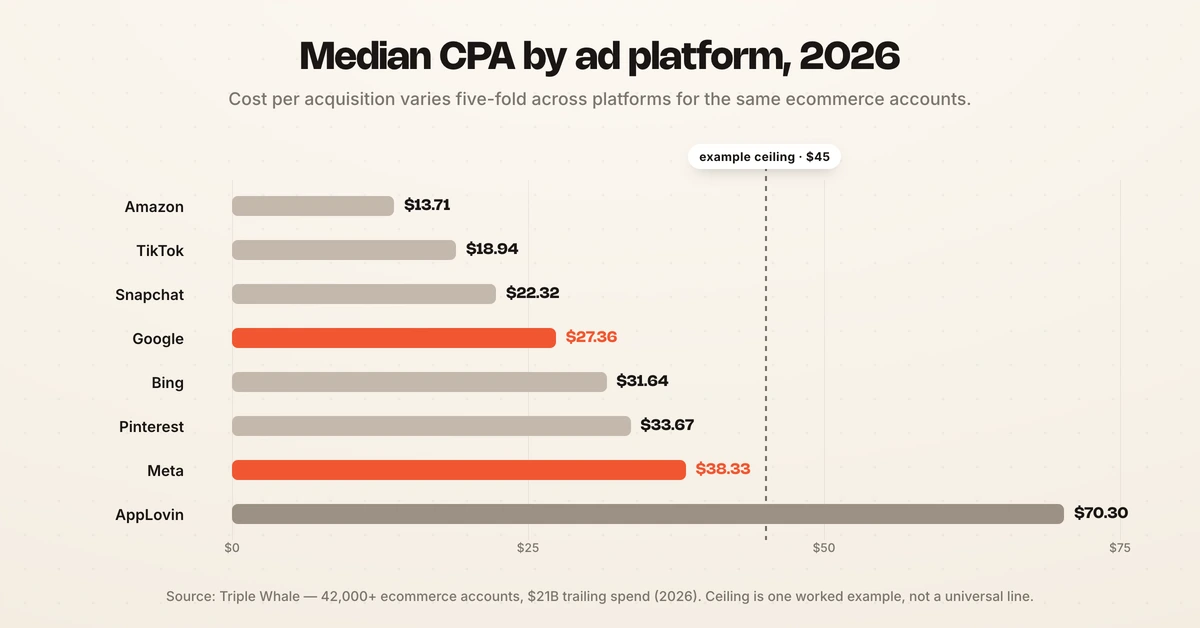
| Ad platform | Median CPA (2026) |
|---|---|
| Amazon | $13.71 |
| TikTok | $18.94 |
| Snapchat | $22.32 |
| $27.36 | |
| Bing (Microsoft) | $31.64 |
| $33.67 | |
| Meta | $38.33 |
| AppLovin | $70.30 |
Source: Triple Whale, 42,000+ ecommerce accounts, $21B in trailing spend (2026).
Two cautions before you anchor on these. First, this dataset is ecommerce-weighted, so purchase-based CPAs read lower than lead-gen accounts where a conversion is a full sale. Second, all-industry Google Ads datasets that fold in legal, B2B, and finance run much higher, near $70.11 across industries in 2025 per WordStream and LocalIQ (2025), so the average you should care about is the one for your vertical, not the global mean.
Google Search CPA benchmarks by industry
Google Search CPA swings widely by vertical, driven by keyword competition and how expensive the click is. Low-consideration categories with fast decisions sit at the bottom, while high-value, high-competition categories like technology and B2B sit at the top. The figures below reflect WordStream's Google Ads search-network benchmark analysis.
| Industry | Avg CPA (Google Search) |
|---|---|
| Auto | $33.52 |
| Travel & Hospitality | $44.73 |
| E-commerce | $45.27 |
| Employment Services | $48.04 |
| Education | $72.70 |
| Health & Medical | $78.09 |
| Finance & Insurance | $81.93 |
| Legal | $86.02 |
| Home Goods | $87.13 |
| Consumer Services | $90.70 |
| B2B | $116.13 |
| Real Estate | $116.61 |
| Technology | $133.52 |
Source: WordStream Google Ads benchmarks; search-network average $48.96, display $75.51.
Use this table to answer one question: is my CPA in the right neighbourhood for my category. A finance advertiser at a $60 CPA is beating the vertical, while an auto advertiser at that number is overpaying. For a deeper read on search costs and conversion patterns, see the Hawky guide to Google Ads benchmarks.
What is a good CPA for Facebook ads? Meta benchmarks by industry
On Meta the median CPA across industries landed at $38.19 in 2025, up a slim 1.04% year over year, with wide spread underneath that median. Lower-consideration lifestyle categories acquire cheapest, while electronics and travel accessories cost the most per purchase. The table shows median Meta CPA by industry from Triple Whale's 2025 analysis.
| Industry | Median CPA (Meta) |
|---|---|
| Lifestyle & Boutique | $29.99 |
| Baby | $30.04 |
| Books & Music | $30.25 |
| Media & Publishing | $33.78 |
| Automotive | $34.15 |
| Apparel & Accessories | $36.76 |
| Beauty | $37.92 |
| Food & Beverage | $38.15 |
| Pets & Animals | $38.18 |
| Health & Wellness | $38.55 |
| Sports & Outdoors | $43.89 |
| Travel Accessories & Luggage | $48.37 |
| Electronics | $49.48 |
Source: Triple Whale Facebook Ads benchmarks, ~35,000 brands, Jan to Dec 2025.
So what is a good CPA for Facebook ads. A good CPA for Facebook ads is one below your industry median that still clears your margin, which for many direct-to-consumer brands lands between $15 and $30, though a $50 CPA can be healthy on high-LTV products and a $15 CPA can lose money on thin margins, per SaveMyLeads (2026). For the broader picture on Meta costs, the Hawky guides to Facebook ads benchmarks and Facebook ads cost go deeper on CPM, CTR, and spend.
How to set your maximum allowable CPA
Your maximum allowable CPA is the highest amount you can pay per acquisition and still hit your profit target, and it is the only benchmark that truly governs whether a CPA is good. Work it backward from margin and lifetime value rather than from a competitor's number. The simplest ceiling ties to a single order.
Maximum CPA equals average order value multiplied by gross margin, minus fixed cost per order, minus the profit you want to keep. Take a $100 AOV at 60% gross margin, with $10 of fixed cost per order and a $5 target profit per order. That gives $60 minus $10 minus $5, or a $45 maximum allowable CPA, a worked example drawn from OptimizeSmart (2024).
For subscription or repeat-purchase brands, run the ceiling off lifetime value instead. Maximum CPA equals LTV multiplied by one minus your target profit margin, but margin-adjust LTV first, because LTV is revenue, not profit. A $480 LTV at 60% gross margin is really $288 of contribution, and that contribution number, not the headline $480, is what sets how much you can spend. A common shorthand is to keep CPA between 10% and 30% of LTV, which maps neatly to the 3:1 ratio.
How do you lower CPA?
You lower CPA by improving the efficiency of every step between the click and the conversion, not by simply cutting bids. Five levers move it the most.
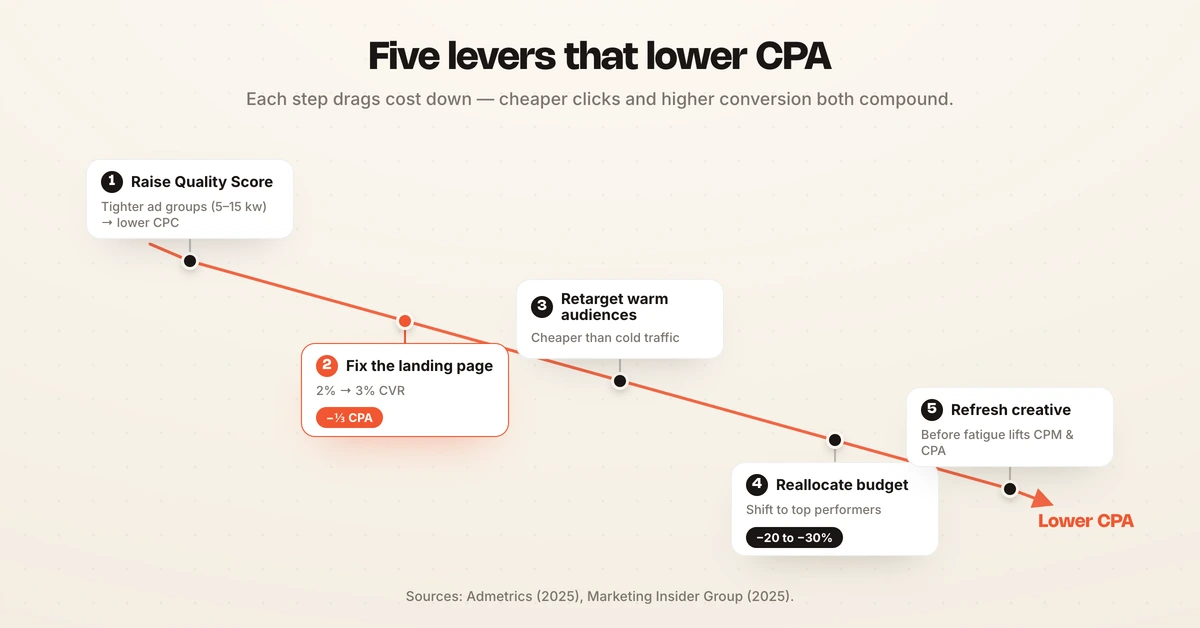
- Raise Quality Score and ad relevance. Tighter ad groups of 5 to 15 closely related keywords let you write more relevant copy, which lifts Quality Score, lowers CPC, and drags CPA down with it (Admetrics, 2025).
- Fix the landing page. Lifting conversion rate from 2% to 3% cuts CPA by a third with no change to targeting or spend, so page speed, message match, and a clean checkout often beat any bid tweak (Marketing Insider Group, 2025).
- Retarget warm audiences. Prospects who already engaged convert at a lower cost than cold traffic, so a disciplined retargeting layer pulls blended CPA down.
- Reallocate budget to what works. Shifting spend toward high-performing campaigns and dayparts rather than splitting it evenly can cut acquisition costs by 20% to 30% (Admetrics, 2025).
- Refresh creative before fatigue hits. Rising frequency and falling CTR push CPM and CPA up, so rotating in new creative on a schedule protects efficiency.
The catch is that these levers need constant attention across every campaign, audience, and creative, which is where most teams run out of hours. Autonomous tooling closes that gap when it is paired with real control. Hawky's Command Center tracks CPA against your target in real time and flags budget leakage and fatigued creatives before they inflate your cost per acquisition.
Hawky's Performance Agent takes it further, buying media against a CPA or CAC KPI around the clock and running a closed loop of test, track, optimize, and scale. Every move is logged with trigger data and a confidence score, is one-click reversible, and stays inside spend caps, guardrails, and an audit trail, so the autonomy has a brake pedal. You keep the judgement while the agent handles the repetitive tuning, and its outcome-based pricing ties cost to the KPI it moves.
CPA also does not live alone. To read it in context, pair it with the sibling metrics in the Hawky guides to what is a good ROAS, ROAS benchmarks by industry, what is a good CPC, what is a good CPM, and average ad conversion rate.
Frequently asked questions
What is a good CPA?
A good CPA is any cost per acquisition below your maximum allowable CPA, the ceiling set by your margin and lifetime value, that also beats your platform and industry benchmark. A common rule is an LTV to CPA ratio of at least 3:1, or keeping CPA between 10% and 30% of customer lifetime value.
What is the average cost per acquisition?
Median CPA in 2026 is roughly $27 on Google and $38 on Meta for ecommerce accounts, per Triple Whale, though all-industry Google Ads datasets that include legal, B2B, and finance run near $70. The average that matters is the median for your specific channel and vertical, not the global figure.
What is a good CPA for Facebook ads?
A good CPA for Facebook ads is one below your industry median that still clears your margin. Meta's overall median CPA was $38.19 in 2025 (Triple Whale), and many direct-to-consumer brands target $15 to $30, though a $50 CPA can be profitable on high-LTV products.
How do you lower CPA?
Lower CPA by raising Quality Score with tighter ad groups, improving landing page conversion rate, retargeting warm audiences, reallocating budget to top performers, and refreshing creative before fatigue spikes costs. Lifting landing page conversion from 2% to 3% alone cuts CPA by about a third.
What is the difference between CPA and CAC?
CPA measures the media cost of a single tracked conversion inside an ad platform, while CAC divides your total sales and marketing cost by the number of new customers won. CAC is broader and usually higher, because it includes salaries, tools, and non-media spend that CPA ignores.
Is a lower CPA always better?
No, because a very low CPA can signal underinvestment or low-quality conversions that never become paying customers. The goal is a CPA that maximizes profitable volume, not the lowest number, which is why an LTV to CPA ratio above 5:1 often means you should scale spend, not celebrate.
If manually tuning bids, budgets, and creatives to chase a lower CPA is eating your team's week, Hawky's Performance Agent is built for that job.
Ready to hire your first AI performance team? Book Demo