What Is a Good CPM? Benchmarks by Platform and Industry
A good CPM sits between roughly $2 and $15 for most paid social and display campaigns, but what is a good CPM depends entirely on the platform, industry, and audience you are buying. Google Display can run under $3, Meta clusters around $8 to $15, and LinkedIn routinely charges $30 or more to reach the same person. A number that looks expensive on one channel is a bargain on another.
CPM is one of the first metrics every media buyer learns and one of the last they fully understand. It sets the price of attention, shapes how far a budget stretches, and moves with seasonality, competition, and creative quality. This guide defines CPM, gives current benchmarks by platform and industry, and explains what pushes your rate up or down.
What is CPM (cost per mille)?
CPM stands for cost per mille, the cost to serve 1,000 ad impressions. "Mille" is Latin for thousand, so CPM is literally the price of a thousand views. It is the standard currency of awareness and reach buying across Meta, Google, YouTube, TikTok, and LinkedIn.
The formula is simple. Divide total spend by total impressions, then multiply by 1,000. Spend $500 to earn 100,000 impressions and your CPM is $5.00. You can read a fuller breakdown in the Hawky glossary.
CPM measures cost of exposure, not cost of action. It answers "how much am I paying to be seen," while cost per click (CPC) and cost per acquisition (CPA) answer what happens after the impression. Buyers use CPM to compare the raw price of attention across channels and to spot when a rising rate is quietly eating into results.
What is a good CPM?
A good CPM is any rate at or below the average for your platform, industry, and campaign objective. There is no universal target, because the same dollar buys wildly different reach depending on where and to whom you advertise. One source frames it plainly: a good CPM is one that is not higher than the average for your industry and type of campaign (Post Affiliate Pro, 2025).
As a working guide, $5 to $15 is normal for most business-to-consumer paid social, $20 to $50 signals premium audiences like finance, insurance, and B2B, and anything above $50 usually means LinkedIn or a restricted ad category. Lower is generally better, but only if reach quality holds. A rock-bottom CPM against the wrong audience is not a win, it is cheap waste.
The honest answer is that CPM is a relative metric. To judge yours, you need the benchmark for your specific channel, which is where platform data comes in.
Average CPM by platform: the 2025 benchmarks
Average CPM by platform ranges from under $3 on Google Display to more than $30 on LinkedIn, a spread of roughly 10x. The gap reflects targeting precision and demand: the more narrowly a platform can identify a valuable audience, the more advertisers pay to reach it. The table below shows typical 2025 ranges and a representative figure for each channel.
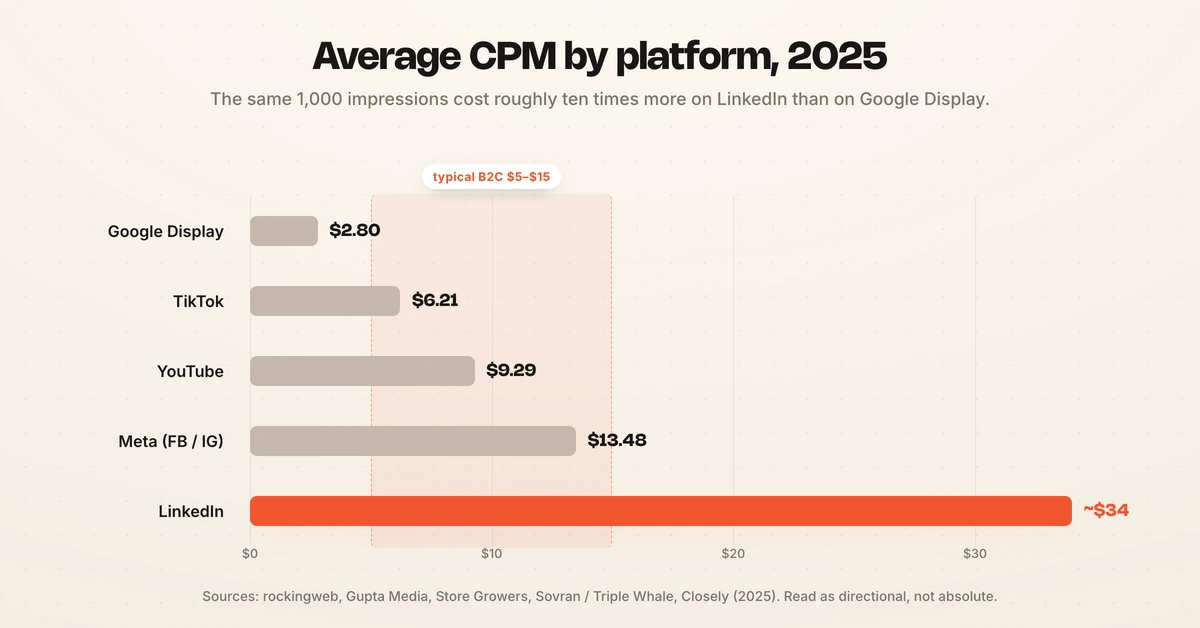
| Platform | Typical CPM range | Representative CPM | Source (year) |
|---|---|---|---|
| Google Display Network | $2–$4 | $2.80 | rockingweb, 2025 |
| TikTok | $4–$13 | $6.21 (June) | Gupta Media, 2025 |
| YouTube | $5–$10 | $9.29 | Store Growers, 2025 |
| Meta (Facebook / Instagram) | $8–$15 | $13.48 median | Sovran / Triple Whale, 2025 |
| $30–$40 | $31–$38 median | Closely, 2025 |
Read these as directional, not absolute. Reported averages differ by dataset because each measures different objectives, geographies, and verticals. A second source puts Meta closer to $8.19, TikTok $4.82, and YouTube $4.99 on a broad average (Post Affiliate Pro, 2025), which is why cross-checking two sources beats trusting one headline number.
Google Display stays cheapest because inventory is vast and targeting is loose. LinkedIn stays most expensive because professional targeting is scarce and B2B advertisers compete hard for it. For a deeper channel view, see the Hawky guides to Facebook ads benchmarks, Google ads benchmarks, and TikTok ads benchmarks.
What is a good CPM for Meta ads?
What is a good CPM for Meta ads is the same question as Facebook, since Instagram and Facebook share one auction. Expect broadly $8 to $18 depending on audience and placement.
What is a good CPM for Facebook ads?
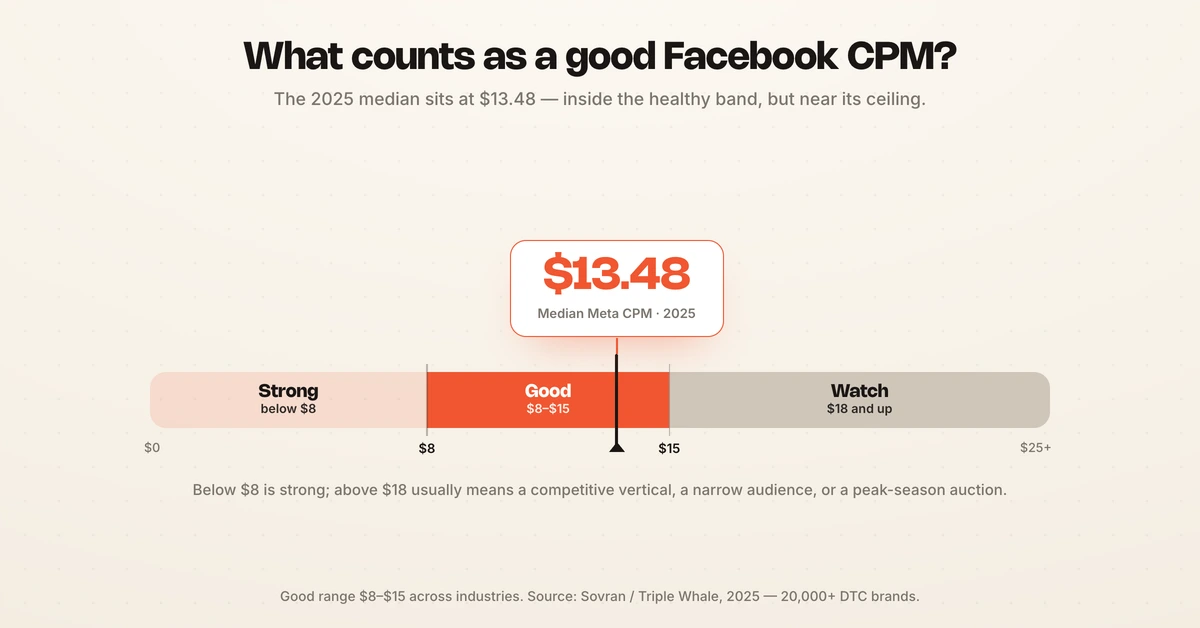
A good CPM for Facebook ads in 2025 falls between $8 and $15, with the median across industries landing at $13.48 (Sovran / Triple Whale, 2025). Rates below $8 are strong, and anything pushing past $18 usually means a competitive vertical, a narrow audience, or a peak-season auction.
Meta CPM also swings by objective. Awareness campaigns optimized for reach often land in the $5 to $10 band, traffic campaigns run $10 to $15, and lead generation or conversion campaigns can climb to $20 to $45 or higher (Post Affiliate Pro, 2025). The platform charges more when you ask it to find people likely to act, not just people likely to scroll past.
Format matters too. Feed placements tend to price higher than Stories and Reels, so the same budget buys different reach depending on where the ad lands. If you also track engagement, pair your CPM read with a good CTR and good ROAS so a cheap impression that never converts does not fool you.
CPM benchmarks by industry
CPM benchmarks by industry can vary by 2x or more inside a single platform, driven by how valuable and contested each audience is. On Meta, regulated and high-value categories pay a premium, while commodity retail pays less. The table below shows Meta CPM by industry from a dataset of more than 20,000 direct-to-consumer brands.
| Industry (Meta) | CPM range | Source (year) |
|---|---|---|
| Finance & Insurance | $14–$18 | Sovran / Triple Whale, 2025 |
| Real Estate | $12–$15 | Sovran / Triple Whale, 2025 |
| Electronics & Tech | $12–$14 | Sovran / Triple Whale, 2025 |
| Beauty & Health | $12.46 | Sovran / Triple Whale, 2025 |
| Clothing & Fashion | $9–$11 | Sovran / Triple Whale, 2025 |
| Food & Beverage | $8–$10 | Sovran / Triple Whale, 2025 |
| Hardware & Automotive | $6.96 | Sovran / Triple Whale, 2025 |
The industry pattern repeats on other channels. Google Ads averages around $11.12 CPM overall, but Health and Healthcare Services tops the list near $35.07 (Coupler.io PPC stats, 2025). On LinkedIn, SaaS and software run $30 to $50 while retail sits nearer $25 (Closely, 2025). The lesson holds across platforms: benchmark against your own vertical, never against the global average.
What drives your CPM up or down?
Your CPM moves with four main forces: seasonality, audience competition, campaign objective, and creative quality. Understanding each turns a mysterious rate spike into a diagnosable, fixable problem.
Seasonality is the loudest driver. Q4 pushes CPMs up 50% to 200% across most platforms as holiday advertisers flood the auction, and Black Friday and Cyber Monday can spike rates 60% to 138% above the annual average (Post Affiliate Pro, 2025). January is usually the cheapest month of the year, when the same impression costs a fraction of its December price.
Audience competition sets the floor. The more precisely a platform can target a scarce, valuable audience, the more that audience costs. That is why LinkedIn CPMs run 5x to 10x higher than Google Display for the same individual: professional targeting is both rarer and more contested. Narrow your audience too far and you bid against yourself, driving your own CPM up.
Campaign objective and creative quality do the rest. Asking the algorithm to find converters costs more than asking it to find viewers, so conversion campaigns carry higher CPMs than awareness ones. Strong, relevant creative earns cheaper delivery because platforms reward engagement, while creative fatigue quietly raises your effective CPM as click-through rate decays. Fresh creative is one of the few CPM levers fully in your control.
Why is my CPM so high, and how do you bring it down?
A high CPM almost always traces back to one of a handful of causes: a peak-season auction, an audience that is too narrow or too contested, a conversion-heavy objective, or fatigued creative that the platform has stopped favoring. Diagnosing which one is the fix.
Start with these practical steps to lower a stubborn CPM:
- Broaden a too-narrow audience. Over-segmentation makes you compete against yourself. Widen targeting and let the algorithm find efficient reach.
- Refresh fatigued creative. Rising frequency and falling CTR inflate CPM. Rotate in new hooks and formats before performance decays.
- Match objective to goal. If you only need reach, do not pay conversion-tier CPMs. Align the campaign objective with the outcome you actually want.
- Time spend around seasonality. Pull budget forward into cheaper months where the calendar allows, and expect to pay more in Q4.
- Improve relevance. Better creative-to-audience fit earns cheaper delivery, because engagement is what platforms reward.
Doing this well means watching CPM, CTR, frequency, and ROAS together, across every platform, all the time. That is where most teams fall behind, because manual monitoring cannot keep pace with auctions that shift by the hour. Hawky's Command Center unifies live performance across Meta, Google, YouTube, and TikTok in one control room, flagging rising CPMs and fatigued creative before they drain budget.
Beyond monitoring, Hawky's Performance Agent runs the optimization loop autonomously against your KPI, with guardrails, spend caps, and a one-click-reversible audit trail keeping humans in command. It tests, tracks, optimizes, and scales around the clock, so a CPM spike triggers a response in minutes rather than at the next weekly review. You set the gate, from shadow mode to fully autonomous, and loosen it as trust builds. Pricing is outcome-based, detailed on the Hawky pricing page.
Frequently asked questions
What is a good CPM?
A good CPM is any rate at or below the average for your platform, industry, and objective. Broadly, $5 to $15 is normal for most B2C paid social, $20 to $50 signals premium or B2B audiences, and $50 or more usually means LinkedIn or a restricted category (Post Affiliate Pro, 2025).
What is the average CPM?
Average CPM varies sharply by platform. In 2025, Google Display averaged about $2.80, TikTok about $6.21 in June, YouTube near $9.29, Meta a median of $13.48, and LinkedIn $31 to $38 (Sovran / Triple Whale; Closely; Gupta Media, 2025).
Why is my CPM so high?
A high CPM usually comes from peak-season auctions (Q4 can raise CPMs 50% to 200%), an audience that is too narrow or too contested, a conversion-focused objective, or fatigued creative with a falling click-through rate. Broadening targeting, refreshing creative, and matching objective to goal are the fastest fixes (Post Affiliate Pro, 2025).
What is a good CPM for Facebook ads?
A good CPM for Facebook ads in 2025 is $8 to $15, with the cross-industry median at $13.48. Below $8 is strong, and above $18 usually points to a competitive vertical, a narrow audience, or a peak-season auction (Sovran / Triple Whale, 2025).
Is a lower CPM always better?
Not always. A low CPM only helps if it reaches the right audience, since cheap impressions against unqualified viewers waste budget without driving results. Judge CPM alongside CTR, conversion rate, and ROAS rather than in isolation.
If watching CPM creep up while you juggle five dashboards is the daily grind, Hawky's Performance Agent is built for that job.
Ready to hire your first AI performance team? Book Demo