What Is a Good CPC? Cost-Per-Click Benchmarks (2026)
A good CPC is any cost per click low enough that the click still turns a profit after it converts, which in 2026 means roughly $0.30 to $2 on Meta and TikTok and about $2 to $6 on Google Search for most industries. The honest answer to what is a good CPC is that it depends on the click's downstream value, not a universal dollar figure. A $9 legal-services click can be a bargain, and a $0.40 click that never converts is expensive at any price.
This guide gives you real cost-per-click benchmarks by platform and industry, then shows you what actually moves CPC up or down. Use the numbers to sanity-check your account, not as a target to chase in isolation.
What is CPC (cost per click)?
CPC, or cost per click, is the amount you pay each time someone clicks your ad. It is the core pricing unit of most paid search and paid social campaigns, and it sits between your budget and your results. You set a bid, the platform runs an auction, and the winning advertiser pays a price based on competition and ad quality.
CPC matters because it decides how many clicks your budget buys. If your CPC is $2 and your daily budget is $100, you get about 50 clicks. Halve the CPC and you double the traffic for the same spend, which is why cost per click is one of the first metrics performance marketers watch. For a plain-language definition of related terms, the Hawky glossary breaks down the auction mechanics.
CPC is not the same as what you bid. Your maximum bid is the ceiling you are willing to pay, while your actual CPC is usually lower because the auction charges you just enough to beat the next advertiser. That gap is where Quality Score and relevance do their work, a point covered later in this guide.
What is a good CPC? The benchmark answer
A good CPC is one that keeps your customer acquisition cost below the profit a customer generates. That framing matters more than any benchmark, because CPC only becomes "good" or "bad" once you factor in conversion rate and order value. A click is an input, and profit is the output you actually care about.
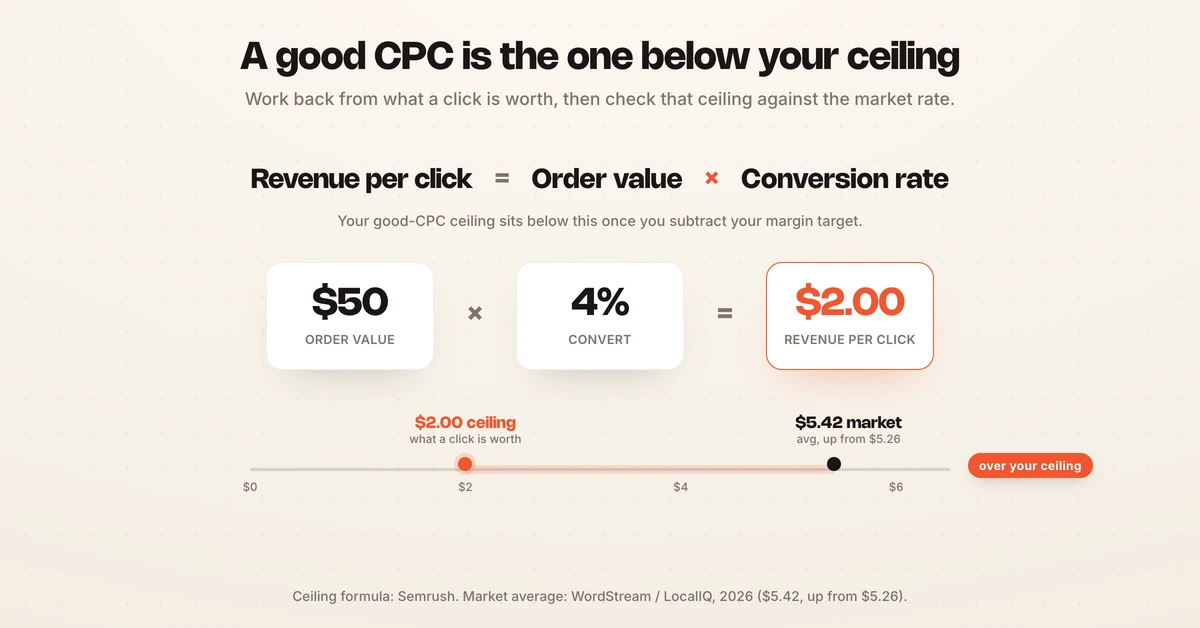
The practical way to judge your own number is a simple ceiling. Your maximum profitable CPC equals your average order value times your conversion rate, divided by one plus your target return, a formula documented by Semrush. If a converting visitor is worth $50 and 4% of clicks convert, each click is worth about $2 in revenue before you apply a margin target. Any CPC comfortably under that ceiling is good for your business.
Benchmarks still help as a reality check. They tell you whether you are paying a normal rate for your platform and category, or whether a bidding or Quality Score problem is quietly inflating your costs. The tables below give you those reference points.
What is the average cost per click by platform?
The average cost per click varies more by platform than by almost any other factor. Google Search sits at the expensive end because it captures high-intent demand, while paid social and video clicks run far cheaper. The table below pulls current CPC benchmarks from platform-specific 2025 and 2026 reports.
| Platform | Average CPC | Source (year) |
|---|---|---|
| Google Search | $5.42 | WordStream / LocalIQ (2026) |
| Google Display Network | $0.63 | Store Growers (2026) |
| Meta (traffic campaigns) | $0.70 | WordStream (2025) |
| Meta (leads campaigns) | $1.92 | WordStream (2025) |
| TikTok | $0.30 to $1.50 | AdManage (2026) |
| Microsoft (Bing) | $1.54 | Sender (2025) |
| YouTube | $3.56 | Sender (2025) |
| $5.58+ | Sender (2025) |
Two patterns stand out. Search clicks cost multiples of display and social clicks because a search query signals active intent, and intent is what advertisers bid up. A Google Display click at $0.63 and a Google Search click at $5.42 are not comparable buys, since one interrupts browsing and the other answers a stated need.
The second pattern is objective. On Meta, a traffic-objective click averages $0.70 while a leads-objective click averages $1.92, because the platform optimizes toward users more likely to submit a form, as the related breakdown of Facebook ads cost explains. Cheaper clicks are not automatically better clicks, a theme that runs through every table here.
What is a good CPC by industry?
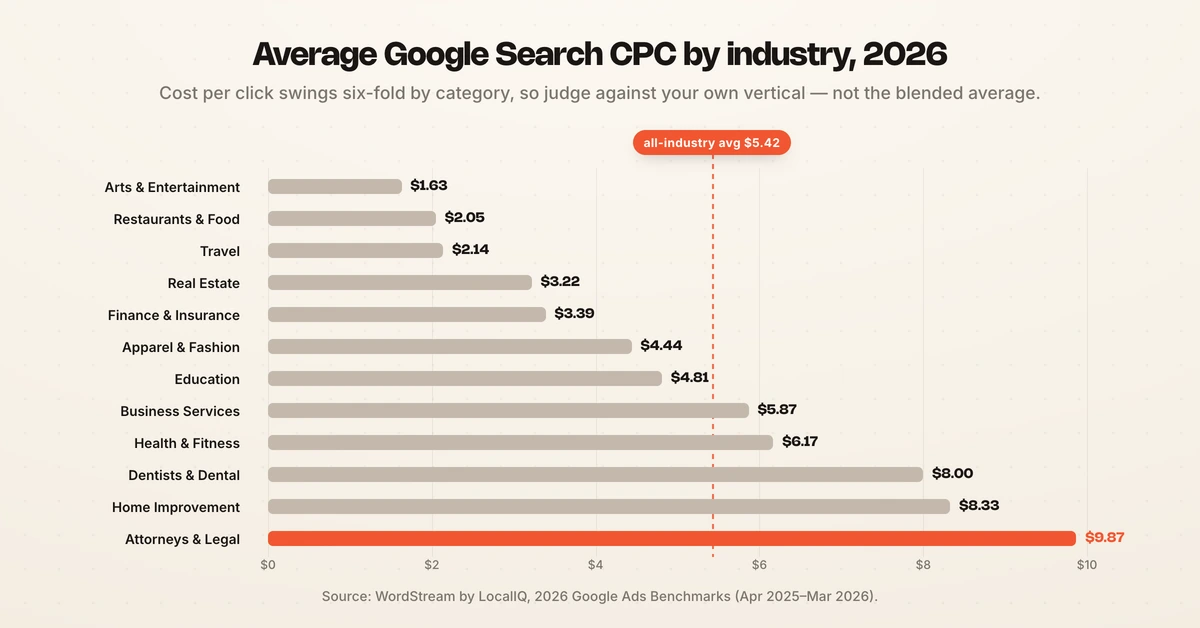
A good CPC by industry depends heavily on how much a customer is worth in that vertical. Legal and dental clicks cost the most because a single new client can be worth thousands, so advertisers bid aggressively. Low-margin, high-volume categories like restaurants and entertainment sit at the cheap end. The figures below come from the WordStream by LocalIQ 2026 Google Ads Benchmarks (data covering April 2025 to March 2026), cross-checked against the matching LocalIQ search benchmarks.
| Industry (Google Search) | Average CPC |
|---|---|
| Arts & Entertainment | $1.63 |
| Restaurants & Food | $2.05 |
| Travel | $2.14 |
| Real Estate | $3.22 |
| Finance & Insurance | $3.39 |
| Animals & Pets | $4.06 |
| Apparel / Fashion & Jewelry | $4.44 |
| Education & Instruction | $4.81 |
| Business Services | $5.87 |
| Health & Fitness | $6.17 |
| Dentists & Dental Services | $8.00 |
| Home & Home Improvement | $8.33 |
| Attorneys & Legal Services | $9.87 |
The spread is roughly six-fold from cheapest to most expensive, which is why a single "good CPC" number is misleading. Against an all-industry average of $5.42, a $4 click looks strong for a law firm and expensive for a restaurant. The right comparison is your own vertical, not the blended average.
Costs also move year over year. Real estate CPCs rose about 27% in the latest data while education fell nearly 23%, per the same WordStream and LocalIQ report. Benchmarks are a snapshot, so treat them as a starting line rather than a fixed rule.
What is a good CPC for Google Ads?
A good CPC for Google Ads is one at or below your industry benchmark while still hitting your target cost per acquisition. On Google Search the 2026 all-industry average is $5.42, up from $5.26 the prior year, according to WordStream and LocalIQ. Search costs keep climbing, but conversion rates rose alongside them, so the higher CPC is not automatically a worse deal.
The Google network you use changes the answer completely. Search clicks average $5.42 because they intercept active demand, while Google Display Network clicks average just $0.63, per Store Growers. Display and Search serve different jobs, so compare each against its own baseline rather than against each other. For a fuller cost picture, see the related guides on Google Ads cost and Google Ads benchmarks.
Brand terms and non-brand terms also behave differently inside one account. Clicks on your own brand name are cheap and convert well, so blending them with cold prospecting keywords hides the real cost of new-customer acquisition. Segment the two before you decide whether a CPC is good.
What lowers your CPC? Quality Score and relevance
Quality Score is the single biggest lever most advertisers control for lowering CPC. Google calculates Ad Rank as your bid multiplied by Quality Score and the expected impact of your assets, then charges you the minimum needed to hold your position. A higher Quality Score lets you win the same auction at a lower price, so relevance directly discounts what you pay.
The math is steep. A keyword at Quality Score 1 to 3 can cost up to 400% more per click than the same keyword at a Quality Score 5 baseline, while a Quality Score of 10 can unlock up to a 50% CPC discount, according to (un)Common Logic. Quality Score has three inputs: expected click-through rate, ad relevance, and landing page experience. Improving any of them lowers CPC without cutting your reach, which is what makes it more efficient than simply lowering bids.
Creative and click-through rate feed the same loop on social platforms. A higher CTR signals relevance to the auction, which lowers the price of the next click, so better creative is a cost lever, not just a performance one. The connection between click-through rate and cost is covered in the guide on what is a good CTR. Tightening ad-to-keyword match, pausing low-quality placements, and refreshing fatigued creative are the practical moves that pull CPC down.
Is a lower CPC always better?
A lower CPC is only better if the cheaper clicks convert at the same or a better rate. Cost per click is an input metric, and optimizing it in isolation is one of the most common ways to waste budget. WordStream and LocalIQ make the point directly in their benchmark data: focusing too much on cost per click can push you toward cheap clicks that never convert.
Consider two campaigns. Campaign A buys clicks at $1 that convert at 1%, so each conversion costs $100. Campaign B buys clicks at $4 that convert at 8%, so each conversion costs $50. Campaign B has four times the CPC and half the cost per acquisition, which is the number that pays your bills.
This is why CPC belongs on a dashboard next to conversion rate, cost per acquisition, and return on ad spend, never alone. A cheap click that bounces is more expensive than a costly click that buys. The related benchmarks on average ad conversion rate, what is a good CPA, and what is a good CPM give you the surrounding context CPC needs.
How to set and defend your own target CPC
Start from the value of a customer, then work backward to the click. Calculate your maximum profitable CPC from average order value, conversion rate, and margin target, and use the platform and industry benchmarks above only to check whether the market will let you buy clicks at that price. If your ceiling is $2 but your category averages $5, you need either a higher conversion rate or a higher order value before that channel works.
From there, defend the number with the levers that actually move it. Raise Quality Score and relevance, segment brand from non-brand, prune wasteful placements and keywords, and keep creative fresh so CTR stays high. These are ongoing tasks, not one-time fixes, because auctions and competitors shift constantly. Watching CPC against conversion metrics in a single view, such as Hawky's Command Center, keeps a cheap-but-dead click from hiding behind a healthy average.
Bid management is where autonomy earns its keep. Hawky's Performance Agent adjusts bids and reallocates budget toward the clicks that convert, running against your KPI 24/7 with spend caps, guardrails, and a reversible audit trail so a human stays in command. That keeps the target CPC honest without a manager babysitting the auction, and the Command Center shows every move it makes. Pricing for that model is outcome-based rather than per-seat.
If your CPC looks fine on average but your cost per acquisition keeps drifting because cheap clicks are not converting, Hawky's Performance Agent is built for that job.
Ready to hire your first AI performance team? Book Demo
Frequently asked questions
What is a good CPC?
A good CPC is any cost per click low enough that the click stays profitable after it converts. In 2026 that usually means about $0.30 to $2 on Meta and TikTok and roughly $2 to $6 on Google Search, but the real test is whether your cost per acquisition stays below what a customer is worth.
What is the average cost per click?
The average cost per click on Google Search is $5.42 in 2026, per WordStream and LocalIQ. Google Display averages $0.63, Meta traffic campaigns average $0.70, and TikTok runs about $0.30 to $1.50, so the blended average depends heavily on which platforms you run.
What is a good CPC by industry?
A good CPC by industry tracks how valuable a customer is in that vertical. Google Search CPCs range from about $1.63 in arts and entertainment to $9.87 for attorneys and legal services in 2026, so compare your cost against your own category rather than the all-industry average of $5.42.
What is a good CPC for Google Ads?
A good CPC for Google Ads is at or below your industry benchmark while still meeting your target cost per acquisition. Search clicks average $5.42 and Display clicks average $0.63, so judge each network against its own baseline and factor in Quality Score, which can swing your CPC by up to 400%.
Is a lower CPC always better?
No. A lower CPC only helps if the cheaper clicks convert at the same or a higher rate. A $1 click that converts at 1% costs $100 per conversion, while a $4 click that converts at 8% costs $50, so cost per acquisition beats raw CPC every time.
How can I lower my CPC?
Raise your Quality Score, since a top score can cut CPC by up to 50% versus a mid-range keyword. Tighten ad-to-keyword relevance, improve landing page experience, lift click-through rate with stronger creative, and prune wasteful placements and keywords to bring cost per click down without losing reach.