TikTok Ads vs Facebook Ads: Which Is Better in 2026?
TikTok Ads deliver cheaper reach and younger, discovery-driven audiences, while Facebook Ads offer sharper targeting and higher conversion rates. TikTok wins for top-funnel discovery and creative-led brand building; Facebook wins for retargeting, precise audiences, and closing the sale. Most growth brands in 2026 use TikTok to create demand and Facebook to convert it.
The TikTok Ads vs Facebook Ads decision comes down to where a customer is in their journey and how your creative is built. This guide compares cost, audience, conversion, creative, and targeting with 2026 benchmarks, then shows you exactly when to pick each.
TikTok Ads vs Facebook Ads at a glance
The headline difference is discovery versus conversion. TikTok is an entertainment engine where people discover products between videos, so it excels at cheap, high-engagement reach. Facebook is a mature performance platform with deeper targeting and higher intent per impression, so it converts more reliably. One fills the top of the funnel; the other closes the bottom.
| Factor | TikTok Ads | Facebook Ads |
|---|---|---|
| Best funnel stage | Top (discovery) | Middle and bottom (conversion) |
| Average CPM | ~$3.50 – $9 (lower) | ~$6.50 – $15 (higher) |
| Average CPC | $0.20 – $2.00 | Often lower for conversion goals |
| Conversion rate | 3% – 6% | 8% – 14% |
| Core audience | 1.7B users, mostly 16 – 34 | 2.9B users, mostly 25 – 54 |
| Targeting | Algorithm-led, less granular | Granular, mature custom audiences |
| Creative style | Raw, native, creator-style | Polished, varied formats |
Audience: who you reach on each platform
The audiences overlap less than most marketers assume. TikTok reaches roughly 1.7 billion monthly active users skewed toward 16 to 34, though the platform has aged up fast, with the 25 to 44 band now over 40% of users. Facebook reaches around 2.9 billion monthly active users concentrated in the 25 to 54 range, a broader and older base with more established buying power.
Behavior differs as much as age. TikTok users are impulsive and discovery-driven, primed to find something new mid-scroll, which makes the platform strong for introducing products. Facebook users are more deliberate and often convert after multiple touches, which makes the platform strong for closing.
The engagement gap is stark. Average engagement on TikTok runs near 3.9% against Facebook's roughly 0.8%, per WebFX benchmarks. That energy is why TikTok creative spreads, but engagement is not conversion, which is where the platforms diverge.
Cost and conversion: cheaper clicks vs stronger closes
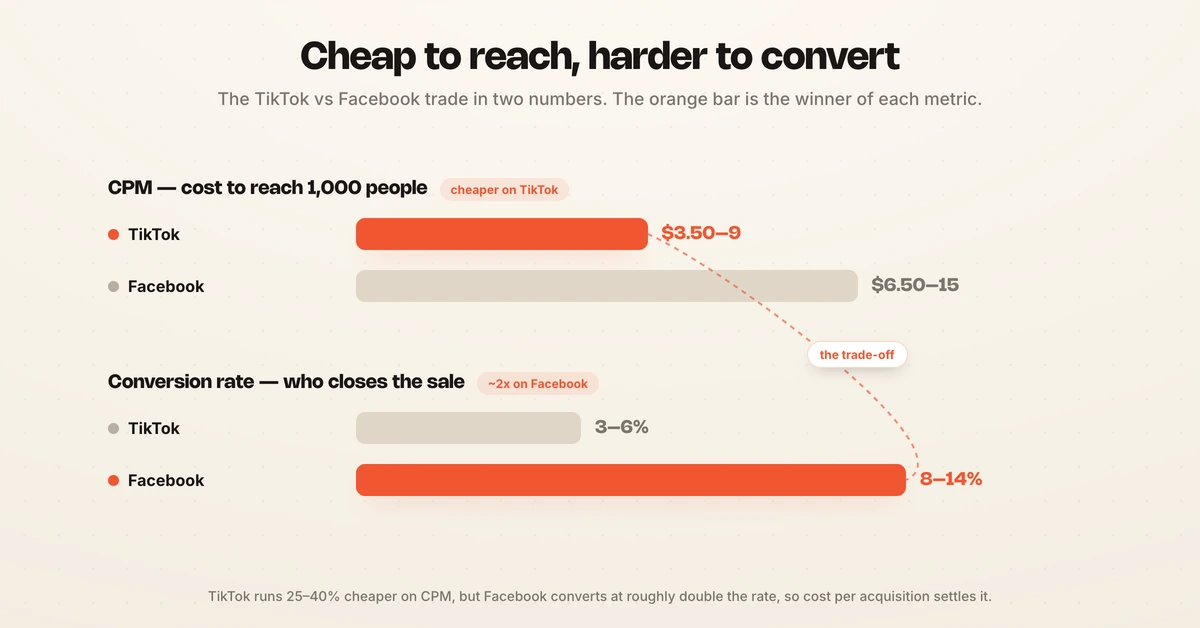
TikTok is the cheaper platform to reach people, but Facebook converts them at a higher rate, and that trade defines the whole comparison. TikTok generally runs 25% to 40% cheaper on CPM and CPC than Facebook, per Stackmatix 2026 data, so your budget buys more impressions and clicks on TikTok.
| Metric | TikTok Ads | Facebook Ads |
|---|---|---|
| CPM | ~$3.50 – $9 | ~$6.50 – $15 |
| CPC | $0.20 – $2.00 | Competitive on conversion goals |
| Conversion rate | 3% – 6% | 8% – 14% |
| Strength | Cheap reach, engagement | Conversion quality, retargeting |
The catch is downstream. Facebook's conversion rate for ecommerce and lead-gen runs 8% to 14%, roughly double TikTok's 3% to 6%, per Triple Whale. So you pay less per click on TikTok but often need more clicks to produce a sale. Cost per acquisition, judged against your break-even ROAS, is the only number that settles it. For platform detail, see TikTok Ads cost and Facebook Ads cost.
Creative: the biggest practical difference
Creative style is where the two platforms diverge most in day-to-day work. TikTok rewards ads that are indistinguishable from organic content: raw, fast-paced, creator-style, with on-screen captions and native audio. A polished, produced ad often underperforms on TikTok because it reads as an interruption.
Facebook tolerates a wider range. Video, carousel, and professionally produced image ads all work reliably, and the platform's varied placements reward different formats. A brand can reuse studio creative on Facebook that would fall flat on TikTok.
This has a real operational cost. Winning on both platforms means producing two distinct creative styles, not recycling one, which doubles the creative demand on the team. Volume and native feel matter more on TikTok; format flexibility matters more on Facebook.
Targeting: manual precision vs algorithmic reach
Facebook still offers the more sophisticated targeting toolkit, with detailed demographics, behaviors, life events, and mature custom and lookalike audiences. That granularity lets you define exactly who sees an ad, which suits products with a well-understood buyer.
TikTok's targeting is less granular but its algorithm compensates, often finding the right viewers from the creative and pixel signals without heavy manual setup. On TikTok, the creative effectively is the targeting, because the algorithm serves your ad to whoever engages with similar content. In practice, you steer Facebook with audiences and steer TikTok with creative.
Measurement and attribution
Attribution is where the two platforms are least equal, and it changes how you should read their numbers. Facebook has the more mature measurement stack, with a longer track record, richer conversion APIs, and better-understood attribution windows, even after Apple's privacy changes reshaped tracking. Marketers trust its reported conversions more, though it still tends to over-credit itself on last-click.
TikTok's measurement is younger and improving fast, but its attribution leans heavily on view-through and often takes credit for discovery it genuinely drove yet cannot always prove. Because TikTok frequently sits at the top of the funnel, a sale it sparked may get attributed to the Facebook retargeting ad or the branded Google search that closed it. That mislabeling makes TikTok look weaker than it is on a last-click report.
The practical fix is to judge both platforms on blended performance and incrementality, not siloed platform ROAS. Look at whether total revenue rises when TikTok spend goes up, not just at what TikTok's own dashboard claims. Reconciling both against actual sales, ideally with a third-party attribution tool, keeps you from cutting a channel that is quietly feeding the rest of the funnel.
When to choose TikTok Ads
Choose TikTok when discovery and cheap reach matter more than immediate conversion:
- Younger target audience: brands selling to Gen Z and younger millennials.
- Visual, trend-friendly products: items that demo well in short, native video.
- Top-of-funnel growth: creating demand and introducing a product to new audiences.
- Creative-led brands: teams that can produce native, high-volume short video.
When to choose Facebook Ads
Choose Facebook when targeting precision and conversion quality lead:
- Older or broader audience: buyers concentrated in the 25 to 54 range.
- Retargeting and closing: re-engaging warm audiences who already know you.
- Precise audience needs: products with a specific, well-defined buyer.
- Format flexibility: reusing polished creative across placements. For scaling tactics, see how to scale Facebook Ads.
Why the best answer is usually both
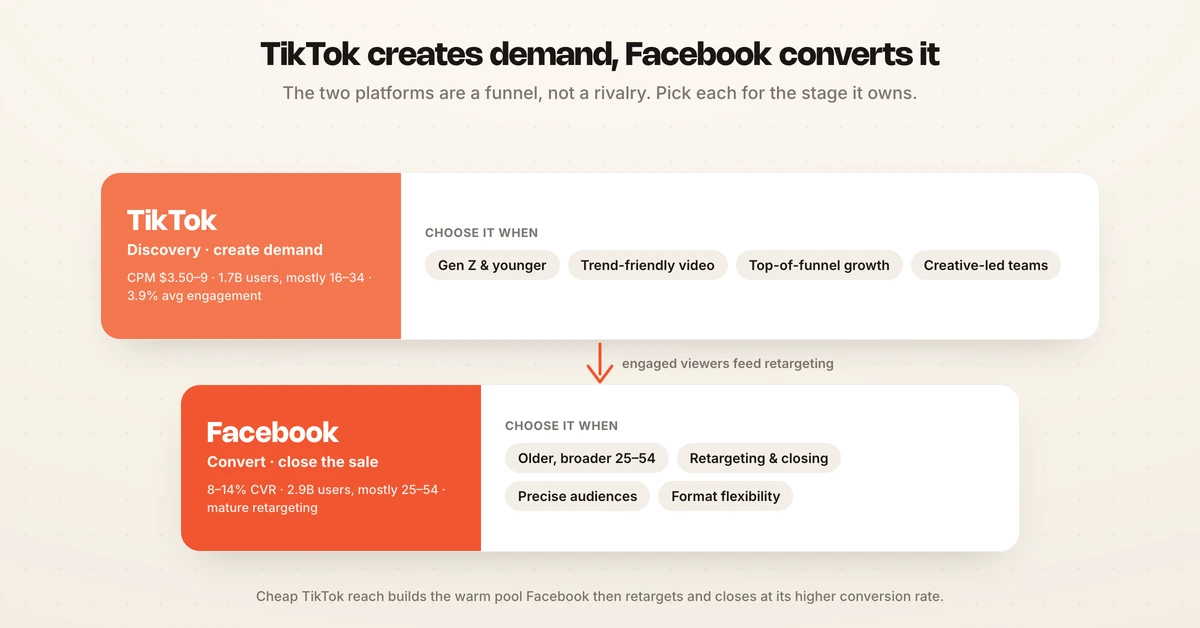
The strongest 2026 playbook uses TikTok to create demand and Facebook to convert it. TikTok introduces the product to a discovery-hungry audience at low CPM, and Facebook retargets the people who engaged, closing them at its higher conversion rate. The platforms compound: cheap TikTok reach feeds warm Facebook retargeting pools.
Picture a skincare launch. TikTok creator-style videos seed the product to thousands of new viewers at a low CPM, building a large pool of people who watched or engaged. Facebook then retargets that warm pool with a polished carousel and a limited-time offer, converting at its higher rate. Neither platform alone matches the pair: TikTok manufactures the demand cheaply, and Facebook harvests it efficiently.
The hard part is operating both at once, each with its own creative style, auction, and optimization rhythm. Hawky's Performance Agent runs TikTok, Facebook, Google, and YouTube against one KPI, shifting budget to whichever platform returns best and refreshing creative before it fatigues, with spend caps, guardrails, and a full audit trail. For picking the tools around it, see the best TikTok ads tools, and for the wider comparison, Facebook Ads vs Google Ads.
Frequently asked questions
Is TikTok Ads or Facebook Ads better?
Neither is better in every case. TikTok delivers cheaper reach and a younger, discovery-driven audience, making it stronger for top-funnel demand generation. Facebook offers more granular targeting and roughly double the conversion rate, making it stronger for retargeting and closing sales. Most growth brands use TikTok to create demand and Facebook to convert it.
Are TikTok Ads cheaper than Facebook Ads?
Yes, on a cost-per-impression and cost-per-click basis, TikTok is generally 25% to 40% cheaper than Facebook in 2026. TikTok CPMs run roughly $3.50 to $9 against Facebook's $6.50 to $15. However, Facebook converts at a higher rate, so cheaper TikTok clicks do not always mean a cheaper customer once you measure cost per acquisition.
Which platform converts better?
Facebook converts better on average, with ecommerce and lead-gen conversion rates of 8% to 14% versus TikTok's 3% to 6%. Facebook's audience is more deliberate and its retargeting is more mature, so it closes warm buyers more efficiently. TikTok's strength is cheap discovery at the top of the funnel, not bottom-funnel conversion.
Which is better for ecommerce?
It depends on your product and audience. Visual, trend-friendly, lower-priced products aimed at younger buyers often thrive on TikTok's discovery engine. Higher-consideration or broader-audience products usually convert better on Facebook. Most ecommerce brands run TikTok for discovery and Facebook for retargeting, rather than choosing one.
Should I run TikTok and Facebook Ads together?
Yes, they work best as a pair. TikTok generates demand cheaply among discovery-driven users, and Facebook retargets and converts the people who engaged. The challenge is producing two creative styles and managing two platforms at once, which is why many teams use an agent or unified platform to balance budget across both.
If running TikTok and Facebook together against one KPI, with the right creative for each, is the problem, Hawky's Performance Agent and Creative Agent are built for that job.
Ready to hire your first AI performance team? Book Demo