Demonstration Ads for Facebook & TikTok: 30+ Examples That Convert
Demonstration ads are short videos that show your product actually working, and they convert because they answer the only question a skeptical buyer has: does this really do what it claims? On Facebook and TikTok in 2026, a clear demo that proves the result in the first few seconds beats a polished brand film almost every time.
This guide breaks down what makes a demonstration ad convert, the structure that works on both platforms, and 30+ example concepts you can adapt today, organized by the type of proof they deliver.
What demonstration ads are and why they convert in 2026
A demonstration ad is a creative that shows the product in use and proves its core benefit on camera, rather than describing it. Instead of telling the viewer the vacuum is powerful, you show it lifting debris off three surfaces in ten seconds.
Demonstration ads convert because they build belief fast. People buy when they accept three things: the problem is real for them, the product actually fixes it, and it will work for someone like them. A demo answers all three in one watch, which is why TikTok's own creative guidance centers a strong hook, a clear value demonstration, and a direct CTA.
The format also fits how people watch now. Native, creator-style demos that do not look like ads outperform glossy production, and UGC-style video earns far higher engagement and conversion than polished brand creative. The proof, not the production value, is what moves the buyer.
The anatomy of a demonstration ad that converts
A converting demonstration ad follows a tight three-part structure: hook, demo, then call to action, all inside 15 to 30 seconds. Each part has one job, and skipping any of them costs you the conversion.
| Section | Timing | Job |
|---|---|---|
| Hook | 0-2 seconds | Name the problem or promise the result |
| Demo / payoff | 3-12 seconds | Show the product solving it on camera |
| Call to action | last 3-5 seconds | Tell the viewer exactly what to do |
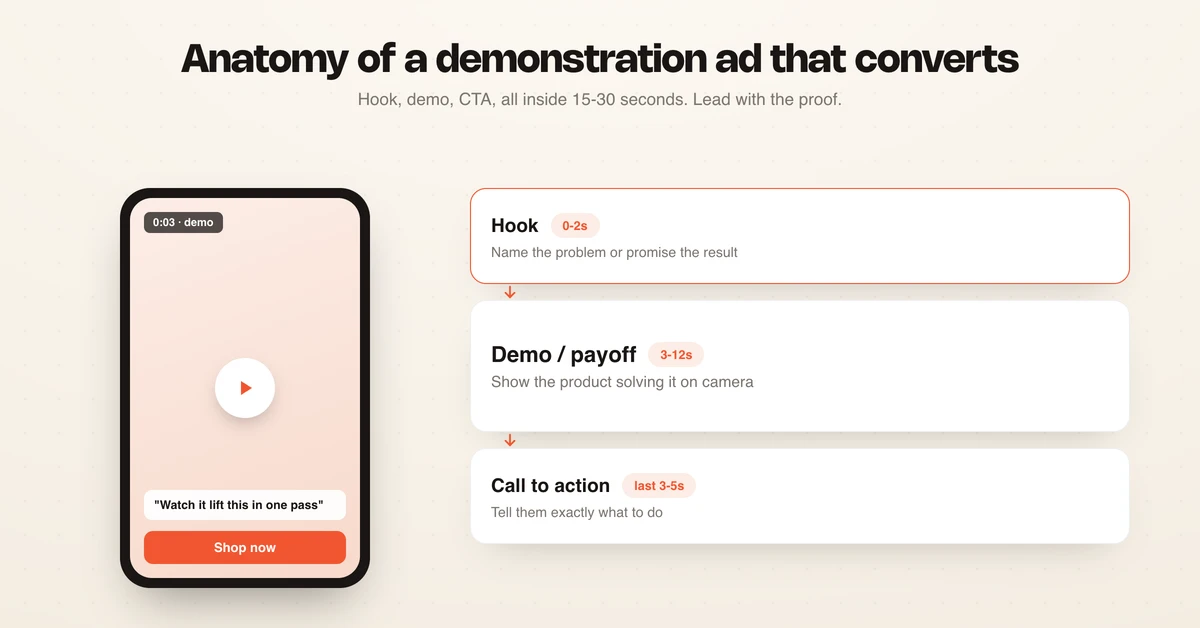
Build it vertical (9:16), captioned for sound-off viewing, and put the most convincing moment of the demo as early as possible. The hook carries the most weight, because if the first two seconds do not earn attention, the demo never gets seen. For more openers, study a swipe file of Facebook ad hooks.
What makes a demonstration ad believable
A demonstration ad is believable when the proof is specific, visible, and hard to fake. Vague claims invite doubt; a measured result on camera removes it, which is why the most convincing demos lean on concrete detail.
Belief gets built through a few repeatable devices: the demo itself, a before-and-after comparison, a creator or customer using it for real, and credible specificity like exact numbers, timers, or quantities. Price anchoring ("this replaces three products") and a visible flaw the brand owns up to also raise trust, because they signal honesty. Stack two or three of these and the ad reads as evidence rather than a pitch.
The fastest way to kill believability is over-production. A studio-perfect shot reads as an ad and the viewer's guard goes up, while a slightly rough, real-hands demo reads as truth. Aim for clear, not cinematic.
30+ demonstration ad examples that convert
Below are 30+ demonstration ad concepts grouped by the kind of proof they deliver. Each works on both Facebook and TikTok; adapt the tone to the platform.
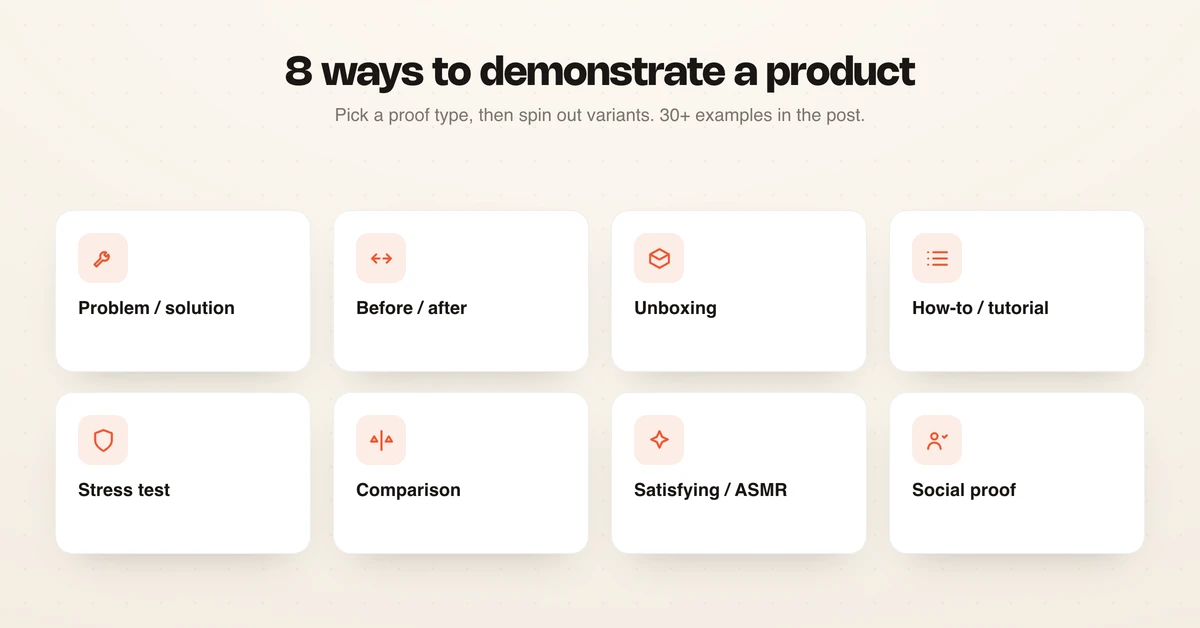
Problem-solution demos
These open on a relatable problem, then show the product erasing it.
- The mess your product cleans up in one pass.
- The everyday frustration (tangled cables, spills) solved in one motion.
- A "you've been doing this wrong" reveal, then the easier way.
- The pain point shown in real time, then the fix on screen.
- A frustrated user, then the calm after the product fixes it.
Before-and-after transformation demos
Transformation demos let people visualize the result in seconds, ideal for beauty, home, fitness, and grooming.
- Split-screen skin, hair, or surface before and after.
- A timer or day-count overlay showing progress.
- The dirty-to-clean reveal in a single continuous shot.
- A messy space organized by the product.
- The "30 days later" recap with real footage.
Unboxing and first-impression demos
Bring the viewer along for the first real reaction.
- The unboxing with genuine first use right after.
- A first-time reaction shot to the result.
- "What you actually get in the box" walkthrough.
- The setup-in-under-a-minute speed run.
How-to and tutorial demos
Teach a quick win and let the product star in the steps.
- A three-step routine using the product.
- "How I use this every morning" walkthrough.
- A recipe, look, or build the product makes easy.
- A common task done faster with the product.
Stress-test and durability demos
Proof through punishment answers "will it hold up?"
- The drop, scratch, or waterproof test.
- The "can it handle this?" extreme-use challenge.
- A side-by-side of your product surviving where others fail.
- The long-haul test after months of use.
Comparison and "vs the old way" demos
Show the gap between your product and the status quo.
- Your product versus the cheap alternative, same task.
- The manual old way versus your faster new way.
- A blind test or reaction comparing results.
- Cost-per-use math shown on screen.
Satisfying, ASMR, and process demos
Lean on the oddly satisfying pull of the product in action.
- The satisfying close-up of the product working.
- An ASMR-style sound-on demo of the process.
- The repeatable "just one more" loop moment.
- A behind-the-scenes of how it is made or works.
Social-proof demos
Let real users do the demonstrating.
- A creator demo with a genuine verdict.
- A "reading the reviews, then testing it myself" format.
- A duet or stitch reacting to the product in use.
Facebook vs TikTok: what to change per demonstration ad
The same demo works on both platforms, but the framing differs. TikTok rewards raw, creator-led, sound-on energy, while Facebook tolerates slightly more polish and longer context.
| Element | TikTok | |
|---|---|---|
| Tone | Native, creator-style, trend-aware | Authentic but slightly more polished |
| Length | 9-21 seconds, fast | 15-30 seconds, room for context |
| Sound | Often sound-on, trending audio | Assume sound-off, caption everything |
| Format | Spark Ads, in-feed video | In-feed video, Reels, Stories |
| Hook | Pattern interrupt in frame one | Problem or promise in first line and frame |
On TikTok, the best demos use Spark Ads so a creator demo runs natively from their handle. On Facebook, build for the silent autoplay feed and let on-screen text carry the proof. Either way, repurpose a winner across both before you build net-new.
How to make a demonstration ad
You make a demonstration ad by picking one clear benefit, scripting a hook that names the problem, filming the proof, and closing with a direct CTA. Keep the scope to a single claim so the demo stays tight.
- Pick one benefit to prove. One ad, one claim. Save the rest for other variants.
- Write a hook that earns the next second. Name the problem or promise the payoff in the first two seconds.
- Film the proof, not the pitch. Show the result on camera in real time, captioned.
- Close with one specific CTA. "Shop now," "Get 30% off today," one action only.
- Cut several variants. Different hooks on the same demo, so you can test which opener converts.
Sourcing real users helps; here is how to find UGC creators for paid ads.
Common mistakes to avoid
Most demonstration ads underperform for a handful of fixable reasons.
- Burying the proof. If the demo's best moment is at second 12, most viewers never see it. Lead with it.
- Too polished to be believed. Over-produced demos read as ads. Keep it native and real.
- Demonstrating too much. One ad proving five features proves none. One claim per ad.
- No captions. Most of the feed watches on mute. If the proof is not legible silently, it is invisible.
- Weak or missing CTA. A great demo with no clear next step leaks the conversion. End on one action.
Tools to produce demonstration ads at scale
The hard part of demonstration ads is not the idea, it is producing enough variants to find the winners and keep them fresh. Volume and iteration are where most teams stall.
Editing tools and creator marketplaces speed up production, and analytics tools tell you which demos convert. An agentic platform like Hawky compresses the whole loop: its Creative Agent reads your winning demos and competitor patterns, then generates on-brand variants bound to a specific ad set, while its creative analysis scores each demo at the hook, visual, and CTA level so you know which proof angle is working. Configurable autonomy keeps you in command, from approval-gated to fully autonomous, with a full audit trail.
The payoff is iteration speed. The Man Company doubled creative performance and cut iteration cycles by 50% running this loop, because the next demo variant ships while the current winner is still strong. However you produce them, the rule holds: prove the result fast, keep it native, and test relentlessly.
Frequently asked questions
What is a demonstration ad?
A demonstration ad is a short video that shows a product actually working and proves its main benefit on camera instead of just describing it. It answers the buyer's core question, does this really do what it claims, by showing the result in the first few seconds. Demonstration ads are among the highest-converting formats on Facebook and TikTok because proof builds belief faster than copy.
Why do demonstration ads convert so well?
Demonstration ads convert because they build belief fast: the viewer sees the problem is real, the product fixes it, and it would work for them, all in one watch. They also feel native to the feed when shot in a creator or UGC style, which outperforms polished brand film. Showing the result beats claiming it, especially for visually demonstrable products.
How long should a demonstration ad be?
A demonstration ad should run about 15 to 30 seconds, with the hook in the first two seconds and the product proof by second ten. TikTok favors the shorter end at 9 to 21 seconds, while Facebook tolerates a little more context. Across both, front-load the most convincing moment so viewers who drop early still see the payoff.
What products work best for demonstration ads?
Products that are visually demonstrable work best: anything with a clear before-and-after, a satisfying process, or a result you can show on camera, such as beauty, home, kitchen, fitness, and grooming. Products that carry enough margin to pay creators and that suit short vertical video are the strongest fit. If the benefit is hard to show, pair the demo with a testimonial or outcome graphic.
Are demonstration ads different on Facebook and TikTok?
The core demo is the same, but the framing differs. TikTok rewards raw, creator-led, sound-on content using Spark Ads, while Facebook favors slightly more polish and assumes sound-off, so captions carry the proof. Build the demo once, then adapt tone, length, and format per platform rather than starting from scratch.
How many demonstration ads should I test?
Test several demo concepts at once, each with a few hook variants, and keep a steady pipeline rather than a one-off batch. The right number scales with spend, but most brands run a handful of new concepts weekly so a winner is always emerging. Keep the body constant and vary the hook so you learn which opener drives the conversion.
If producing enough demonstration ad variants to find winners and refresh them before they fatigue is the bottleneck, Hawky's Creative Agent is built for that job: it generates on-brand demo variants from your winners and scores each one, with guardrails and a full audit trail keeping you in command.
Ready to hire your first AI performance team? Book Demo