How to Find UGC Creators for Paid Ads (Vetted Playbook 2026)
By the end of this playbook you will have a repeatable system to source, vet, and scale UGC creators whose video ads actually move ROAS, not just fill a content calendar. Finding UGC creators for paid ads means sourcing creators through marketplaces, native platforms, your own customers, and agencies, then vetting them with a paid trial and clear usage rights before you put spend behind their work.
Most teams treat UGC sourcing like casting. They scroll TikTok, pick faces they like, and hope, which is why so much UGC footage dies in the ad account. The creators who win on paid social do not look like influencers. They look like customers, and they deliver conversion-style hooks on a schedule you can scale.
What you need before you start
You need three things in place before sourcing a single creator. First, a target KPI for the campaign these ads feed: ROAS, CPA, or cost per lead. Second, access to your ad account so you can test creators at the ad-set level. Third, a brand kit and at least a few past winners so creators understand the hooks and angles that already convert for you.
If you have run paid social before, pull your top three performing creatives. Those are your reference for what good looks like. If you are starting cold, define the customer pain point and the single benefit each video must communicate.
Step 1: Define what a vetted UGC creator means for your account
A vetted UGC creator is one whose delivered footage has been proven to match their portfolio and to perform against a real ad metric, not just look good in a feed. Vetting is the difference between a roster you can scale and a graveyard of one-off videos. Write down your non-negotiables before you look at anyone.
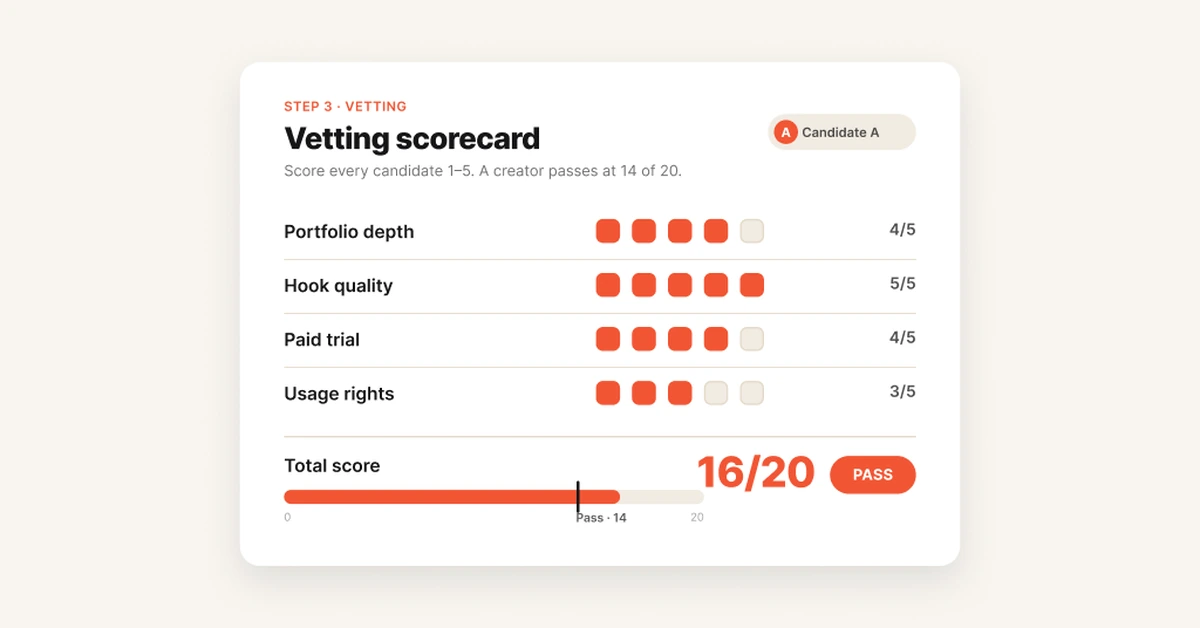
For most paid-social accounts, the vetting bar is four checks: portfolio depth in your category, hook quality that stops the scroll, willingness to do a small paid trial, and clarity on usage rights. A creator who clears all four is worth a batch. A creator who fails any one of them is a risk you are paying to take.
Niche fit matters more than polish. A creator who understands skincare routines will outperform a glossy generalist when the product is a serum. Match the creator's lived context to your customer, and the script writes itself.
Pro tip: Score every candidate on a simple 1-to-5 scale across those four checks. Anyone below 14 out of 20 does not get a trial. The number keeps you honest when a creator has a likeable personality but a thin track record.
Step 2: Source UGC creators across four channels
There is no single best place to find UGC creators. The strongest rosters pull from four channels at once, because each surfaces a different kind of creator. Run all four in parallel rather than betting on one.
| Channel | Best for | Watch out for |
|---|---|---|
| UGC marketplaces (Billo, Trend.io, Insense, Influee) | Speed and vetted networks, fast turnaround | Generic output if the brief is weak |
| Native marketplaces (TikTok Creator Marketplace, Meta Brand Collabs) | Platform-native creators and built-in analytics | Discovery is manual and time-heavy |
| Your own customers | Authenticity and product knowledge | Variable production quality |
| Agencies and creator networks | Hands-off volume | Higher cost, less direct control |
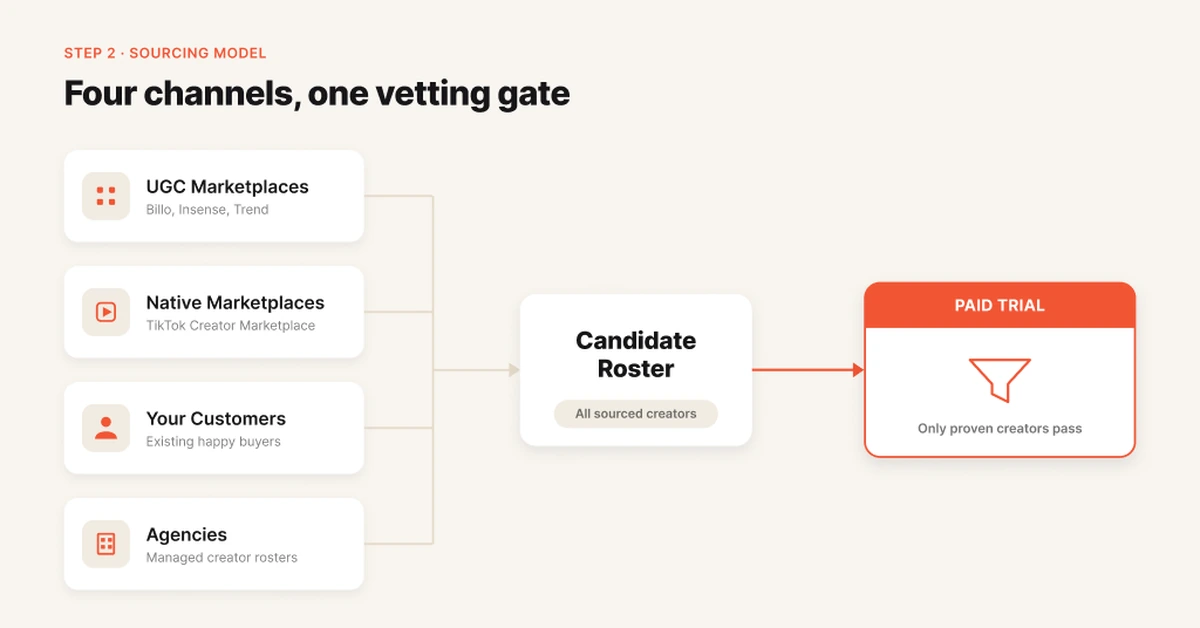
UGC marketplaces are the fastest start. Platforms like Billo, Trend.io, and Insense maintain networks of vetted creators filtered by platform, category, budget, and language, and most deliver finished video in three to seven days. You retain content rights and can repurpose footage across paid ads, organic social, and product pages.
Native marketplaces give you the deepest pool. The TikTok Creator Marketplace is the official channel for brand-creator partnerships and surfaces creator analytics directly. Meta's Brand Collabs interface does the same for Instagram creators across Reels, feed, and Stories.
Do not overlook your own customers. The hustler-marketing thesis holds: your best creators are often already buying from you. Search your reviews and tagged posts, then offer your most enthusiastic buyers a paid UGC deal. Their product knowledge is real, which means their hooks land.
Social discovery rounds it out. Search tags like #UGCcreator, #brandcollab, #UGCcontent, and #paidpartnership, plus your category terms. Prioritize creators whose organic videos already use performance-style hooks.
Step 3: Vet UGC creators with a paid trial
Portfolio review filters the obvious mismatches, but the paid trial is where vetting actually happens. Request a sample script for your specific product during evaluation. If it comes back as a generic template, the creator is not customizing, and generic scripts do not convert. A real script references your product benefits, use cases, and a customer pain point.
Watch for the standard red flags. Reviews that are all glowing with zero constructive feedback are either curated or from a creator too new to have a track record. A creator demanding 100% payment upfront for a large batch has removed their own incentive to deliver. Over-polished footage that looks like a traditional influencer ad usually underperforms native, customer-style UGC on paid social.
Then run a single paid trial video before committing to a batch. One video at the creator's standard rate tells you what the portfolio cannot: do they hit the deadline, take direction, and deliver footage that matches the reel. This small spend is the cheapest insurance in the entire process.
Pro tip: Ask to speak with one past collaborator. Two questions settle it: did the creator deliver on time, and would you book them again. The answers are more honest than any portfolio.
You know this step is done when you have a short list of creators who passed the trial, hit their deadlines, and produced footage you would actually put spend behind.
Step 4: Lock usage rights and rates in writing
This is where unprepared brands get exposed. If you run a creator's footage as a paid ad without paid-ad usage rights, you are using their likeness commercially without a license. Settle rights and rates before the first batch ships, in writing.
Expect to pay a premium for paid-ad usage on top of the base creation fee. The 2026 market looks like this.
| Tier | Base per video | Paid-ad rights add-on |
|---|---|---|
| Beginner | $75-$300 | +30-50% of base |
| Mid-tier | $300-$1,000 | +30-50% of base |
| Top-tier | $600-$3,000+ | up to +100% for perpetual |
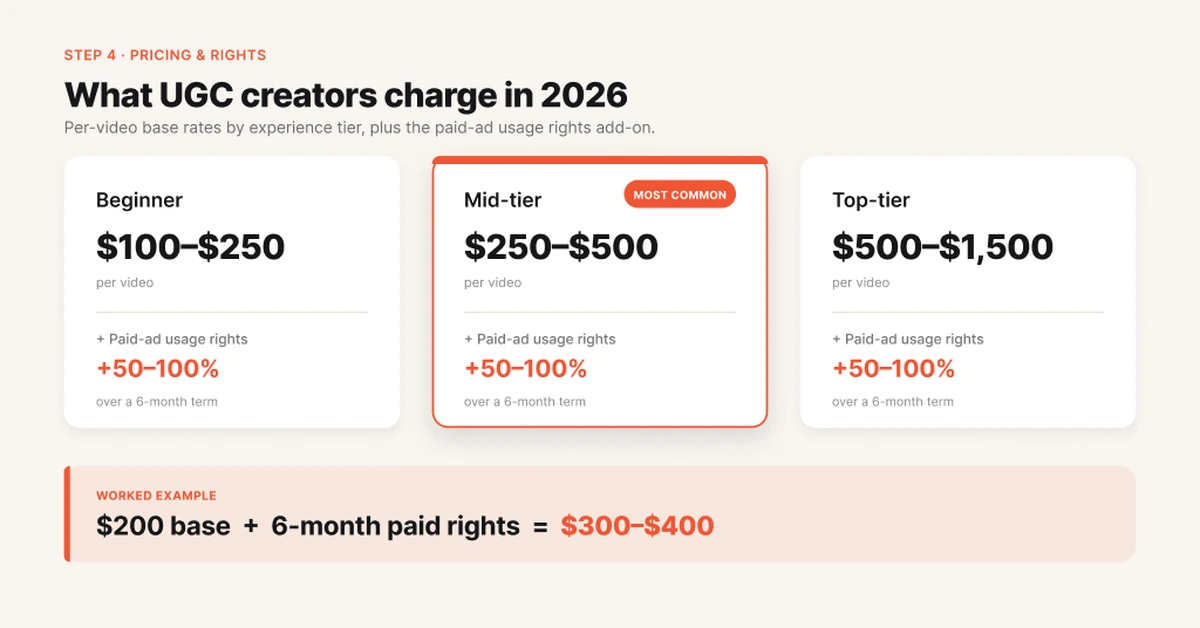
The market average sits around $198 per deliverable, though SaaS, FinTech, and health-tech command the top of the range because the content requires real product understanding. A $200 base video with six-month paid-ad rights typically runs $300 to $400. Perpetual rights roughly double the base.
Standard structure is a 50% deposit, the rest on delivery. Specify the platforms (Meta, TikTok, YouTube), the duration of the rights, and whether you can edit and re-cut the footage into ad variations. Get all of it in the contract so a winning creative does not become a legal problem when you scale it.
Step 5: Brief, launch, and measure against your KPI
A vetted creator with a vague brief still produces a weak ad. Give every creator the customer pain point, the single benefit, the hook direction, and two or three reference winners. Leave room for their voice; the reason UGC works is that it sounds like a real person, not a script reading.
Launch each new creator's footage at the ad-set level so you can read performance cleanly. Test multiple hooks from the same creator before you judge them, because the hook drives most of the variance on paid social. Hold creative variables steady and let the metric decide.
Then act on the data. The creators whose videos beat your KPI go into a roster you re-book and scale. The ones that underperform get one revision or get cut. Paid social burns through creative fast, so creative fatigue is the real constraint: a hook that crushed last month decays, and you need fresh variations from your proven creators ready to rotate in.
This is the point where sourcing becomes a system. Once you know which creators and which hooks convert, the job shifts from casting to scaling: producing more variations of what already works, faster than fatigue sets in.
Common mistakes to avoid
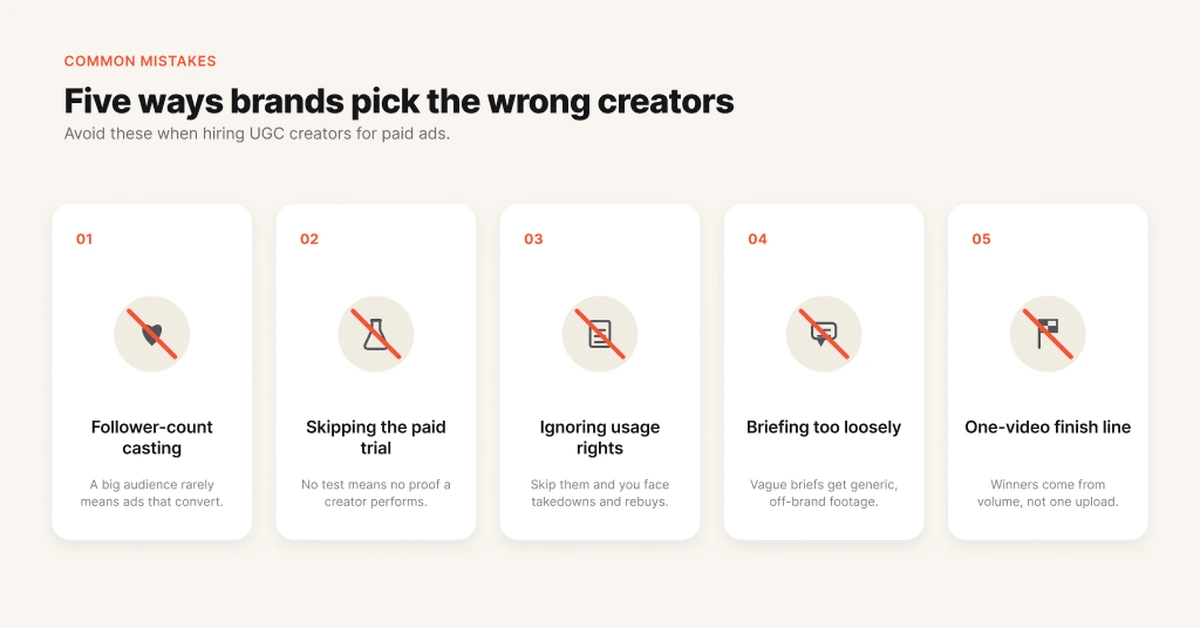
Judging creators by follower count. Reach is not the job. A creator with 2,000 followers and conversion-style hooks will outperform a 200,000-follower influencer whose content does not sell. Vet the work, not the audience size.
Skipping the paid trial. Booking a ten-video batch off a portfolio alone is how teams end up with footage they cannot use. One paid trial video catches the mismatch before you have spent real money.
Ignoring usage rights. Running UGC as paid ads without paid-ad rights is a legal exposure, not a shortcut. Settle rights in the contract every time.
Briefing too loosely or too tightly. A vague brief gets generic footage. A word-for-word script kills the authenticity that makes UGC convert. Give direction and reference winners, then let the creator perform.
Treating one good video as the finish line. One winner is a starting point. Paid social needs volume and constant rotation, so build a roster and a pipeline for fresh variations, not a single hero asset.
Tools that make finding UGC creators easier
You can run this entire playbook with a marketplace, a contract template, and your ad account. A few tools remove friction at specific steps.
Billo, Trend.io, and Insense handle sourcing. Each maintains a vetted creator network with filters for platform, category, and budget, and delivers ad-ready footage in days. Use them to fill the top of your roster fast.
TikTok Creator Marketplace and Meta Brand Collabs handle native discovery and surface creator analytics, useful when you want platform-native talent and first-party performance data.
Hawky handles the step most tools skip: turning your winning UGC into more winning ads. Hawky's Creative Agent reads your past winners and competitor patterns from FeatherDB and renders finished, on-brand creative variations, then routes them through seat-level approval before anything ships.
When a creator's hook proves out at the ad-set level, the agent spins fresh variations to fight fatigue, and Hawky's Performance Agent buys media against your KPI. You set the autonomy, from approval-gated to fully autonomous, with every move logged behind guardrails and one-click reversible. Sourcing finds the creator; Hawky scales what the creator proved.
Frequently asked questions
How do I find UGC creators for paid ads?
Source creators through four channels: UGC marketplaces like Billo and Trend.io, native marketplaces like the TikTok Creator Marketplace and Meta Brand Collabs, your own customers, and agencies. Vet each with a sample script and one paid trial video before booking a batch, and lock paid-ad usage rights in writing.
How much do UGC creators charge for paid ad usage rights?
Base rates run $75 to $300 for beginners, $300 to $1,000 for mid-tier, and $600 to $3,000+ for top-tier creators, averaging around $198 per deliverable. Paid-ad usage rights add 30% to 50% of the base fee, and perpetual rights roughly double it. A $200 video with six-month paid rights typically costs $300 to $400.
How do you vet a UGC creator?
Check four things: portfolio depth in your category, hook quality, a custom sample script for your product, and willingness to do a small paid trial. Run one paid trial video at their standard rate before committing to a batch, and ask to speak with a past collaborator about deadlines and delivery.
Where can I find vetted UGC creators?
UGC marketplaces such as Billo, Trend.io, Insense, and Influee maintain pre-vetted creator networks filtered by platform, category, and budget. Your own customer base is another strong source, since buyers already know the product. Always run your own paid trial regardless of how a platform vets.
What should a UGC creator brief include?
A strong brief includes the customer pain point, the single product benefit to communicate, a hook direction, two or three reference winners, and the usage terms. Give direction without writing a word-for-word script, so the footage stays authentic.
Is UGC good for paid ads?
Yes. Customer-style UGC consistently outperforms polished, influencer-style content on paid social because it reads as native and trustworthy. The win comes from testing multiple hooks at the ad-set level and scaling the creators whose videos beat your KPI.
If sourcing and vetting creators is solved but scaling their winners into fresh, fatigue-proof ad variations is the bottleneck, Hawky's Creative Agent is built for that job.
Ready to hire your first AI performance team? Book Demo