Best Facebook Ad Hooks for 2026: 25 That Stop the Scroll

Facebook ad hooks decide whether your ad gets watched or skipped, and in 2026 that decision happens faster than ever. Feeds are denser, attention is shorter, and Meta's delivery rewards creative that earns a stop in the first second. Get the hook wrong and even a brilliant offer never gets seen.
This guide gives you 25 scroll-stopping hooks you can copy, plus how to test them and where each one fits. Use it as a swipe file, not a script.
Quick answer: A Facebook ad hook is the first line of copy or the first 3 seconds of a video that grabs attention and earns the next moment of viewing. It matters because most people decide whether to keep watching almost instantly, so the hook does the heavy lifting on your hook rate and downstream CTR. A strong hook lifts 3-second video views and thumb-stop ratio, which signals Meta to deliver your ad to more people at a lower CPM.
Why do Facebook ad hooks matter so much in 2026?
Attention spans on social feeds are short, and research on digital attention shows people allocate only a few seconds before moving on (see this Microsoft attention study summary and broader Nielsen Norman Group reading behavior research). On Meta, that window is where you win or lose the click.
The hook is also a delivery lever. A high thumb-stop ratio tells Meta's auction your creative is worth showing, which can lower your CPM and CPL. With Advantage+ shifting more decisions to the algorithm, the creative hook is one of the few inputs you fully control.
Hooks also fight creative fatigue. The same audience scrolls past the same opener within days, so a deep bench of hook variants keeps performance stable. If your CTR is sliding, your hook is usually the first suspect, not your targeting (more on that in creative fatigue explained).
How to read this list
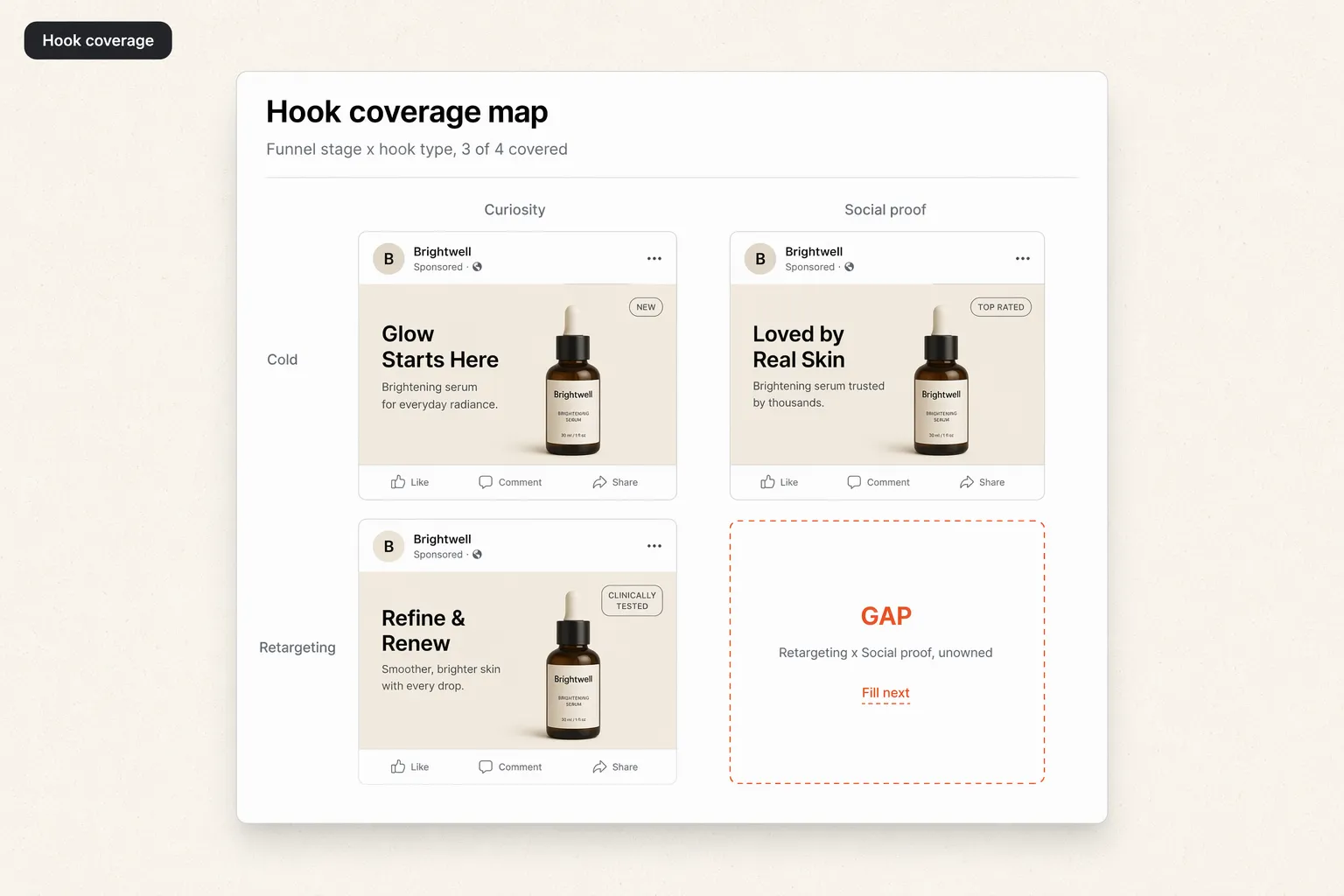
Each hook below includes a template line you can adapt, plus a quick note on why it stops the scroll and when to use it. They are grouped into six themes so you can pull the right type for the right job.
Here is how the categories map to funnel stage and use case.
| Hook category | Best funnel stage | Use it when |
|---|---|---|
| Curiosity | Top (cold) | You need cheap clicks and broad reach |
| Problem-agitate | Top to middle | The pain point is sharp and specific |
| Social proof | Middle | Trust is the blocker, not awareness |
| Bold-claim / contrarian | Top (cold) | You have a real differentiator or stat |
| Offer / urgency | Bottom (warm) | Retargeting or a live promo |
| Story / relatable | Top to middle | Founder brands and lifestyle products |
Curiosity hooks (1-5)
Curiosity hooks open a loop your reader needs closed. They work cold because they promise information, not a sale.
1. "I was today years old when I learned [surprising fact]." Opens an information gap instantly. Use for cold prospecting on broad audiences.
2. "Nobody talks about this, but [insight]." Implies insider knowledge. Strong for category education and TOFU video hooks.
3. "Here is what [product category] companies do not want you to know." Frames you as the honest source. Use when distrust of the category is high.
4. "The real reason your [outcome] is not working." Promises a diagnosis. Best for problem-aware audiences who have tried other things.
5. "Watch this before you buy another [product]." Implies you will save them a mistake. Strong thumb-stopping opener for considered purchases.
Problem-agitate hooks (6-10)
These name a pain, then twist it. They convert because they make the reader feel seen before you pitch.
6. "Still [doing painful thing the old way]?" A direct callout that filters for your exact buyer. Use at the top of a problem-solution sequence.
7. "If your [metric] looks like this, you are losing money." Pairs a visual with a stakes-raising line. Excellent for B2B and finance offers.
8. "[Common product] is quietly ruining your [outcome]." Reframes a familiar item as the villain. Use for replacement and switch campaigns.
9. "You are not [bad thing]. Your [tool/system] is." Removes blame, builds trust. Works well for software and tools.
10. "Tired of [specific frustration] every single [time period]?" Specificity makes it land. Use when the frustration is recurring and obvious.
Social-proof hooks (11-15)
Social proof hooks borrow trust from numbers, people, and results. Best in the middle of the funnel where credibility is the gap.
11. "[Number] people switched to [product] last month. Here is why." Numbers plus a reason create momentum. Use for retargeting and consideration.
12. "This [product] has [number] five-star reviews for a reason." Anchors on volume of proof. Strong for D2C with deep review counts.
13. "My [skeptical person] did not believe me until they tried it." A mini story with a built-in objection. Use for products with a high trust barrier.
14. "We did not expect this review." Curiosity plus proof in four words. Pair with a real screenshot for a high thumb-stop ratio.
15. "[Recognizable name or title] uses this. Here is what happened." Authority transfer. Use only when the claim is true and verifiable.
Bold-claim and contrarian hooks (16-20)
These take a stance. They earn the stop because they break the pattern of polite marketing. Back every claim with proof.
16. "Most [category] advice is wrong. Here is what actually works." Contrarian framing pulls in people who feel misled. Strong for education-led brands.
17. "Stop [common action]. Do this instead." A command plus a redirect. Use when you have a genuinely better method.
18. "[Bold outcome] in [short timeframe], no [common requirement]." Specific, falsifiable, attention-grabbing. Only run if you can deliver.
19. "Everyone is doing [trend] wrong." Implies the reader might be too. Use sparingly so it does not feel like clickbait.
20. "[Surprising statistic] of people [unexpected behavior]." A real stat earns instant credibility. Source it so it holds up.
Offer, urgency, and story hooks (21-25)
The last group splits across two jobs: closing warm buyers and humanizing the brand. Match the hook to the temperature of the audience.
21. "[Discount] ends [time]. After that it is back to full price." Clear stakes and a deadline. Use only for retargeting and live promos.
22. "We almost did not make this offer." Reluctance signals real scarcity. Strong for limited drops and founder-led brands.
23. "I quit my job to fix [problem]. This is what I built." Founder origin in one line. Use for brand storytelling at the top of the funnel.
24. "Three years ago I was [relatable struggle]. Today [transformation]." Before-and-after in a sentence. Works for personal brands and coaching.
25. "POV: you finally found a [product] that just works." Native, casual framing that fits the feed. Strong for short video hooks aimed at younger audiences.
Here is a quick reference mapping the formula to an example and the psychology behind it.
| Hook formula | Example | Psychological trigger |
|---|---|---|
| Information gap | "Nobody talks about this, but..." | Curiosity |
| Pain callout | "Still doing it the old way?" | Loss aversion |
| Proof in numbers | "12,000 five-star reviews for a reason" | Social proof |
| Contrarian stance | "Most advice is wrong" | Pattern interrupt |
| Deadline | "Sale ends tonight" | Urgency / scarcity |
| Origin story | "I quit my job to fix this" | Relatability |
How to test your Facebook ad hooks
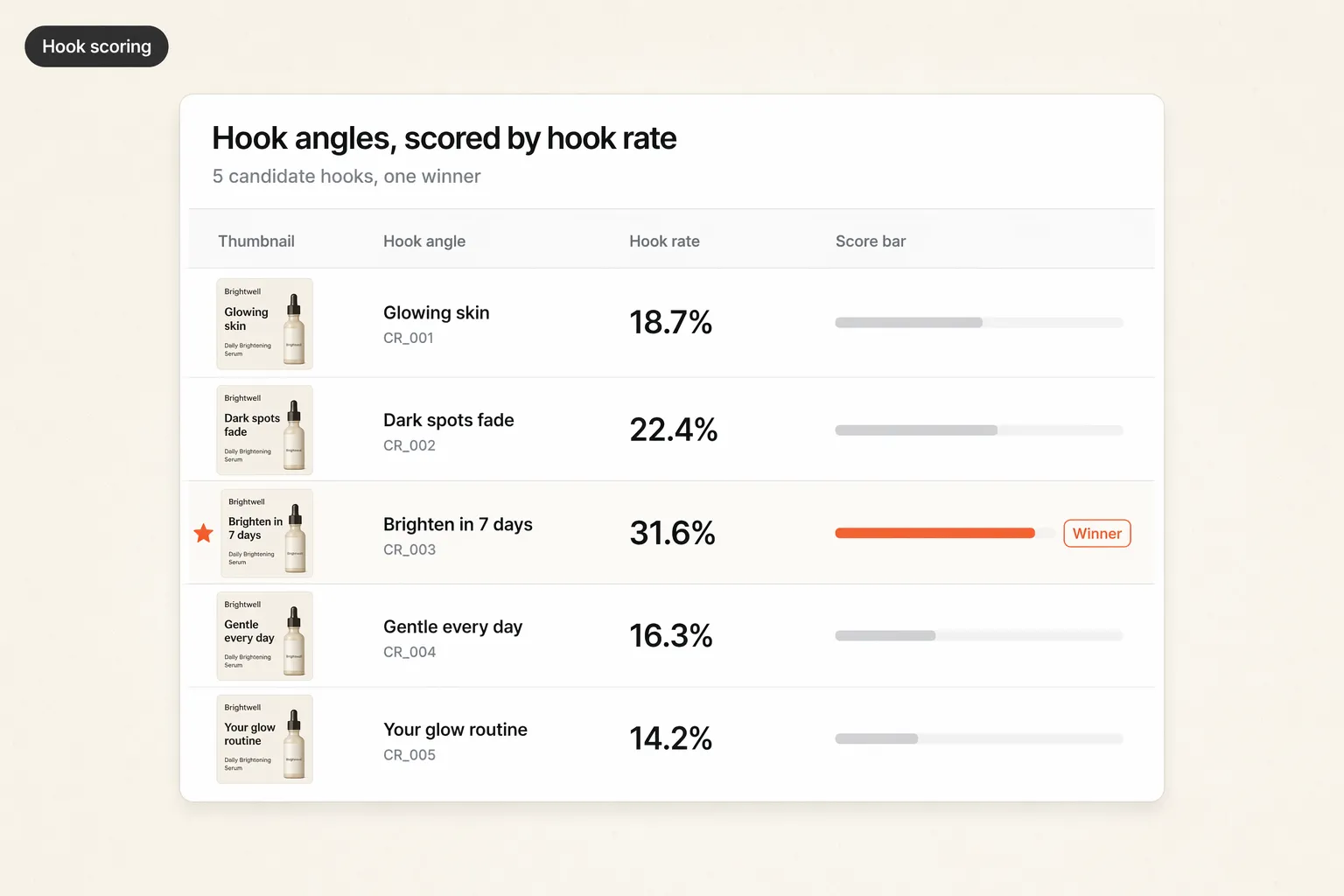
A hook is a hypothesis. The only way to know if it stops the scroll is to put real spend behind it and read the data. Start with hook rate, the share of impressions that become 3-second video views, sometimes called thumb-stop ratio.
Run hooks in volume, not one at a time. Launch four to six hook variants against the same body and offer, so the only changing variable is the opener. This isolates the hook as the cause of any lift or drop in CTR.
Give each variant enough impressions to read a stable signal before you judge it, and watch for the point where hook rate decays, which is your early creative fatigue warning. For a deeper method, see creative performance analysis. You can also study what competitors keep running in the Meta Ad Library to spot durable hook patterns. Meta's own ad creative best practices are a useful baseline for format specs.
Common hook mistakes to avoid
The fastest way to waste budget is to bury the hook. Here are the misses that cost the most.
- Slow openers. A logo splash or a five-second intro kills your 3-second video views. Lead with the hook, brand later.
- Vague promises. "Change your life" stops no one. Specificity is what earns the stop.
- Mismatched hook and offer. A clickbait hook that does not pay off tanks your CTR-to-conversion ratio and trains the algorithm on the wrong audience.
- Reusing one hook forever. Even a winner fatigues. If you have read why your Facebook ads are not converting, you know stale creative is a top cause.
- Ignoring the silent feed. Most people watch without sound. If your hook lives only in the audio, it does not exist. Put it on screen.
How Hawky helps you find and scale winning hooks
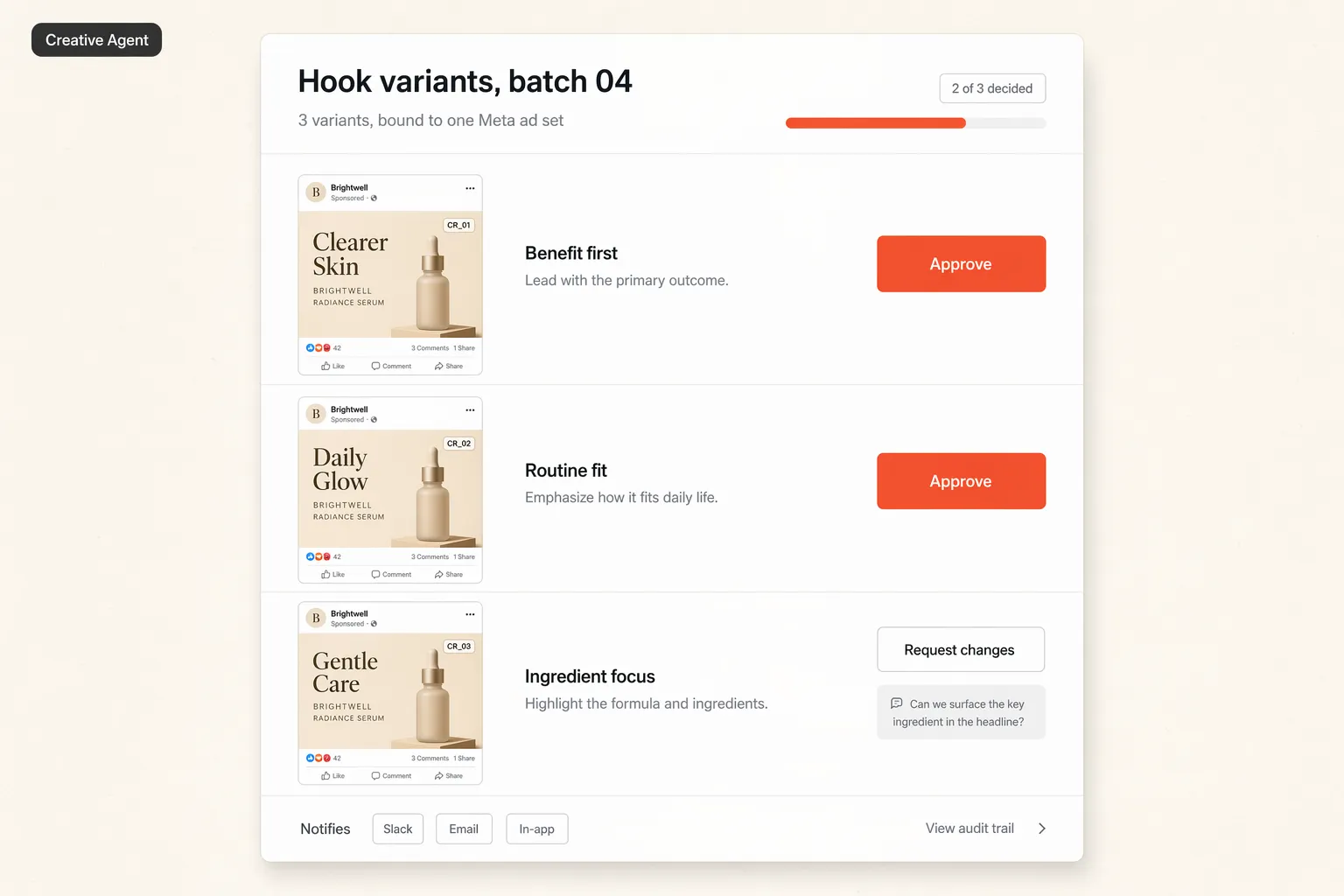
Finding the hook that works is a data problem, and that is where Hawky fits. Hawky's Creative Analysis breaks any ad down to the element level, scoring the hook, visual hierarchy, and CTA so you can see exactly why one opener stops the scroll and another gets skipped. You can run the same hook-level breakdown on competitor ads through Competitor Analysis to learn from patterns that are already winning.
Once you know what works, the Creative Agent generates fresh hook variants from your past winners, reading proven patterns from Hawky's living-context memory and rendering them on brand. It fires on a schedule or a signal, and it is autonomous within guardrails: every variant runs through seat-level approval before it goes live, so your team stays in command of what ships.
Frequently asked questions
What is a Facebook ad hook?
A Facebook ad hook is the opening line of copy or the first 3 seconds of a video ad that captures attention and earns the next moment of viewing. It is the single most important part of the creative because most viewers decide whether to keep watching almost immediately. A strong hook lifts your hook rate and 3-second video views, which improves delivery. A weak hook means the rest of your ad, however good, never gets seen.
How long should a Facebook ad hook be?
For copy, aim for one short line that fits above the "see more" fold, usually under 125 characters. For video, the hook should land within the first 3 seconds, ideally the first second. Shorter is almost always better because the goal is to stop the scroll, not explain the offer. You have the rest of the ad to do the selling.
What makes a hook stop the scroll?
Scroll-stopping hooks break the pattern of the feed and open a curiosity loop, name a sharp pain, or make a bold, specific claim. Specificity beats vagueness every time because real numbers and concrete details feel credible. On-screen text matters too, since most people watch without sound. The best hooks feel native to the feed rather than like an obvious ad.
How many hooks should I test?
Test four to six hook variants per creative concept so you have enough range to find a winner without splitting your budget too thin. Keep the body and offer constant so the hook is the only variable. Give each variant enough impressions to read a stable signal before cutting it. Then scale the winners and refresh your bench regularly to stay ahead of creative fatigue.
What is a good hook rate on Facebook?
Hook rate is the percentage of impressions that turn into 3-second video views, also called thumb-stop ratio. A rate around 30 percent is generally solid, and anything above that is strong, though benchmarks vary by industry, audience, and placement. Track your own baseline first, then push every new hook to beat it. A rising hook rate usually pulls CPM and CPL down with it.
Hooks are the highest-impact thing you can change in a Facebook ad, and the brands that win in 2026 will be the ones testing the most of them. Build a swipe file, test in volume, and retire winners before they fatigue. Treat every hook as a hypothesis and let hook rate be the judge.
If building and refreshing a deep bench of scroll-stopping hooks faster than fatigue can catch you sounds like the real bottleneck, Hawky's Creative Agent is built for that job.
Ready to hire your first AI performance team? Book Demo