3 Growth Marketing Meeting Templates Every Performance Team Needs

Most performance marketing meetings burn 40 minutes reading numbers out loud and 5 minutes deciding anything. The fix is structure. These growth marketing meeting templates exist so your team walks in with the data already assembled and walks out with decisions, owners, and deadlines.
Below are three agendas you can copy, paste, and run this week. Each one has a job. Run them together and your growth team cadence covers the daily fires, the monthly strategy, and the creative pipeline without a single meeting that exists only to "sync."
Quick answer: Performance teams need three recurring meetings. The Weekly Performance Standup (15 to 30 minutes, run by the performance lead with media buyers and the analyst) keeps spend and pacing on track. The Monthly Growth Review (60 to 90 minutes, run by the growth lead with marketing leadership, finance, and channel owners) sets strategy against KPIs and OKRs. The Creative Review and Testing Meeting (45 to 60 minutes, run by the creative lead with designers, copy, and the media buyer) decides which creatives ship, scale, or get killed.
How do the three meetings fit together?
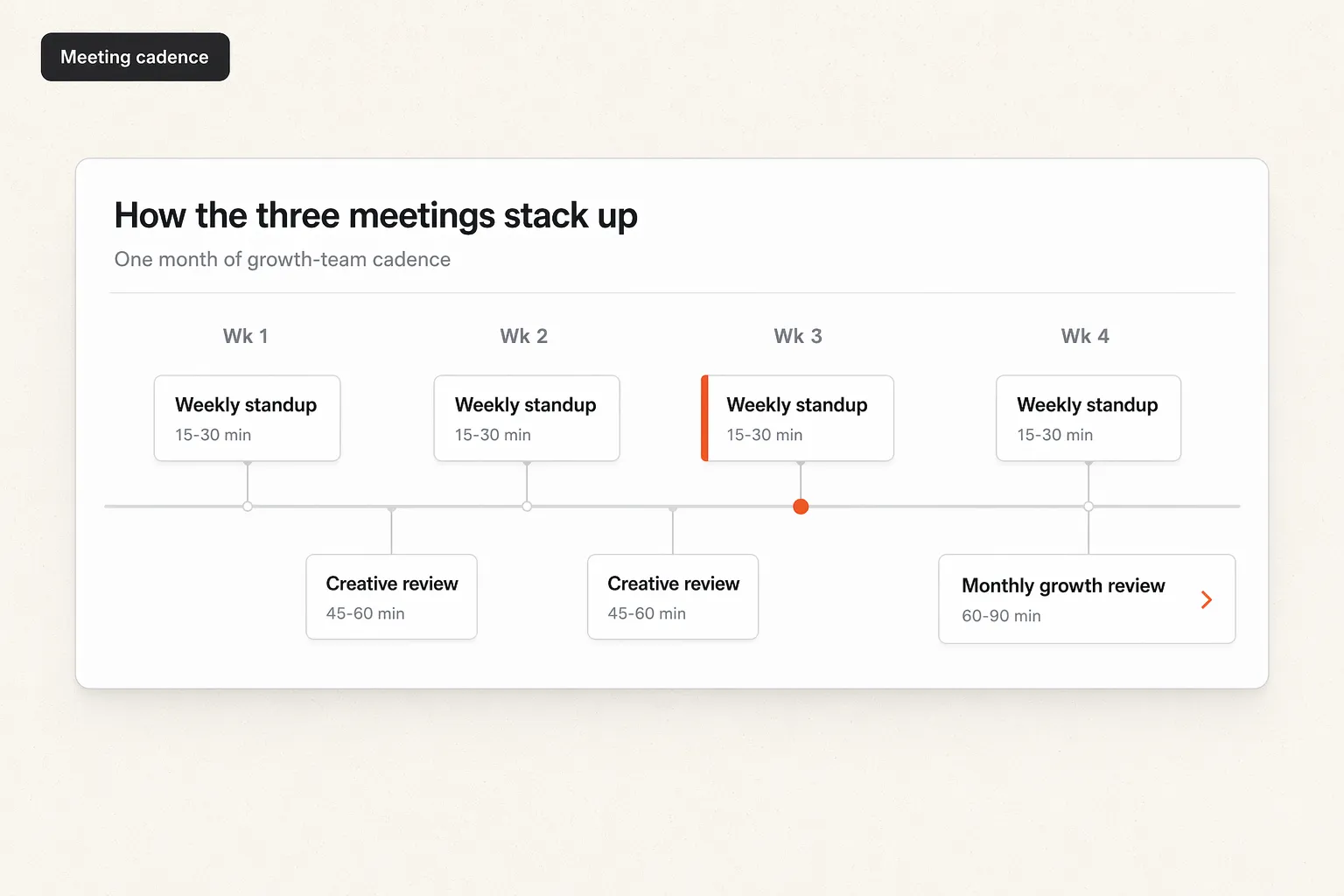
Think of them as different altitudes. The standup is ground level: what is happening right now with spend, pacing, and performance. The growth review is the map: are we hitting targets and where do we reallocate next month. The creative meeting is the engine room: what new concepts feed the channels so performance does not decay.
| Meeting | Cadence | Attendees | Duration | Primary output |
|---|---|---|---|---|
| Weekly Performance Standup | Weekly (Mon or Tue) | Performance lead, media buyers, analyst | 15 to 30 min | This week's optimization actions and owners |
| Monthly Growth Review | Monthly | Growth lead, marketing leadership, finance, channel owners | 60 to 90 min | Next month's budget split and priorities |
| Creative Review and Testing Meeting | Weekly or biweekly | Creative lead, designers, copy, media buyer | 45 to 60 min | Creative test queue: ship, scale, or kill |
Each meeting reviews a different slice of metrics. Bringing the wrong metric to the wrong meeting is how standups balloon into strategy debates.
| Meeting | Core metrics reviewed |
|---|---|
| Weekly Performance Standup | Spend pacing, ROAS, CPA, CTR, CPM, daily budget vs. plan |
| Monthly Growth Review | ROAS by channel, CAC, LTV, blended CAC, OKR progress, budget efficiency |
| Creative Review and Testing Meeting | Hook rate, CTR, thumb-stop rate, creative fatigue, test win rate |
Template 1: The Weekly Performance Standup (or sprint)
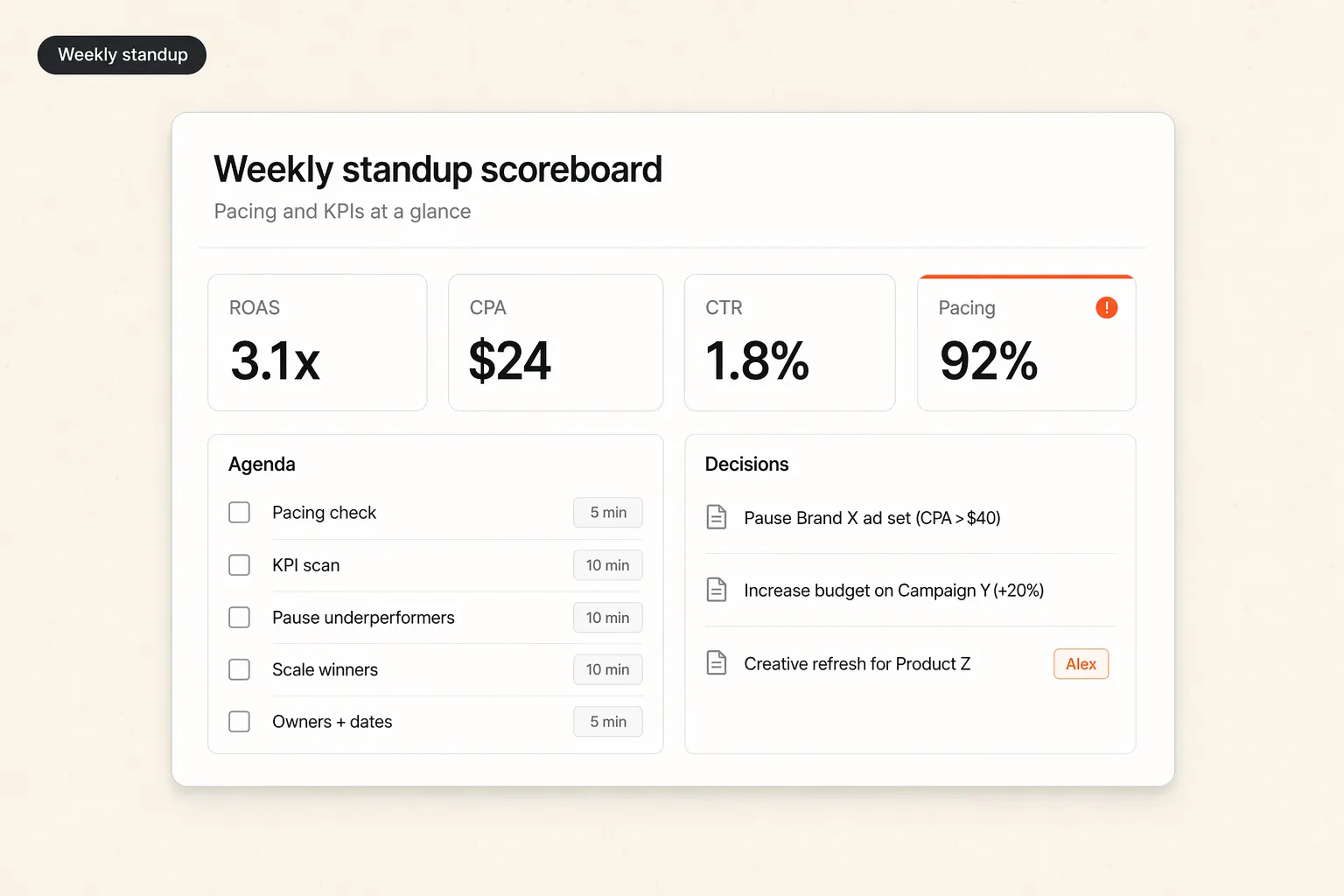
This is your operating meeting. The purpose is simple: catch what is off pace, agree on the optimizations for the week, and assign owners. It is not a strategy meeting and it is not a creative review. If a topic needs more than two minutes of debate, it gets parked.
Cadence: Weekly, Monday or Tuesday morning. Attendees: Performance lead (runs it), media buyers, growth analyst. Length: 15 to 30 minutes, standing or camera-on.
Agenda (25 minutes)
- Pacing check (3 min). Are we on, over, or under budget across Meta and Google? Flag anything more than 10 percent off plan.
- KPI scan (5 min). ROAS, CPA, and CTR vs. last week and vs. target. Name the three biggest movers, up or down.
- Underperformers (5 min). Which campaigns or ad sets are bleeding budget for no return. Decide: pause, cut budget, or watch one more day.
- Winners to scale (4 min). What is beating target and has room. Decide the scale step (usually 20 percent budget, not double).
- Blockers (3 min). Anything waiting on creative, tracking, or approval.
- Actions and owners (5 min). Every decision gets a name and a deadline. No orphaned tasks.
Inputs to bring: Spend pacing vs. plan, ROAS, CPA, CTR, CPM by campaign, and a flag list of anything that breached a guardrail since the last standup. For the benchmark context behind these numbers, see ROAS Benchmarks by Industry.
Decisions this meeting must produce: What to pause, what to scale, and what to fix this week, each with an owner. If the meeting ends with zero changes to the account, it was a status update, not a standup.
What good looks like: Under 30 minutes, every attendee leaves knowing their one or two actions, and the account looks different by Friday. For the metric definitions that should anchor this conversation, Mastering Performance Marketing: Key Metrics and Tools is a useful shared reference. Short, focused standups are well supported by research on effective team rituals from sources like the Atlassian Team Playbook.
Template 2: The Monthly Growth Review
The monthly growth review is where you zoom out. The purpose is to judge performance against KPIs and OKRs, decide where next month's budget goes, and surface the structural problems a weekly standup cannot fix. This is the meeting leadership actually cares about, so the numbers need to be airtight before anyone walks in.
Cadence: Monthly, first week. Attendees: Growth lead (runs it), marketing leadership, finance, channel owners. Length: 60 to 90 minutes.
Agenda (75 minutes)
- Month in one slide (10 min). Blended ROAS, CAC, LTV, total spend, and revenue vs. target. The headline before the detail.
- OKR and KPI progress (15 min). Where each objective stands and what moved it. Green, yellow, red, with the why.
- Channel deep dive (20 min). Meta vs. Google vs. the rest. ROAS, CAC, and efficiency per channel. Which channel earned more budget and which lost it.
- Wins and losses (10 min). The two tests or bets that worked and the two that did not, with the lesson from each.
- Next month's plan (15 min). Budget reallocation, new bets, and the one or two priorities the whole team rallies behind.
- Risks and asks (5 min). Tracking gaps, hiring needs, budget approvals.
Inputs to bring: ROAS by channel, blended and channel-level CAC, LTV, OKR scorecard, budget efficiency, and a clear before-and-after on every major change from last month. Tie creative performance into the channel view using Creative Performance Analysis. For platform-level context on benchmarks, Google's Skillshop and Meta Blueprint are credible reference points.
Decisions this meeting must produce: Next month's budget split by channel, the top priorities, and any structural fixes (new tracking, new creative volume, new audience tests). A growth review that ends without a reallocation decision did not earn its 90 minutes.
What good looks like: Leadership leaves confident in the numbers, finance signs off on the budget, and the team has a clear one-page plan for the month. The format borrows from the weekly business review discipline that operators like Amazon popularized, summarized well in Harvard Business Review's work on running better meetings.
Template 3: The Creative Review and Testing Meeting
Performance decays without fresh creative. This meeting exists to keep the pipeline full and the testing disciplined. The purpose is to review what is live, decide what ships next, and kill what has fatigued before it drags down account efficiency.
Cadence: Weekly or biweekly. Attendees: Creative lead (runs it), designers, copywriter, media buyer. Length: 45 to 60 minutes.
Agenda (50 minutes)
- Live creative scoreboard (10 min). Top and bottom performers by hook rate, CTR, and thumb-stop rate. Numbers, not opinions.
- Fatigue check (8 min). Which winners are declining on frequency and CPM creep. Flag what needs a refresh before it dies. The mechanics are covered in Creative Fatigue Explained.
- Test results (10 min). What the last batch of tests proved. Winner, loser, and the insight that transfers to the next batch.
- Next test queue (12 min). Concepts, hooks, and formats to ship next. Each gets a hypothesis, not just "let's try this."
- Production status (5 min). What is in design, what is in copy, what is stuck.
- Decisions and owners (5 min). Ship, scale, kill, or iterate, each with a name and a date.
Inputs to bring: Hook rate, CTR, thumb-stop rate, frequency, CPM trend, and a fatigue flag per creative. The media buyer brings the spend context so creative decisions connect to budget. For how to read these signals together, Paid Ad Analytics for Creative Teams breaks it down.
Decisions this meeting must produce: A ranked test queue for the next cycle, a kill list for fatigued creatives, and owners for every concept in production.
What good looks like: The test queue is always full, decisions are made on hook rate and CTR rather than taste, and no fatigued creative survives past the meeting it was flagged in.
How to run these meetings without drowning in prep
The reason most of these meetings fail is not the agenda. It is that someone spends three hours pulling numbers the night before, and the data is stale by the time it hits the screen. The prep eats the value.
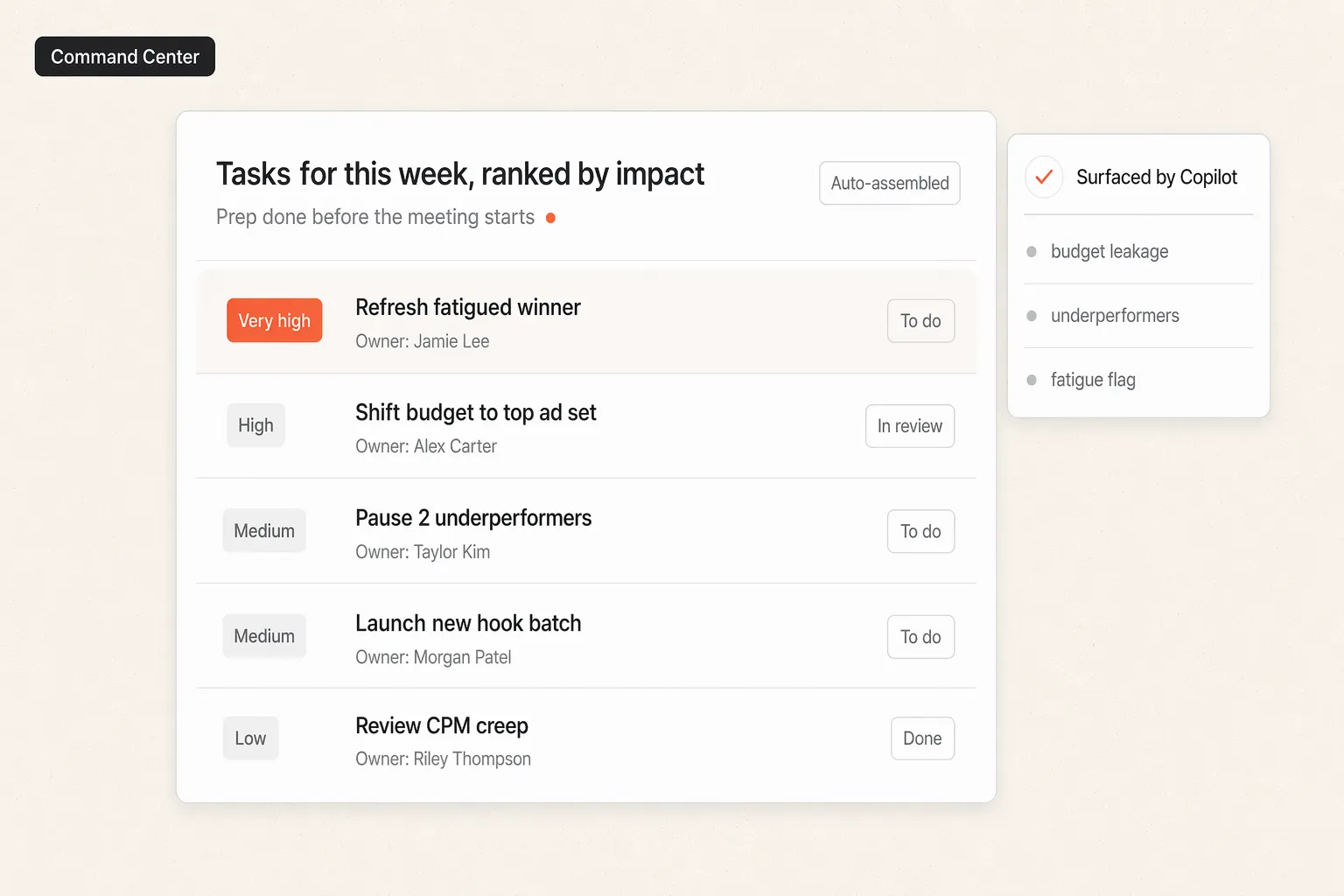
Hawky's Copilot answers campaign, creative, and competitor questions with sourced data in seconds, so the standup deck assembles itself instead of someone exporting CSVs at midnight. One-Click Executive Decks turn the monthly growth review into a generated artifact, not a manual slide marathon. The Command Center ranks tasks by impact and flags budget leakage, underperformers, and fatigued creatives before anyone asks.
Scheduled Agents run daily, weekly, or monthly, surface what changed, and route the right task to the right person over email or Slack. The agents do the reporting prep, so the meeting is about decisions, not status. The Performance Agent operates as an always-on paid-media operator against your KPI, with every action logged and reversible, which means the standup reviews what the agent already flagged rather than hunting for it manually. For the creative review, the Creative Agent can have on-brand variants of fatigued winners ready before the meeting, so the test queue is full rather than empty.
Common growth meeting mistakes to avoid
- Treating the standup as a strategy meeting. Big decisions hijack the 20-minute slot. Park them for the growth review and keep the standup operational.
- Showing up without the numbers ready. If the first 15 minutes is spent finding data, the meeting is already lost. Inputs should be assembled before anyone joins.
- No owner, no deadline. A decision with no name attached is a wish. Every action item leaves with a person and a date.
- Judging creative on taste, not data. Hook rate and CTR decide, not whoever has the loudest opinion in the room.
- Never killing meetings. If a recurring meeting has not produced a decision in a month, cancel it. Cadence should serve outcomes, not the calendar.
Frequently asked questions
What meetings does a growth marketing team need?
A growth marketing team needs three core meetings: a weekly performance standup for spend pacing and optimizations, a monthly growth review for strategy and budget allocation against KPIs and OKRs, and a creative review and testing meeting to keep the creative pipeline full and kill fatigued ads. Together they cover the operational, strategic, and creative work without redundant syncs.
How often should performance marketing teams meet?
Performance marketing teams should hold a short standup weekly (15 to 30 minutes), a creative review weekly or biweekly (45 to 60 minutes), and a strategic growth review monthly (60 to 90 minutes). Daily standups are usually overkill unless you are in a high-spend launch sprint where pacing changes hour to hour.
Who should attend a growth marketing meeting?
Attendance depends on the meeting. The weekly standup needs the performance lead, media buyers, and an analyst, while the monthly growth review needs the growth lead, marketing leadership, finance, and channel owners. The creative review needs the creative lead, designers, a copywriter, and the media buyer. Keep each meeting to the people who own a decision in it.
What should be in a weekly performance marketing meeting agenda?
A weekly performance marketing meeting agenda should cover a budget pacing check, a KPI scan (ROAS, CPA, CTR, CPM), a review of underperformers to pause, winners to scale, current blockers, and a closing round where every decision gets an owner and a deadline. Keep it to six items and time-box each one to stay under 30 minutes.
How long should a growth marketing meeting be?
Length should match the meeting's job. A weekly standup runs 15 to 30 minutes, a creative review and testing meeting runs 45 to 60 minutes, and a monthly growth review runs 60 to 90 minutes. If a meeting consistently overruns, the agenda is doing too much and a topic should move to a different meeting.
Good meetings are not about better notes. They are about walking in with the numbers already assembled and walking out with decisions, owners, and dates. Structure the cadence, time-box the agenda, and stop using meetings as a place to read reports out loud.
If your team is losing hours every week pulling reports before the meeting even starts, Hawky's Performance Agent is built for that job.
Ready to hire your first AI performance team? Book Demo