How to Create the Perfect Facebook Ad in 2026
The perfect Facebook ad in 2026 is engineered, not guessed. It comes down to five things working together: one clear campaign objective, broad Advantage+ targeting, a scroll-stopping hook, one sharp call to action, and clean conversion tracking feeding Meta's algorithm. Get those right, in that order, and the platform does most of the heavy lifting.
Most teams still build ads the 2021 way: narrow interest stacks, busy creative, and three competing CTAs. That approach fights the algorithm instead of feeding it. This guide walks through the exact process to create a high-performing Facebook ad in 2026, step by step, with the specs, metrics, and mistakes that decide whether your spend converts.
What makes a Facebook ad "perfect" in 2026
A perfect Facebook ad in 2026 is one where the targeting is broad, the creative carries the message, and every action the algorithm takes is fed by clean conversion data. The job of the advertiser has shifted from manual audience building to creative and measurement, because Meta's machine learning now finds the buyer once your signals are clean.
The manual versus Advantage+ toggle is effectively gone. Advantage+ now activates on its own when you combine broad targeting, optimized placements, a campaign-level budget, and a purchase or lead event. That means your creative and your tracking, not your audience spreadsheet, are the variables that separate winners from losers.
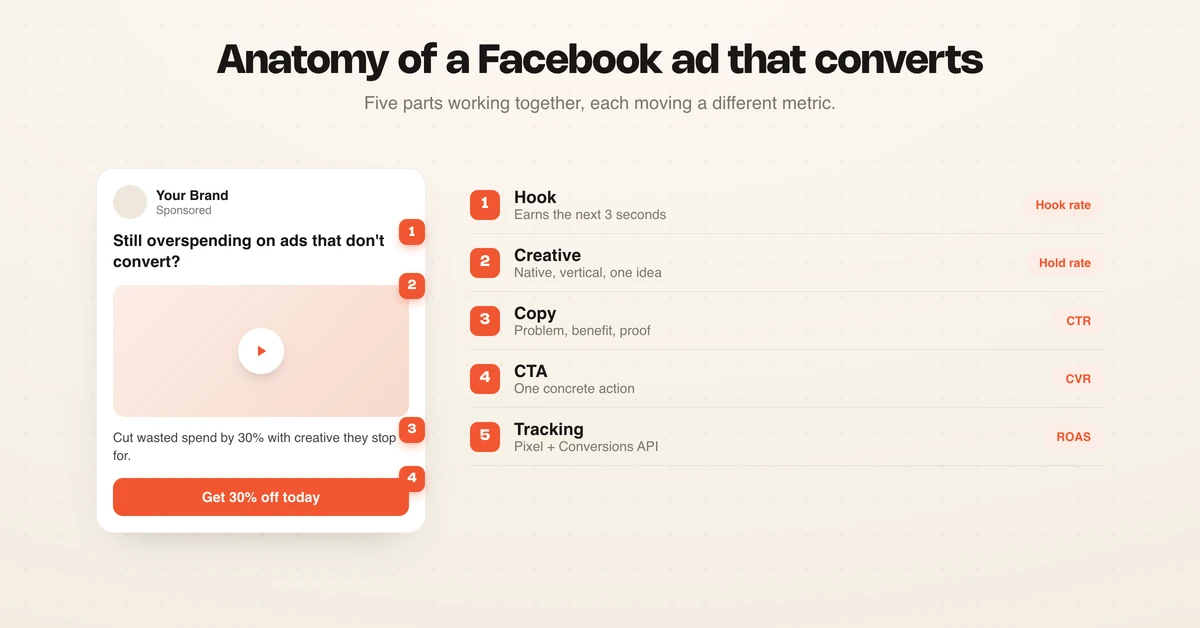
Here is the anatomy of an ad that performs, and the metric each part moves.
| Component | What good looks like in 2026 | Metric it moves |
|---|---|---|
| Objective | One conversion goal (Sales or Leads), nothing split | CPA, ROAS |
| Audience | Broad, Advantage+ on, signals clean | CPM, reach |
| Hook | Earns the next 3 seconds in the first second | Hook rate, CTR |
| Creative | Native, mobile-first, one idea | Hold rate, CTR |
| Copy | Problem, benefit, proof, action | CTR, CVR |
| CTA | One specific, concrete action | CVR, CPA |
| Tracking | Pixel plus Conversions API | Attribution, ROAS |
What you need before you start
Before you build a single ad, you need a Meta Business account, an ad account with the correct currency and time zone, a published Facebook Page, and the Meta Pixel installed with Conversions API turned on. Without the tracking layer, the algorithm is optimizing blind and your reporting will not match reality.
You also need a realistic budget. Plan for enough daily spend to reach roughly 50 conversions per week per ad set, because that is the volume Meta needs to exit the learning phase and optimize reliably. For many ROAS-focused accounts that means a starting daily budget in the range of 50 to 100 USD per ad set, scaled to your average order value.
Finally, gather raw material for creative: product shots, customer footage, reviews, and at least three or four distinct hook ideas. You will test the opener, so you need range before you launch.
Step 1: Pick one campaign objective and commit to it
The right objective is the single conversion event that maps to revenue: Sales for ecommerce, Leads for service and B2B. Pick one per campaign and resist the urge to chase traffic or engagement as a proxy.
Meta optimizes toward the event you select, so a Traffic objective buys you clicks from people who like clicking, not buyers. If your goal is purchases, choose the Sales objective and set the optimization event to Purchase. If you sell a considered, higher-ticket product, Leads with a quality follow-up sequence usually beats forcing a direct sale on cold traffic.
What "done" looks like: one campaign, one clear objective, optimizing for a bottom-funnel event that your business actually counts as a result.
Step 2: Feed the algorithm with clean tracking
Clean tracking is the foundation of every high-performing Facebook ad in 2026, because Meta can only optimize toward conversions it can see. The pairing that matters is the browser-side Pixel plus the server-side Conversions API, which recovers signal lost to iOS limits and ad blockers.
Install the Pixel, enable Conversions API, and verify your domain. Configure your priority events in Events Manager and confirm that test purchases fire correctly before you spend. A 10-minute check here saves weeks of optimizing against broken data.
Pro tip: match quality matters. Pass hashed email, phone, and other first-party parameters through the Conversions API so Meta attributes more conversions correctly, which directly improves how the algorithm spends your budget.
Step 3: Go broad and let Advantage+ find the buyer
Broad targeting is the default that wins in 2026, because Meta's audience model now outperforms manual interest stacking for most accounts. You set the country, basic exclusions, and let Advantage+ do the rest.
Detailed interest targeting still has a narrow place, mainly for very small budgets or tightly regulated niches, but for most advertisers it caps reach and raises CPMs without improving quality. Open the audience, keep your placements on Advantage+ (Automatic), and give the system room to learn. The creative becomes your real targeting: the algorithm reads your copy and visuals and routes the ad to people who engage with similar content.
What "done" looks like: a broad audience, automatic placements, and a campaign-level budget, so Advantage+ activates and the machine learning has room to work.
Step 4: Write a hook and copy that do the selling
The hook is the most important line in the ad, because most viewers decide whether to keep reading or watching in the first second. A strong hook rate lifts your 3-second views, which improves delivery and pulls CPM down with it.
Lead with the sharpest version of the customer's problem or a bold, specific claim, then follow a simple structure: problem, benefit, proof, action. Specificity beats vagueness every time, so "Cut your CAC by 30% in 60 days" outperforms "Grow your business faster." Keep the first line above the see-more fold, usually under 125 characters, and write the rest to do the convincing.
In 2026 your copy does double duty. The algorithm reads your text to understand who the ad is for, so clear, on-topic language helps Meta find the right buyer. For more openers that stop the scroll, study a swipe file of proven Facebook ad hooks and adapt the patterns to your offer.
Step 5: Design the creative to platform spec
The best Facebook ad creative in 2026 is mobile-first, native to the feed, and built around one idea. Polished, studio-perfect ads now underperform authentic, UGC-style content in most direct-response accounts, because viewers trust what looks real.
Design vertical first. Most impressions are on mobile, so a 4:5 feed ratio and a 9:16 ratio for Stories and Reels capture the most screen. Build at Meta's recommended minimum of 1080 px on the shortest side, and keep your core message and any on-screen text in the safe zone, away from the edges where the interface crops. The table below covers the formats that matter.
| Placement | Aspect ratio | Recommended minimum | Best format |
|---|---|---|---|
| Feed (square) | 1:1 | 1080 x 1080 px | Static or video |
| Feed (vertical) | 4:5 | 1080 x 1350 px | Static or video |
| Stories and Reels | 9:16 | 1080 x 1920 px | Short video |
| Carousel | 1:1 | 1080 x 1080 px | Multi-image |
Assume sound-off viewing. Caption your videos, put the value in the first frame, and make the message legible without audio. For more on building static ads that convert, the same rule applies: one clear idea per asset, designed for the thumb.
Pro tip: produce more variants than you think you need. The reason is creative volume, not perfection, drives results, because you cannot predict the winner and the platform rewards fresh creative.
Step 6: Give the ad one specific call to action
A high-converting Facebook ad has exactly one call to action, and it names a concrete next step. Direct, specific CTAs consistently beat vague, aspirational ones, and testing CTA wording alone can move conversion rates by 20% or more.
"Get 30% off today" or "Start your free trial" gives the reader a reason and a result, while "Learn more" and "Unlock your potential" ask for effort with no payoff. Match the CTA button to the copy so the promise and the click line up. Send the click to a fast, relevant landing page, because a strong ad dies on a slow or mismatched page.
What "done" looks like: one CTA, one destination, and a message-match between the ad, the button, and the page.
Step 7: Launch, hold, then test and scale
The launch rule that protects performance is simple: ship 3 to 5 ads in one ad set, then leave them alone for 72 hours so the algorithm can exit the learning phase. Editing or judging an ad in the first three days resets learning and wastes budget.
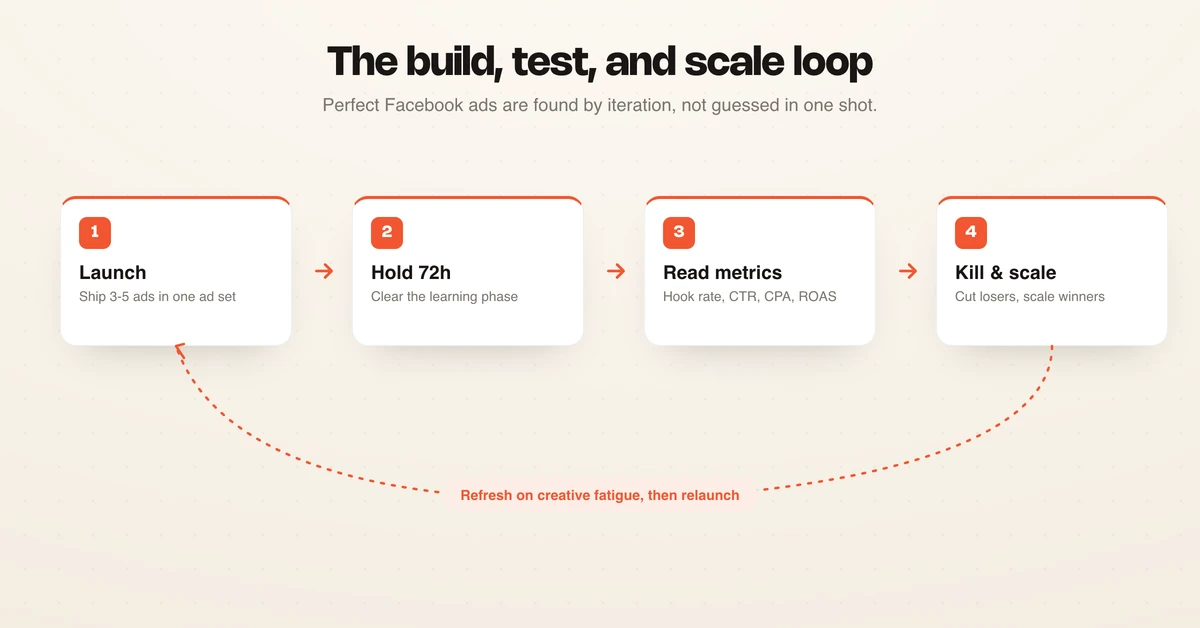
Once you have data, read the metrics in funnel order: hook rate for attention, CTR for intent, and CPA or ROAS for the decision. Kill the clear losers, keep the winners, and feed the next round of creative built from what worked. This is the loop that compounds, and it is why disciplined creative testing beats one-off "perfect" ads.
Watch for creative fatigue. When a winning ad's hook rate or CTR starts sliding and CPM climbs, the creative is wearing out, often within one to two weeks on high-spend accounts. Refresh the hook on a proven body before you rebuild the whole ad, and keep a bench of new concepts ready so you never run dry.
Common Facebook ad mistakes to avoid
Most underperforming Facebook ads fail for the same handful of reasons. Avoid these and you are ahead of most advertisers.
- Targeting too narrow. Stacking interests fights Advantage+ and raises CPMs. Go broad and let the creative do the targeting.
- Judging ads too early. Touching an ad inside 72 hours resets the learning phase. Set a review window and hold.
- Optimizing for the wrong event. Traffic and engagement objectives buy cheap clicks, not buyers. Optimize for the conversion that maps to revenue.
- One creative, no bench. A single ad fatigues and there is nothing to replace it. Always have the next batch ready.
- Broken tracking. Without the Pixel plus Conversions API, the algorithm optimizes blind. Verify events before you spend. If ad approvals are a recurring blocker, run creative through a compliance checker before launch.
Tools that make this easier
You can run this entire process by hand, but the labor adds up fast: briefing creative, building variants, watching metrics, catching fatigue, and refreshing winners every week. A few tools compress the work.
Meta Advantage+ is the native baseline. It handles audience discovery and placement optimization for free inside Ads Manager, and every advertiser should use it as the foundation rather than fighting it with manual setup.
Hawky is an agentic performance marketing platform that runs the build-test-scale loop end to end. Its Creative Agent reads your past winners and competitor patterns, then renders finished on-brand variants bound to a specific ad set, while the Performance Agent launches, optimizes, and reallocates budget against your KPI 24/7. The autonomy is configurable: you start in shadow mode, move to approval-gated, then to fully autonomous, with every action logged and one-click reversible the whole way. Hiveminds used Hawky to cut CPL by 27% and save 160+ hours per brand monthly.
Creative testing and analytics tools sit alongside either approach, scoring ads at the hook, visual, and CTA level so you learn faster which elements to keep. The point is the same: spend your time on judgement and creative direction, and let software handle the repetitive labor.
Frequently asked questions
What makes a Facebook ad effective in 2026?
An effective Facebook ad in 2026 pairs broad Advantage+ targeting with a strong, native creative and clean conversion tracking. The targeting is largely automated, so the variables that decide performance are the hook, the creative, the single specific CTA, and whether the Pixel and Conversions API are feeding Meta accurate data. Ads that nail those convert; ads that rely on narrow interest stacks and polished but generic creative usually do not.
What is the best Facebook ad format in 2026?
Short vertical video is the highest-performing Facebook ad format for most direct-response accounts in 2026, followed by authentic UGC-style statics. Build creative vertical-first at a 4:5 ratio for feed and 9:16 for Stories and Reels, design for sound-off viewing with captions, and put the value in the first frame. Test multiple formats, because the winner depends on your offer and audience.
How much should I budget to start Facebook ads?
Start with enough daily budget for an ad set to reach roughly 50 conversions per week, which lets Meta exit the learning phase and optimize reliably. For many accounts that means 50 to 100 USD per day per ad set, scaled to your average order value and target CPA. Spreading too little budget across too many ad sets starves each one of the data it needs to perform.
How long should I wait before optimizing a Facebook ad?
Wait at least 72 hours, and ideally until the ad set clears the learning phase at around 50 conversions, before judging or editing an ad. Changing budget, creative, or targeting inside that window resets learning and wastes spend. Read upper-funnel signals like hook rate early, but make kill-and-scale decisions on CPA and ROAS once you have a defensible sample.
Do I still need detailed targeting with Advantage+?
For most advertisers in 2026, no. Broad targeting with Advantage+ now outperforms manual interest stacking because Meta's model finds buyers from your creative and conversion signals. Detailed targeting still helps on very small budgets or in tightly regulated niches, but for typical ecommerce and lead-gen accounts, going broad and investing in creative is the stronger play.
Why are my Facebook ads not converting?
Most Facebook ads fail to convert because of broken tracking, a weak hook, the wrong objective, or targeting that is too narrow. Verify the Pixel and Conversions API first, then check that your opener earns attention, your objective optimizes for a real conversion event, and your audience is broad enough for Advantage+ to work. For a full diagnosis, see why your Facebook ads are not converting and how to fix it.
If briefing, building, and testing every Facebook ad variant by hand is your real bottleneck, Hawky's Creative Agent and Performance Agent are built for that job: they produce on-brand creative from your winners and optimize spend against your KPI, with guardrails and a full audit trail keeping you in command.
Ready to hire your first AI performance team? Book Demo