Ad Creative Testing: A Framework That Actually Works
Ad creative testing is the systematic process of comparing ad variations to find which creative drives the best performance, using enough data to be sure the winner is real. A reliable framework isolates one variable at a time, runs each test 7 to 14 days, and waits for statistical significance (roughly 100 conversions per variant) before declaring a winner. The goal is a repeatable Test, Track, Optimize, Scale loop, not a lucky guess.
Creative is the single biggest driver of paid performance, and testing is how you find the winners on purpose instead of by accident. This framework covers what to test, how many variants to run, how long, and how to know a result is real, so you stop calling winners on noise.
What is ad creative testing?
Ad creative testing is the practice of running multiple ad variations against each other to measure which performs best on a chosen metric. Instead of trusting instinct about which hook or visual will work, you let the market decide with real data. It is the difference between opinion-led and evidence-led creative.
Testing matters because creative decides most of your results and your intuition is unreliable at predicting winners. Ads that teams expect to flop often outperform the "safe" favorite, and the only way to know is to test. Systematic testing turns creative from a gamble into a compounding advantage, because every test teaches you what works for your specific audience.
The discipline is what separates testing from guessing. Randomly swapping creatives and eyeballing the dashboard is not testing; it produces conclusions built on noise. Real testing controls variables, gathers enough data, and measures against significance, which is what this framework provides. For the broader picture, see the ad creative analysis guide.
The Test, Track, Optimize, Scale framework
A repeatable creative testing system runs on a four-stage loop, and each stage feeds the next. Skipping a stage is where most programs break down.
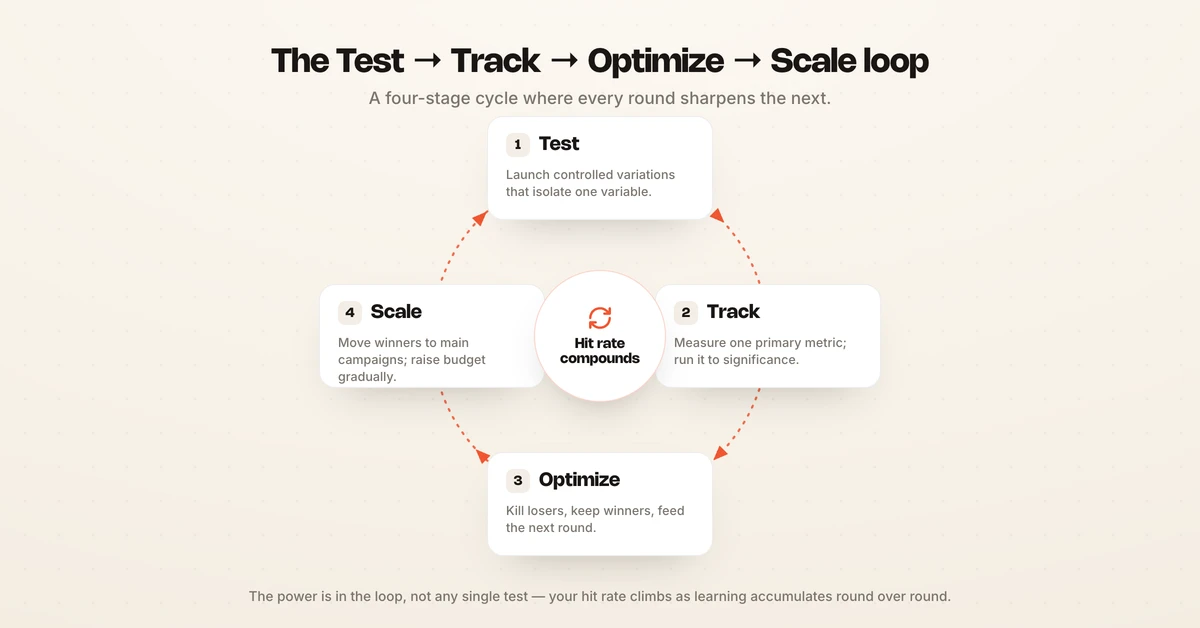
- Test: launch controlled variations that isolate one variable, with enough budget for each to gather signal.
- Track: measure against a clear primary metric and let the test run to significance, not to a hunch.
- Optimize: kill clear losers, keep winners, and feed what you learned into the next round of hypotheses.
- Scale: move proven winners into your main campaigns and increase budget gradually so you do not reset learning.
The power is in the loop, not any single test. Each round should start from the last round's learning, so your hypotheses get sharper and your hit rate climbs over time. A team running this loop for six months tests smarter than one running its first test, because the knowledge compounds in a creative testing framework built on accumulated evidence.
What to test: isolate one variable
Good creative testing changes one thing at a time so you can attribute the result to a cause. If you swap the hook, the visual, and the CTA all at once and performance jumps, you have learned nothing about why. Isolation is what makes a test informative.
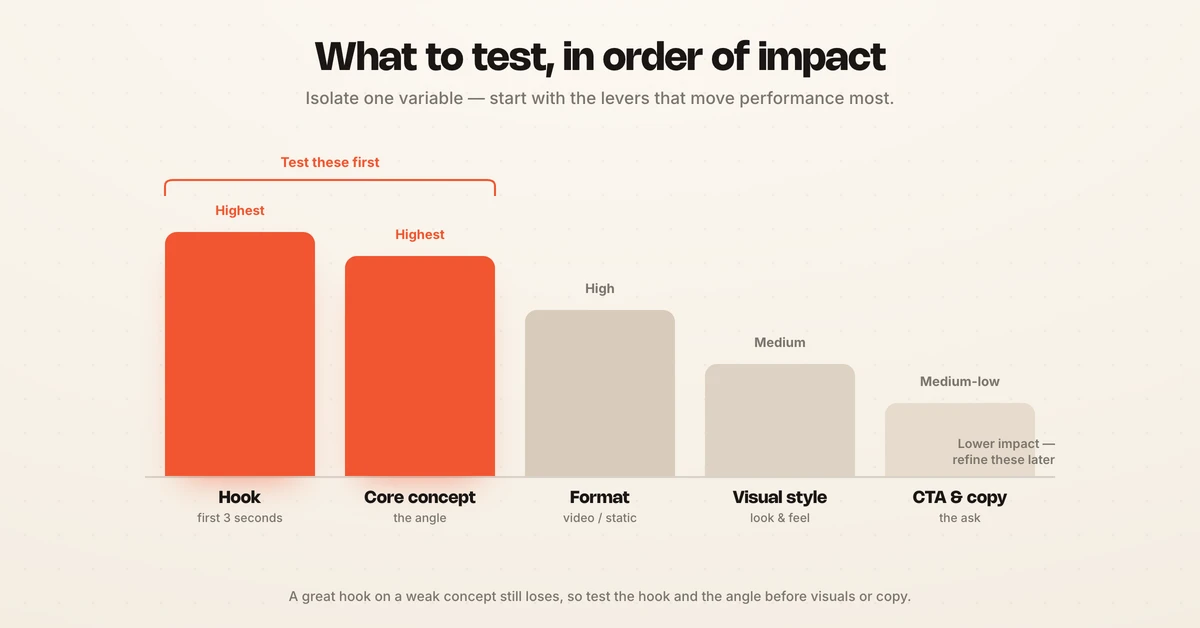
Test variables in order of impact, because not everything moves the needle equally:
| Variable | Impact | Test first? |
|---|---|---|
| Hook (first 3 seconds) | Highest | Yes |
| Core concept / angle | Highest | Yes |
| Format (video, static, carousel) | High | Early |
| Visual style | Medium | After concept |
| CTA and copy | Medium-low | Later |
The hook and the concept carry the most weight, so test them first; a great hook on a weak concept still loses. Once you have a winning concept and hook, refine format, visuals, and copy. Testing a button color before you have a working concept is optimizing the wrong end of the funnel.
How many creatives to test at once
Test enough variants to learn quickly, but not so many that each starves for data. A practical starting point is three to five variants per test, with enough budget that each generates real signal, roughly $25 per variant per day or a minimum of 500 impressions per variant per day. Splitting a small budget across ten variants means none of them reaches significance.
Budget dictates the ceiling. If you can only fund four variants to significance, test four, not twelve, because a half-powered test of twelve gives you twelve unreliable answers. Match the number of variants to the budget available to power them, and run more rounds rather than more variants per round.
This is also why isolating variables matters for volume. Testing four hooks in one round and four formats in the next teaches you more than testing sixteen random combinations at once, and it keeps each variant funded well enough to trust.
How to reach statistical significance
Statistical significance is what tells you a winner is real and not random luck, and ignoring it is the most expensive mistake in creative testing. Aim for 95% confidence before making major budget decisions, and treat anything below 80% as "need more data, not a decision," per AdManage. Meta generally recommends at least 100 conversions per variation before trusting a result. The creative testing tools compared here differ mainly in whether they read that verdict for you or leave it to a spreadsheet.
Time and volume both matter. Run tests at least 7 to 14 days to clear Facebook's learning phase and average out day-of-week swings, and make sure each variant clears roughly 500 impressions per day so it can accumulate signal. Use an A/B testing significance calculator, such as Evan Miller's, to check whether observed differences have crossed the 95% threshold rather than judging by eye.
The classic error is calling a winner too early. An ad showing a 20% better CPA after three days and $500 of spend is almost certainly noise, and scaling it wastes budget on a result that will regress. When conversions are too slow to reach significance in 21 days, switch to a faster proxy metric like click-through or hook rate, treating the result as directional rather than conclusive. For the metrics themselves, see how to measure ad creative performance.
Common creative testing mistakes
Most testing programs fail for the same handful of reasons. Calling winners too early tops the list, followed by testing too many variables at once so no result is attributable. Underfunding tests so no variant reaches significance produces confident-looking conclusions built on nothing.
The subtler failure is not closing the loop. Teams run a test, pick a winner, and then start the next test from scratch instead of from what they learned, so their hit rate never improves.
Testing velocity is the constraint underneath all of this. Reaching significance needs a steady stream of fresh creative, and the teams that win are the ones that can generate and run more good tests per month than their competitors. Higher testing velocity means more shots at a breakout winner and faster learning, but it also means more creative than most in-house teams can produce by hand, which is where the bottleneck usually sits. Hawky's Creative Agent generates on-brand test variations from your winning patterns, and Creative Analysis breaks down results at the element level, so the Test, Track, Optimize, Scale loop runs on real throughput with guardrails and approval, not on a designer's spare hours.
Frequently asked questions
How do you test ad creatives?
Test ad creatives by running controlled variations that isolate one variable, such as the hook or format, with enough budget for each to gather signal. Let each test run 7 to 14 days and to statistical significance, roughly 100 conversions per variant, before declaring a winner. Then scale the winner into your main campaigns and feed what you learned into the next round in a Test, Track, Optimize, Scale loop.
What is creative testing?
Creative testing is the systematic process of comparing ad variations to find which performs best on a chosen metric, using enough data to be confident the winner is real. It replaces guessing with evidence, since teams are poor at predicting which creative will win. Done systematically, it turns creative into a compounding advantage because every test teaches you what works for your audience.
How many ad creatives should I test at once?
Test three to five variants per round, with enough budget that each gets real signal, roughly $25 per variant per day or at least 500 impressions per variant daily. Testing too many variants at once starves each of data so none reaches significance. If your budget only powers four variants to a reliable result, test four and run more rounds rather than more variants per round.
How long should you run a creative test?
Run a creative test at least 7 to 14 days to clear the platform learning phase and average out day-of-week performance swings. Continue until each variant reaches statistical significance, generally at least 100 conversions per variation and 95% confidence. Calling a winner after three days and a few hundred dollars almost always measures noise, not a real difference.
What should I test first in ad creative?
Test the hook and the core concept first, because they carry the most weight; a weak concept cannot be saved by a better button. Once you have a winning hook and angle, refine format, then visual style, then CTA and copy. Testing lower-impact elements like button color before you have a working concept optimizes the wrong end of the funnel.
If running a disciplined creative testing loop is capped by how fast your team can produce new variations, Hawky's Creative Agent and Creative Analysis are built for that job.
Ready to hire your first AI performance team? Book Demo