Competitor Creative Analysis: How to Learn From Rivals' Ads
Competitor creative analysis is the practice of deconstructing rivals' ad creative, the hooks, visuals, angles, and structure, to learn what resonates in your market and adapt the principles into your own ads. It is craft-level work, distinct from the strategic view of where competitors spend. The goal is never to copy an ad, but to reverse-engineer why it works and apply that understanding to original creative.
Your competitors are running thousands of dollars of live creative tests in public, and their long-running ads are the results. Competitor creative analysis is how you read those results. This guide covers what to analyze in a rival's creative, how to learn without copying, and how to turn the patterns into your own winners.
What is competitor creative analysis?
Competitor creative analysis is the close reading of the creative itself in a competitor's ads: the hook that opens them, the visual style, the message angle, the format, and the structure. Where broader competitor ad analysis maps strategy across channels and spend, creative analysis zooms into the craft of the individual ad.
The reason it works is that competitors have already paid to find out what converts. An ad a rival has run for two months is a proven winner in your category, tested with real budget against a real audience. Studying it shortcuts your own trial and error, because someone already ran the experiment.
The distinction from copying matters. Creative analysis extracts the transferable principle (a pain-led hook, a demonstration structure, a specific proof device) and applies it to your own brand and product. Copying clones the surface and ages fast; analysis learns the underlying pattern.
What to analyze in a competitor's creative
A useful teardown looks at the same elements every time, so you can compare across a rival's library and against your own. Break each competitor ad into its parts.
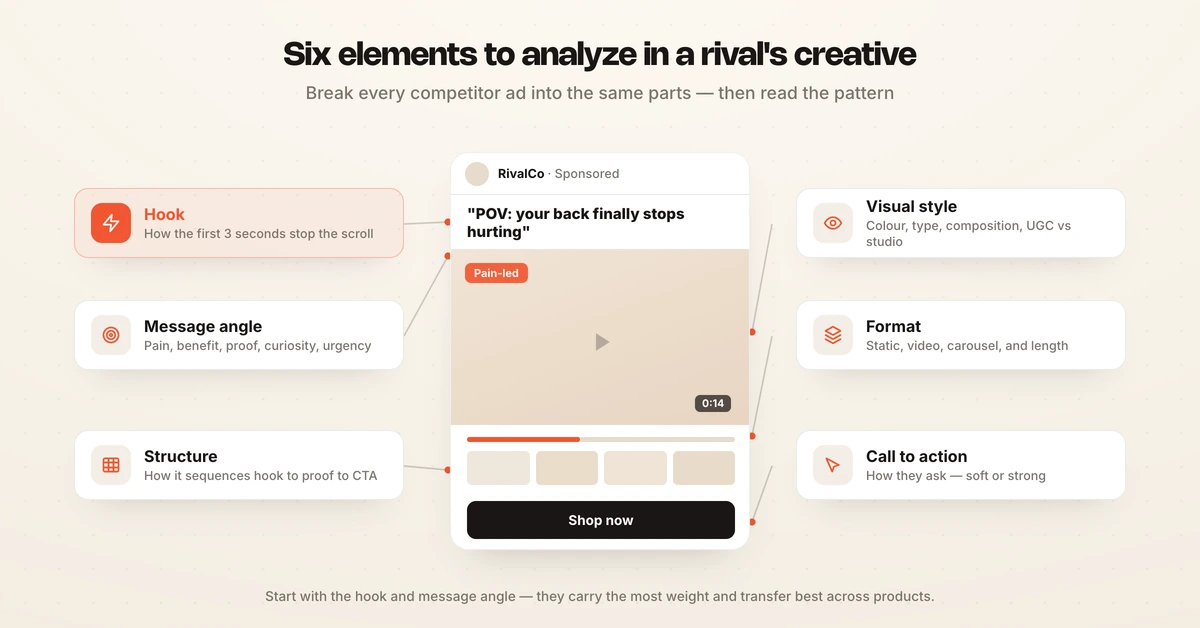
| Element | What to study |
|---|---|
| Hook | How the first 3 seconds or the headline stops the scroll |
| Message angle | The core promise: pain, benefit, social proof, curiosity, urgency |
| Visual style | Colors, typography, composition, UGC vs studio |
| Format | Static, video, carousel, or collection, and video length |
| Structure | How the ad is sequenced from hook to proof to CTA |
| CTA | How they ask for the action, soft or strong |
Start with the hook and the message angle, because those carry the most weight and transfer best across products. Then note the structure: many winning ads follow a repeatable sequence (hook, problem, demonstration, proof, offer) that you can adopt without copying a single word. The visual and format choices tell you what your market expects to see.
Focus your effort on their long-running ads. A creative a competitor has kept live for weeks is one they keep funding because it works, which makes it far more worth analyzing than a brand-new ad that may not survive the week, a principle echoed across competitor research guides.
Consider a worked teardown. A rival's best-performing ad opens on a UGC clip of someone struggling with a common problem (pain-led hook), cuts to the product solving it in three seconds (demonstration), overlays a "4.8 stars, 12,000 reviews" card (social proof), and closes on "Try it risk-free" (soft CTA with a guarantee). None of those words are yours to take, but the sequence, pain to demonstration to proof to risk-reversal, is a pattern you can rebuild with your own product and footage. That is the difference between learning and copying.
How to learn from competitor creative without copying
The whole skill is extracting the principle, not the execution. When you find a winning competitor ad, ask what makes it work at the level of pattern, then rebuild that pattern with your own product, voice, and proof.
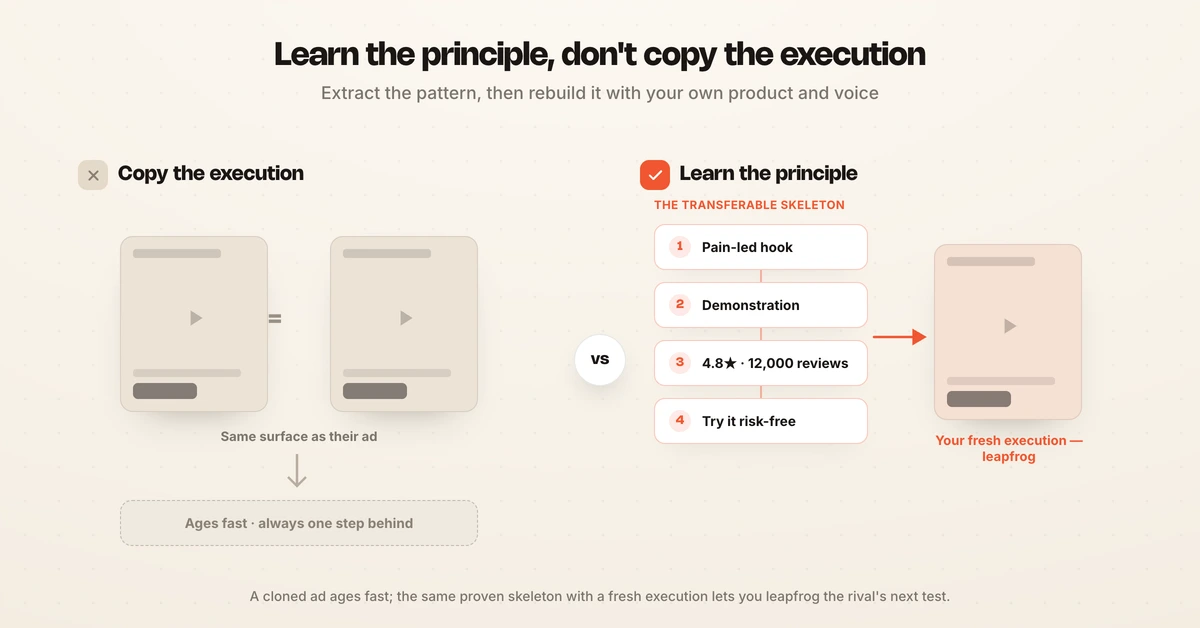
Take a winning hook structure and adapt it to your product. Use the same emotional trigger but with your unique angle. Mirror the ad's sequence but fill it with original content. If a rival's ad opens by stating a problem as a question, that is a pattern you can use with your own problem; the specific words are just one instance of it.
This keeps you on the right side of two lines. Cloning a competitor's exact creative can raise trademark and copyright issues and cedes them the lead, since you are always one step behind their next test. Learning the principle lets you leapfrog, because you apply a proven structure to a fresh execution the market has not seen. For the deeper method on winners, see how to analyze winning ads.
How to spot patterns across a competitor's creative
One competitor ad is an anecdote; the pattern across their library is their strategy. Tag a rival's ads by hook type, angle, format, and structure, then look for what repeats. The repeating elements are the formula they have settled on.
If a competitor's last ten ads all lead with social proof in the first three seconds, they have found that social proof converts for your shared audience, which is a signal worth acting on, as AdLibrary and other analysts note. If they suddenly shift from discount-led to benefit-led messaging, that change is telling you they are repositioning, a pattern Ryze frames as reading messaging evolution over time. Patterns reveal the strategy; changes reveal the bets.
Doing this across several competitors and over time is where it stops being manual. Hawky's Competitor Analysis maintains a searchable repository of competitor creative across Meta, Google, and TikTok, flags weekly what changed in their hooks and angles, and feeds the gaps into the Creative Agent so the analysis becomes your next batch of creative. Where you find rivals' ads to analyze is covered in the best TikTok ad spy tools and the Google Ads Transparency Center.
Common mistakes in competitor creative analysis
Most competitor creative analysis goes wrong in the same ways. Avoid these:
- Copying the execution. Cloning an ad ages fast and cedes the lead. Extract the pattern and rebuild it with your own content.
- Analyzing one ad. A single ad is an anecdote. Study the pattern across a rival's library to find the real formula.
- Ignoring longevity. A brand-new competitor ad may flop. Prioritize the ones running for weeks, which are proven.
- Losing your brand voice. Adopting a rival's structure with their tone makes you a weaker copy. Keep your own voice.
- Never applying it. An insight that stays in a doc does nothing. Turn each pattern into a creative test.
Frequently asked questions
How do you analyze competitor creatives?
Analyze competitor creatives by deconstructing each ad into its elements: the hook, message angle, visual style, format, structure, and CTA. Prioritize the ads a competitor has run for weeks, since longevity signals they work. Look for what repeats across their library to find the formula they have settled on, then extract the transferable principle, such as a pain-led hook or a demonstration structure, and rebuild it with your own product and voice.
What can you learn from competitor ad creative?
You can learn which hooks, angles, and formats convert in your market without paying to test them yourself, because a competitor's long-running ads are proven winners. You learn the message angles that resonate, the visual styles your audience expects, the structures that sequence attention to action, and where gaps exist that no rival has claimed. The point is to learn transferable principles, not to copy specific ads.
How do competitors structure their creatives?
Many winning competitor ads follow a repeatable structure: a hook that stops the scroll, a problem or desire, a demonstration or proof, and a clear call to action. The specific execution varies, but the sequence is common because it mirrors how a viewer moves from attention to action. Studying a rival's structure lets you adopt the proven sequence while filling it with your own original content.
Is analyzing competitor creative different from analyzing your own winning ads?
Yes. Analyzing your own winning ads tells you what works for your specific brand and audience, grounded in your outcome data. Analyzing competitor creative tells you what works in your market more broadly and reveals angles or formats you have not tried. The two are complementary: your own winners confirm what converts for you, and competitor creative expands the range of proven ideas you can test.
How is competitor creative analysis different from competitor ad analysis?
Competitor ad analysis is the strategic view: which channels a rival uses, how much they test, their offers, and where they invest. Competitor creative analysis is the craft view: the hook, visual, angle, and structure inside individual ads. Ad analysis tells you what your competitor is betting on; creative analysis tells you how they execute it. Most teams do both, using strategy to prioritize and creative analysis to learn the craft.
If tracking rivals' creative across Meta, Google, and TikTok and turning their winning patterns into your own ads is the problem, Hawky's Competitor Analysis and Creative Agent are built for that job.
Ready to hire your first AI performance team? Book Demo