8 Best Creative Testing Tools in 2026, Ranked and Priced
The best creative testing tools in 2026 are Hawky for agentic testing that generates variants, launches them and reads the result against your KPI, Motion for reading which creative and which element won, and Marpipe for testing catalog and product-level ads. Meta, TikTok and Google all ship a free native split tester, so a paid tool only earns its place when it does a job those cannot. Every price below was read on the vendor's own pricing page in September or October 2026.
Creative is the lever that moves paid performance most, and testing is how you find winners on purpose instead of by luck. This guide ranks eight creative testing tools by the job each one does, prices them, and shows how to build a stack that scales without paying three tools for one decision. It is the tool companion to the ad creative testing framework those tools execute.
What creative testing tools actually do in 2026
Creative testing tools are software that helps you compare ad variations and learn, with statistical confidence, which ad or which element drove the result. The category covers four separate jobs: generating the variants, running a clean split, reading the result at element level, and acting on it. Most ad creative testing platforms do one or two of those jobs well, which is why teams end up with stacks.
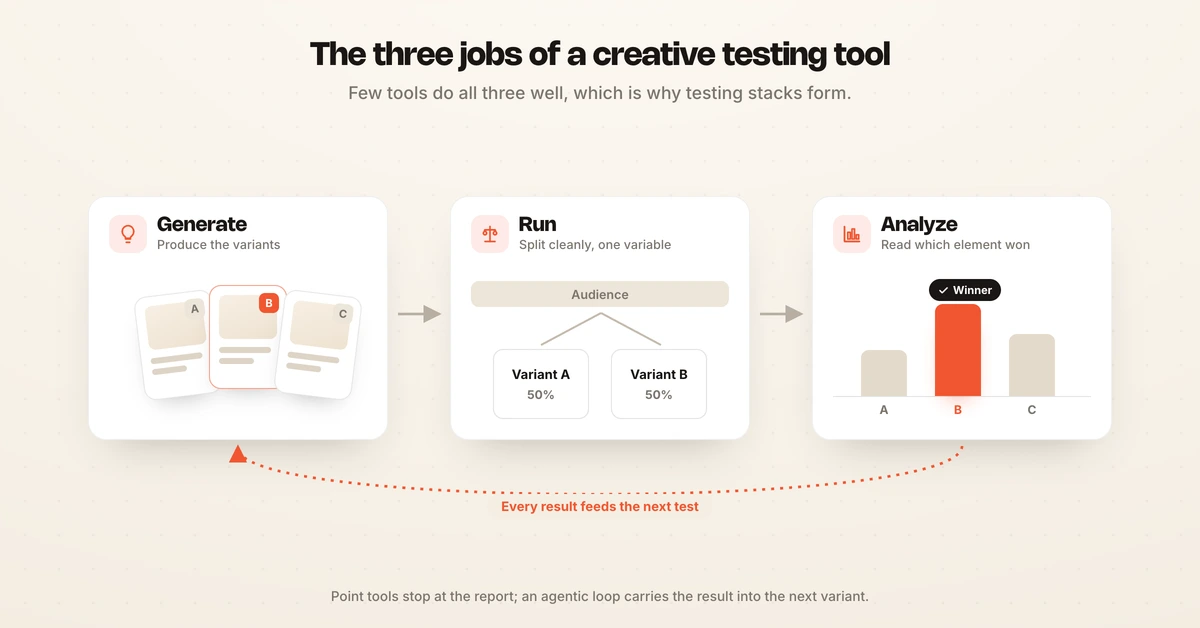
The fourth job is the one that changed in 2026. Analysis tools tell you what won and hand the next move back to a person. Agentic platforms carry the loop through: they write the next variant from the winner, launch it into a live ad set and keep testing against the KPI you set, with approval gates and an audit trail.
Knowing which job you are short on is the whole buying decision. A team that cannot produce enough variants needs a generator, not a dashboard. A team drowning in results it cannot interpret needs an analysis layer, not more variants. Concept pre-testing from research firms such as Kantar and System1 is a separate category that scores ads with panels before launch, and it suits brand campaigns more than weekly performance testing.
What makes a good creative testing tool
A good creative testing tool isolates variables, reaches a trustworthy verdict and reports at element level, not just ad level. Those three properties decide whether a test teaches you something or just picks a winner you cannot explain.
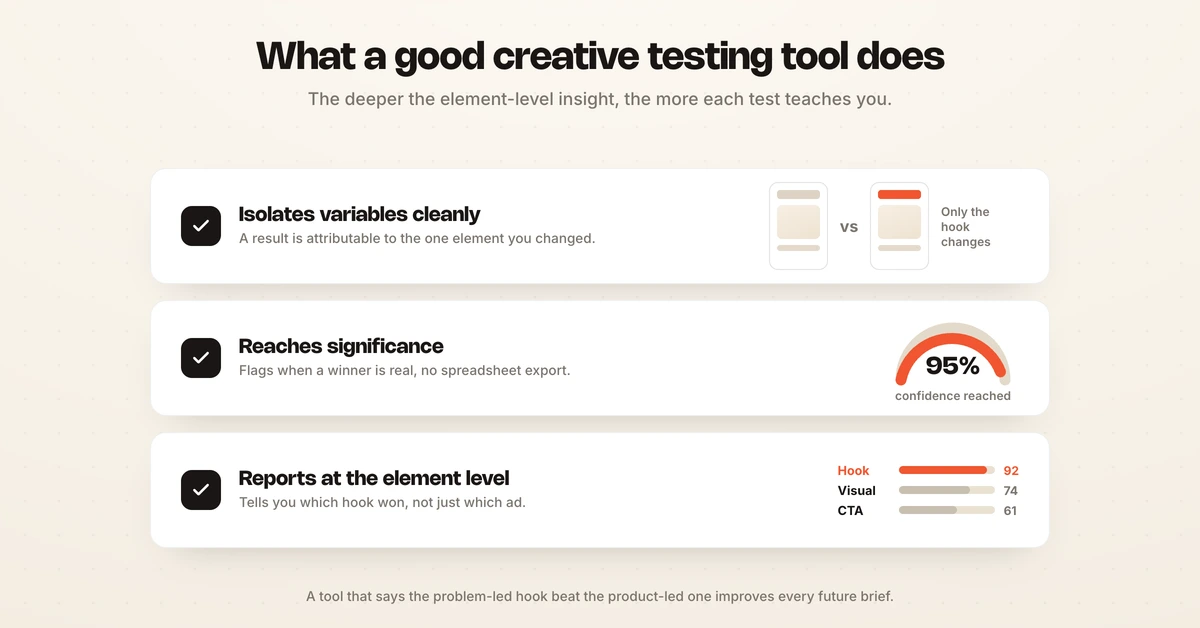
Isolation means a result is attributable to the hook, visual or CTA you changed, with audiences that do not overlap. Meta's own guidance warns that testing informally, by switching ad sets on and off, produces overlapping audiences and unreliable results, per Meta's A/B testing help page. A trustworthy verdict means the tool tells you when a result has reached statistical significance, so you stop calling winners on three days of noise.
Element-level reporting is what makes the next test smarter. Knowing that ad B beat ad A helps once. Knowing that the problem-led hook beat the product-led hook improves every brief after it, which is the gap Hawky's Creative Analysis and Motion both exist to close.
No tool shortens the time a test needs. Practitioner guidance converges on 7 to 14 days and roughly 100 conversions per variant before a winner means anything, as the ad creative testing framework explains, and a tool that calls winners sooner is reading noise.
To choose a platform that supports creative testing, check four things on the demo: which channels it reads, whether it tags creative by element automatically, whether it can launch tests or only read them, and how it prices as your spend grows.
The 8 best creative testing tools in 2026
The eight creative testing tools below are ordered by how much of the testing loop each one covers. Hawky leads because it generates, launches and reads in one system. Each entry gives a strength, a limitation and the price as published on the vendor's own page.
1. Hawky: Best for agentic creative testing
Hawky is an agentic performance marketing platform that runs creative testing as a closed loop: Test, Track, Optimize, Scale. The Creative Agent produces on-brand variants from your past winners and competitor patterns, and binds each batch to a specific Meta or Google campaign and ad set. The Performance Agent then runs and reallocates against the KPI you choose (ROAS, CAC or contribution margin) across Meta, Google, YouTube, TikTok and LinkedIn.
The difference from a reporting tool is who does the next step. Creative Analysis scores each ad by hook, frames, copy, audio and CTA, and the agents act on that read instead of handing it back. Every move ships with the data behind it and a rollback, and autonomy is configurable: many teams start in shadow mode, move to approval-gated, then loosen the gate as trust builds.
Key capabilities:
- Creative Agent: generates test variants from your winners, bound to a live ad set, with seat-level approval by email, Slack or in-app.
- Creative Analysis: element-level scoring so you learn which hook or CTA won, and predictive fatigue that names the element responsible.
- Performance Agent: launches, rotates and kills against your KPI, logged and reversible, inside spend caps you set.
- Guardrails: shadow mode, approval gates or full autonomy, with the same audit trail at every level.
Limitation: the Creative Agent ships statics today, with video as the next major release, and the agents are built for teams with real spend rather than a first test. Best for: brands and agencies spending $50k or more a month that want the testing loop operated, not just measured. Pricing: Hawky publishes no list price; the Performance Agent runs on an outcome-based model with a free 30-day pilot on one account, and platform plans are priced per brand with unlimited users. The Man Company doubled creative performance and ran 50% faster iteration cycles on Hawky.
2. Motion: Best for reading creative test results
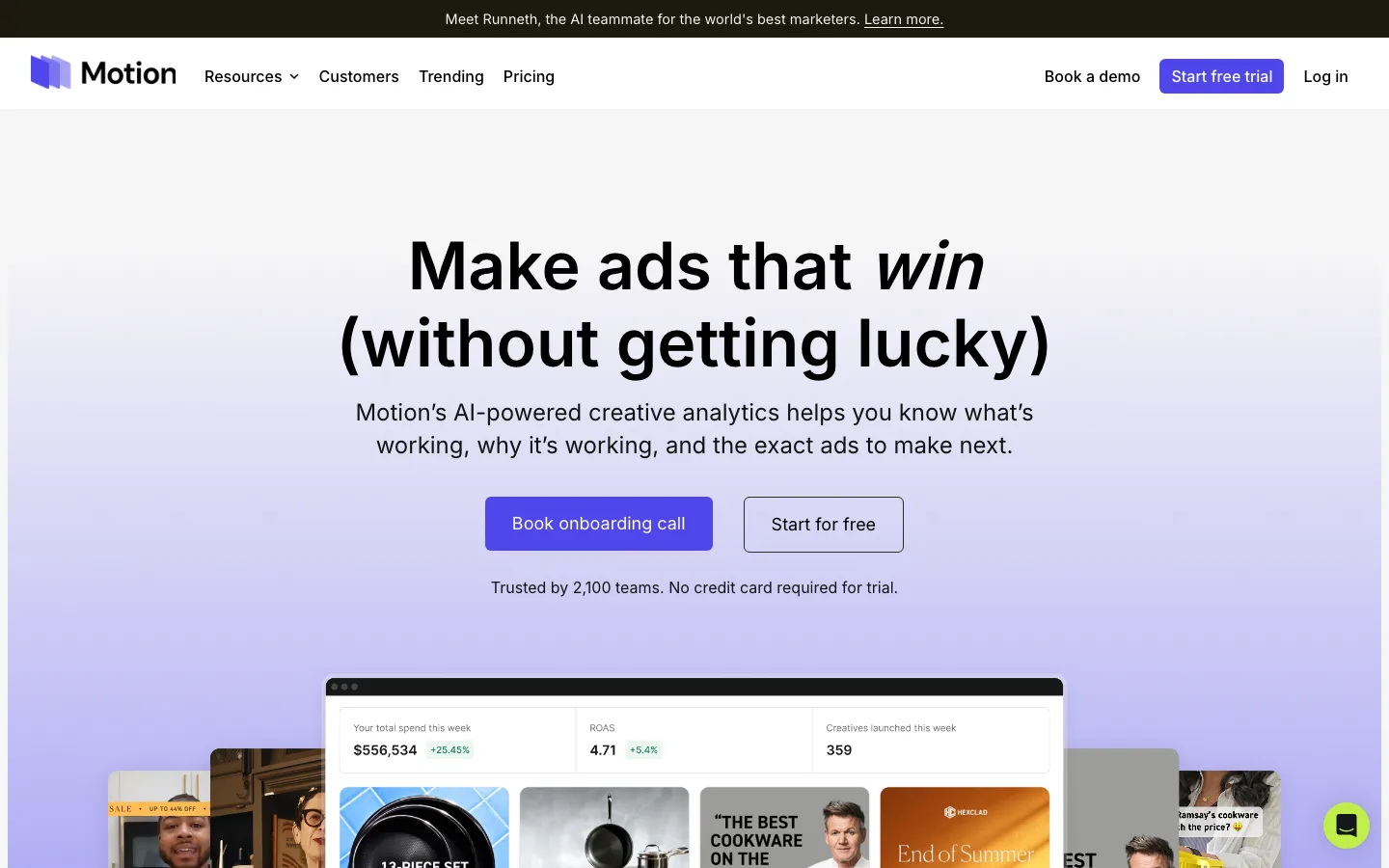
Motion is a creative analytics platform that turns ad performance into visual reports for Meta, TikTok, YouTube and LinkedIn, per its homepage. It groups creatives automatically, auto-tags each asset with AI by asset type, visual format, hook and creative angle, and analyzes video frame by frame to surface the patterns behind winners.
Strength: the clearest read of which creative and which element won, in reports a creative team and a growth team can both use. Limitation: Motion is built to read tests you run in your ad platforms, and its site describes reporting and analysis rather than traffic splitting, so you still need a testing engine and a creative source. Best for: creative-led DTC teams that already test on-platform and want to understand why a winner won. Pricing: Starter at $750 a month for up to $50k in monthly ad spend and Pro at $1,200 a month above that, per Motion's pricing page, September 2026.
3. Marpipe: Best for catalog and product-level testing
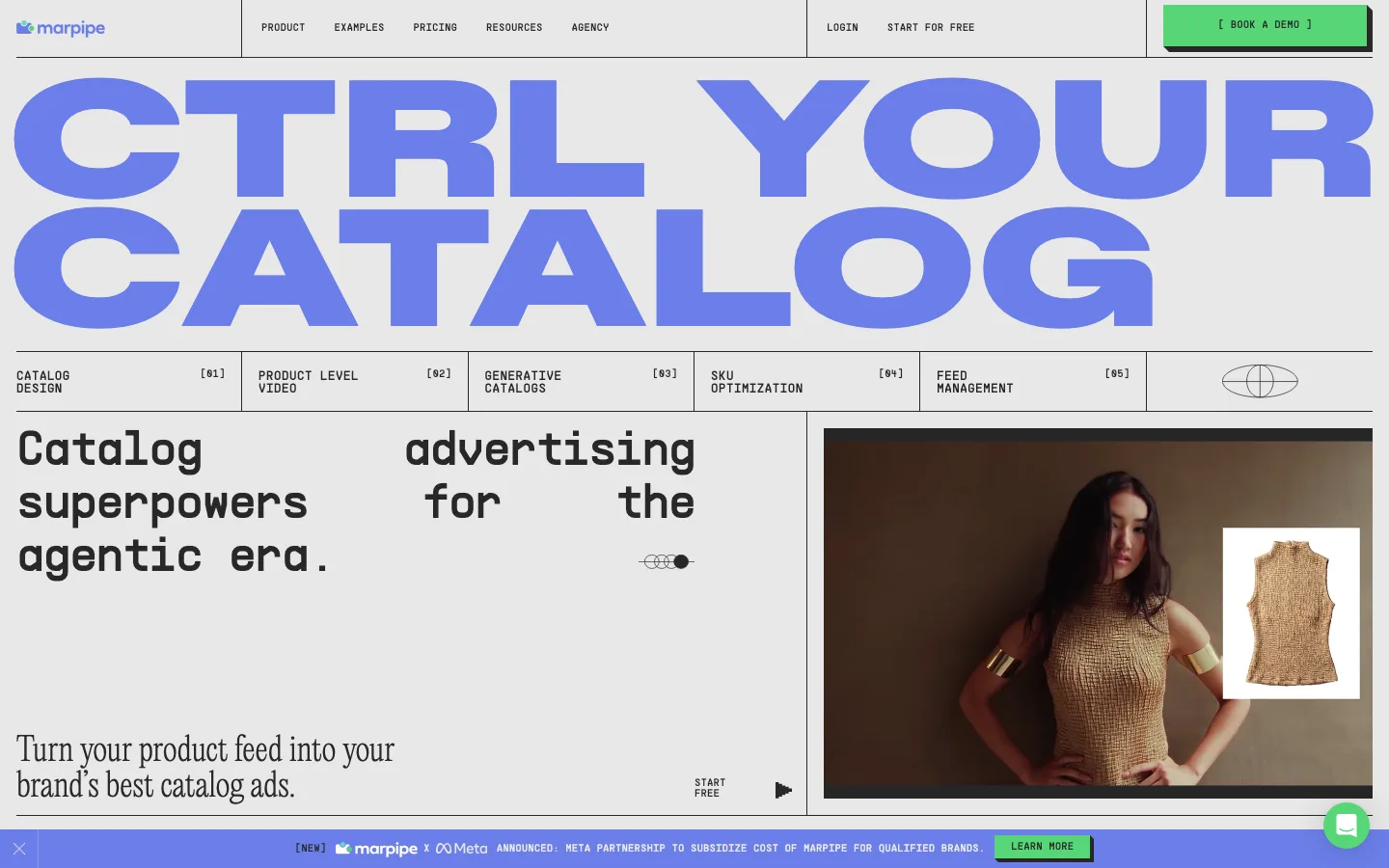
Marpipe built its name on multivariate testing of ad creative, and older roundups still describe it that way. Its site now centers on catalog advertising: its homepage reads "Control Your Catalog Ads", and its pricing page lists catalog creative, product-level video and feed management plans.
Strength: testing designs, templates and product-level video across a large catalog, which is where dynamic product ads win or lose. Limitation: if you want to test hooks in a UGC video, Marpipe is no longer built for that job, so check the product against your use case before you buy on an older review. Best for: ecommerce brands with large SKU counts running catalog and dynamic product ads. Pricing: a free plan, Startup at $199 a month and Enterprise at $999 a month, per Marpipe's pricing page, September 2026.
4. AdCreative.ai: Best for AI-generated test variants
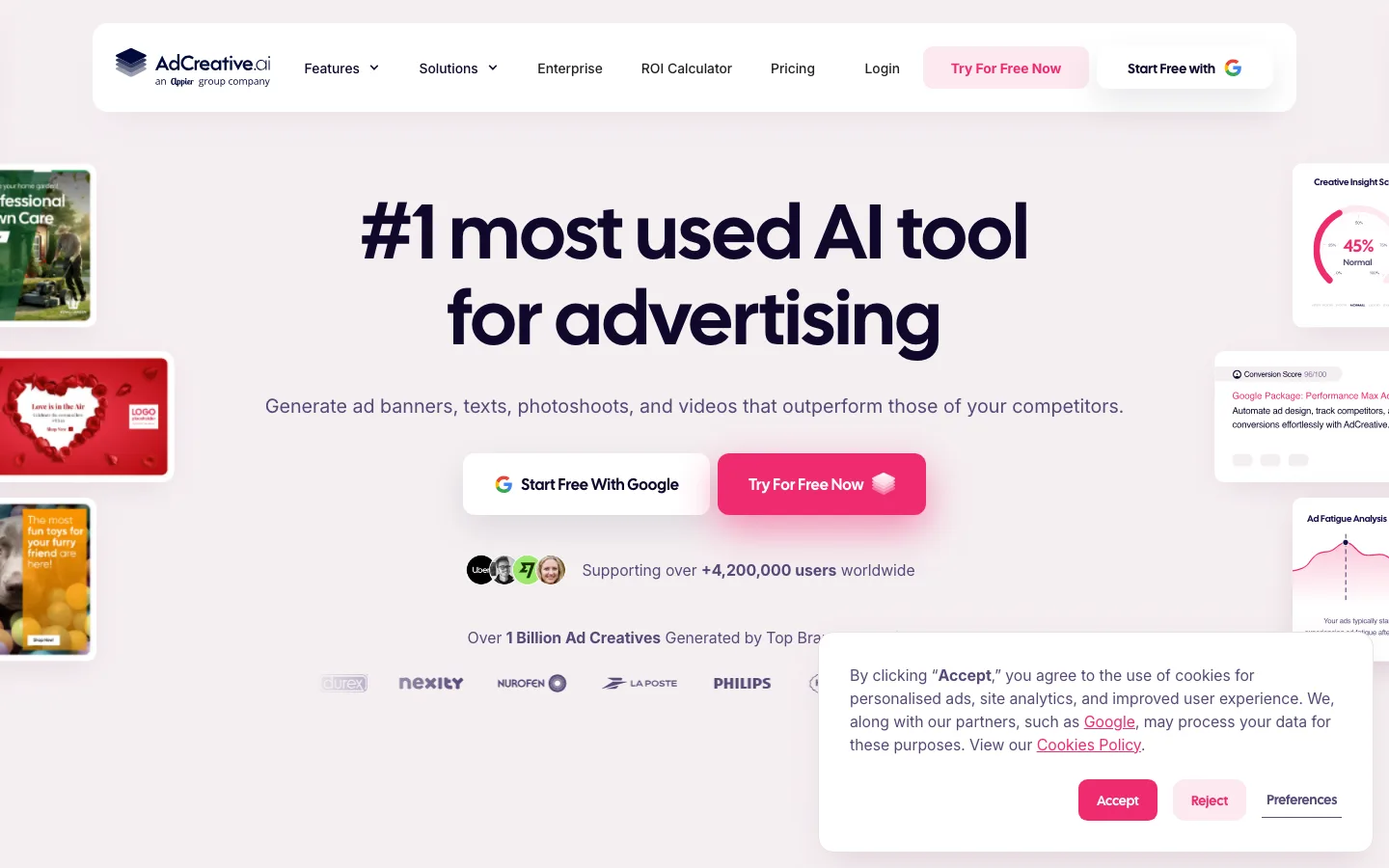
AdCreative.ai generates ad creative variations with AI and, on its Professional plan, adds a Creative Scoring AI that rates designs before launch. It fills the front of the testing funnel: more variants, faster, for teams whose bottleneck is production.
Strength: fast variant volume and a pre-launch score to decide what is worth paying to test. Limitation: a predicted score is a prioritization aid, not a test result, so the live test still runs in your ad platform. Best for: small teams that need test volume quickly and will validate with real spend. Pricing: Starter at $39 a month (10 credits, one brand), Professional at $249 a month (50 credits, ten brands, scoring and video) and Ultimate at $999 a month, per AdCreative.ai's pricing page, October 2026.
5. Madgicx: Best for Meta-only automation
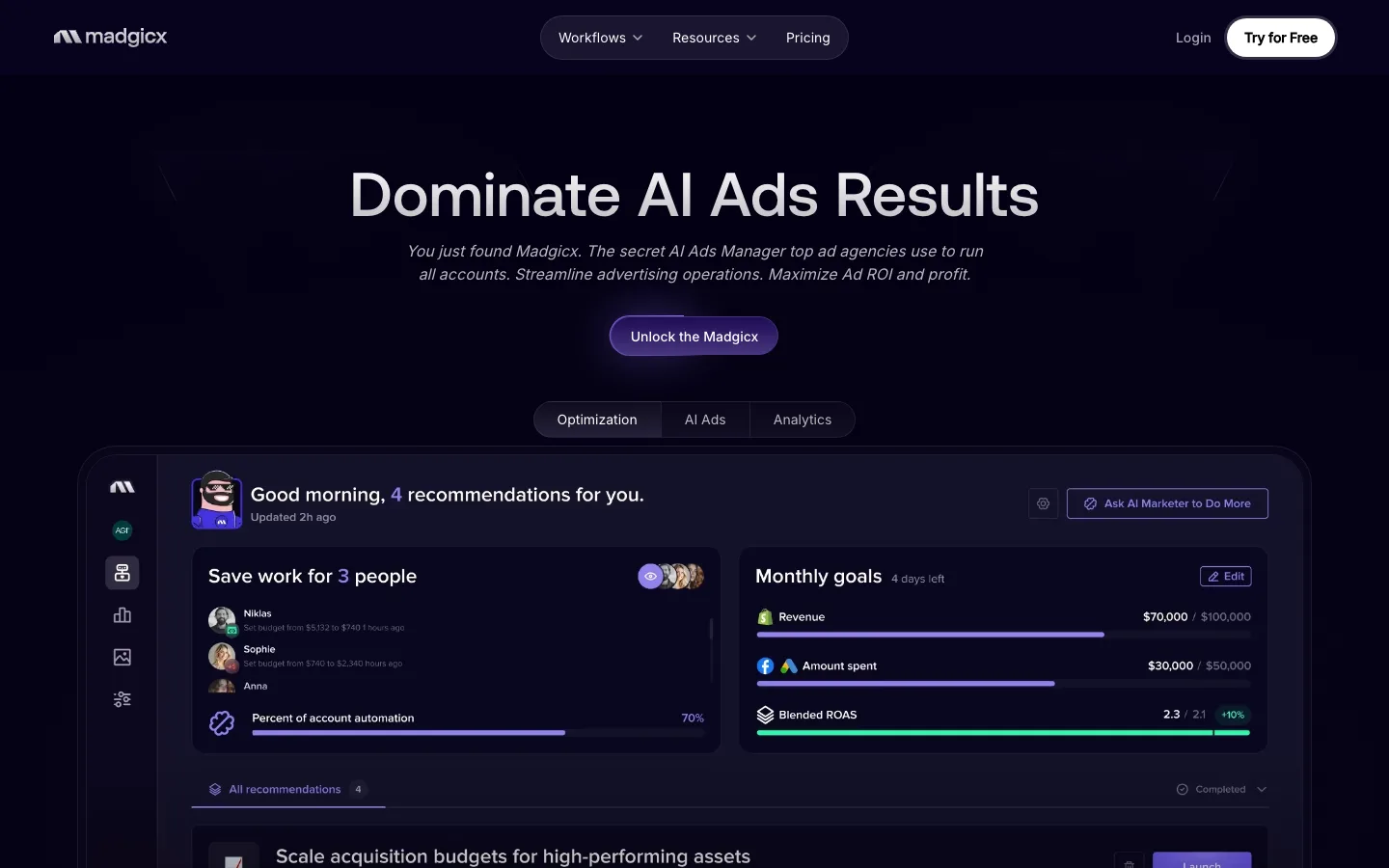
Madgicx is an AI platform for Meta ads management that combines optimization, AI ad generation, workflows and analytics in one subscription. For creative testing, it automates the mechanics of running and rotating tests on Meta while surfacing which creatives perform.
Strength: a broad Meta toolset under one login at an accessible entry price. Limitation: it is built for Meta, so a team testing across Google, TikTok or YouTube needs another layer. Best for: Meta-heavy ecommerce teams that want automation and creative reporting together. Pricing: plans scale with monthly ad spend, from about $49 a month, per Madgicx's pricing page, October 2026.
6. Birch (formerly Revealbot): Best for rule-based test management
Birch, formerly Revealbot, automates the mechanics of test management through condition-based rules. Its Stage tool builds ads from Drive media by duplicating your setups, Explorer tracks performance and spots creative fatigue, and rules pause losers and scale winners once your thresholds are set.
Strength: reliable, hands-off execution of test decisions you have already defined. Limitation: rules execute decisions you have already made; they do not decide which hook or element to test next. Best for: media buyers running many tests who want losers paused overnight without a person watching. Pricing: Essential at $49 a month and Pro at $99 a month (automated rules sit on Pro) for up to $10K in monthly ad spend, rising with spend, per Birch's pricing page, October 2026.
7. VidMob: Best for enterprise creative scoring
VidMob calls itself "The Creative Data Company" and sells creative scoring, creative analytics and a creative data API to brand, creative and media teams. It scores assets against platform and brand best practices and reads performance by creative attribute across a large brand's channels.
Strength: one creative data layer across many brands, markets and agencies. Limitation: it is an enterprise measurement platform sold through sales, which is more than a single DTC brand needs. Best for: global advertisers that want consistent creative measurement across teams. Pricing: VidMob publishes no price and sells through its sales team, per its site, September 2026.
8. CreativeX: Best for brand creative quality at scale
CreativeX measures creative quality across content and media for large brands, scoring assets before they go live and linking pre-testing, creative and media data. Its homepage cites Nestlé seeing a 74% lift in ROAS on Meta for ads with a high Creative Quality Score.
Strength: a single quality standard production partners can score against before a launch. Limitation: it governs and scores creative quality rather than running media tests, so it sits beside a testing engine. Best for: enterprise brand teams with many agencies and markets. Pricing: CreativeX publishes no price, per its site, October 2026.
Free native split testers: Meta, TikTok and Google
Every major ad platform now includes a free creative testing tool, and each one gives you a statistically clean split at no cost beyond ad spend. Use them before you pay for anything, because a paid tool should add a job the native tester cannot do.
Meta A/B Test
Meta's A/B Test compares versions of an ad by changing one variable (image, text, audience or placement), shows each version to a separate segment and makes sure nobody sees both. You can duplicate a campaign, ad set or ad and change a variable, or compare two that already exist. See how to test Facebook ad creatives for the setup.
TikTok Split Test
TikTok's split test divides your audience into two equal groups, each seeing one ad group, so you can draw a statistical conclusion about which version performed, per TikTok's split testing help page. Its help center now documents split tests for targeting, placement and bidding inside the upgraded Smart+ experience.
Google Ads asset experiments in Performance Max
Google added asset testing to Performance Max, and it runs inside a single campaign instead of two. Traffic splits within the campaign into control and treatment groups, which shortens the learning period, and you can measure the lift from adding text, image and video assets, or from adding video, per Google's asset testing documentation. You cannot change the campaign's assets once the experiment starts. The Advantage+ and Performance Max testing guide covers what that means for creative.
| Native tester | What it splits | What it cannot tell you |
|---|---|---|
| Meta A/B Test | Creative, audience or placement, no overlap | Which element inside the winning ad worked |
| TikTok Split Test | Two ad groups, equal audience halves | Anything outside TikTok |
| Google PMax asset experiment | Control vs treatment assets in one campaign | Element-level reasons, cross-channel view |
Creative testing tools compared: jobs, platforms and prices
Creative testing tools split cleanly by the job they do, and the price gap between them is wider than the feature gap. The table compares all eight on the jobs from the first section and the published entry price.
| Tool | Main job | Scope | Element-level read | Entry price (date read) |
|---|---|---|---|---|
| Hawky | Generates, launches and reads in one loop | Meta, Google, YouTube, TikTok, LinkedIn | Hook, frames, copy, audio, CTA | No list price; outcome-based, 30-day pilot |
| Motion | Reads test results | Meta, TikTok, YouTube, LinkedIn | AI tags by hook, format, angle | $750/mo (Sept 2026) |
| Marpipe | Catalog and SKU testing | Catalog and product ads | Design and SKU level | $199/mo (Sept 2026) |
| AdCreative.ai | Generates and scores variants | Ad creative production | Predicted score | $39/mo (Oct 2026) |
| Madgicx | Meta automation and AI ads | Meta | Creative reports | ~$49/mo (Oct 2026) |
| Birch | Rule-based test management | Live ad accounts | Top-asset tracking | $49/mo (Oct 2026) |
| VidMob | Enterprise creative data | Multi-brand, multi-channel | Creative attributes | No public price (Sept 2026) |
| CreativeX | Creative quality scoring | Multi-market brand teams | Quality score | No public price (Oct 2026) |
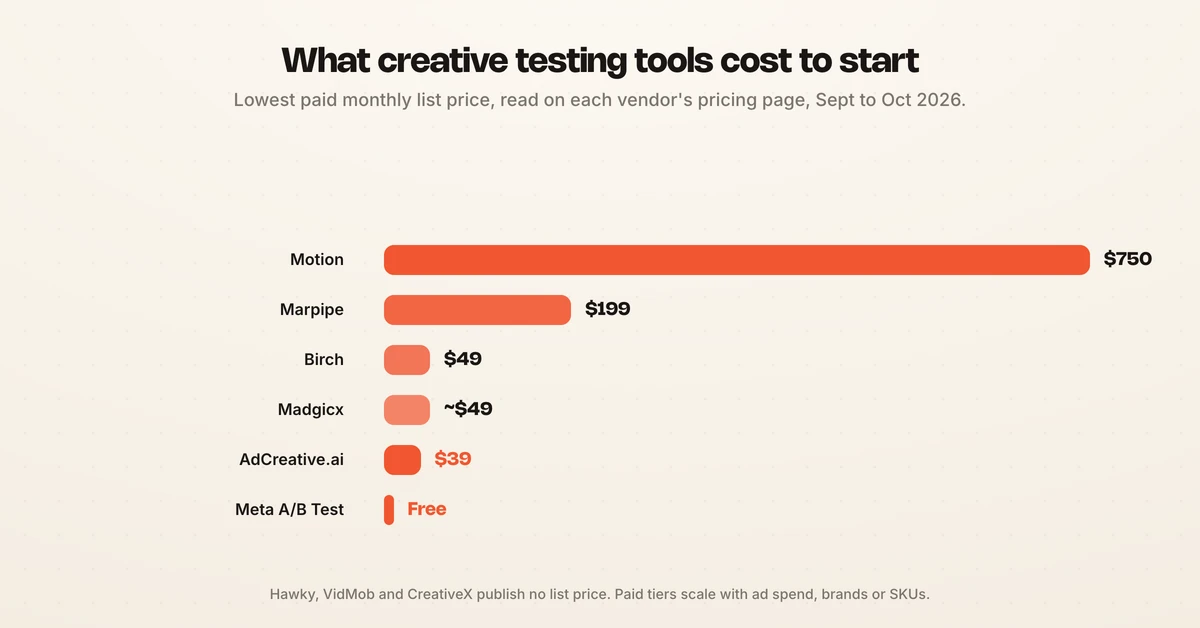
The cheapest paid tools generate or automate; the expensive ones read. That pattern is worth noticing before you buy, because a team that needs better reads will not get them from a $39 generator, and a team that needs volume will not get it from a $750 dashboard.
Tools for scaling creative testing without scaling headcount
Scaling creative testing means feeding more variants into clean tests and reading them faster, without adding a person for every new channel. The bottleneck usually moves in the same order: first variant volume, then reading results, then the hours spent acting on them.
Practitioners describe the same chain. A November 2025 analysis of 74 Reddit posts about ad creative testing tools for DTC brands found short ad lifespan named in 8 of 21 core posts, and a common workflow of spy tools, then spreadsheets, then guessing, then testing, per the thread on r/Entrepreneur. The same analysis found 8 posts complaining that AI-generated ads came out too generic. Generation without a read of your own winners produces volume, not learning.
| Your bottleneck | Add this | Example tools |
|---|---|---|
| Not enough variants to test | A generator | AdCreative.ai, Hawky Creative Agent |
| Results you cannot explain | An element-level analysis layer | Motion, Hawky Creative Analysis |
| Hours lost pausing and scaling by hand | Rules or an agent | Birch, Hawky Performance Agent |
| Large catalog, dynamic product ads | Catalog testing | Marpipe |
| Many brands, markets and agencies | Enterprise creative data | VidMob, CreativeX |
Which platforms automate creative A/B testing?
Hawky, Madgicx and Birch automate creative A/B testing to different depths. Birch runs your rules on live ads, Madgicx automates testing and rotation on Meta, and Hawky's agents generate the variant, launch it into an ad set and act on the result against your KPI, inside guardrails and with an audit trail. The native testers on Meta, TikTok and Google automate the split itself but leave the next decision to you.
Top AI tools for ad creative testing
The top AI tools for ad creative testing use AI in three different places: to generate variants (AdCreative.ai, Madgicx), to tag and read results (Motion, VidMob, CreativeX), and to operate the loop (Hawky). Ask which of the three a vendor means by "AI", because a predicted score before launch and an element-level read after launch answer different questions.
Creative testing tools for mobile marketing
Creative testing for mobile apps runs on the same native testers and analysis layers, with one extra requirement: the result has to be read against installs and in-app events, not clicks. Run the split on Meta, TikTok or Google App campaigns, read creative results by element in your analysis layer, and judge winners on cost per in-app event so a cheap install that never converts does not win the test.
Which tools reduce creative testing costs?
The tools that reduce creative testing costs are the ones that stop spend on losers sooner and cut wasted variants before launch. Rules and agents pause underperformers without waiting for a person, element-level reads mean each test teaches you enough to skip weak concepts next round, and the free native split testers remove the need to pay for the split itself.
Which creative testing tool is right for your team?
The right creative testing tool is the one that removes your current bottleneck, and most teams need two at most. Match your situation to one of these.
If you are on a tight budget: start with Meta's free A/B Test, TikTok's split test or a Google asset experiment. Add a paid tool only once you have enough spend to read results by element.
If your bottleneck is understanding results: Motion gives the clearest cross-platform read of which creative and which element won, from $750 a month.
If you run catalog and dynamic product ads: Marpipe is built for testing designs and product-level video across SKUs.
If you need more variants, fast: AdCreative.ai produces volume from $39 a month; validate every predicted winner with live spend.
If you run a real cross-channel operation: Hawky generates the variants from your winners, launches them into live ad sets and reads the result against your KPI in one loop, so you run one system instead of three. See the best ad creative analysis tools for the analysis layer on its own.
Frequently asked questions
What are the best creative testing tools?
The best creative testing tools in 2026 are Hawky for agentic testing that generates, launches and reads variants against your KPI, Motion for element-level analysis of test results, and Marpipe for catalog and product-level ad testing. Meta, TikTok and Google each include a free native split tester that every advertiser should use first. Most teams pair one testing engine with one analysis layer.
What are creative marketing testing tools?
Creative marketing testing tools are software that compares ad or content variations to find which performs best and why. They cover four jobs: generating variants, running a clean split, reading the result at element level, and acting on it. Native platform testers handle the split for free; paid tools add generation, analysis or automation.
How much do creative testing tools cost?
Creative testing tools range from free to enterprise contracts. Meta, TikTok and Google split testing is free; AdCreative.ai starts at $39 a month, Birch at $49, Madgicx at about $49, Marpipe at $199 and Motion at $750, per each vendor's pricing page in September and October 2026. Hawky, VidMob and CreativeX publish no list price.
What is the difference between a creative testing tool and a creative analytics tool?
A creative testing tool creates or runs the experiment, while a creative analytics tool reads the results. Meta's A/B Test splits the audience; Motion tells you which hook or format won across your account. Agentic platforms such as Hawky do both and act on the result, so the next variant ships without a manual handoff.
Which platforms automate creative A/B testing?
Hawky, Madgicx and Birch automate creative A/B testing to different depths. Birch applies your rules to live ads, Madgicx automates testing and rotation on Meta, and Hawky's agents generate, launch and act on variants against your KPI with approval gates and an audit trail. Native testers automate only the split.
Do I need a paid creative testing tool?
Not at first. The free native testers on Meta, TikTok and Google give you statistically clean splits on a single platform. A paid tool earns its cost once you need element-level reads, cross-platform testing, more variants than your team can produce, or someone to act on results overnight.
If generating enough test creative and acting on every result without stitching three tools together is the problem, Hawky's Creative Agent is built for that job.
Ready to hire your first AI performance team? Book Demo