Creative Testing for Advantage+ and Performance Max: How to Test When the Algorithm Decides
In the Advantage+ and Performance Max era, you no longer test audiences, you test creative, because the algorithm now controls who sees which ad. Your job has shifted from building tight audience experiments to feeding the system a diverse, high-quality creative pool and reading which assets it rewards. This guide shows how creative testing works when the algorithm decides delivery, on both Meta and Google.
Automated campaign types changed the rules. Meta's Advantage+ and Google's Performance Max collapsed the old lever set, broad-then-narrow audiences, manual placements, ad-set-level budgets, into one AI-driven delivery engine. The control you have left is creative, so creative testing is now the highest-impact work in the account. For the foundational mechanics of a clean test, pair this with the ultimate guide to creative testing; this piece focuses on what changes when the algorithm picks the winner.
What changed: from testing audiences to testing creative
For a decade, testing meant isolating audiences, placements, and bids. Automated delivery removed most of those dials. Meta's Advantage+ campaigns and Google's Performance Max now decide who sees which asset, where, and at what bid, in real time.
That makes creative the primary variable you still control. The platform reads engagement and conversion signals, then pushes spend toward whatever creative earns the most efficient result. You are no longer choosing the winner; you are stocking the shelf the algorithm shops from.
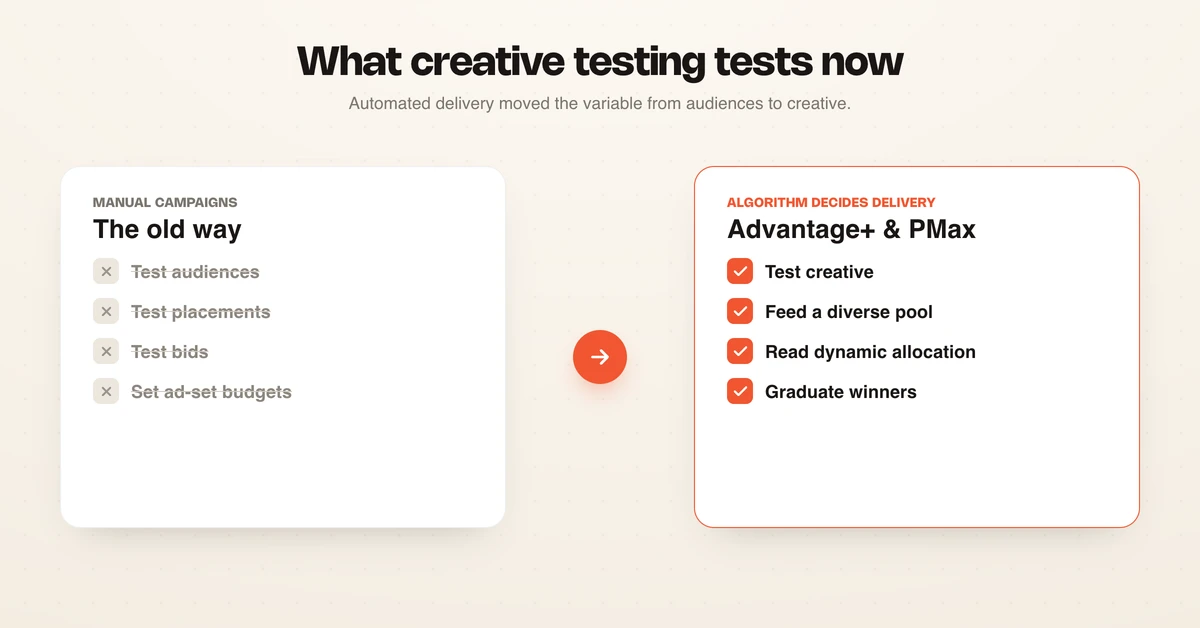
The practical consequence is volume and diversity. Meta's system can dynamically select from up to 150 creative combinations and performs best with a deep, varied pool rather than two near-identical ads. Creative diversity has become the new targeting: different hooks, formats, and angles let the algorithm match the right message to the right person.
Why creative volume and diversity now drive performance
When delivery is automated, a thin creative pool starves the algorithm of options. Reporting from 2026 shows Meta's Advantage+ optimizing best with roughly 15 to 50+ active, genuinely different creatives, and creative volume requirements have climbed as the system matured.
Diversity matters more than raw count. The pool should span formats (static, video, carousel, UGC), angles (problem, proof, offer, identity), and hooks, so the system has distinct options for distinct people. Ten variations of one concept is not a test; it is one bet entered ten times.
This is also why creative fatigue hits faster in automated campaigns. The algorithm leans hard on its current winner, exhausts the audience for it, then has nowhere to turn if the bench is empty. A steady pipeline of fresh, diverse creative is what keeps automated delivery efficient.
How to structure a creative test when the algorithm decides
You cannot run the old clean split test inside a fully automated campaign, because you do not control delivery. Testing in this era means structuring the creative pool and the campaign so the signal is still readable.
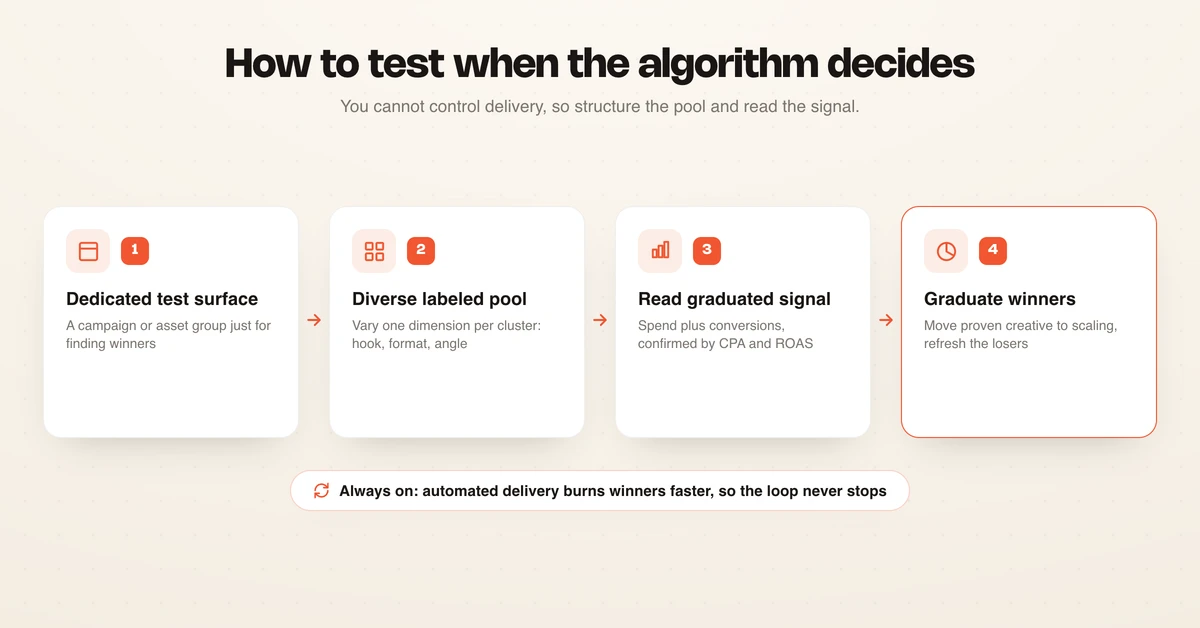
1. Use a dedicated testing surface. Run a separate campaign or asset group whose only job is to surface new winners, kept apart from your scaling campaign so tests do not disrupt proven performance. On Google, the cleanest option is the built-in tool below.
2. Feed it a diverse, labeled pool. Launch new creatives in clusters that vary one dimension on purpose (hook, format, or angle) so that when one wins, you know why. Label every asset by its variable so the read is not guesswork.
3. Read graduated signal, not vanity wins. Because budget is allocated dynamically, the platform tells you what it favors through spend and conversions. Watch which assets the system feeds, then confirm with downstream metrics like CPA and ROAS, not just early CTR.
4. Graduate winners into scaling. Move proven creatives into your main Advantage+ or Performance Max campaign, and retire fatigued ones. The loop never stops, because automated delivery consumes winners faster than manual ever did.
Creative testing inside Google Performance Max
Google made this materially easier in 2026. In January 2026, Google expanded asset-level A/B testing to all Performance Max campaigns, so you can run a controlled test without duplicating the whole campaign.
The structure uses three buckets inside one asset group: a control set (your baseline assets), a treatment set (the challengers you want to prove), and common assets that both share. That isolates the creative variable while the rest of the campaign holds steady.
A few practices keep these tests clean. Upload and get assets approved three to five days before the experiment starts so policy reviews do not derail the launch, and follow Google's asset best practices, including enough image assets and a 1200 x 1200 option. Test one clear idea per experiment, such as lifestyle imagery against product photography, so the result is unambiguous.
Creative testing inside Meta Advantage+
Meta does not expose a single split-test button inside Advantage+ the way Google now does, so testing is about pool design and reading dynamic allocation. Launch new creatives in defined waves, give the system enough varied options, and let budget allocation reveal preference.
The signal lives in delivery. When Advantage+ concentrates spend on a creative and that spend converts efficiently, that is your winner surfacing. Confirm it against your KPI over a meaningful window rather than reacting to a single day, then graduate it and refresh the losers.
Keep the learning requirements in mind. Automated campaigns need enough conversion events to optimize, so do not split budget so thin across tiny tests that nothing exits the learning phase. Fewer, better-resourced creative waves beat a scatter of underfunded ones.
Common mistakes when testing in the algorithm era
The biggest mistake is testing audiences that the platform no longer lets you control, then misreading creative results as audience results. In automated delivery, attribute outcomes to the creative, because that is the variable you actually changed.
The second is a shallow creative pool. Submitting near-duplicate ads gives the algorithm nothing to choose between and produces a flat, unscalable result. The third is killing too fast: dynamic budget allocation means a strong creative may take a few days to get its share of spend, so judge on a defensible window, not an afternoon.
The fourth is letting the bench run dry. Because automated campaigns burn winners quickly, teams that test in occasional batches stall out, while teams that test continuously always have the next winner ready. Treating creative testing as an always-on system is what separates accounts that scale from accounts that plateau.
How AI agents change creative testing velocity
The bottleneck in the algorithm era is no longer analysis, it is producing enough diverse, on-brand creative to keep automated delivery fed. This is where AI agents change the math. Hawky runs an agentic performance marketing platform whose agents generate the creative volume these systems demand and act on the results, with every action logged and one-click reversible.
The Creative Agent reads your past winners and competitor patterns and renders finished on-brand creatives, each batch bound to a specific ad set, so the diverse pool Advantage+ and Performance Max need gets produced on schedule instead of bottlenecking on a designer. The Performance Agent then watches delivery across Meta, Google, and YouTube, graduates winners, and refreshes fatigued creatives against your KPI, 24/7.
Element-level creative analysis closes the loop by telling you which hooks, visuals, and formats the algorithm actually rewarded, so the next creative wave is sharper than the last. Configurable autonomy keeps humans in command: start in shadow mode where the agents only report, move to approval-gated, then to fully autonomous, with the same audit trail throughout. The Man Company doubled creative performance and cut iteration cycles 50% running this loop.
If your bottleneck is feeding automated campaigns enough fresh, diverse, on-brand creative to test, Hawky's Creative Agent and Performance Agent are built for that job.
Frequently asked questions
How is creative testing different with Advantage+ and Performance Max?
With Advantage+ and Performance Max, the algorithm controls who sees which ad, so you test creative instead of audiences. You feed the system a diverse pool of assets, and it allocates budget toward whatever converts most efficiently. Your control shifted from targeting and placements to the quality and variety of the creative you supply.
How many creatives do I need for Advantage+ campaigns?
Meta's Advantage+ optimizes best with roughly 15 to 50 or more active creatives that are genuinely different, not minor variations of one concept. The system can dynamically select from up to 150 creative combinations, so a deep, diverse pool gives it more ways to match the right ad to the right person. Volume plus diversity, across formats, hooks, and angles, matters more than a high count of similar ads.
Can you A/B test creative inside Performance Max?
Yes. In January 2026 Google expanded asset-level A/B testing to all Performance Max campaigns, letting you compare a control asset set against a treatment set inside one asset group without duplicating the campaign. Upload and approve new assets a few days before launch, and test one clear creative idea per experiment so the result is unambiguous.
How do you know which creative won when the algorithm controls delivery?
Read the platform's dynamic budget allocation: when the system concentrates spend on a creative and that spend converts efficiently against your KPI, that creative is the winner surfacing. Confirm it with downstream metrics like CPA and ROAS over a meaningful window rather than reacting to early CTR or a single day. Then graduate the winner into your scaling campaign and refresh the losers.
How often should I refresh creative in automated campaigns?
More often than in manual campaigns, because automated delivery leans hard on its current winner and exhausts that audience faster. Keep an always-on pipeline so a fresh, diverse wave is ready before performance dips, rather than testing in occasional batches. Let each creative's own fatigue curve, rising frequency with falling hook rate or CTR, signal when to refresh.
Do I still need to understand creative testing fundamentals?
Yes. Automated delivery changes where you apply the work, but the fundamentals of forming a hypothesis, isolating one variable, and reading results with confidence still decide whether your tests teach you anything. The ultimate guide to creative testing covers that foundation, and this guide layers on what changes when the algorithm controls delivery.
If feeding Advantage+ and Performance Max enough fresh, diverse creative to test is your real bottleneck, Hawky's Creative Agent generates the volume and the Performance Agent acts on the results, with guardrails and a full audit trail keeping you in command.
Ready to hire your first AI performance team? Book Demo