The Performance Marketing Meeting Cadence: From Daily Pulse to Quarterly Plan
A performance marketing meeting cadence is the fixed rhythm of daily, weekly, monthly, and quarterly check-ins that keeps a team aligned without drowning it in meetings: an async daily pulse, a weekly performance standup, a monthly growth review, and quarterly planning. Match each decision to the right timeframe and you replace a calendar full of status calls with a tight operating rhythm.
Most performance teams do not have too few meetings; they have the wrong ones at the wrong frequency. This guide lays out the cadence that works in 2026, what each meeting is for, who should be in it, and how to keep the whole rhythm lean. If you want the agendas themselves, pair this with our growth marketing meeting templates.
What a performance marketing meeting cadence is
A meeting cadence is the regular, predictable schedule on which a team meets to make decisions, and a good one matches each meeting's frequency to the speed of the decisions it owns. Spend pacing changes daily, so it needs a fast loop; strategy changes quarterly, so it needs a slow one.
The point of a cadence is rhythm, not volume. A predictable schedule means people prepare, decisions get an owner, and nobody calls a surprise meeting to cover something the weekly already handles. (Atlassian on meeting cadence)
A performance team runs on four timeframes, each answering a different question: what changed today, what do we adjust this week, what trend is forming this month, and where are we headed this quarter. Get those four right and most other meetings become unnecessary.
The performance marketing cadence at a glance
The full cadence fits on one table, and the discipline is keeping each meeting to its job. The faster the loop, the shorter and more operational it should be.
| Cadence | Meeting | Owns | Length | Who |
|---|---|---|---|---|
| Daily | Async pulse | Pacing, blockers, anomalies | Async or 10 min | Buyers, analyst |
| Weekly | Performance standup | Optimizations, scale/kill calls | 30 min | Performance lead, buyers, analyst |
| Biweekly | Creative review | Creative pipeline and testing | 45 min | Creative lead, designers, buyer |
| Monthly | Growth review | Strategy, budget, KPI trends | 60-90 min | Growth lead, leadership, finance |
| Quarterly | Planning | Goals, bets, channel mix | Half day | Full team, leadership |
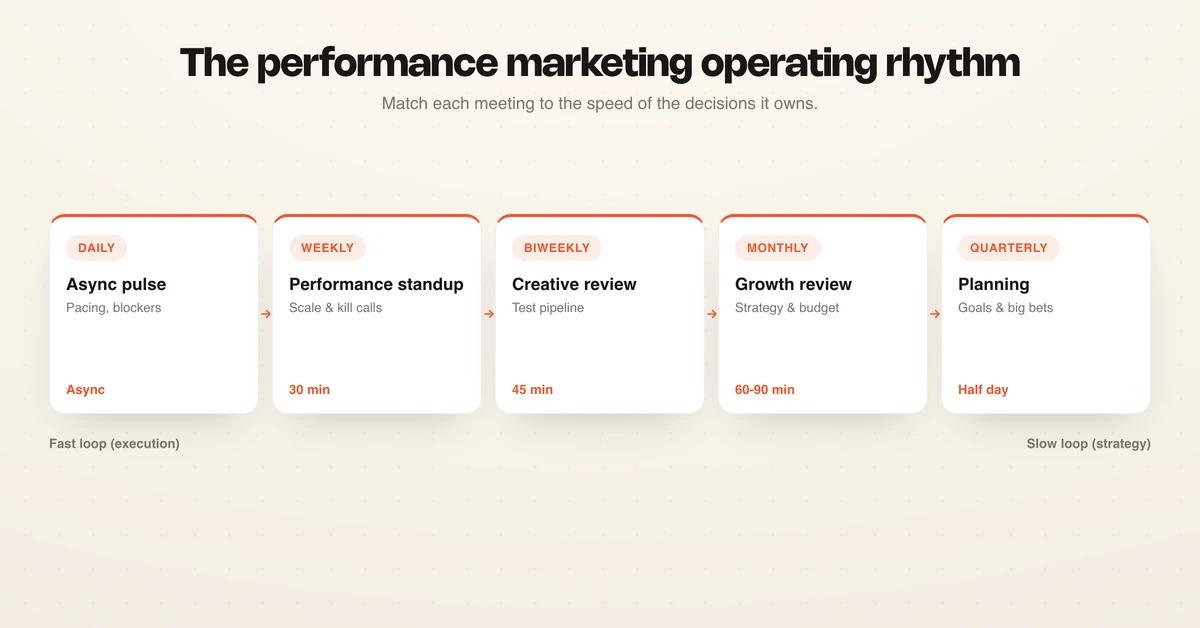
Daily: the async pulse
The daily check-in should be asynchronous for most performance teams, because pacing and anomalies need eyes every day but rarely need a live meeting. A short written or dashboard-based update beats a recurring 9 a.m. call that interrupts deep work.
Each buyer posts the numbers that moved, any pacing issues, and anything blocked, in a shared channel or doc. The team reads and reacts in minutes, and only escalates to a live call when something is genuinely on fire. Async updates keep the calendar clear while still catching a CPA spike the same day it happens.
What good looks like: a 60-second read that tells everyone what changed and what needs attention, with zero meeting on the calendar.
Weekly: the performance standup
The weekly performance standup is the operational core of the cadence, and it exists to make scale-and-kill decisions on the week's data. Keep it to 30 minutes and keep it to action, not narration.
Run a tight agenda: budget pacing, a KPI scan (ROAS, CPA, CTR, CPM), underperformers to pause, winners to scale, and blockers. Every item ends with an owner and a deadline, or it does not belong in the meeting. The goal is to leave with a short list of changes, not a shared sense of how things are going. (Creative performance metrics)
What good looks like: a 30-minute meeting that produces a handful of owned decisions and ends on time.
Biweekly: the creative review
The creative review runs every one to two weeks and owns the creative pipeline: what is fatiguing, what is winning, and what to test next. Creative is the biggest performance lever now, so it earns its own ritual separate from the numbers-focused standup.
Bring the creative lead, designers, a copywriter, and the buyer who runs the ads. Review what fatigued, what won and why at the element level, and agree the next batch of concepts and tests. This is where the creative testing pipeline gets refilled so the standup always has fresh winners to scale.
What good looks like: a filled creative pipeline and a clear list of next tests, tied back to what the data showed.
Monthly: the growth review
The monthly growth review steps back from execution to read trends, reallocate budget, and check progress against KPIs and targets. It is the meeting where you stop optimizing ads and start questioning the plan.
Bring the growth lead, marketing leadership, finance, and channel owners. Review the month's KPI trends, channel-level efficiency, budget allocation for next month, and progress toward the quarter's goals. Monthly meetings create the space for trend analysis that a weekly standup moves too fast to allow.
What good looks like: a reallocated budget, a clear read on what is working at the channel level, and decisions that set up the next month.
Quarterly: strategy and planning
Quarterly planning connects daily execution to long-term strategy: it sets goals, picks the big bets, and decides the channel mix for the next 90 days. This is the slow loop, and it should feel different from every other meeting.
Block a half day, bring the full team and leadership, and work on the questions the weekly cannot touch: which channels to lean into, what big creative bets to make, what targets to commit to, and what to stop doing. Quarterly cadence is where a team pivots based on results instead of drifting on autopilot.
What good looks like: a written plan with owned goals, a clear channel and budget strategy, and an explicit stop-doing list.
How to keep the cadence lean
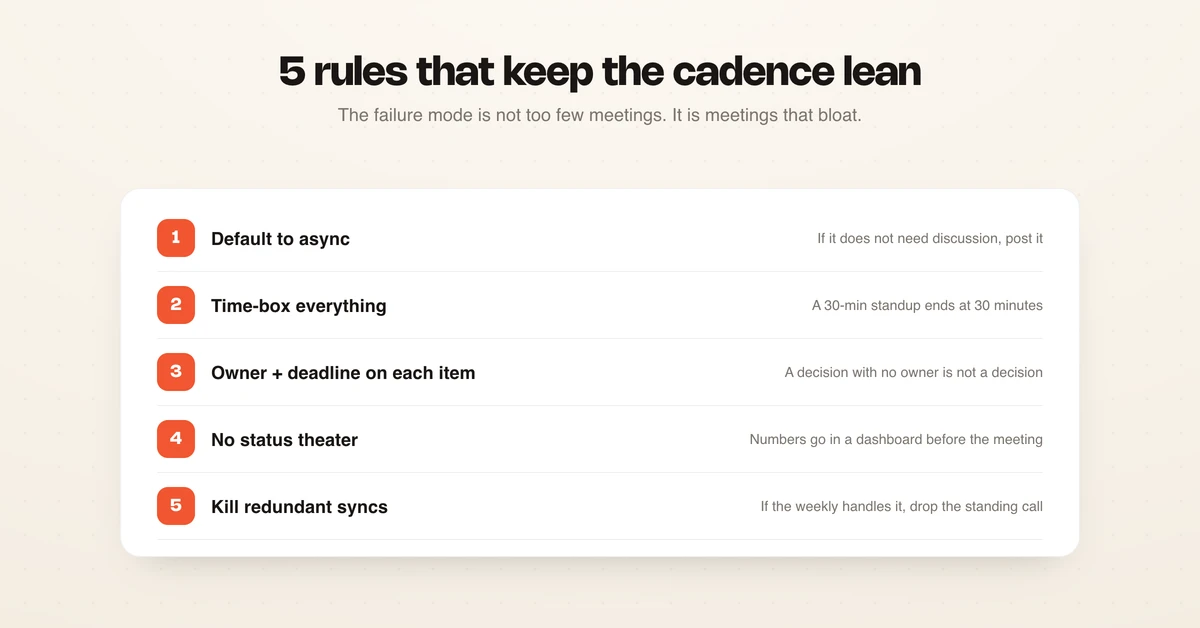
The cadence only works if every meeting stays disciplined, because the failure mode is not too few meetings, it is meetings that bloat and multiply. A few rules keep the rhythm tight.
- Default to async. If an update does not need discussion, it does not need a meeting. Post it.
- Time-box everything. A 30-minute standup that runs 60 is doing two meetings' work. Split it or cut it.
- Every item gets an owner and a deadline. A decision with no owner is not a decision.
- No status theater. Numbers go in a dashboard before the meeting, so the meeting is for choices, not recaps.
- Kill redundant syncs. If a topic is handled in the weekly, it does not need its own standing call.
Adapt the cadence to your team size
The four timeframes hold at any size, but how you staff them changes with the team. The rhythm is the same; the room is different.
On a lean team of one to three people, the meetings collapse into fewer slots: the daily pulse and weekly standup may be the same person reviewing a dashboard, and the monthly and quarterly merge into a single strategy block. The discipline that matters is still writing decisions down with owners, even if the owner is you.
At an agency or larger in-house team, the cadence splits by account and by function: each client or brand gets its own weekly standup, creative reviews run per pod, and the monthly growth review rolls up across accounts for leadership. The risk at scale is meeting sprawl, so the lean rules matter more, not less. Keep the timeframes fixed and let the attendee list, not the meeting count, grow.
Common cadence mistakes to avoid
Most performance teams break their own rhythm in the same few ways.
- Daily live standups. A recurring live call for pacing interrupts deep work. Make it async.
- One mega-meeting. Cramming pacing, creative, and strategy into one weekly produces a long meeting that decides little. Separate the timeframes.
- No agenda, no owner. Meetings without a fixed agenda drift, and decisions without an owner evaporate.
- Reviewing the same data twice. If the monthly re-litigates the weekly, one of them is redundant.
- Skipping the quarterly. Without the slow loop, teams optimize ads forever and never question the plan.
How agents cut your meeting load
Half of most performance meetings is status: pulling numbers, building decks, and recapping what changed. That prep and narration is exactly the work an agent can remove, leaving the meeting for decisions.
Hawky's agents handle the status layer so the cadence gets lighter. The Command Center ranks what needs attention by impact, scheduled agents surface anomalies and route tasks to the right owner before the meeting, and the Copilot turns any view into a presentation-ready deck in one click, so nobody spends an evening building the monthly review. With the recap automated, the standup is just the decisions.
That is real time back. Hiveminds saved 160+ hours per brand monthly running Hawky, much of it the manual reporting and prep that meetings used to demand. However you run your cadence, the principle holds: automate the status, and meet only to decide.
Frequently asked questions
What is a meeting cadence in performance marketing?
A meeting cadence is the fixed, predictable schedule on which a performance team meets to make decisions, matched to how fast each decision changes. Pacing changes daily and gets an async pulse, optimizations change weekly and get a standup, trends shift monthly and get a growth review, and strategy changes quarterly and gets planning. The right cadence keeps a team aligned without filling the calendar with status calls.
How often should a performance marketing team meet?
Most performance teams need an async daily pulse, a 30-minute weekly performance standup, a 45-minute creative review every one to two weeks, a 60 to 90 minute monthly growth review, and a half-day quarterly planning session. The exact mix scales with team size and spend, but matching each meeting to the speed of its decisions matters more than the precise number. Daily live standups are usually overkill outside a high-spend launch.
What should a weekly performance marketing meeting cover?
A weekly performance standup should cover budget pacing, a KPI scan of ROAS, CPA, CTR, and CPM, underperformers to pause, winners to scale, and current blockers. Every item should end with an owner and a deadline, and numbers should live in a dashboard beforehand so the meeting is for decisions, not recaps. Keep it to 30 minutes.
Should daily standups be live or async?
For most performance teams, daily check-ins should be asynchronous. Pacing, anomalies, and blockers need daily visibility but rarely need a live conversation, so a short written or dashboard-based update keeps everyone informed without interrupting deep work. Reserve a live call for genuine emergencies, like a tracking break or a runaway campaign.
How do you stop performance marketing meetings from bloating?
Keep meetings lean by defaulting to async for anything that does not need discussion, time-boxing every meeting, giving each agenda item an owner and a deadline, and moving numbers into a dashboard so the meeting is for choices rather than status. Kill any standing sync whose topic is already handled in another meeting. The test for any meeting is whether it produces owned decisions.
How can AI reduce time spent in marketing meetings?
AI agents reduce meeting time by automating the status layer: pulling and ranking the numbers, surfacing anomalies, routing tasks to owners, and generating presentation-ready decks automatically. That removes the prep and recap that fills most meetings, so the team meets only to make decisions. Teams using agents for this reclaim hours a month that used to go to manual reporting and meeting prep.
If status updates, deck-building, and recap meetings are eating your team's week, Hawky's agents are built for that job: they rank what needs attention, route tasks to owners, and turn any view into a deck in one click, with a full audit trail keeping you in command.
Ready to hire your first AI performance team? Book Demo